
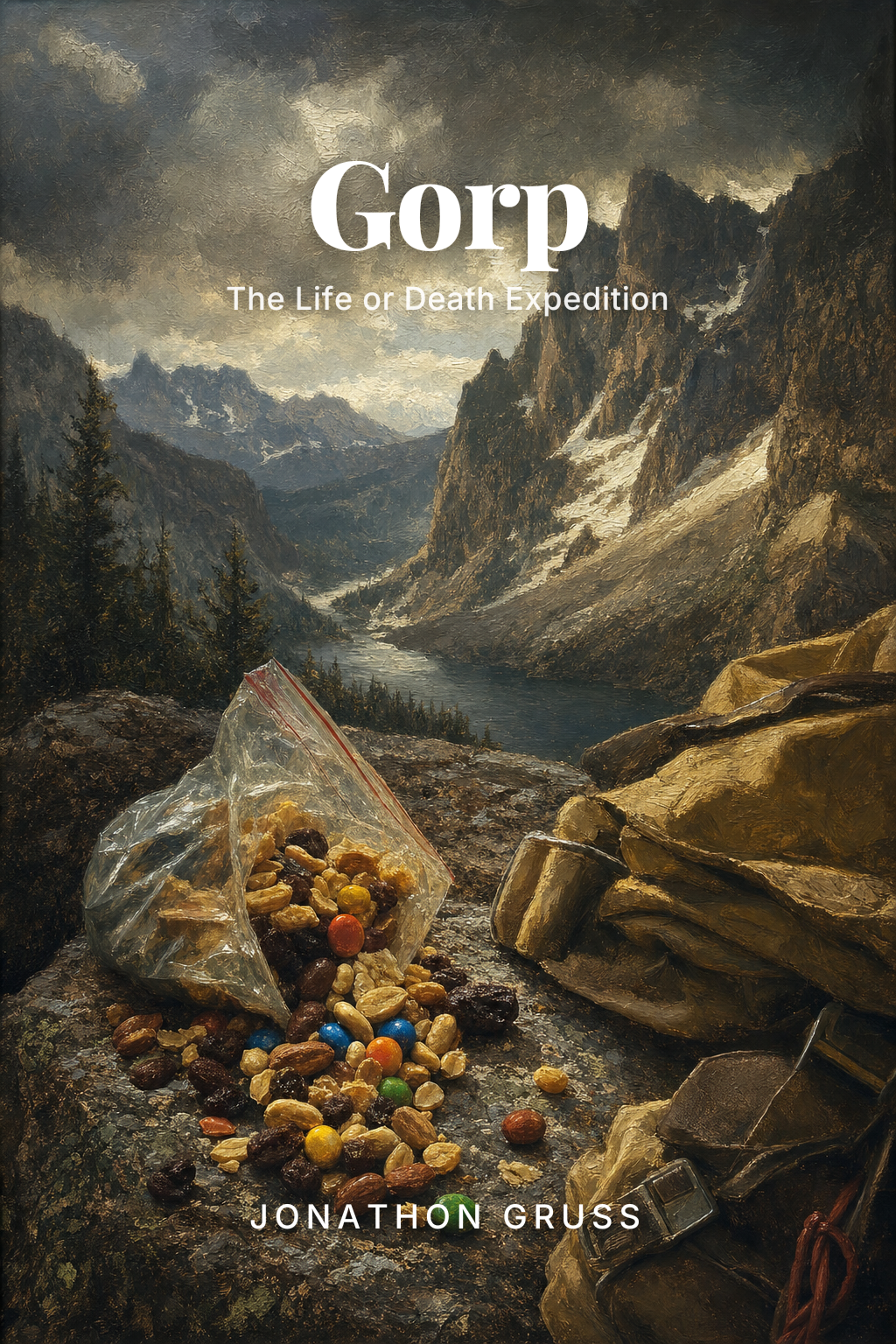
Book · 5 chapters · 19,089 words
Gorp
Contents5 chapters
Chapter 1
The Pouch on the Hook
The paper sack hung from a bent brass hook between a coil of red bootlaces and three dented tin cups nested inside one another. Someone had written GORP across its front with a black marker that had bled into the fibers, the O gone slightly square. Under it sat a glass jar of peppermints, cloudy with fingerprints. Beside that, a stack of folded trail maps held down by a river stone.
Mara stood with one hand on the counter and looked at the sack as if it might explain itself.
The shop was not much more than a room cut into the side of the mountain road, with floorboards sloped enough that marbles would have rolled toward the stove in the back. The place smelled of canvas, coffee grounds, cedar dust, and something sweet and old from the barrel of molasses chews near the register. A fly worried the window. On the wall behind the counter hung fishing flies in a faded card, blister pads, pocketknives, a shelf of sunscreen with chalky caps. Everything looked useful. Nothing looked decorative except a string of trout vertebrae over the door, and that might have had a use too.
“You can take it down,” the man behind the counter said.
Mara glanced at him. He had the kind of face that seemed carved with a pocketknife and then left in a vest pocket for twenty years. His shirt cuffs were rolled twice. One thumbnail was split. He had been repairing a buckle when she came in; the small screwdriver still rested in the crease of his palm.
“I was trying to decide if it was a product or a warning.”
“It’s a sack with a word on it.” He tipped his chin toward the hook. “That part’s free.”
She reached up and lifted it. The bag was lighter than it looked, just brown paper folded over at the top and stapled shut, with a grease shadow near one bottom corner. Nothing on it besides the word.
“What is it?”
He set the buckle down. “Food.”
“That narrows it poorly.”
A corner of his mouth moved. “Trail mix, if you like store terms. Gorp, if you like useful ones.”
Mara turned the sack in her hands. “I don’t know if I like either one yet.”
“You headed up?”
She followed his glance to the pack by the door. It was new enough that the nylon still had a factory stiffness to it. A tag string clung to one zipper pull. Beside it leaned a pair of borrowed trekking poles with somebody else’s initials burned into the handles.
“Just overnight,” she said. “Maybe six miles in. Seven if I miss the turn and make a bad choice.”
“Plenty of room for bad choices up there.”
“I’m trying to limit them to one category at a time.”
“That’s shopping.”
He took the sack from her, pulled the staple free with a thumbnail, and opened the top. He did not hold it out. He sniffed it once, as if checking for treachery, then spilled a little into his hand and let it rattle back. Peanuts. Raisins. Pumpkin seeds. A few chocolate disks with their shine going soft in the room’s heat. A broken cashew. Something pale and curled that might have been coconut.
“Made this morning,” he said.
“By whom?”
He shrugged with one shoulder. “Me, unless the mice have improved.”
She leaned closer. The smell was nut oil and sugar and dusted salt, warmer and more honest than the sealed energy bars arranged by the register in glossy wrappers showing people mid-leap over impossible streams.
“I thought I was buying dinner things,” she said. “Dried noodles. Maybe a can of soup if I hated myself.”
“You can still hate yourself. I stock for all faiths.”
She laughed despite herself, then looked down at the list in her hand. It had started neat and become frantic halfway through. Water purification tablets, socks, lighter, oatmeal, coffee, bandage tape, ibuprofen, something cheerful. At the bottom, squeezed in different pen, was snacks? and after that three underlines.
“I’ve never done this before,” she said.
He nodded once. Not kind, not unkind. Just accepting new information.
“I mean I’ve walked places before,” she said. “I know how feet work. But not with a pack. Not with a sleeping bag. Not carrying what I need.”
“That explains the soup.”
“Soup’s food.”
“Soup’s ballast.”
He reached below the counter and brought up a dented aluminum bowl. Then he crouched and produced jars and bins from under the shelves with the slow accuracy of a man who knew his inventory by touch: roasted peanuts from a pickle crock, raisins in a square deli tub, sunflower seeds, pumpkin seeds, a jar of chocolate pieces, toasted coconut, banana chips yellow as hazard paint, almonds, pretzel sticks in a paper sleeve, dried cherries kept in a mason jar with a lid that had lost its ring of rubber years ago. He arranged them in a half-circle on the scarred counter between them.
“This,” he said, tapping the empty bowl, “is your problem.”
“My problem is bigger than that bowl.”
“Not for today.”
Mara folded her list and tucked it in her back pocket. “I thought gorp came in a bag made by a company.”
He lifted one shoulder again. It seemed to serve him for several shades of opinion. “A lot of things come in bags made by a company. Doesn’t mean that’s where they begin.”
“So what is it exactly?”
He took a metal scoop from the peanut crock and poured a measure into the bowl. They landed with a hard, dry clatter. “It’s what you can carry that still feels like eating.”
Another scoop, this one raisins. Soft thuds among the nuts.
“It’s what won’t sulk if it gets shaken.”
He pinched in sunflower seeds, then pumpkin seeds, dark green and flat as little tongues.
“It’s what survives being forgotten in a side pocket for half a day until you need it enough to stop being picky.”
The chocolate came next. Not many. He let them fall with care, as if the bowl had a budget.
“That’s not a definition,” Mara said.
“No. Definitions are indoor furniture.”
He looked up then to see if she would object to that. She didn’t. She was watching his hands.
A woman in paint-flecked overalls came in with a propane canister under one arm and a black dog at her heels. The bell over the door gave one tired clap. The dog walked directly to the stove and lay down in the path it had probably worn all season.
“You got any more of the small fuel?” the woman asked.
“Back crate,” the man said. “If Amos hasn’t ordered by moonlight again.”
“He only drinks after dark now?”
“He plans after dark. Drinking’s all-hours.”
The woman found the crate, inspected two canisters, and brought one up. She glanced at the bowl. “New hiker?”
“Visible, isn’t it,” Mara said.
The woman set the canister on the counter. She was somewhere near fifty, with forearms browned into leather and white paint in the lines of her knuckles. “Only to those who remember doing it badly.” She nodded at the bowl. “Don’t let him talk you into carob.”
“I don’t stock carob,” the man said, offended in a quiet way.
“Good. Means there’s still law.”
She paid, scratched the dog once behind one ear, and left with the canister bumping against her leg. The door shut. The room settled again.
Mara touched the rim of the bowl. “So that’s all it is? Nuts and raisins?”
“That’s most of what it is. Which is not the same as all.”
He slid the bowl toward her and nudged the almond jar. “Go on. Build a case.”
“A case?”
“For carrying your own food.”
She looked from jar to jar. “Is there a right answer?”
“If there were, people wouldn’t discuss it so much.”
“That sounds like there are many wrong ones.”
“Now you’re hiking.”
She took the scoop and added almonds. Too many, probably. Then some dried cherries, because they looked less resigned than raisins. A small handful of pretzel sticks because the salt called to her. When she reached for the banana chips, he made a small sound in his throat.
“No?”
“You can put them in. I won’t stop you.”
“That sounded like stopping.”
“It sounded like history.”
She withdrew her hand. “What did bananas do to you?”
“They survive. That’s not praise.” He leaned one hip against the counter. “Listen. You need four things from a trail handful. Fat, salt, sugar, and the feeling that you are not being punished. Miss one and you’ll notice before the day is done.”
“You make it sound medicinal.”
“It is medicinal. It just tastes better than cough syrup.”
Mara looked again at the shiny bars by the register. “Why not just buy those?”
“You can.”
“You disapprove.”
“I sell them,” he said. “Disapproval would be poor retail.”
“But.”
He picked up one of the bars, a wrapper the color of emergency equipment. He turned it over and handed it to her. The ingredient list was long enough to need two columns. There were things in it that sounded extracted, isolated, persuaded. Protein crisp. Chicory root fiber. Brown rice syrup. Natural flavors, which always made her feel less informed than before.
“Eat that at a desk,” he said. “Fine. Eat it on mile five with your shoulders starting to argue and your lunch two hours behind you, and maybe you’re still fine. But maybe what you want is a peanut, a raisin, another peanut, some salt, one piece of chocolate if you’ve been brave enough to save it. Something you can take in pieces. Something old enough not to need a paragraph.”
He took the bar back and returned it to its place among the others, squared to the edge of the display.
“And cheap,” Mara said.
“That too.”
She pulled her wallet halfway from her pocket, peered in, then shoved it back. He pretended not to notice.
“How cheap?”
He eyed the bowl. “Depends how sentimental you get around cherries.”
“I can be practical.”
“Most people can, right up to the good stuff.”
She lifted a dried cherry and bit it in half. Tart, sticky, better than practical. She dropped the remaining half into the bowl and reached for the peanuts.
“What does the word mean?” she asked. “Gorp.”
He rubbed a thumb along the edge of the counter where varnish had worn away. “Depends who you ask. There’s always someone eager to tell you it stands for good old raisins and peanuts.”
“Does it?”
“Only if you arrange history after the fact.”
“So it’s a lie.”
“It’s tidy. Tidy and true aren’t twins.”
He took up the scoop again and added more peanuts to bring the whole thing into balance. “People like words to justify themselves. Most trail words don’t. They get used because they’re handy in the mouth and hard to mistake. Gorp sounds like something you can eat from your hand while walking. You say it once and everybody knows it isn’t custard.”
Mara said it under her breath. “Gorp.”
“There. It lands where it needs to.”
“You’re telling me nobody knows?”
“I’m telling you whoever first said it was probably busy. Hungry, too.”
He folded the top of the paper sack flat and pressed the crease with the side of his thumb. “A lot of mountain language starts like that. Somebody needing to say a thing fast enough for it to matter. If the word sticks, it stays. If it doesn’t, it goes down the slope with everything else.”
On the shelf by the maps, a little battery radio muttered static and one line of fiddle before losing courage. The fly found the peppermint jar again. Outside, tires hissed over gravel on the road, then passed.
Mara looked into the bowl. The ingredients had settled into one another. What had seemed miscellaneous in separate jars had turned coherent the minute it shared a container. She stirred it with her fingertips. Her nails came away salted.
“Did people always make this?”
“People have always carried food. This particular version? Near enough. Hunters. Camp crews. Scouts. Parents trying to keep children from mutiny. Anything that can sit in a pocket and answer a bad hour gets invented over and over.”
He bent to the shelf below the counter and brought up another container, this one with sesame sticks lacquered orange with spice. “Those are too loud for some folks. For some folks that’s the point.”
She smiled. “You really have opinions.”
“I have seen enough failed mixtures to earn a few.”
“What counts as failure?”
He dropped a couple sesame sticks in, as if to demonstrate moderation. “Too sweet and you’re sick of yourself by noon. Too virtuous and you start eyeing other people’s lunches. Too crumbly and your pocket turns into bird feed. Too precious and you don’t eat it when you should because you’re saving it for a better time, then get home with it untouched and mean.”
That landed close enough to home that she said nothing.
He looked at her pack by the door. “Who told you to take the hike?”
“No one told me.” She reached for the pumpkin seeds, added a little more. “A friend mentioned the lake. Said it was easy.”
“Friend coming?”
“She had to work.”
“And you came anyway.”
Mara shrugged. “I bought the permit before she canceled.”
“That’s one reason.”
She scraped a drift of sunflower seeds back toward the center of the bowl. “Another reason is I’m tired of hearing myself say I should do things.”
He nodded, but his eyes had already gone to the paper bag. It was enough. He didn’t dig.
At the far end of the counter stood a scale with a shallow metal pan, its enamel chipped to gray steel at the edges. He set the bowl on it. The needle trembled, then steadied.
“You need enough for this afternoon, tomorrow morning, and the walk out,” he said. “Assuming you also take breakfast and something with shape for supper.”
“Shape?”
“Food that knows what meal it belongs to.”
“You really hate soup.”
“On your back? Yes.”
He tipped the bowl and let the mix slide into the paper sack in a dry rush. A few raisins stuck to the metal and had to be coaxed loose with his finger. He folded the top once, twice, then reached for a small strip of blue painter’s tape and sealed it there. On the tape he wrote M with a pencil stub.
“That’s me,” Mara said.
“Unless another customer objects.”
He set the sack aside and lifted her list off the counter where she’d left it near the register. “What else have you got.”
They moved through it item by item. Oatmeal. Fine. Coffee. He raised an eyebrow until she added instant packets instead of the pound bag she’d picked up. Water purification tablets, yes, though he told her where the spring ran clean by the switchback and where not to trust anything that looked innocent. He swapped her canned soup for a packet of noodles and a waxed round of hard cheese. He steered her away from a cast-iron skillet she had only touched out of longing. He sold her two apples after pressing each thumb into them for firmness.
“What about jerky?” she asked.
“If you want jerky, buy jerky.”
“Can it go in the gorp?”
He considered. “It can. Then you have a different conversation.”
“With whom?”
“With your mouth, mainly.”
She laughed again. The room had changed. Or she had. The pile of needed things had stopped looking like evidence and become a shape she could imagine carrying.
He rang up the items on a register older than either of them. Each key gave a stubborn, mechanical chunk under his fingers. She watched the numbers rise. He saw her watching and plucked the dried cherries off the tally without mentioning it.
“That’s not all in there,” she said.
“It is today.”
“I can pay for cherries.”
“Then buy another handful after the hike and tell me if you learned anything.”
He bagged the other supplies in a paper sack broader and stiffer than the one marked GORP. Her little bag he left separate. That seemed intentional. He placed it on top of the folded map she’d chosen, as if it belonged there more naturally than the compass did.
She picked it up and weighed it in her hand. Light enough to dismiss. Heavy enough to matter after miles, maybe. The paper was already taking a faint bloom of oil.
“So the point is portability,” she said. “That’s the definition you trust.”
“The point is use.”
He came out from behind the counter for the first time, carrying her pack by one shoulder strap. Up close he was taller than she had thought. He set the pack on the counter, loosened a side pocket with two fingers, and slid the gorp bag in.
“Not buried,” he said. “If you have to unpack half your life to get to food, you wait too long.”
She adjusted the strap automatically after him, making sure the bag wouldn’t jump out. “How long is too long?”
“When you start bargaining. I’ll eat at the next turn. I’ll eat at the lake. I’ll eat when I’m in a prettier mood.” He cinched the pocket and tugged once. “Eat before noble thoughts set in.”
“You should print that on the sack.”
“I like people to think I’m less opinionated than I am.”
The bell over the door clapped again. Two boys came in all knees and wet hair, smelling of creek water and cold stone. One made directly for the freezer chest in back where ice cream bars lived among bags of frozen peas. The other stopped at the counter and pointed at the open jars.
“You making trail mix?” he asked.
“Looks that way,” the shopkeeper said.
The boy looked at Mara with frank curiosity, then at the little bag in her side pocket. “You want more chocolate than that.”
“Do I.”
He nodded with gravity. “The trick is you think you don’t, but then later you do.”
His friend called from the freezer chest, “They got the kind with the almonds.”
“Life turns generous,” the boy said, and trotted off.
Mara watched them go. “He may be right.”
“He is often right in very small areas.”
She slung the pack upright and threaded her arms into the straps. The weight brought her forward for a second until she found where to stand under it. The shopkeeper watched without fussing. When she’d settled it, he reached over and tightened one load-lifter strap half an inch. The pack came closer to her shoulders.
“There.”
“Thanks.”
“You know where the trailhead is?”
She held up the folded map.
“That wasn’t the question.”
She smiled. “I know where the trailhead is.”
“And the turn to the lake?”
“There’s an old fir with a lightning scar. Cross the log bridge and keep left where the path pretends to split but only one side gets used.”
He looked at her for a beat. “You do listen.”
“Only when cornered.”
He picked up the brass hook’s empty swing where the sample sack had been hanging and steadied it with one finger until it stopped moving. Then he hung another brown paper bag there from beneath the counter. This one already had GORP written across it, same black marker, same square O. Ready for whoever came in next needing a name for a handful.
Mara put cash on the counter. He counted out change into her palm: quarters cool from the till, a dime, two nickels. She pocketed them and took the map.
At the door she stopped. The trout vertebrae above it clicked softly when the frame shifted.
“One more thing,” she said. “If good old raisins and peanuts isn’t really where the word comes from, why does everyone keep saying it?”
He had gone back to the buckle repair. He fit the screwdriver to the slot, not looking up yet.
“Because people enjoy a story they can remember with their mouths full.”
Then he glanced at her.
“And because raisins and peanuts have kept a lot of people from becoming somebody else’s problem.”
Outside, the road bent around the shoulder of the mountain and dropped toward the river. The gas pump out front wore a cardboard bag over its nozzle. A rack of postcards turned on one complaining bearing in the doorway breeze: black bear, waterfall, fire lookout, mule deer in winter brush. Across the road, a ditch carried clear water over stone polished the color of old bones.
Mara stepped off the porch boards and felt the pack settle into a second, less theoretical weight. In the side pocket, the little paper sack made a dry sound against her water bottle. She stood a moment with one hand on the strap, not delaying exactly, just taking the measure of what had changed. She had come in looking for food as a category, one more item to purchase before she could start. She was leaving with something more specific and less important-seeming than that, a mixed bag tucked where her hand could find it without thought.
Down the road, a trail sign showed only a white hiker icon and a mileage number someone had shot at with birdshot years ago. She walked toward it, gravel crunching, and after a dozen steps she reached into the side pocket, pulled out the bag, and opened the folded top.
The first handful was mostly peanuts and seeds. One raisin, one chocolate piece already beginning to soften. She ate while walking. Salt first, then the dense, plain richness of the nuts, then the raisin blooming dark and sweet at the end. The chocolate smeared against her thumb before it gave way.
Not a treat. Not only that.
By the time she reached the sign, she had folded the top closed again and put the bag back where it belonged. Behind her, the shop door opened and shut. Ahead, the path left the road and narrowed between alder and stone, asking the old question in the ordinary way: what can you carry, and what will carry you a little farther when your own reasons begin to thin.
She went in with the answer rustling at her side.
Chapter 2
What a Handful Has to Do
By the third switchback Mara had stopped looking at the lake.
The path had gone up with a kind of insult from the first, as if the mountain had listened to her city legs and decided to teach them manners. Fir roots crossed the tread like knotted ropes. Dust, tamped hard by boots and hooves, loosened under her soles where the grade pitched. The pack she had fussed over at the shop had found the one bruise-prone place on each shoulder and settled there. When she tipped her face down she could see the dark crescents of sweat spreading under her shirt straps. When she looked up, all she got was more climb, another bend cut into the slope, another section of trail that seemed to stand nearly on edge before easing just enough to be called a path.
She braced one hand on her thigh and breathed through her mouth.
A man came down with trekking poles and the expression of someone already having his second day. He stepped aside for her, not out of kindness exactly but because he knew she was in no shape to make room quickly.
“Lake’s worth it,” he said.
She laughed once, sharp and small.
“That obvious?”
He flicked a glance at the side pocket of her pack where the paper bag rode folded down inside a plastic sack the shopkeeper had insisted on. “Eat before you get mean.”
Then he went on, tapping away downhill.
Mara watched him disappear between lodgepole trunks and had time to think, I’m not mean, before the thought turned in her mouth and showed its teeth. She was hot. She was thirsty in that foolish way that comes from trying to save water for later, as if later won’t bring its own reasons. She had drunk coffee on an empty stomach because she’d been too busy checking and rechecking the permit, the route note, the borrowed stove, the straps. At the shop she had eaten one neat handful because it felt ceremonial, because she was pleased with herself, because standing on a road with a full pack and a paper bag of something new had made the day seem manageable. Since then she had kept walking under the vague discipline of not wanting to “waste” the good food early.
The mountain had no interest in that plan.
She unshouldered the pack on the outside edge of the switchback and sat on a flat stone warm as bread crust. Pine needles had gathered in the angle of it. Her pulse was beating in the soft roof of her mouth. Below her the valley road was a pale thread among the trees. Somewhere lower, a truck door slammed. The sound came up thin and late.
She pulled out the bag.
The top was twisted and folded, then tucked under itself. The shopkeeper’s handwriting, thick black marker on brown paper, had softened where her damp hand had touched it earlier. Through the plastic she could smell coconut and salt and the faint, sweet dust of chocolate beginning to think about melting.
She hesitated. That, more than the climbing, annoyed her.
The bag was food. Not a prize. Not a moral problem. Still she found herself trying to portion virtue into the day: be hungry now, be rewarded later. The sort of thinking that had once made a granola bar live in her desk drawer for three months because she was always waiting for a more deserving emergency.
She untucked the fold and poured a little into her palm.
Nothing in it looked noble. Halved cashews with their blunt commas. Almonds, brown and unglossed. Pumpkin seeds flat as fish scales. Raisins wrinkled into themselves. Threads and flakes of coconut. Chocolate pieces gone soft at the edges. A peanut or two from some drift in the scoop. It looked accidental in the way that good things often do once they are no longer arranged.
She ate the first handful standing up, because she was too impatient to sit with it. Chocolate first by chance, then a walnut bitterness, then salt, then the drag of coconut in her teeth, then a raisin loosening into sugar. She took another handful and this time paid attention. There was no one grand flavor to admire. It worked by handoffs. The sweet hit early. The salt woke everything behind it. The nuts did the slower job, quiet but insistent, asking for chewing, taking time to become part of her. Even the seeds mattered because they filled the spaces and kept each bite from becoming only one thing.
By the third handful the bad temper had lost the edge that made it feel like truth.
She capped the bag, set it back in the pocket, and drank. The water was warm already, tasting faintly of plastic and the last rinse from her sink at home. Better than coffee. Better than pride.
When she stood again, the pack still weighed what it weighed. The trail had not relented. But the climb no longer felt personal. Her legs were only legs. They had work to do; now they had been informed.
She took the next switchback without stopping.
The trees thinned in patches where old burn had come through years ago, leaving silver trunks upright and barkless among younger fir. In the openings she got sun full on the side of her face and smelled hot pitch lifting from stumps. In shade the air cooled fast enough to notice. She passed a family gathered around a map spread over a boulder. The father was saying “contour lines” in the voice of a man who’d rather be doing anything else. A little girl in a pink cap looked at Mara’s pack and then at Mara’s face with ruthless accuracy.
“Are you tired?”
“Only in a way that builds character,” Mara said.
The girl considered this and turned away as if she had heard adults say stranger things.
A quarter hour later, the improvement she’d felt from the snack showed itself plainly. Not as vigor exactly. She wasn’t suddenly a mountain goat. But the shaking hollowness had receded. The climb settled into a pattern: twelve minutes moving, one minute slower, then on again. Her thoughts stopped skidding. She noticed birds. She noticed the shape of the land. She could choose her footing without resenting each stone for existing.
Then, as the trail crossed a dry wash and reared up its far side, she felt the first downward slip.
It was subtle. A thinning. The sweetness had gone; the body had spent what it could spend quickly. Her mouth wanted another taste before her stomach knew it was hungry again. She knew that feeling. Office afternoons had trained her in it: the bright, false lift of something sugary from a vending machine and then the odd, insulted despair an hour later, as if the day had changed terms without warning.
She stopped before the feeling could become command and took another handful, smaller this time.
This was the part the shopkeeper had meant, though he hadn’t made a lecture of it. Afternoon. Morning. Walk out. He had spoken as if a person could meet the day by feeding it at the right moments, not by bargaining with it. He’d packed the mix not as candy and not as health, but as something built to bridge the actual failures that happen outside: sloppy planning, long grades, weather, appetite gone strange, the body turning stupid at bad times.
Mara chewed an almond and understood why a bag of only nuts would not have done the same job for her right now. Good food, solid food, probably the sort of thing certain superior people carried in cloth sacks and praised for its seriousness. But almonds alone, or cashews alone, would have asked for more patience than she had. Fat stayed. That much she could feel. It lined the emptiness and quieted it in a lasting way. But it came on like a lamp turned low. What she had needed half an hour ago was a match. The raisins and chocolate had struck first, little fast-burning things. They had cleared enough fog for the nuts and seeds to do the slower work behind them.
And if she had packed only candy, she thought as she started walking again, she’d be flying now straight toward misery.
The trail made a traverse across a slope of broken granite. Heat came up off the stone in white, hard sheets. Lizards flicked between cracks. Her shirt clung to the small of her back. She was sweating more than she liked, enough that when she licked her lip she got salt there. The next swallow from her bottle made her aware of how little coolness remained in it.
She stepped aside for two runners coming down loose and easy, their knees somehow forgiving them for this abuse. One had a vest with soft flasks bouncing on his ribs. The other carried nothing at all. They smelled briefly of detergent and effort and were gone.
Mara was alone again with the sound of her own breath and the soft rattle from the bag in the pocket.
The rattle mattered more than she would have guessed.
It wasn’t only food. It was proof of enoughness. A can of soup in a backpack would have been weight and promise, but sealed away, requiring stopping, water, a stove, a pot, a place to sit long enough to turn fuel into calories. Useful later. Useless now. A nutrition bar—she could imagine the shopkeeper saying desk bar with that side glance of his—would have solved some of this, maybe. But she knew her own habits with bars. Three bites in, the taste flattened. Four bites in, her jaw got tired of sweetness pressed into a shape. Five bites in, she’d wrap the rest and tell herself she’d finish later. Later it would be linty or forgotten.
A handful asked less and gave more. No unwrapping. No commitment to a single flavor. No requirement that appetite behave itself. Even if she felt half sick from climbing, she could usually want one salted cashew, one raisin, one piece of chocolate. Appetite, she was learning, could be coaxed by variety where it would refuse instruction.
At the next bend there was a log set as a bench, its top worn smooth by decades of people grateful for wood at sitting height. Mara lowered herself onto it and took stock without drama. Her hands had gone slightly clumsy. She was breathing too high in her chest. The skin at the back of her neck felt overexposed. Not danger. Stupidity in progress, if left alone.
She ate more deliberately now, sorting a little in her palm.
Chocolate. Fast. Friendly. Almost too friendly. Left to itself it would flatter a person right into trouble. The sweetness hit and vanished, leaving want behind. Raisins next. Not noble either, but steadier than candy, with a chew that made them seem like food and not just permission. They filled the space between pleasure and fuel. Nuts after that, and the pumpkin seeds, both salted enough to be noticed. Salt was not the glamorous part of any of this, but her body reached for it all the same. Sweat had been taking pieces of her with it for the last hour. The salt put some shape back into things. Not energy exactly. More like the difference between a radio station coming in through static and coming in clear.
Coconut she had thought decorative in the bowl at the shop. Here it proved otherwise. It made the bite wider. It kept the sweet from feeling syrupy and the nuts from feeling like homework. The shreds stuck in her molars, yes, but they also brought a dry, sweet scent that made the whole mix feel less like emergency feeding and more like a thing one might choose.
She smiled at that. Chosen. A useful luxury.
A pair of women came up from below while she was still sitting there. One wore a sun hoodie and moved with the compact economy of someone who had packed and repacked the same kit for years. The other had a bandanna tied over her hair and a branch in one hand she had clearly adopted as a walking stick out of sudden need.
“Steeper than they said,” Bandanna said to no one in particular.
“They always mean emotionally,” said the other.
Mara laughed, and because they had all earned the right to skip introductions, the experienced one nodded at the open bag and said, “There’s your answer.”
“I was just figuring that out.”
“What’d you put in it?”
Mara named the contents as the women drank from their bottles in turn.
“Good,” the woman said. “Too many people carry all sweet and then wonder why they’re furious at a fern.”
Bandanna dragged the back of her wrist across her mouth. “Last summer my nephew packed gummy worms and beef jerky. That was his whole strategy.”
“How’d that go?”
“He cried at a meadow.”
The three of them held that for a second, not unkindly.
Then the women moved on, the branch ticking against stones. Mara watched them until the trail took them around the hill. Furious at a fern was as neat a summary of preventable wilderness despair as she had heard.
She took one more pinch from the bag and this time got mostly seeds and coconut. Less satisfying than the mixed handful before it. That taught her something too. Proportion was not abstract. If a bag settled badly—everything heavy to one side, everything sweet eaten first, all the fun gone by mile four—it stopped being the same food. Each handful had to have enough agreement in it to do the job.
She stood and shook the bag gently before stowing it.
Higher up, the air changed. Not cooler by much, but less packed with the lower forest’s old heat. The trail entered a stand of subalpine fir where the trunks were thinner and closer together. The ground there held more shadow and the smell shifted from dust and pitch to something greener, sharper, almost medicinal where crushed needles lay in the path. A trickle crossed the trail in a groove worn by boots. Mara crouched and touched the water. Snowmelt cold. She wet her wrists, then her neck, and sat back on her heels for a moment longer than she intended.
The friend who had canceled would have said this was the exact place to stop for photos. Mara could hear her voice on certain slopes, bright with advice, enthusiastic in ways that made a person agree before asking practical questions. “There’s a little crossing,” she’d said when she first sold Mara on the lake. “And then this climb that’s annoying but not bad.” A phrase that now seemed less like information than a category of optimism.
Mara stood and shouldered the pack again without following that thought further. There would be plenty of room for that voice later, if she wanted it.
The trail steepened one more time under a scatter of loose stone. Her calves tightened. Her left boot rubbed a place on the back of her heel that had not yet become a blister but was making plans. She shortened her steps. The rhythm became almost domestic: plant, push, breathe; plant, push, breathe. No heroics. Just repetition.
When the next hunger came, it came cleaner. Not foul mood this time. Just a tapering off. The body asking before it had to complain. She liked that better. She took the bag out while walking and managed a one-handed handful without spilling. Progress.
Now that she was less desperate, the mix gave up another lesson. It wasn’t only that different ingredients did different jobs. It was that each one corrected the others’ worst habit. Nuts could be rich to the point of refusal; fruit brightened them. Fruit could go sticky and childish; seeds and salt pulled it back toward seriousness. Chocolate could shout over everything; coconut and nuts made it part of a sentence instead of a speech. Even texture had a use. Crunch woke her up. Chew slowed her down enough to notice whether she was still thirsty. Soft pieces alone would have vanished without asking anything of her. Hard pieces alone might have felt like punishment once she was tired.
She thought of bad snack choices from long drives and airport gates and workdays stretched stupidly thin. Foods that left a waxy coating. Foods that tasted only of the package they came in. Foods so virtuous they seemed to resent being eaten. None of them had this modest intelligence. Gorp, she thought, and was surprised by how naturally the word fit now. Not cute, not quaint. Just accurate. A thing with a job.
She rounded a shoulder of the mountain and found a view opening west through two ranks of trees. Far off, another ridge lay blue and folded, its snowfields dirty at the edges where summer had been at them. Closer, below, the road and the shop and the hook with the paper sack had disappeared into scale. She could no longer imagine the exact shelf where the peppermints were. This seemed right. Some instructions had to become muscle or they stayed decorative.
A squirrel ran across the path carrying something white and impossible in its mouth—a mushroom stem, maybe, or a scrap of somebody’s sandwich bread stolen from camp. It vanished into brush. Mara laughed aloud with no one to report to. That, too, was better than earlier.
She reached a wooden sign nailed to a post at a junction with an older trail. The letters had weathered gray except where hikers’ fingers had polished them by tracing directions. The lake lay not far now by the numbers. The campground farther beyond. Mara set the pack down in the shade of the sign and let her shoulders hang empty for a minute.
The bag had grown lighter. She tried to estimate without taking inventory. Enough for supper? No, that was not its job; the shopkeeper had been plain about that. Supper should be supper, food shaped for sitting and steaming and feeling the day settle. Enough for the morning and the walk out if she was sensible? Yes, likely, if she stopped pretending hunger was a character test and paid attention instead.
She ate another measured handful and this one came almost perfectly balanced: two raisins, one chocolate piece, three pumpkin seeds, a cashew, an almond, a flap of coconut. If there had been a lecture attached, she would have resisted it. In her palm it made its own case. Quick lift, longer burn, salt enough to matter, texture enough to keep her interested, sweetness enough to make the whole thing welcome when she was tired and vaguely cross and not inclined toward virtue.
Below all that was the simplest fact: she would keep eating it.
That was not trivial. Half the problem with trail food, she suspected, was not nutrition but refusal. A person could carry the cleverest fuel in the woods and still lose to it if every bite felt dutiful. Hunger on a climb was not a clean, rational appetite. It frayed. It got picky and peevish. It forgot what was good for it. A useful trail food had to survive contact with that version of a person. It had to be good enough, easy enough, various enough, that even when tired and overheated and behind on water, you would still reach into the bag.
Mara licked salt from the base of her thumb and drank the last of the warm bottle. Then she pulled out the second one from deeper in the pack, still a little cool from the morning, and took four long swallows that seemed to spread all the way into her wrists.
A breeze moved through the firs. Needles whispered against one another overhead. Somewhere uptrail a jay scolded like a rusty hinge.
She rolled her shoulders, retightened the hip belt, and looked toward where the lake would be, though trees still kept it hidden. The climb had not become easy. Her legs had no sentimental speeches for her. But the terms were plain now. A handful was not luck. Not magic. A small machine made of opposites, built to carry a person over the ordinary failures of appetite and planning and mood. Too much candy and the machine ran hot, then quit. Too much nut and it asked more mouth and morale than a hard climb could spare. The fruit and salt and crunch did not decorate the mix. They kept it working.
She slid the bag back into the pocket where her hand could find it without looking and set off again, this time with less drama and better timing, the trail rising ahead in the same old way and Mara, at last, beginning to understand how to answer it.
Chapter 3
The Argument in the Mixing Bowl
“Absolutely not,” said the woman with the red braid, and tipped a whole mug of yogurt-covered raisins back into her own tote before anyone could claim them.
The cabin table was scarred pine, sticky in two places where syrup had dried and been half-wiped, and crowded before breakfast with a confusion of offerings: a sack of peanuts folded shut with a clothespin, pumpkin seeds in a canning jar, stale pretzel twists in a zip bag that had once held frozen peas, chocolate buttons cloudy at the edges, chopped apricots, sunflower kernels, sesame sticks, dried cherries, banana chips, toasted coconut gone a little oily, and, for some reason, a paper bag of cereal stars the color of wet sand.
Mara stood at one end with her enamel mug and watched it happen the way people watch a dog approach a picnic blanket—aware that in a second there would be trouble and not yet sure whether to stop it. She had come in for hot water and maybe one sensible handful from her own bag before heading out. Instead she found six people making territory out of snack food.
“Those are candy in a cardigan,” said the budget cook. He was a broad man in a faded college sweatshirt with the sleeves cut off, his forearms freckled with old burns. He had been up before everyone else, making oats in a dented pot big enough to wash a baby in, and the room still smelled of cinnamon and propane. “If you want candy, put candy in. Don’t dress it up.”
“They don’t melt,” said the woman with the braid. “That is the point. Some of us are not interested in excavating brown grout out of a pack seam.”
A college-age boy with a sleep-creased cheek pushed his glasses up and held up a bag of almonds like evidence. “This is all beside the point if Lia can’t eat half of what’s on the table.”
“More than half,” said the girl beside him without looking up. She was reading ingredients on a granola pouch with the distrust of a customs officer. “And if anyone puts cashews in that bowl, I’m not even staying in the room.”
“Then we don’t put cashews in,” said a father in a green rain shell. He had one hand on the shoulder of a little boy who was trying to palm the chocolate buttons one by one. “Easy fix.”
His daughter, maybe eight, already had dried cranberries lined in a red row by her plate and was sorting them by size. “Can there be marshmallows?”
“No,” said four people at once.
The little boy grinned. “That means maybe.”
At the stove, a woman in a camp T-shirt cracked eggs one-handed into a bowl and snorted. “Best trail mix I ever saw on a family trip was Cheerios, peanuts, and M&M’s in a bread bag. Nobody died. Everybody walked.”
“Did anybody enjoy themselves?” the braid said.
“They were children. Enjoyment was not the metric.”
The room had that cabin kitchen cluttered warmth that made people bolder than they would be outside. Damp socks steamed near the woodstove. A dish towel with blue stripes hung from a nail by the sink. Someone had left a topo map under the sugar tin, and one corner had gone translucent with butter. Through the window over the basin, the slope across the clearing showed gray fir trunks and a stripe of old snow holding in shade. Packs leaned against the wall by the door like tired men.
Mara set her mug down and drew her own paper bag from the side pocket of her pack. It was creased soft now and freckled with grease where the coconut had warmed against the nuts. The hand-lettered word still showed if you turned it right. GORP. She felt foolishly proprietary about it, as if the bag knew something these people were about to rediscover the loud way.
“Look,” said the budget cook, rapping a spoon on the table. “There are two questions. What can you carry, and what will you still eat when your legs are shaking?”
“That is one question,” said the braid.
“That is marriage. Not one question.”
A few people laughed. The little boy took advantage of this and closed his fist around six chocolate buttons. His father pried open the fingers without heat and put four back.
Mara might have slipped out then if the woman in the camp T-shirt hadn’t spotted the bag in her hand.
“You,” she said. “You look like you’ve already got religion. What’s in yours?”
Every face turned too quickly. Mara hated this. A person could walk twelve miles alone and be perfectly calm, then be asked a simple thing by seven strangers and feel all her joints become separate.
“Nothing dramatic,” she said. “Nuts. Raisins. Seeds. Chocolate. Coconut.”
“That sounds sane,” said the father.
The braid tipped her chin. “Ratio?”
Mara blinked. “I didn’t—”
“Ratio matters,” said the college boy.
“Texture matters more,” said the braid.
“Price matters most,” said the cook, with the authority of a man who had bought food for groups large enough to make arithmetic personal. “You can build a beautiful bowl if you’ve got twenty dollars to throw at dried fruit. Some of us are feeding twelve.”
“Some of us don’t want peanuts because every cheap mix on earth tastes like a baseball game floor,” said the braid.
“Some of us would like not to need an EpiPen before lunch,” said Lia.
The children had begun to listen with bright predator attention. Adults arguing over food promised loopholes.
The father dragged an empty mixing bowl from the dish rack, a stainless one wide as a hubcap, and put it in the center of the table with a clang that gave the room a shape.
“Fine,” he said. “Argue into something useful. We’ve got another day out. Build one for each person, if that’s what it takes. But somebody make coffee while you’re doing it.”
That set them in motion.
The first version belonged to the cook because he had volume on his side and ingredients enough to shame everybody. He made his case with a measuring cup.
“You need ballast,” he said, pouring roasted peanuts in a steady tan flood. “Not little decorative things. Food. Real food.” In went sunflower seeds, a thick rain against the steel. Then raisins by the handful, dark and wrinkled, because they were cheap and because, as he put it, “they do the sweet job without acting precious.” He added broken pretzels for salt and crunch and, after some muttering, a restrained amount of chocolate buttons.
“That’s not restrained,” said the braid.
“It is for morale.”
“It’s seventy percent peanuts.”
“It is a worker’s mix.”
“No,” said Lia, reading over his shoulder as though there might be shellfish hidden in the pretzels by grammar alone. “It’s a hostel vending machine with ambitions.”
The cook ignored her and tossed the bowl with a practiced lift. The contents rose and settled with a dry hiss. He handed the father a sample.
The father chewed. “This is the kind that disappears because you keep eating around the peanuts and then there are only peanuts left.”
“That,” said the cook, pointing with the spoon, “is a discipline problem.”
“It’s a design problem,” Mara said before she meant to.
The room paused on her. She wished immediately to be inside her own mouth and not out in the air.
“What kind?” asked the camp T-shirt woman, not unkindly.
Mara reached into the bowl and pinched up a few pieces. “If one ingredient turns into leftovers, there was too much of it or not enough to go with it. You want handfuls that make sense without sorting.”
The braid’s face changed. Not softer exactly, but interested.
“Yes,” she said. “That.”
The cook folded his arms. “Easy to say with boutique coconut in your paper bag.”
“It wasn’t boutique,” Mara said. “It came in a scoop bin.”
“Everything in a scoop bin costs more than it ought.”
The father was still chewing. “She’s right, though. If my son can pick out all the chocolate by mile one, then by mile three I’m asking him to eat salty gravel and resentment.”
The little boy, hearing himself discussed as a species, climbed into a chair and reached for the cereal stars.
“For children,” said the camp T-shirt woman, taking the bag from him and opening it herself, “you build against mutiny.” She poured the cereal stars into the clean second bowl the daughter had fetched. Then peanuts were vetoed by the children as too much work and by Lia as too risky for the shared table, so she used toasted soy nuts from a bag she’d had tucked in her food crate. Pretzel sticks snapped in by hand. Dried cranberries. Tiny chocolate candies with candy shells that would not smear if held in a hot fist. Then, to the horror of the braid, miniature animal crackers.
“That is not gorp,” the braid said.
“That is exactly gorp,” said the woman. “It’s food in a bag for walking. You think a six-year-old cares about your purity?”
“I care about not hiking behind a rain of crumbs.”
The daughter had been waiting for permission no one gave. She scooped a pinch and chewed solemnly, then nodded once. “This one is better.”
“Because of the cookies,” said the braid.
“Because every bite is different,” said the girl.
There it was again. Mara looked down at the bowls. The cook’s version sat heavy and worthy. The children’s mix was ridiculous and, plainly, effective. The little boy had already eaten three handfuls while everyone argued about whether that counted against it.
The college boy cleared a space with his sleeve and set down a package of pumpkin seeds, a bag of dried mango, and a tub of toasted chickpeas.
“For allergy-safe,” he said, “we start over from zero. New bowl. New spoon.”
Lia nodded once, approving him and the procedure both. The father rinsed the big spoon and dried it with the blue-striped towel. The boy washed the bowl too, because caution had made a habit of him.
“No peanuts, no tree nuts,” Lia said. “And read the labels on the chocolate before anybody gets cute.”
“That leaves seeds, legumes, dried fruit, cereal, coconut maybe, depending on processing,” said the braid. “Plenty.”
“Not sesame for me,” Lia said.
“Right. Not plenty-plenty.”
They built carefully. Pumpkin seeds first, green and flat, with a clean mineral smell. Toasted chickpeas, which hit the bowl like pebbles. Dried mango cut smaller with a pocketknife because the strips were too leathery to mix well. Raisins came under suspicion for shared-facility wording and got rejected. Banana chips were ruled out for being “sweet drywall.” A dark chocolate bar, verified line by line, was chopped into shards on a cutting board scarred by onions and old camp meals.
“This one tastes like you’re doing homework,” the little boy announced after trying a piece.
“It tastes good,” said Lia.
“It tastes responsible.”
Lia shrugged. “Responsible is good if your throat stays open.”
Nobody had a joke for that. The room quieted. Outside, a pack buckle clacked against the wall where some breeze shifted it. The camp T-shirt woman turned the eggs in the pan with more care than before.
Mara took a small handful from Lia’s bowl. The pumpkin seeds had a flat richness to them that arrived slowly. The mango was louder than the raisins she was used to, more floral, more insistently itself. The chickpeas were almost too hard until the chocolate appeared and changed the whole mouthful.
“This would be better with something salty and thin,” she said. “Rice crackers, maybe. Or pretzel pieces if the label works.”
Lia glanced up. “Exactly.”
The college boy looked relieved enough to show it. He had likely been defending ingredient labels to groups for years, and relief had become part of his posture.
The braid uncapped a jar with a grunt. “Now for heat,” she said. “Because if we’re walking the south side this afternoon, all your lovely chocolate morals are going to be paste by noon.”
“Chocolate paste is still chocolate,” said the cook.
“Chocolate paste coats the salt and ruins the paper.”
She poured roasted cashews into the third bowl, then stopped at Lia’s expression and swore under her breath.
“Sorry. Separate table. Force of habit.”
She moved two feet down the pine boards, as if danger obeyed furniture, and started again in a metal pot. Cashews, because she liked them. Almonds. Dried tart cherries. Toasted coconut. A fist of crystallized ginger chopped fine. Pumpkin seeds for width. Then, instead of chocolate, yogurt-covered raisins after all, and a handful of small sesame sticks. The smell coming off it was bright in a way the others were not. Ginger rose clean and medicinal. Cherries gave off that wine-dark sugar smell that made your jaw wake up before your mouth did.
“That’s fancy,” said the cook.
“That’s practical,” said the braid. “Acid helps when you’re heat-stupid. Ginger keeps your stomach from sloshing. Coatings matter. Shape matters. What turns to mortar in a side pocket is not practical.”
The camp T-shirt woman sampled and raised her brows. “I hate that this is good.”
The braid accepted this as tribute.
Mara tasted one of the ginger bits with a cherry and understood at once what the woman meant. The bowl leaned sharp where the others leaned round. It would wake a person who had gone dull with sun. It would not comfort anybody. It was not built for comfort.
The father, now with coffee in hand and children half-fed on eggs, sat down at last. “You all are making different speeches,” he said. “One says cheap. One says safe. One says heat. One says kids. Is there any version that doesn’t need a footnote?”
“No,” said the cook.
“Yes,” said the braid.
“Maybe,” said Mara.
The little boy banged his spoon on the table. “Marshmallows.”
“No,” said everyone again, and this time even he laughed.
The father looked at Mara because she had said maybe, and because people will always turn toward the one who sounds least certain if they want the room to hold together.
She touched her paper bag. Its top had been folded and refolded so many times it was beginning to split at one corner. She could smell the coconut from it, warm and faintly sweet, and underneath that the blunt, good smell of nuts. Yesterday on the climb it had done exactly what it was supposed to do, though she had not known enough to praise it in the right language. It had been sweet when she needed a quick answer, salty when she got hollow, chew and crunch mixed so she didn’t start hating the idea of food. That did not make it law.
“I think the footnote is the point,” she said.
The braid leaned back against the counter. “Go on.”
Mara hated rooms waiting on her. She preferred trails, where a person could think with her feet and no one demanded she explain. But the table was full now of proofs. She could point.
“If you’re feeding a bunch of people and trying not to spend all your money, you use ingredients that are cheap and easy to buy in quantity. Peanuts, raisins, pretzels. Maybe less glamorous, but if the choice is between enough food and elegant food, enough wins.”
The cook tipped his mug in salute.
“If it’s for children, the mix has to survive being picked through. Or maybe it doesn’t survive that, maybe it works because it has enough things they want that they keep eating all of it by accident.”
The camp T-shirt woman grinned. “By accident is the cornerstone of parenting.”
“If someone has allergies,” Mara said, nodding toward Lia, “then safety isn’t a variation. It’s the whole design. You don’t start with what sounds best and modify from there. You start with what’s safe and build pleasure inside that.”
Lia looked down at the bowl, not shy, just unwilling to make a scene out of being understood.
“And if it’s hot,” Mara said, “you don’t put in things that punish you later. If chocolate melts, or coatings turn greasy, or your bag gets sticky, then the best taste at breakfast becomes the thing you’re scraping off your map at noon.”
“Thank you,” said the braid.
The father rubbed a thumb over the rim of his mug. “And for someone like you?”
Mara could have lied and made herself tidier. She could have said solo hiker, moderate weather, one overnight, mixed terrain. All of that was true enough. But the question sat under those things.
“For someone who almost didn’t come,” she said.
Nobody interrupted.
Mara picked up a raisin from her bag, then a nut, then let both fall back in. “I think mine needed to be easy to trust. Nothing so weird I’d stop wanting it. Nothing so much like candy I’d burn through it and feel sick. Enough sweet to fix my head when it got ugly. Enough salt and fat to last past that. Things I could eat while walking without looking.”
The cook nodded slowly. The braid did too, though with less concession and more recognition, as if she had met this species of truth elsewhere.
The little girl pointed to the bowls one by one. “So these are all right?”
“They are,” said her father. “For different jobs.”
“That’s irritating,” said the braid. “But yes.”
The cook scraped his chair back. “It’s also useful. Means we can stop pretending there’s one correct bowl and ask better questions.”
He took a marker from the shelf by the stove and tore the back off an old pancake mix box. On the plain gray cardboard interior he wrote in large block letters that bled slightly at the edges.
Who is it for?
Where is it going?
What will happen to it before it gets eaten?
What will it cost?
What can’t be in it?
What will still taste good when you’re tired?
He set the cardboard upright against the sugar tin. The questions looked absurdly official there, as if the cabin had developed a department overnight.
“Add one more,” said Lia.
The cook handed her the marker.
She wrote, pressing hard: Will you actually eat it?
“That should be first,” said the camp T-shirt woman.
“It should be written on most food packaging,” said the father.
The little boy, sensing a turn toward procedure and away from pilfering, made another attempt on the chocolate. This time Mara caught his wrist lightly and traded him a banana chip from the rejected pile.
He looked at it as if she had handed him insulation foam.
“Not a chance,” he said.
The room broke up into practical work after that. Which was how arguments often proved they had been worth having: not by ending in agreement, but by turning into tasks. Zip bags came out. Names were written on strips of masking tape. The cook portioned his worker’s mix into sandwich bags with the speed of a man shoveling coal. The camp T-shirt woman made a bag for each child and, at the last second, removed one-third of the chocolate from the little boy’s because she was not a fool. Lia and the college boy packed theirs in a hard-sided container so it would not get crushed into dust. The braid wrapped hers in waxed paper first, then slid it into a cloth pouch, all efficiency and no apology.
Mara stood with her own bag open, looking into it as if it might answer a question she had not learned how to ask.
The father came beside her, lowering his voice from group level to something fit for coffee steam and a sink full of dishes. “You heading up higher today?”
“Past the meadow, if the trail’s clear.”
“Toward the pass?”
Mara nodded.
He glanced toward the window, though there was nothing to see there but trees and the last strip of snow. “My wife wanted to come this weekend,” he said. “She got called in. Hospital. We brought the kids anyway because if you wait for all the pieces to line up, they never do.”
Mara folded her bag shut. “A friend was supposed to come with me.”
“Work?”
She nodded.
He did not say the usual things. Didn’t tell her solo was brave or foolish or better. He only tapped the bag in her hand.
“Then pack for the version of you that has to make all the calls.”
It was such a plain sentence she almost missed its weight. The little girl was asking whether cranberries counted as fruit enough to skip an apple. The little boy had somehow acquired a spoonful of dry cocoa and was regretting it visibly. At the stove, eggs stuck and then released. Cabin life resumed, with all its petty salvations.
Mara opened her bag again and looked hard. It was good, what she had. Better than good. But the route note folded in the lid of her pack, the one with the permit tucked behind it, meant a longer day than yesterday and more exposure once she cleared tree line. She could picture the path narrowing across the open slope, the places where she would stop because the view insisted and the places where she would stop because her legs did. She could picture what would happen if she waited too long to eat, because she knew now the exact shape of her own meanness.
“Can I borrow some of that ginger?” she asked the braid.
The braid slid the jar over without comment.
“And a little more salt,” Mara said to the cook.
He handed her the broken pretzels.
She thought about chocolate, then switched half of it for the candy-shelled kind from the children’s bowl. The camp T-shirt woman watched this without protest, perhaps because exchange was the only law that ever worked in shared kitchens.
“No banana chips?” she asked.
Mara smiled. “Not unless I need roofing material.”
The woman barked a laugh.
Mara added a little dried mango from Lia’s supply, then hesitated. “Is this okay?”
Lia looked at the ingredients in Mara’s palm and then at the bowls they had all made. “For your bag? Of course.”
Mara nodded, more chastened than she had expected to be by the necessity of asking. She mixed the additions in by hand. The ginger smell rose immediately, changing the whole bag. Not enough to turn it into the braid’s hot-weather creed. Just enough to sharpen an edge. The pretzels gave the nuts more company. The candy shell on the chocolate looked childish and therefore sensible.
When she shook the bag, she could hear the design of it. That was the strange thing. The sound had changed. Less thud, more scatter. A handful would have more than one idea in it.
The cook saw her listening and smirked. “Well?”
“I think,” Mara said, “it might keep me from becoming a public nuisance on a ridge.”
“That is the nicest thing anybody’s said about trail food all season.”
The father started collecting bowls for washing. The daughter asked to write labels and was allowed. She printed carefully: KIDS, SAFE, HOT, CHEAP, and finally MARA, though she looked up before writing that last one, checking the name with her eyes.
Outside, someone shouldered a pack and called for whoever was still hunting socks. Boots thumped on the porch. The day had begun in earnest while they were making theories out of snacks.
Mara slid her remade bag into her side pocket. The paper crackled. It would not last forever. Neither would the mix. That was part of the comfort. You made it for a need, and then you used it up.
At the door, the braid held up her own pouch. “For the record,” she said, “mine is still best.”
“Cheap heresy,” said the cook, tying off another bag.
“Child propaganda,” said the camp T-shirt woman.
“Regulated excellence,” said Lia.
The father opened the door with his hip, children orbiting his legs. “Conditional truth,” he said. “That’s as close as anybody’s getting.”
They filed out in little bursts of noise and nylon and coffee breath. Mara lingered long enough to look back once at the table. A few escaped raisins. Salt crystals. The cardboard questions leaning against the sugar tin. The great stainless bowl drying upside down by the sink, innocent again.
Who is it for.
Where is it going.
What will happen to it before it gets eaten.
What will it cost.
What can’t be in it.
What will still taste good when you’re tired.
Will you actually eat it.
It was not a recipe. Better. It was a way to stop lying to yourself in the snack aisle.
Mara touched the side pocket of her pack to feel the bag there and went after the others, carrying the smell of coffee, woodsmoke, and ginger into the day.
Chapter 4
When the Bag Breaks
Something in Mara’s pack made a wet, granular sound when she set it down on the rock.
Not the clean slosh of her bottle. Not the soft bump of her stove against the pot. This was a drag and shift, like sand in a sock.
She kept one hand on the pack and listened. The trail here crossed a shoulder of stone above the meadow, then ducked into a stand of subalpine fir where the light went green and thin. Rain ticked on the needles. It had been doing that for the last hour: not a storm, not drama, just a patient soaking that got into seams and cuffs and the flat places under pack straps. Her sleeves were dark to the elbow. Her hair, braided badly that morning, had begun to work loose at the neck.
She unbuckled the top lid and folded it back.
The first thing she saw was brown paper pasted to the inside fabric like skin.
For a second she stared without understanding. Then she pulled up the spare socks, the little tin mug, the folded rain cover she had meant to put on sooner, and there it was: the paper sack from the road shop, split wide along one damp crease, collapsed into itself. Raisins had bled a dark shine into the map envelope. Coconut clung in white strings to the zipper tape. Chocolate pieces, their shells cracked, had gone soft and then hard again in clots among sunflower seeds and grit. A quarter of an orange route note showed through the mess, smeared but still legible where the ink had bitten deep.
“Oh, no,” she said, softly, as if the pack might yet be persuaded.
She lifted the bag by two corners. The bottom stayed behind.
A few seeds rolled into the seam at the base of the pack. One raisin stuck to her thumb and would not come off until she scraped it with a fingernail. The smell rose then—sweet, oily, a little rank from wet paper and bruised nuts. Not rotten. Not good either. Food after being sat on.
Mara looked up the trail as if someone might arrive with a simple answer. Only rain in the firs, and the little silver run of water making a path where the path already was.
She crouched and began taking everything out.
It made a poor altar on the rock: stove, canister, mug, spoon, rolled shirt in a dry bag, permit wallet, map, first-aid pouch, the zip bag she kept for trash, a heel of bread wrapped in wax paper, ginger chews from the cabin, one flattened square of jerky she had forgotten she still had. She laid the map on her knee and felt the wet at once. The corner had been chewed into brown pulp by sugar and friction. She swore then, with more feeling.
“Trouble?”
The voice came from below, from the line of firs where the trail turned. A hiker in a blue rain shell came up the last slick steps and stopped when he saw the spread of gear. He was about her age, maybe a little older, with a pack smaller than hers and raindrops beaded on the brim of his cap. A red bandanna was tied around one wrist, already dark from rain. He took in the scene in one quick look and did not smile.
“My food bag exploded,” Mara said.
He stepped closer, careful with his boots. “That’s a bad break.”
“It was paper,” she said, holding up what remained as if presenting evidence against herself.
“In the pack?”
“I know.”
He crouched, not touching anything. “Is that your map under it?”
“Part of it.”
“You have another?”
“No.”
He nodded once, as if adding that to some private ledger, then set his trekking poles against the rock. “I’ve got a pencil and tape if you need to patch the note. And a spare quart bag.”
The offer came without flourish. Mara almost said she was fine out of habit, then looked at the raisins welded to the pack seam and changed course.
“Yes,” she said. “Please.”
He shrugged off his pack and brought out a freezer bag, not the thin kind but one with a sliding zipper and square bottom, clouded from use and washed clean. Then a little coil of repair tape wrapped around an old card. He handed them over.
“Thanks.”
“Eli.”
“Mara.”
He glanced at the mess again. “You want to sort what can be saved before it all gets in the foam?”
She looked at the damp scatter, the needles and lint and map pulp caught in it. “Can it?”
“Some of it.” He pointed. “Whole candy pieces, maybe. Ginger if you kept it wrapped. Anything that didn’t turn into glue. The rest is tuition.”
That made her laugh once, unwillingly.
They worked without much talking for a minute. Mara pinched out the intact candy-shelled chocolates and dropped them into the freezer bag. A few roasted pumpkin seeds still looked clean enough to pass, trapped in the folds of the broken paper where they had stayed dry. The ginger chews, mercifully wrapped, survived with only a fur of coconut on the outside wrappers. Everything else had become one brownish, sticky gravel. Raisins full of pack lint. Cashews slick with paper. Mango strips plastered with what might have been fir needles or threads from her spare socks. She threw those into the trash bag and tried not to count the loss.
Eli picked up the route note with two fingers. “This yours?”
She nodded.
The card stock, once a bright traffic-cone orange, was darkened and limp along one edge. A ranger’s stamp still showed. So did the handwritten line beneath it: Pass by noon if weather builds. Do not camp in the upper basin. Mara had read it enough times to know the indentation of the pen.
Eli read only long enough to avoid folding over the wet part. “You’re headed over, then.”
“If I can still tell where over is.”
“I came from that side yesterday.” He held the card flat on his knee and laid a strip of tape along the split corner with the care of someone wrapping a knuckle. “Trail’s plain enough once you clear the trees. Harder if the clouds drop.”
Mara watched his hands. Clean nails, one knuckle skinned. He did not ask why she was alone, or whether she knew what she was doing. It was a relief so sudden it bordered on anger.
“Do you always carry spare bags for strangers?” she asked.
“I carry spare bags because bags fail,” he said. “Strangers are just where the lesson gets demonstrated.”
He handed back the note and she slid it into the map wallet, then into the dry bag with her shirt. That should have happened earlier. So should the rain cover. So should a dozen things.
Eli looked at the rock. “What else you got to eat?”
Mara took inventory aloud because it seemed more honest that way. “Bread. Jerky. A packet of instant soup for tonight. Oats for morning. Two apples in the top lid that are probably bruised. Half a bag, maybe less, of things I can still call gorp if I’m charitable.”
“And miles?”
“Up to the pass if it stays decent. Then down to the lower tarns. Out tomorrow.”
He sat back on his heels. “That’s enough food if you stop pretending the ruined part still counts.”
She gave him a look.
He raised both hands. “Not scolding. Everyone does arithmetic with optimism when something leaks.”
The rain thickened for a moment, tapping harder on the hood of his shell, then slackened again.
“Do you want some?” he asked.
“What?”
“Food. I’ve got extra roasted chickpeas, dried apricots, and rice crackers. I packed for company and then didn’t have any.”
He said it lightly. Too lightly. Mara glanced at him and then away. On the trail people handed each other odd truths in small formats: a strip of tape, the location of water, half a sandwich, one sentence about a life outside the trees. It was understood that you could take the useful part and leave the rest untouched.
“I can trade,” she said.
“For what?”
She looked at the salvage bag. “Candy? Ginger?”
“The ginger maybe.”
She passed him two wrapped chews. He handed over a small pouch from his side pocket. Clear plastic, hard-sided enough to stand up, with neat black writing on painter’s tape: WET DAY. Inside were pale chickpeas dusted red, a tumble of apricot halves, and square rice crackers the size of postage stamps.
“No nuts?” Mara said before she thought about it.
He shook his head. “Not for me.”
“Allergy?”
“My sister’s kid. Not here, but the habit stuck.” He zipped his pocket shut. “Also nuts go greasy when they get old, and I forget things at the bottom of my pack until they taste like a hardware store.”
Mara looked down at the remains of her own careful blend. Cashews had seemed sensible at the cabin kitchen, almost elegant against the ginger and mango. Now several of them were mashed into the backpack fabric like damp soap.
“I thought nuts were the point,” she said.
“They’re one point.” He picked up a soft candy shell from the rock and flicked it into the trash bag. “People talk like there’s one classic mix and every other version is a compromise. That’s just nostalgia wearing a beard.”
That pulled a short bark of laughter out of her despite the situation.
He nodded toward the freezer bag. “You save enough to keep your mouth interested, that matters. But if I’m out more than a day, I want at least one bag that can get sat on, rained on, and forgotten in a side pocket without turning tragic.”
“What’s in that bag?”
“The one I just gave you? Crunchy things, salty things, sour fruit. No chocolate. No nuts. Nothing that melts. Nothing that turns the whole lot stale if one piece splits open.”
“That’s very bleak.”
“It’s the weekday bag,” he said. “I have a better one for clear weather.”
Mara tipped the pouch in her hand. The rice crackers made a dry little clatter. Practical, yes. Also the sort of food one could eat until one discovered one had eaten it all.
As if he had followed the same thought, Eli said, “Portion it, though.”
“I’m not a child.”
“No. But walking makes idiots of all ages.”
She opened her mouth, shut it, and looked at the almost-empty freezer bag.
He said, “If I keep my snack where I can reach it every twenty minutes, I’ll eat by boredom, not hunger. Then at three o’clock I’m carrying an empty bag and bad opinions. So I make myself stop. Small pocket portion. Rest buried.”
The rain tapped the firs. Water ran off the rock in a narrow thread and darkened the toe of Mara’s boot. She thought of how many times she had dipped into the paper sack that day without looking, by feel only, choosing one sweet thing, one salty thing, another because climbing had become a metronome and her hand wanted a task. Not ravenous. Just automatic. Trail as habit machine.
“How small?” she asked.
He pinched the air between both hands. “Enough to settle your head. Not enough to become lunch.”
Mara packed the salvage into the freezer bag and then, after a moment, split it in two. Half into the top pocket of her pack. Half back into the bag with the chickpeas and apricots, which she tucked deeper under the dry shirt. The gesture made the day feel less ruined. Not fixed. Divided.
Eli watched and nodded once.
“Where are you headed?” she asked.
“Down, eventually.” He checked the sky through the trees, though there was not much to see except gray worked through branches. “I camped below the pass. Came over to look at a saddle farther east. Too socked in. So now I’m pretending this was the plan.”
Mara slid the rain cover over her pack at last, cinching the cord hard. “I know that move.”
“Everyone on a trail knows that move.”
She shouldered the pack. It felt smaller, which was annoying. Less food had weight. So did mistakes.
They walked together up through the firs where the path was a black ribbon of roots and slick dirt. Water had begun to use the trail in earnest now, making decisions of its own. At a narrow place Eli stepped aside and tapped the uphill edge with his pole.
“Keep to that. Lower side’s undercut.”
Mara did. Mud sucked at her boot and let go with a sound like a cork pulled from a bottle. For twenty minutes neither of them spoke much. Breath had work to do. The trees thinned by degrees, trunks shortening and spreading, the ground changing from fir duff to stone and low mats of heather hammered flat by rain.
At the edge of the trees they stopped beneath an overhang of rock no bigger than a bus shelter. Someone years ago had stacked a low wall there from flat stones. It kept the wind off one side. The place smelled of wet granite and old smoke.
Eli took off his cap and shook it once. “Eat now,” he said.
“I just—”
“Exactly now.”
Mara leaned her pack against the wall and pulled out the top-pocket portion. The freezer bag crackled. Inside were six or seven chocolates, the wrapped ginger, a pinch of clean seeds, and, now, some of the roasted chickpeas. A meager-looking lot. She felt absurdly protective of it.
Eli had his own bag open already. Not the wet-day pouch; another, sturdier one with a hard screw lid, the kind that once held peanut butter but had been scrubbed clean. From it he shook a measured amount into his palm: something golden and toasted, with slivers of dried apple and flat green pumpkin seeds.
Mara looked at the jar. “You put gorp in a jar?”
“On trips where crushing matters.”
“That seems… committed.”
“It also keeps me from hearing it call to me all day.”
He twisted the lid back on. No rattle.
She ate three chickpeas, a chocolate, and half a ginger chew. The chickpeas were dry and stony at first bite, then gave way to heat and salt. The apricot after them tasted louder than it should have. She could feel, almost physically, the difference between eating because food was there and eating because she had stopped and paid attention. The handful sat differently.
Eli pointed at her bag. “How much of that is still actually appetizing?”
She considered. “The ginger. Some of the candy. Seeds if I’m in a noble mood.”
“Then don’t save the bad part for later out of thrift. Later you’ll be wet and cross and your standards will rise, not fall.”
“My standards seem flexible so far.”
“Not where stale sugar is concerned.”
He was right. There was no medal for carrying misery to camp.
Mara tipped two suspect pieces—a sticky cashew fragment and a clotted lump that had once been three things—into the trash bag. Then, after another second, three more. Relief again. Such a stupid amount of relief over deciding not to eat garbage.
Eli looked toward the slope above them. “You crossing today because of your permit?”
“And because if I stop below it now, I’ll have to do the whole push damp in the morning.”
“That’s the real answer.”
She smiled despite herself. “Yes.”
He tore an apricot in half with his teeth. “Mine was supposed to come last month.”
“Your crossing?”
“My nephew’s first overnight.” He swallowed. “Then my sister called. Her boy had hives from a cookie at school. Nothing fatal. Enough for an ambulance and a hard family lecture. So now I read labels like a prosecutor.”
Mara thought of the cabin kitchen, of Lia and the fresh spoons and separate bowls and the college-age boy squinting at ingredient lists as if they might try to trick him. She had listened, nodded, added her ginger, and still some buried part of her had filed all that under other people’s problems. A special case. A careful household. Meanwhile nuts had remained the default in her head, the center of gravity.
She held up the wet-day pouch. “So this is your answer.”
“This is one answer.” He leaned his shoulder against the rock. “You build for who’s eating. Then for where they’re eating. Then for how stupid the bag might get treated.”
“How stupid?”
He ticked off on his fingers. “Dropped in dirt. Sat on. Left in sun. Forgotten open in a tent. Shared with a child who takes only the chocolate. Stuffed in a hip belt pocket till everything turns to dust. Wet hand in, wet hand out.”
Mara grimaced. “You make it sound doomed.”
“Only if you design like nothing ever happens.” He shrugged. “People romanticize trail food. But mostly it lives a rough life. Good mix has to survive contact.”
Rain swept past the mouth of the shelter in a silvery sheet and moved on. Beyond it the upper basin showed itself in pieces: black ribs of rock, streaks of old snow, the trail faint but present where it climbed a talus ramp toward the pass. Not kind country, exactly. Honest country.
Mara screwed the lid back on her water bottle and said, “I almost didn’t come.”
Eli did not turn his head. “That so.”
“My friend was supposed to be with me.” The words came easier while she looked at the basin instead of at him. “She knew the route. Then her boss called two days before, and she took the shift because she needed the money. I said I’d still go. She said maybe I should wait.”
“But you came.”
Mara rubbed a thumb over the taped corner of the permit wallet. “I bought the permit already. Which is a childish sentence, but there it is.”
Eli smiled into his apricot. “I’ve made worse decisions for flimsier reasons.”
“She also said the pass would tell me something.” Mara heard herself and winced. “Which is exactly the kind of sentence that should disqualify a person from maps.”
“That depends what she meant.”
“She didn’t say.”
“Convenient.”
Mara laughed once. “Yes.”
They shouldered packs again and left the shelter. Above tree line the rain changed character. It came slantwise, not harder but with more reach, finding the strip of skin between cuff and glove, getting under the rim of Mara’s hood. The trail crossed a field of broken stone where each rock had its own opinion about footing. Water ran between them black as wire.
They climbed in silence. Mara felt the new arithmetic of her food with every switchback. Not panic, exactly. Precision. Camp, soup, oats, apple if not bruised to mash, small snack now, another before the top, reserve for morning, reserve for the walk out. There was a pleasure in this too, she found grudgingly—the plainness of making a thing last by paying attention to it.
Halfway up the talus ramp she stopped and took out the lower portion rather than reaching for the top. Deliberate. Two apricot halves, four chickpeas, some seeds. No candy. She chewed while looking at the next line of cairns.
Eli nodded as if this confirmed something.
“Don’t be smug,” she said.
“I’m conserving energy.”
“By letting me say your point for you?”
“Exactly.”
The pass arrived without grandeur. One moment they were still climbing between wet boulders; the next the ground leveled and the wind found them full in the chest. Beyond lay the other side: a long basin tipped away into cloud, gray water pooled in rock, one tarn showing pewter through the weather. No revelation stepped out to meet her. No music. Just space, and the fact of having reached it.
Mara stood with her hood snapping lightly at the cheeks. Her friend had been right and wrong at once.
Eli touched the brim of his cap and began angling down toward the east, where his separate route must have peeled away. “Lower tarns stay left at the split. Right branch dies in scree.”
Mara looked over. “You’re not going the same way?”
“Not unless you want a long, unnecessary tour.”
“I’ve had one of those already.”
He grinned. “Then save your strength.”
She held up the wet-day pouch. “I’ll wash this and give it to somebody someday.”
“Better lesson is buy your own.”
“Less poetic.”
“More sanitary.”
He put his poles down the slope and then paused. “One more thing.”
“What?”
“If you get to camp and the idea of your remaining snack makes you tired, that’s information. Write it down.”
“About what?”
“About what belongs in the next bag.”
Then he was gone into the gray, first a blue shape among rocks, then only the click of poles, then nothing.
Mara stood a minute longer, letting the rain make beads on the freezer bag in her hand. Then she tucked it away and started down.
By the time she reached the lower tarns the rain had nearly stopped. The basin held that washed, metallic light that comes after a long wet spell, every stone dark, every lichen bright as if just painted. She found a legal site on gravel above the water, well below the line the note had warned against, and set her tent with clumsy, cold fingers. The fly snapped; the last stake bent and then bit. When she crawled inside, the enclosed air smelled faintly of nylon and old dust.
She stripped off her rain shell, wrung her braid into the vestibule, and took stock again.
The apples were indeed bruised, one split at the stem. She ate that one immediately, crouched in the tent doorway while the stove hissed under the vestibule edge. Sweetness and brown mush, still welcome. The soup came next, too salty and perfect. After that she spread the surviving food on the overturned pot lid and looked at it with the seriousness the day had earned.
Candy shells intact enough to count: eight.
Ginger chews: three.
Seeds: a modest scatter.
Chickpeas and rice crackers from Eli: enough for tomorrow if she respected them.
Jerky: one square.
Bread: damp at one corner but sound.
Oats: untouched.
Apple: one.
Small wealth. Small discipline.
She took out the pencil from her map wallet and turned over the orange route note. On the blank side, beneath the ranger stamp ghosting through, she wrote in cramped letters:
Paper bag only for dry day / outside bag.
Chocolate separate if hot.
One tough portion where hand can reach, rest buried.
Build for weather, trip length, and who can eat it.
No ingredient should ruin the whole bag when it breaks.
If tired of it at camp, fix the mix, not your mood.
She looked at the list, added one more line, and underlined it once.
Do not count spilled food as packed food.
The pencil point tore the damp card a little on the downstroke.
Outside, the tarn made no sound at all. Somewhere higher in the rocks water kept dripping from ledge to ledge with maddening patience. Mara ate four chickpeas and a ginger chew for dessert, each on purpose. Then she sealed the rest in the hard-sided mug, inverted another bowl over it, and tucked the whole awkward contraption into the corner of the tent away from her sleepy grabbing hands.
A ridiculous little fortress. Also, she suspected, effective.
Lying back in her bag, she could still smell the ruined sweetness on her fingers. Pack lint and chocolate and wet paper. Failure had an odor. So did learning it.
She turned on her side and listened to the mountain settle into dark. Tomorrow would ask for the walk out, and she had enough, not plenty. Enough was cleaner. Enough did not pretend.
In the morning she would eat the oats, save the candy for the climb, and use the rest before it became something she carried only because she had once meant it well.
Chapter 5
A Recipe You Can Walk With
Mara tipped the freezer bag over the picnic table and listened to what was left of her planning hit the wood.
A few candy-shelled chocolates knocked first, bright and hard. Ginger chews came after, wrapped and stubborn. Sunflower seeds pattered in a small dry scatter. There were fragments besides: a raisin flattened to the plastic seam, coconut gone leathery, one cashew with a brown wet mark she pushed away with a fingernail. The table was rough gray plank, scored by pocketknives and ringed with old coffee cups. Pine pollen sat in the cracks. Near the far end someone had burned a black coin-sized crater with a stove.
Her car keys lay beside the pile. Her pack leaned against the bench with its zippers open like a mouth. The pack still smelled faintly of sugar and damp paper. Under that, fir needles, wet nylon, the iron smell from the little stove she had not needed this morning.
She stood there a minute, palms on the table, looking at the remains as if they might organize themselves out of courtesy.
A family in the next lot clattered ski boots into a trunk, though there was no snow here now, only old snow folded far up in the shaded gullies. A boy dragged a stick along the guardrail. Somewhere behind the vault toilet door a latch slammed. Cars came off the gravel road one at a time, slow with dust.
Mara took out the route card she had rewritten at the tarn. The pencil marks had held. On one side she had the pass, the lower basin, the turn back to the lake. On the other she had written in block capitals while Eli boiled water under the shelter roof: NO PAPER FOR FOOD. DOUBLE BAG IF WET. EAT EARLY. SALT MATTERS. KEEP A DRY PORTION.
There was room still at the bottom. She turned the card over and set it under her hand.
The shop sat down the road, not visible from here, but close enough that if she wanted she could drive back and buy another scoop of somebody else’s answer. She could let the matter end there. Instead she uncapped the water bottle, rinsed her fingers, and began making separate little islands on the picnic table: quick sweet, plain ballast, things with salt, things that had survived because they were individually wrapped, things that had failed because they had not.
A truck rolled in and parked crooked under the pines. Eli got out from the passenger side with his pack on one shoulder and waved the same way he had on trail—no extra performance, just seeing someone he knew existed.
“You look like you’re doing field surgery,” he said.
“I’m doing an autopsy.”
He came over. His boots left small crescents of dust on the asphalt. He looked at the arranged remains and let out a breath through his nose. “Cause of death?”
“Paper sack. Rain. My own confidence.”
“That last one gets most people.”
He set his pack on the bench and leaned over the table. He had a face that looked younger when he smiled and older when he didn’t. On trail she’d mostly seen the practical version of him, tape already in his hand before talk. Here, with the road below them and no climb ahead, he seemed willing to waste a few words.
“You save more than I thought,” he said.
“I saved the things built to survive being ignored.”
He picked up one ginger chew and set it back down. “That’s not a bad rule for food.”
“Not a bad rule for a few things.”
He glanced at the route card. “You adding laws?”
“Trying to. Before I forget which mistake belongs to which lesson.”
He read upside down. “Salt matters sounds severe.”
“It is severe.” She reached for the pencil. “I nearly ate all the sweet first yesterday and then wondered why climbing felt personal.”
“It usually does.”
“No, this was worse. I was offended by rocks.”
“That’s altitude’s whole personality.”
She gave him a look. He lifted one shoulder and sat on the bench. His pack made the old wood creak.
For a while they sorted together without discussing whether this was a favor or company. Mara peeled the freezer bag flat and picked out salvage. Eli handed her the dry things from his side pocket—what remained of the extra plain cereal squares and roasted chickpeas he’d carried after they split food under the shelter. He dropped them into a clean pile.
“You don’t have to do that,” she said.
“I know.”
“That’s your drive home food.”
“I have peanuts in the truck and an orange that’s either perfect or gone.” He pointed at the table. “This is more interesting.”
That was not exactly true, but she let it stand.
At the edge of the lot a woman in running shorts stretched one calf against a bumper and ate straight from a giant plastic tub of something neon. Two cyclists in matching jerseys unwrapped bars with the defeated expression of men submitting to paperwork. Mara looked back at the small piles on the table.
Interesting, maybe. Because broken things showed the joints.
She wrote one word on the route card: BASE.
Then she stopped.
“What counts as base?” she said, mostly to the wood grain.
“The thing you can eat a lot of without bargaining with yourself.”
She looked at him.
He spread a hand. “You want the trail answer or the human answer?”
“Those are different?”
“Often.”
She looked at her piles. “All right. Human answer first.”
“The thing that keeps the sweet from becoming a dare.”
That sat right at once. She wrote it down.
Base: the thing that keeps the sweet from becoming a dare.
Then, beneath it, because she knew what she would forget if she tried to make this too literary:
something sturdy
something cheap enough to use
something you can chew when you’re tired
“What was yours on this trip?” Eli asked.
“Supposed to be nuts and seeds.” She touched the little drift of sunflower seeds. “In practice? Whatever hadn’t dissolved.”
“That’s another criterion.”
She kept writing.
If the first part was easy, the next was easier. Sweetness had announced itself all weekend with no modesty at all. Candy shell when the climb got mean. Mango at the cabin kitchen, sticky and bright. Raisins she had once thought old-fashioned and now respected for their bluntness. Sweetness was the first thing you noticed and the worst thing to trust by itself.
She printed SWEET beside the first heading.
fast
clear
not all of it sticky
some of it should survive heat
some of it should survive your bad mood
Eli watched her write. “You planning to publish from the picnic table?”
“I’m making a recipe.”
“That’s not a recipe.”
“It is for the kind of person who buys canned soup for a hike.”
He laughed once. “Fair.”
She drew a line and added RICHNESS.
This took longer because richness was where people lied. Richness was the ingredient that made a handful feel complete, but it was also the one that turned a bag into little chores if you chose badly. Too greasy and everything wore a coat. Too fancy and each bite wanted a chair and a napkin. Too little and you ate twice as often and wondered why food had become an interruption.
She wrote:
the part that lasts
fat, but not only fat
choose what you still want on the third handful
if it melts into glue, it may not belong on this day
“Ballast,” Eli said, reading the line over her shoulder.
“Don’t start. I’ve met enough zealots.”
“That wasn’t zealotry. That was useful language.”
She thought of the cabin kitchen, the bowls, the pancake-box checklist, children taking sides as if the fate of the republic depended on cranberries. She thought of the red-braided woman talking about ratio like weather and the budget cook insisting on ingredients a person could afford to spill. All of them had been right until they weren’t. The point was never to win the argument. The point was to eat at the right time and keep walking.
She wrote TEXTURE next.
something crisp
something chewy
something that does not require perfect teeth or patience
variety keeps you from quitting early
Then SALT.
Mara paused there, hearing again the blunt improvement after the right handful, how the body stopped speaking in insults and returned to ordinary complaints. She had once treated salt as garnish, something decorative people sprinkled on things to prove they enjoyed life. On trail it had the plain authority of a bandage.
She wrote only three lines.
not a flourish
especially in heat
put it in before you need it
Eli nodded.
“And surprise?” he said.
She looked at him. “What surprise?”
“You forgot surprise.”
“I did not.”
“You did. Every good bag has one thing that wakes the rest up.”
“That sounds made up.”
“So does all of this, if we’re being strict.”
She thought of ginger. Of the sudden clean fire of it after chocolate and dust. Of mango among seeds. Of the ridiculous relief of a candy shell still intact after rain. Surprise was not novelty for its own sake. It was the little note that kept the bag from becoming a task. A handful should not be dramatic, but neither should it feel like paying a bill.
She wrote OPTIONAL SURPRISE and under it:
spice, tartness, crunch, odd shape, bright color
small amount
there to keep attention alive
Eli read the list and sat back. “There. You can go home now and become insufferable.”
“Too late.”
A pickup pulled out. The lot thinned. Wind moved through the high branches, and the pine shadows shifted across the table until the candies rolled a little into the grain. Mara flattened the route card under her palm again and looked at the categories. Base. Sweet. Richness. Texture. Salt. Surprise. It was a recipe and not one. There was no sacred ratio in it, no final bag hanging from a hook beyond revision. That felt better than she would have expected. More solid, not less.
She opened the top pocket of her pack and brought out the things she had shoved there at the car in a hurry before driving down from the trailhead. A nearly full sleeve of plain crackers from the emergency kit. Two little packets of salted almonds from a gas station stop weeks ago. A zip bag with the rest of the allergy-safe cereal stars Lia’s father had insisted she take because his children were “mysteriously bored” with them the second chocolate reappeared. At the bottom, folded shut with a rubber band, a small sack from the shop containing the extra ginger she had bought at the cabin turnoff and forgotten.
“Well,” Eli said. “Now we’re cooking.”
“We are absolutely not cooking.”
“You know what I mean.”
She did. She opened everything.
The picnic table changed. What had been salvage became ingredients again. Crackers broken by pressure but dry. Almonds with their salt dust. Cereal stars cheerful beyond dignity. Ginger cubes sticky in their starch. The few surviving chocolates. Seeds. Chickpeas. Even the leathery coconut contributed something once it sat among the rest and stopped trying to be a snack on its own.
Mara began to build.
Not by pouring all of each thing in, not by correcting toward purity, and not by making the bag reflect some prettier version of herself. She took a handful of crackers and broke them smaller. Added enough almonds to be found often but not constantly. A lesser amount of candy, because she knew now how quickly sweetness could erase good judgment if she gave it rule of the bag. Seeds for the empty corners. Chickpeas because they endured. Ginger because it changed the weather in the mouth. Cereal stars because they made room for appetite on days when appetite got stubborn. A little coconut after all, though she flicked aside the worst of it. Then she stopped and looked.
“Needs one more thing,” Eli said.
“You always say that?”
“Not if it doesn’t.”
She considered. “Salt.”
“Salt.”
She dug in the ditty bag for the folded lunch-counter salt packet she had taken with a hard-boiled egg two days before and forgotten to use. She tore it carefully and let only part of it snow over the pile. Then she mixed with both hands, lifting and turning rather than stirring, trying not to crush what deserved to stay itself.
The smell rose modestly: roasted grain, sugar, ginger, almond, that faint dusty sweetness from dried fruit even when there was hardly any fruit left. Food smell, not perfume. The useful kind.
She held out a handful to Eli.
He took it, tasted, and nodded once. “Walkable.”
“That’s your review?”
“It’s the one that matters.”
She made her own test handful. First candy shell, then salt, then cracker, then ginger. The mouth arranged the argument quicker than thought. Fast, then steady. Crunch, chew, a small flare. Nothing trying to dominate. Nothing asking to be admired. It was not the best bag anyone had ever made. It did the more difficult thing. It made her want another handful later instead of all of them now.
A station wagon rolled in, rattling. A woman got out with two children and a paper map that kept folding itself shut. One of the kids had the hollow-eyed look of someone who had missed the right snack window by thirty minutes and was moving toward litigation. The woman spread the map on her hood, failed to flatten it, and said, too brightly, “We’re almost there,” though they were plainly already somewhere they had meant to be.
Mara looked at the child, then at the tub of neon mix by the runners’ car, then back at her own table.
“This is the whole thing,” she said.
Eli brushed crumbs from his palm. “Which whole thing?”
“It’s not trail food.”
“No?”
“It is, but not only. That’s too small.” She leaned on the table with one hip and looked at the pile as if it had become legible in a new language. “This works anywhere the problem is that you become a worse thinker before you admit you need to eat.”
He smiled. “That’s a broad market.”
“It’s almost everybody.”
She thought of office drawers, the smell of stale coffee and printer heat. Of waiting rooms. School pickup lines. The bottom of a tote bag at a swim meet. The glove compartment for road closures and bad timing. The shelf above the coats where a person put batteries, candles, and things they hoped not to need but would be stupid not to have. Long train platforms. Flu week. A lunch box packed at six-thirty by a parent trying to avoid a noon collapse that would arrive as tears or fury and be mislabeled character. The little private emergencies that were not emergencies until they stacked up.
She turned the route card over and began another list.
For school: smaller pieces, no choking foolishness, mind the rules, sweetness enough to matter but not enough to start trade negotiations.
For work drawer: less messy, less fragrant, no chocolate if the office runs hot, choose things that do not turn into dust under a stapler.
For the car: heat-proof first, wrappers not too loud, one hand possible at a stop, no powdered coating that will stripe your pants and steering wheel.
For long walks: more salt, more easy sugar, chewable when tired, keep it where your hand can reach without unloading your life.
For emergency kit: durable, labeled, date written on it, ingredients you will actually eat under stress, rotate before they become archaeology.
For hard effort: enough fast fuel to interrupt the fog, enough lasting food to hold the line after, test before the big day, not during.
Eli read as she wrote and whistled softly at archaeology.
“You’d be amazed what lives in the back of my desk drawer,” she said.
“I would not.”
“Fair.”
She added another, smaller note under all of it:
If a bag comes home untouched, the recipe is wrong for you or the place you put it.
That one pleased her because it had no vanity in it. A neglected snack was information. So was an empty bag at ten in the morning. So was the handful you avoided because it had become a bag of obligations: too many hard nuts when your jaw was tired, too much candy when your stomach had gone delicate, too much virtue, too much nostalgia, too much thrift, too much cleverness.
This, she thought, was the useful part. Not any ingredient list. Not a story about old trail names or who claimed to have invented what. Not even the perfect ratio, if such a thing existed for more than one afternoon. The useful part was paying attention before appetite turned crude. Building a mix that met the day you were actually walking into, not the day you wanted credit for.
The woman with the map had given up on the hood and now stood by the picnic area scanning signs with the expression of someone trying not to let children hear the wrong note in her voice. Mara lifted the rebuilt pile into the clean freezer bag and pressed the air out.
“Do you have another bag?” she asked Eli.
He looked at her, then toward the family. “I do.”
He handed one over without comment. Mara took a small portion from her new mix and dropped it in: mostly cereal stars and crackers, a few candies, one ginger chew, enough almonds to count, no leathery coconut. She sealed it and walked over.
The woman looked ready to apologize for existing.
“Do you need trailhead food or map help?” Mara asked.
The woman blinked, then laughed once in surrender. “Possibly both. They had breakfast at six and now apparently I’ve committed a crime.”
The older child, a girl with one braid half-fallen out, looked at the bag in Mara’s hand with concentrated civility. The younger boy did not bother with civility at all.
“We’re just doing the lake loop,” the woman said. “If I can figure out where that starts from here.”
“It’s the path past the kiosk,” Mara said. “Left at the split with the cedar log. Not the steep one.”
The woman exhaled like a punctured raft.
Mara held out the small bag. “Take this until your own food catches up with you.”
“Oh, no, I couldn’t.”
“You could. I made too much.”
This was not quite true, but it was true enough.
The woman hesitated only long enough to decide whether refusal would be more polite than acceptance. The boy decided for her by saying, “Please,” in the cracked, desperate voice of a child already imagining his future grievances. She took the bag.
“Thank you,” she said, with the seriousness adults use when they know the thing offered is small and not small.
Mara nodded toward the kiosk again, and the family headed off, the map tucked under an arm now, the children suddenly willing to move because there was something in motion with them besides instruction.
When she came back, Eli was tightening the straps on his pack.
“You just started a religion,” he said.
“Don’t be annoying.”
“Too late for both of us.”
She slid the route card into the clear map sleeve in her pack where it would stay flat. The rewritten food rules faced outward. The categories sat on the back, less like commandments than prompts. Base. Sweet. Richness. Texture. Salt. Surprise. Enough to make a bag from what was around. Enough to correct a bad one next time. Enough to explain to another person without pretending there was only one right answer.
She thought of the shopkeeper’s hands moving through scoops and measures without fuss. Of the cabin kitchen argument and all its useful nonsense. Of the split paper bag and the ugly education of wet sugar in a pack seam. Of Eli under the shelter, matter-of-fact as tape. None of it had led to a canonical recipe because that had never been the point. The point was a way to think while hungry still felt manageable. The point was to choose on purpose and change when evidence said change.
She packed the fresh mix into the side pocket this time, where her hand could find it without stopping. Then she paused and took it back out again only long enough to double-bag it, because learning should be visible.
“Now?” Eli said.
“Now.”
They walked toward their vehicles, not together exactly, but in the same direction over the same gravel. The lot had gone quieter. The runners were gone. The cyclists too. Wind pushed the dust in low sheets across the road. At the edge of the pines the family had already reached the path, and Mara saw the boy eating from the little bag while walking, no drama now, only the ordinary work of putting one foot ahead of the other.
Eli opened his truck door. “You heading straight home?”
“In a minute.”
He nodded as if he understood there were things a person did not leave all at once. “Eat before the road gets long,” he said.
“I know.”
“You know because you know, or you know because three different strangers and a ruined bag taught you?”
She smiled despite herself. “Go.”
He got in, started the truck, and pulled out with a brief lift of two fingers from the wheel.
Mara stayed where she was. The side pocket of her pack bulged a little with the fresh pouch. She put her hand on it, not from sentiment, just to check placement. Easy reach. Secure zipper. Not where rain would collect first. Ready before hunger had a chance to turn noble plans into stupidity.
Then she shouldered the pack one more time—not because she needed to, not for distance, only for truth—and walked from the picnic table to the trail kiosk and back with the weight settled properly, the bag tapping once against her elbow through the mesh pocket. Small enough to overlook. Important enough not to.
When she set the pack in the car at last, she left the side pocket facing up.
Write your own novel.
ScribistIQ generates full-length novels in minutes. Type your premise, walk away, come back to a finished book.
Try ScribistIQ