
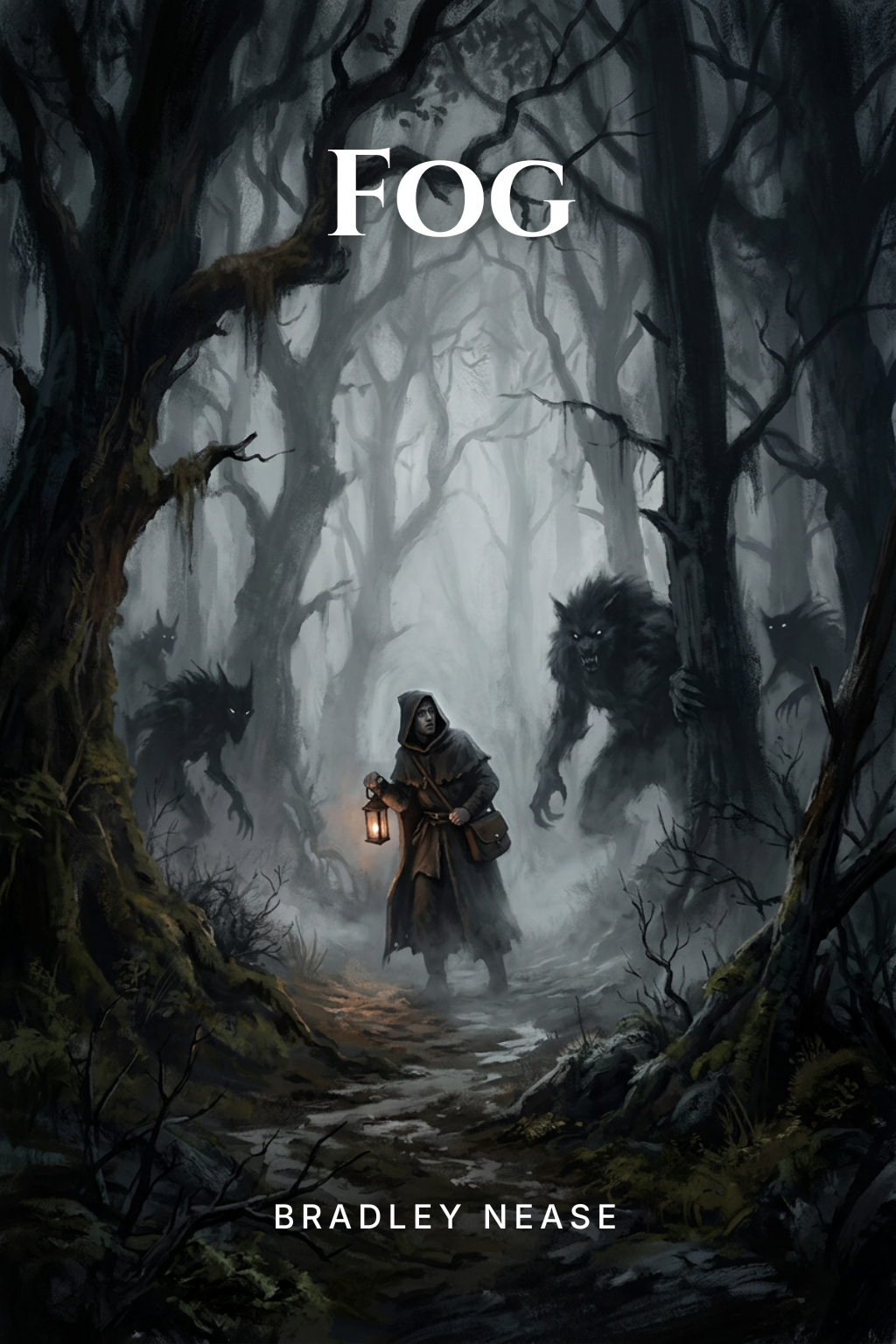
Novel · 8 chapters · 26,092 words
Fog
Contents8 chapters
Chapter 1
The Siren in White Air
The siren started before anyone saw the fog.
It let out one hard note from the pole by the harbor office, a raw metal howl that scraped across the water and shook gulls off the cannery roof. Then it rose again, longer this time, the sound bent by wind and rain until it seemed to come from everywhere at once. Mara Voss looked up from the open engine housing of a trawler and hit her head on the steel lip of the hatch.
“Damn it.”
She pressed one grease-blackened hand to her scalp and listened. The harbor siren was not for weather. Weather announced itself well enough on Bracken Point. The island knew the grind of winter surf against basalt, the hiss of sleet on net floats, the low pressure ache in old wrists and bad knees. The siren meant fire, wreck, man overboard, or something so wrong that the town wanted every ear turned the same way at once.
She slid out from the engine bay and landed on the dock with both boots in a skin of rainwater. The planks flexed under her weight. Diesel, fish rot, kelp, cold iron: the harbor smelled the way it always did in a storm, harsh and honest. Beyond the breakwater, the sea was a broken sheet of slate, peaks blown flat at the tops. The ferry channel had vanished into weather. The last light of afternoon had gone colorless an hour early.
Across the slips, men were straightening from their work and looking out past the harbor mouth. One of the bait boys came running along the finger pier with his hood blown back and his face pale under a spray of freckles.
“What is it?” Mara called.
He only pointed.
At first she thought it was rain sweeping low over the water. Then she saw its edge.
The fog did not drift in tatters or thin bands the way sea fog usually did. It came as a wall. A white front, level at the top, dense enough to hide the swells under it, moved between the marker buoys and the rocks off Gull Head. It did not boil or lift. It advanced. The strange thing was not just its thickness. It was the speed. Wind pushed from the northeast, hard enough to rattle loose halyards against masts, but the fog came in against it, smooth as breath over glass.
Mara wiped rain from her eyes with the back of her wrist and felt, under the cold wet air, a different kind of chill.
Tom Arlen, who kept the fuel shed and had seen sixty winters on the island, stepped out onto the main dock and stared at the harbor mouth. “No,” he said, as if answering an old argument. “No. Not this.”
Mara turned to him. “What do you mean, not this?”
Tom did not answer. He crossed himself once, quick and angry, and began shouting for people to get off the outer slips.
That was enough to move them. Bracken Point was not a town given to drama. Men who ignored weather warnings and stitched up their own hands with bait twine did not take orders fast unless they felt something in the speaker’s voice that had no room for pride. Mara snapped the trawler’s engine hatch shut, grabbed her tool bag by habit, then dropped it again. No use dragging twenty pounds of wrenches through a storm.
The siren cried a third time.
People came out of the harbor office, the net loft, the bait shack. Doors banged. Sheriff Eli Cade appeared from the road above the quay, one hand clamped on his hat, his oilskins already dark with rain. He was broad in the shoulders and moved without waste, stepping down the slick ramp two at a time.
“Off the docks,” he shouted. “Everybody in.”
A voice called back, “Where’s Owen?”
No one answered that either, and Mara saw the first sign that this was not just weather. Men started looking for one face. A deckhand from the Morrow Bride, Owen Pell, nineteen and quick with a line splice, had been unloading chain baskets from the boat not ten minutes earlier. Mara had passed him on the way to the trawler. He had grinned at her through the rain and asked if she could make an old winch outlive common sense. She had told him she did it every week.
Now the Morrow Bride sat with her stern lines jerking in the chop, one chain basket tipped on its side, links spilled across the wet deck like black rope. No Owen.
His skipper, Len Dyer, was on the finger pier yelling his name toward the boathouse. “Owen!”
The boathouse stood near the end of the quay, a long low building of warped boards and corrugated roofing, its doors chained open during working hours. Between the Morrow Bride’s berth and that building ran thirty yards of dock, broken by stacks of crab pots, coils of rope, and a handcart full of net weights. Enough places to duck behind in a squall. Enough places to lose sight of a man for a few seconds.
Mara moved before she decided to. Eli saw her cut across the pier and barked, “Mara.”
“He might be down there.”
“So might half the sea.”
But he followed.
Rain slapped their faces as they ran. The boards shone black underfoot. On Mara’s left, the water in the slip shouldered the pilings and sucked at the ladder rungs. On her right, stacked pots rattled in the gusts. The fog had crossed the breakwater now. She could feel it before it touched her skin, a dampness colder than the rain, carrying a rank smell underneath the salt. Not decay exactly. Something shut up too long.
Len Dyer reached the gap between the pots and stopped dead.
Mara nearly hit him. “Move.”
He pointed down.
Blood lay across the planks in a wide, rain-thinned smear. Not much at first glance; then the eye caught the drag of it, the handprint half washed away near a bollard, the bright clot caught in a splinter where the wood had cracked. One yellow work glove sat upside down in the water by the edge, filling and sinking, filling and sinking. There was no body. No cry. No sign a man had simply slipped between the pilings and struck his head. The blood began near the cart of net weights and trailed toward the boathouse door.
Len made a sound Mara had only heard from injured animals.
Eli crouched, one knee in the wet, and touched the smear with two fingers. Fresh. The rain had not had time to empty the color from it.
“Inside,” he said.
They looked into the boathouse. Gray light showed rows of skiffs, a cracked life ring on the wall, shelves of fuel cans, gaff hooks, spare oars. The chain by the door knocked softly against the wood in the wind. Nothing moved.
“Owen,” Mara called.
The word died quickly. The boathouse swallowed sound in a wrong way, as if the air itself had weight.
Tom Arlen had come up behind them with three more harbor hands. He saw the blood and stopped breathing for a beat. “Shut the doors.”
Eli stood. “Not yet.”
Tom’s eyes stayed fixed on the fog, which had reached the first pilings of the quay and begun to pour between them. Up close it was not white in any clean sense. It was the color of dishwater, of old bone under dirty glass. It rolled low over the dock boards, knee-high in one place, waist-high in another, moving with a slow certainty that made Mara think of floodwater filling a cellar.
“Eli,” Tom said, and his voice had gone thin, “shut the doors.”
The sheriff did not look at him. “Len, get to the office and call every boat in. You hear me? Every one. Tom, clear the harbor. Nobody alone. Nobody at the edge.” He turned to Mara. “You saw him last?”
“Ten minutes ago, maybe less.”
“Anything strange?”
She nearly said no. Then she remembered the gulls. Not one on the water now. Not one on the roof. She remembered how the Morrow Bride’s dog had been whining under the net table instead of begging scraps. Little things. Harbor things. Things a body noticed before the mind bothered to sort them.
“The birds cleared out,” she said. “And it smells wrong.”
Tom flinched as if that settled something.
A new sound came out of the fog.
At first Mara took it for a loose mooring line tapping a mast. Then it came again: chain dragging over wood, link by link, with a stop between each pull. It was down the quay past the boathouse, where the outer berths reached toward open water. Not loud. That made it worse. It had an intimate sound, close to the ground, as if someone out there was hauling something heavy by hand and trying not to be heard.
Everyone on the dock went still.
Len whispered, “Owen?”
The chain dragged again.
Eli drew the flashlight from his belt and clicked it on, though the beam looked weak in the thickening air. “Stay here.”
Mara said, “No.”
He gave her half a glance. He knew better than to waste time ordering her back if he meant to go forward himself. She was the harbor mechanic; she knew every cleat, every rotten board, every ladder and tide step on the quay. In fog, that mattered.
Tom grabbed Eli’s sleeve. “Don’t go into it.”
“What do you think took him?” Eli snapped.
Tom swallowed rain and whatever answer sat behind his teeth.
The chain rasped a third time. Then came a softer noise, almost lost under the wind: a wet bump against timber.
Mara took the gaff hook from the boathouse wall. Ash handle worn smooth, iron tip bright from use. She tested the weight. “I’m coming.”
Eli swore once under his breath and nodded. “Stay on my left. If I say run, you run.”
The dock seemed to narrow as they stepped into the haze beyond the boathouse. Rain still fell, but the fog changed its shape. It broke the world into pieces. A bollard appeared two feet ahead, black and beaded with water, then vanished from the corner of the eye when she looked past it. The nearest skiff became a gray hulk, then only its rope, then nothing. The beam of Eli’s flashlight hit the mist and came back in a flat white wash.
Mara counted her steps from memory. Six to the fish table. Four more to the split plank near berth nine. The dragging sound came and stopped, came and stopped. Not random. Pull, rest. Pull, rest. She heard no breathing, no footfalls, no voice calling for help.
The harbor noises had gone away. No gulls. No engines. No men shouting behind them. Only the rain ticking on tarps, the sea thumping under the dock, and that patient chain.
“Do you see him?” Eli called.
No answer.
They passed the fish table. Mara’s boot skidded on scales and she caught herself with the gaff. The iron tip struck wood with a crack too loud for the space. At once the chain stopped.
The silence that followed had a shape to it. Waiting.
Eli lifted the flashlight. The beam trembled once and steadied. Ten feet ahead, maybe twelve, a chain basket sat on its side across the boards. One length of anchor chain spilled from it and vanished into the fog to the right, over the edge of the dock.
Something pulled it.
Not hard. Just enough for three links to slide over the wood with a scraping complaint.
Mara saw it clearly. The chain was not moving with the tide. It was being taken hand over hand by something below the edge.
Eli stepped forward.
The thing at the end of the chain moved up.
Mara never got a whole picture in that first second. Later, what she could swear to came in pieces. A pale shape rising where no ladder stood. Water pouring from it in ropes. Limbs too long in the joints. Skin, if it was skin, slick and colorless as fish belly. And eyes that did not catch the flashlight like a dog’s or a seal’s. They showed flat and dull, like coins at the bottom of a pail.
The head lifted above dock level. The mouth opened.
It was wider than a man’s mouth had any right to be.
Mara drove the gaff forward on reflex. The iron point hit with a feel she would remember for years: not the strike of steel into wood or the give of a fish, but a thick, tough resistance, followed by a jerk so violent it nearly tore the handle from her hands. The thing made no cry. It thrashed once, slamming the chain basket aside, and dropped backward into the fog below.
Eli shouted, “Back!”
Water erupted against the pilings. The dock kicked under Mara’s boots as something heavy struck it from beneath. She stumbled, felt Eli’s hand hit her shoulder, and ran. The flashlight beam spun over ropes, planks, white air. Behind them the chain went mad, lashing and rattling, then all at once fell still.
They burst past the boathouse into clearer rain and sound rushed back. Men grabbed them by the sleeves. Someone slammed the boathouse doors shut and wrestled the chain free to loop through the handles. Mara bent double with both hands on her knees, dragging in cold air that tasted of iron.
Eli turned and aimed the light back the way they had come. The fog filled the gap between stacked pots and the outer quay. It looked blank again. Empty.
“What did you see?” Len asked.
Mara straightened slowly. Her hands shook. She hated that people could see it.
“A thing,” she said.
Len stared at her as if that were not an answer but an insult.
Tom Arlen moved closer. “Did it come from the water?”
“Yes.”
“Did it stand?”
“Partly.”
Tom shut his eyes.
Eli’s face had gone gray under the rain. “Get everyone inside the harbor office,” he said. “Now.”
No one argued this time. Harbor hands, skippers, the bait boy, two women from the cannery yard who had come running at the siren: all of them crowded up the ramp to the office with wet boots hammering on wood. Mara followed, then stopped and looked back.
On the dock where the blood had been, rain had spread the stain into a pink film over the grain. Owen’s glove was gone from the water. A coil of line near the boathouse shifted, though there was no wind on it. Then the fog rolled another yard inland and covered the place.
Inside the office the room smelled of damp wool, diesel heat, and old coffee. The windows rattled in their frames. Someone killed the overhead light when they realized how little it did but reflect their own faces back at them. People stood shoulder to shoulder among tide charts, clipboards, and a radio set hissing with useless static. Mara leaned the gaff by the door.
There was a mark on the iron tip.
Not paint. Not rust. A smear of cloudy mucus threaded with a darker color that might have been blood, if blood had been mixed with bilge and crushed oyster shell. She did not point it out right away. She wanted one more second in which this might still be panic, confusion, a seal dragged half mad into the harbor, a wounded man seen badly through fog.
Eli saw it anyway.
He took the gaff, lifted it into the lamplight from the desk, and showed the room.
No one spoke.
That was the first proof Bracken Point had. Not the blood on the dock, because blood can come from a slip, a propeller, a hook. Not the missing deckhand, because sea towns know how quickly a body can vanish. Proof came on an iron hook, shining wet in a room full of people who had spent their lives sorting the normal dangers of the coast from the foolish tales told over bottles in winter. Every face in that office changed when they saw it. Some hardened. Some emptied out. Tom Arlen looked only tired, as if the worst thing about dread was having it confirmed.
Outside, the siren had fallen silent. The fog went on coming.
Mara wiped her brow with a dirty sleeve and left a streak of grease across her skin. Her scalp still hurt where she had struck the engine hatch. Her palms smelled of wet ash wood and that foul slick residue from the gaff. Through the warped glass of the office window she could see almost nothing now beyond the nearest piling. White air pressed against the harbor as if trying the doors.
“Sheriff,” she said, and her own voice sounded steadier than she felt, “if that thing took Owen, it won’t be the only one.”
No one told her she was wrong. That, more than the blood or the fog or the shape rising at dock edge, set the island on its true course. The first question had already been asked out on the planks between the boathouse and the berth: bad accident or something hunting in the mist.
By the time the office door was barred, no one in the room believed in accidents anymore.
Chapter 2
What the Fog Leaves Behind
By first light, Eli Cade had nailed a hand-painted sign across the lower harbor road that read CLOSED BY ORDER OF THE SHERIFF, though there was hardly anyone left outside to read it. The fog had not gone when the rain stopped. It sat over the waterfront in a low white mass, brightening with dawn instead of burning off, and that alone changed the shape of the morning. On Bracken Point, people judged danger by what the day did next. Wind rose or dropped. Tide turned. Squalls passed. Nets that looked ruined at midnight could be mended by breakfast. This did not move like weather. It waited.
Eli worked fast because fear spreads fastest when men have nothing to do with their hands. He strung chain between bollards at the harbor entrance, posted Len Dyer and Tom Arlen with lanterns gone cold in the pale light, and told every boat owner the same thing: nobody stepped onto the outer slips, nobody untied a line, nobody went looking alone for what had already taken one man. He had not slept. The skin beneath his eyes had turned the color of wet paper, but his voice stayed level. That mattered. Islands watch a sheriff the way crews watch a skipper in bad water. If he wastes motion, everyone else starts to shake.
Mara stood beside the fuel drums outside the office and drank coffee so black it looked like bilge in the tin mug. The cup rattled against her teeth once, then steadied. Her right palm had stiffened around a shallow blister where the gaff shaft had twisted under strain. She kept flexing the hand as if work would come back into it by insult alone. Beyond the chain barrier the harbor looked stripped of use. No gulls fought over bait scraps. No diesel knocked under engine covers. The moored boats only bumped softly at their fenders, a patient sound, the sound of things waiting for orders.
The dock where Owen Pell had vanished lay half hidden under a skin of white drift. Not the whole harbor. Only parts of it. That was another detail people noticed and did not like. Fog should spread. It should thin at edges, drag in threads, obey the shape of air and water. This clung low around the outer berths and pooled in the alleys between sheds while the church hill above town stood almost clear. Looking at it gave Mara the same feeling she got from opening an engine and seeing clean metal where there should have been grime. Not mystery. Intent.
Doctor Sima Rourke arrived from the clinic in a waxed coat over yesterday’s clothes, carrying her canvas case by the handle rather than the strap. She had pinned her dark hair back in a hurry; a few strands had come loose and plastered themselves to her cheek in the damp. She did not ask first for a story. She asked where the blood had been, where the glove had gone under, and who had touched what. That was one reason the island trusted her. She did not comfort by lying about what she could fix.
“With me,” Mara said.
Eli looked up from knotting the chain. “Not on the outer boards.”
“We’re not walking blind,” Sima said.
Jonas Thorne answered from behind them. “Then you’ll want these.”
He held out two long ash poles taken from the old boat hooks rack, one in each hand as if presenting church candles. Jonas had come down from the lighthouse on foot before dawn. Salt had bleached his beard to the color of rope left too many seasons in sun, and his oilskin smelled of lamp soot and the sea. He was old in the way cliff steps are old: worn, useful, not soft. People listened when he spoke mostly because he rarely wasted speech.
“We test the boards ahead,” he said. “And we do not stand where the fog stands, not if we can help it.”
Eli did not like being outnumbered by practical advice. He took one pole anyway. “Five minutes,” he said. “Then back.”
That was the arrangement. In a place under strain, somebody had to keep rules even if the rules were thin.
They went by the inner side of the slips where the air stayed clearer. Mara led because she knew every warped board and loose spike by memory in her ankles. Sima followed with her case. Jonas walked last, touching the planks ahead with the ash pole before each step near the white patches. Eli kept slightly apart, eyes moving from dock edge to boathouse roof to the open water beyond, as if danger might prefer one route over another if given the chance.
The blood on the boards had changed overnight. Rain had spread it, then dawn had dried the top into rusty veining in the grain. Not much was left to read unless you had seen it fresh. A black scuff marked the place where chain basket and boots had kicked together in the first rush. Near the edge, though, something remained.
“Owen’s knife,” Mara said.
It lay against a cleat, folded shut, slick with damp. Sima crouched without touching it and studied the handle. The wood had a long scrape along one side. Not a drop mark. A drag mark, as if it had been pressed hard against rough surface and pulled free. Jonas bent with surprising ease for a man his age and peered at the brass pivot.
“Not from the dock,” he said.
Mara saw it then. The scrape held a pale residue packed into the grain. Not paint. Not shell. The same cloudy slick she had seen on the gaff, but dried now into a milky crust.
Sima took out forceps, lifted the knife, and turned it to the light. “He opened it,” she said. “At some point.”
“How can you tell?” Eli asked.
“The nick in his thumb pad is fresh on the backspring.” She did not look up. “He fumbled closing it or somebody closed it on him after.” She paused. “No. Not somebody.”
That distinction hung in the air and no one tried to soften it.
A few feet farther on, half under the lip of the dock, Mara spotted a snag of wool caught on a bolt head. She knew the sweater. Mrs. Pell had knitted it in dark green with a ribbed cuff too tight at the wrist because she always made things to outlast growing boys. Now the yarn was stretched into a wet twist, and caught in it were three long filaments clear as fish gut.
Jonas did not touch those either. “Feel that with the pole,” he said.
Mara slid the ash tip beneath the strands and lifted. They clung and drew out farther than they should have, sticky and elastic, then snapped back on themselves. Not hair. Not weed.
Sima’s mouth tightened. “Mucus threads. Thick protein, by the look of them.”
“From its skin?” Eli said.
“Or from feeding.” She glanced at him. “I’m not saying that to be cruel. I’m saying it because if it leaves residue when it handles prey, that gives us something to watch for.”
Useful. That was how she talked when everyone else wanted names. On islands, names come late. First you deal with what a thing does.
The next sign lay near the boathouse door where the chain had lashed in the dark. Deep marks scored the wet boards in pairs, close together, then farther apart, then close again. Mara knelt and set two fingers beside one set without touching the gouge itself. Each cut was narrow and clean-edged, not crushed like boot studs or hook points. They entered at an angle and drove forward. Something had braced itself there and pushed.
“Claws,” Eli said.
“Hooks,” Jonas said at the same time.
Sima crouched between them. “Neither, exactly.”
She set the end of a pencil in one groove. It sank almost to the wood ferrule. “Whatever made these bore weight on points. Hard points. Enough to puncture soaked pine and carry a body upward or sideways.” She looked toward the water beneath the dock. “That tells us more than a footprint would.”
Mara knew what she meant before the words came. “It climbed.”
“Yes,” Sima said. “Or anchored itself while pulling.”
That was a worse answer than simple rising. Rising from water suggested force, hunger, a strike. Climbing suggested method. A thing that climbs understands surfaces.
Jonas had moved to the boathouse wall. He ran his hand along the salt-streaked boards until he found a place chest-high where the gray wood had been smeared clean in an arc. “Here,” he said.
The mark looked at first like a patch where rain had hit differently. Then Mara saw the pattern within it: fine parallel ridges, as if something ribbed or jointed had pressed there and slid. Beside the smear, nailed under a split batten, hung Owen’s second glove. Not fallen. Wedged.
No one spoke for a moment.
Mara reached for it and stopped herself. The glove had not simply been lost in a struggle. Someone—or something—had jammed it there hard enough to pin it. A cuff of black wool showed where the leather had torn. The fingers hung downward, empty and natural in shape, which made the placement worse. Accidents scatter. This had been left.
Eli saw the same thing. “You think it did that on purpose.”
Sima did not answer too quickly. She looked at the glove, then at the chain looped through the door handles, then at the gouges in the boards. “I think we should stop asking whether it can grip and start asking what else it can choose to do.”
That was the turn in the morning. Up to then, fear had room to call the thing animal. A shark in wrong water. A diseased seal. Some storm-driven deepwater predator that struck without understanding where it had come. But a glove pinned at eye level is not weather, and it is not blind hunger. It is evidence placed where people will find it.
Jonas took out his handkerchief, wrapped it around his fingers, and eased the glove free from the nail. Inside, the lining was soaked and stiff. He turned it over once. The palm bore a print in the milky residue: not a full handprint, not even close, but a set of narrow pressure bands crossing the leather at a slant.
“Bring that to the office,” Eli said quietly.
“No,” Sima said. “Bring it to somewhere with a table, good light, and fewer frightened men leaning over my shoulder.”
“The clinic?”
“The station room by the generator shed. If the power stays on.”
They all looked up then, almost at the same instant, because the harbor had made a different sound. Not louder. More absent. The faint electric hum that usually came from the waterfront poles had cut out. No crack. No pop. It simply ceased, and with it the office window fan, the bait freezer in the shed, the sodium lamp over the ice house that had inexplicably still been burning in daylight. Silence spread a shade wider.
Tom Arlen shouted from the chain barrier. “Eli!”
The sheriff was already moving. They came off the dock at once, no one arguing now. Tom pointed uphill toward the utility shed above the net lot. A pair of cable lines dipped lower than they should have, swaying gently. Mara could see where the insulation had been scored pale against the dark sheath. Not severed clean through, but damaged. Recently.
“Stay here,” Eli told Len, and to Mara, Sima, and Jonas: “Come on.”
The generator shed sat in a fenced yard behind the cannery storehouse, a squat concrete building with two diesel units inside and a permanent smell of hot oil soaked into the walls. Men from the town council handled regular maintenance badly and emergency maintenance not at all, so Mara knew the place better than most of them. She jogged ahead, unlocked the gate, and stopped short inside.
The gravel around the tanks had been churned into crescents and drags. Not boot prints. Not dog tracks. The marks came and went as if whatever made them had too many points to leave a neat shape. Near the vent pipe one of the cable conduits had been worried open. The metal cap lay on its side in the stones. The insulation around the feed line showed rows of punctures, not random pecks or chew marks, but repeated tests along its length.
Sima set down her case and crouched. “Not feeding,” she said.
Mara stared at the line. “No animal chews cable like that.”
“Exactly.”
Eli walked the perimeter fence, checking corners. On the seaward side he found what the fog had left as clearly as a written note: streaks of the same cloudy residue smeared on chain links where something had climbed over, gone inside, and climbed out again. One section of mesh bowed inward. Not broken. Pressed.
Jonas stood very still, looking from the damaged line to the harbor below, then inland toward the rise where the radio tower stood on the headland above town. It was a stubby steel mast with a wind meter and repeater dish bolted to it, ugly but necessary. In weather, men looked to the lighthouse by habit and the tower by need.
“If it came here,” he said, “it may have gone there too.”
Eli did not waste breath on hope. “We check.”
The road to the tower wound between back gardens and the schoolyard wall. Higher ground should have meant cleaner air, but the fog had climbed during the morning, spilling itself through ditches and between houses in long white lanes. It did not blanket the whole town. It chose low paths, then lingered there, making every crossing a guess at what might be standing knee-high and unseen. People watched from windows as the four of them passed. Faces behind lace, behind flyspecked glass, behind a board already nailed over one lower pane. No one waved.
At the church corner, Mara heard a woman call Eli’s name from inside a house and then swallow whatever came next. The island had begun to understand the new rule: do not draw attention with your voice if you do not know who else is listening.
They found the radio tower gate unlatched. That alone made Eli curse under his breath. He always latched it himself when storms were due because boys liked to climb where they should not. Today no boys had done this. The padlock hung intact, but the staple screws had been backed half out of the post, one by one, as if twisted under force and then worried loose.
Mara put her hand on the gate and felt the metal cold through her skin. The equipment hut beyond stood shut. The aerial wires hummed faintly in the stillness.
Inside the enclosure the grass was pressed flat in looping paths. Not one path. Several, crossing and doubling back around the hut and the base of the mast. Sima followed one with her eyes. It led to the conduit trench where the radio feed entered the ground, stopped there, then resumed on the far side, as though the thing making it had paused to investigate before moving on. Near the concrete footing she found another residue smear, this one marked with grains of rust and tiny black flakes of cable jacket.
“They’ve been at this one too,” Mara said.
Eli went straight to the hut door and opened it with his revolver drawn, more habit now than threat. The room inside was empty of anything living and full of damage. The transmitter rack still stood, but two panel covers had been pried away and tossed on the floor. Not smashed. Removed. A nest of colored wires hung outward, several stripped, some broken, some only exposed as if tested and left.
Jonas entered behind him and looked once around the room. “That is no beast.”
Nobody contradicted him.
A mindless predator may batter through a fence chasing noise or warmth. It may slash at what startles it. It does not visit the generator, then the tower, then leave both crippled in ways that cut power and silence calls for help. That pattern forces a harder conclusion. The creatures were not merely feeding around Bracken Point. They were reducing it. First the edge. Then the voice. Then the lights.
Sima touched one loose wire with the back of her finger and pulled away. “Still live, some of it.”
“Can you fix it?” Eli asked Mara.
“Not if they come back while I’ve got both hands in the panel.” She looked at the damage more closely. “Maybe temporary. If the generator holds. But this wasn’t an accident. They went for the feed first, then the set.”
Eli absorbed that the way decent men absorb bad weather reports: without ceremony, because there is work after. “Then we stop pretending this is a single attack.”
Outside the hut, the morning had grown brighter in the sky and darker at ground level. The sun sat somewhere above the overcast, enough to silver the edges of roofs, but the fog below held its body. It drifted around the tower base and through the grass in slow, deliberate pours. Looking down from the headland, Mara could see the whole shape of the town now—the harbor half veiled, church hill clear, roads between houses marked by white channels like veins under skin.
Jonas took off his cap and rubbed the back of his neck. “They’re penning us.”
Eli turned toward him. “You’ve seen signs like this before?”
Jonas did not answer at once, and that delay mattered. Old men on islands are allowed long silences because they often contain the part everybody else has been avoiding.
“I’ve seen enough to know a coast can keep bad records,” he said. “Things happen out here and get told wrong on purpose, especially if telling them right would empty the place.”
That was not a full answer, but it was more than superstition. Mara filed it away because practical people always listen when another practical person chooses words that carefully.
Below them, somewhere near the net lot, a dog began barking. It barked three times, stopped, then gave a yelp so sharp and brief it sounded cut off by a hand.
All four of them went still.
The silence after carried farther than the bark had. In it Mara heard the low idle cough of one generator trying to take more load than it should. She heard a halyard strike a mast twice down in the harbor. She heard, from somewhere in the fogged streets below, a metallic tapping in an uneven rhythm.
Not random. Not wind.
Chain on metal.
Eli shut the hut door. “Back to town center,” he said. “We gather everybody who’ll listen. No one stays alone. No one answers a sound from outside unless they see the face making it.”
“You think they’re trying doors now?” Mara asked.
“I think they’ve spent the morning learning the place.”
That was the real finding of the day. Not the gouges, not the mucus, not even the ruined wires. Those were signs. The lesson under them was worse: the creatures had come ashore with more than appetite. They tested barriers. They marked paths. They singled out the machines that gave Bracken Point light, heat, and a way to call beyond itself. In any isolated place, that sequence matters. A town can survive fear for a while. It fails faster when fear arrives in darkness and silence.
Mara looked once more over the headland toward the harbor where Owen had vanished. The fog had not lifted with the sun because lifting was not what it had come to do. It was cover. It was reach. And somewhere inside it, hidden just below sight, something patient had already started on the next step.
Chapter 3
The Last Ferry Gone
The first hard panic of the day hit not at the harbor, but in the church hall when somebody said the ferry should have docked an hour ago and everybody in the room understood at once what that meant.
St. Bartholomew’s sat on the rise above town where the fog thinned but did not leave. It lay in the low streets and around the foundations in pale bands, moving under the hall windows like breath under a door. Eli had sent people there because it was stone, because it had one big room, because a frightened town is easier to count if you put it under one roof. By noon the place smelled of wet coats, paraffin from two lanterns, old hymnals, and fear held too long in the chest.
Mara stood near the front pews with her burned palm wrapped in a strip of clean cloth Sima had tied there. Every few minutes someone new asked whether the radio was working yet, whether the generator could be patched, whether the Coast Guard had been reached, whether the ferry had simply turned back in the weather. The same questions came around like gulls around a gut bucket. The answers did not improve.
“It runs late in fog,” one man said from the middle rows. “You all know that.”
“Not this late,” Tom Arlen said.
Tom had planted himself by the side door with Len Dyer and refused to sit. He kept his cap in both hands and turned it by the brim as if there might be some useful thing hidden in the stitching. Len looked worse. The skipper’s face had gone gray under the windburn, and he had a way of flinching each time the floor creaked, as if the sound came from below him.
At the far end of the hall, Mrs. Pell sat with two women from Upper Road, staring down at her lap. No one had told her Owen was dead. No one had said he was alive either. People on islands become skilled at that narrow cruelty: leaving hope standing after the floor under it has already gone.
Father Cerin moved among the benches with a kettle and cups, quiet and brisk. He gave the old first, then the children, then whoever held a shaking hand out far enough to ask. Prayer had not started yet, though a few people looked at him as if it ought to. He knew better than to mistake ritual for a plan.
Sima stood at the long trestle table near the chancel rail sorting what counted as supplies. Bandages. A half bottle of antiseptic. Three blankets. A biscuit tin of aspirin. She had taken over the work cleanly because nobody else wanted it and because fear gets less room when a person starts naming things by use.
Jonas stayed near the windows. He did not peer through them the way the others did. He listened. Every now and then he tipped his head, not dramatic about it, only attentive, as if the town outside were giving a lesson and he had no intention of missing a word.
Then Nella Greaves came in from the porch where she had been watching the south road and said, “It’s near one. Where is the ferry?”
That sentence broke the room.
Not by shouting at first. By motion. A dozen people turned at once. Bench legs scraped stone. Somebody dropped a cup. Hot tea spread across the floor in a thin brown fan and no one bent to wipe it. A child began crying because his mother had grabbed his shoulder too hard. Another voice said, “Ring them again,” and then remembered there was nothing to ring with.
Eli stepped onto the low platform beneath the plain wooden cross. He did not shout for silence. He had a sheriff’s voice made for wind and dock noise, and he used it the way he always did, as if men were expected to listen because they were men and because the next minute would go better if they did.
“The radio tower is out. You all know that. We have no line off-island right now. That doesn’t tell us where the ferry is. It tells us we don’t know.”
“That’s the same thing,” someone shot back.
“No,” Eli said. “It isn’t.”
It was a useful distinction and nobody liked it.
A woman near the back said they should all go to the north fields where the fog lay thinner. A man from the fish plant said they should get into trucks and drive for the ferry landing anyway because the captain would come if he had any sense. Old Mrs. Vale said this was judgment and that it was time to get on their knees. Her nephew, red-eyed and stinking of stale beer from the night before, said there were no creatures, only nerves and one bad accident worked into a story.
Mara watched the denial spread because denial always moves fast when the truth asks too much. Men who had seen the harbor blood with their own eyes now began trimming it down in memory. Rain made things look worse. Maybe Owen fell. Maybe something in the water took him, but not something that climbed and cut wires and pinned gloves where they’d be found. They wanted the danger stupid because a stupid danger can be beaten with enough noise and enough bodies.
“It came up over the dock rail,” Mara said.
She did not raise her voice much, but the room had thinned enough around Eli that people heard her.
“I put steel into it. Eli saw it. We found feed lines punctured and panel screws backed out at the tower. If any of you want to tell me weather did that, stand up and say it to my face.”
No one stood.
“The question now,” she said, “is not whether you like what’s happening. The question is what still works.”
That moved them for a moment because it was practical, and practical talk is a rope people will grab even while pretending not to drown.
Eli took the point. “Here’s what still works. Doors. Windows. Height. Fire, maybe, if we keep control of it. We gather food, water, tools, bedding. We put watchers on every entrance. Nobody goes anywhere alone.”
“You want us to hide in church?” said the fish plant man. “Till what?”
“Till dark?” somebody else said, and there it was, the real shape of the fear. They had all been thinking about night without saying the word.
“Till we know more,” Eli said.
“That’s not enough,” Mara said.
She did not mean to cut across him in public, but delay had begun to smell in the room, and she knew the cost of it. A machine left half-open in rain will tell on you later. So will a town.
“We need tools moved in now. Hammers, nails, pry bars, axes. Fuel if there is any left in sealed cans. Every blanket and every lamp. We need tubs filled while taps still run. We need the vestry and the undercroft checked for any ground-level access. We need sheets over the windows after boards go up so if they start looking in, people don’t have to look back.”
A few heads turned toward her because that was more detail than fear usually brings. Sima looked up and nodded once, quick and sharp.
Father Cerin said, “The parish shed has nails. Old timber too.”
Len spoke next. “The chandlery’s got line, hooks, tarps.”
Tom added, “Fuel shed’s locked. I’ve got a key.”
The room shifted again. Not calm. Direction.
Then Mrs. Vale rose from her bench with both hands pressed to the top of her cane. “And while you hammer boards over God’s house,” she said, “what do you propose for our souls?”
Father Cerin set down the kettle. “We pray while we work,” he said, and that ended one argument cleanly.
The others did not end so well.
One cluster by the side aisle insisted they should make for the south pier at once and wait there for the ferry. Another argued that if the ferry had failed to dock, the captain might already be dead and the landing was a trap. Two brothers from the upper farms said they would take their own family inland and trust open ground before walls. Eli told them if they walked out alone into low fog he would treat it as a death wish, and one of them told Eli he was not king of the island.
“Good,” Eli said. “If I were king you’d already be carrying lumber.”
That got a short, ugly laugh and bought him another few minutes.
Mara crossed to the side table where a street map from the summer fête hung under a thumbtack. It was hand-painted and cheerful in a way the town no longer was, but the roads were right. She took a church pencil and marked the high places first: church hill, the school rise, lighthouse road. Then the low strips where the fog held deepest even by day: the lane behind the net lot, the fish plant yard, the dip by the cooper’s shed, the south road before the pier.
“It pools here,” she said, tapping the map. “And here. If anything wants to move unseen, it uses those cuts.”
Jonas came to stand beside her. His finger, knotted with age, tapped the same road to the south pier. “There’s open stretch before the landing. No cover but rail posts and crab pots. If the ferry came in and found this on the water, that’s where they’d be committed. Too far to turn easy. Too close to stop clean.”
“Then we need eyes on it,” Mara said.
“We need to stay put,” Eli answered.
They looked at each other. It was not a quarrel of pride. It was the harder kind, between two correct fears.
“If the ferry is still running,” Mara said, “it is the only way off this island that doesn’t require us inventing a boat crew out of whoever can still hold down breakfast. If it’s not running, people need to know that before they spend the next six hours fighting you over it.”
Eli knew she was right. The room knew too. Hope unmanaged becomes a mob faster than grief.
He rubbed at the bridge of his nose, then pointed to Len and Tom. “You two with us.”
Len lifted his head. “South pier?”
“Yes.”
Tom swore under his breath but did not object.
Sima set down the bandage roll in her hand. “I’m coming.”
“No,” Eli said at once. “You stay here.”
“Because I’m useful here or because I’m a doctor and you don’t want to watch one die?”
“Both.”
Sima stared at him long enough to make plain she understood the difference and resented neither. “Then bring me back something true,” she said. “Not a rumor dressed up as mercy.”
They moved fast after that because speed can cover a lot of doubt. Father Cerin opened the parish shed and boys barely old enough to shave began passing out hammers and bent boxes of nails. Men hauled old pew planks to the windows. Women filled stockpots and enamel buckets from the hall taps. Eli placed watchers at each door and made them repeat the rule back to him: do not open to a voice unless you see the face and know it in daylight. Mara took a boathook from the shed because its length comforted her more than a shotgun she did not know well. Eli had his revolver. Len carried a filleting gaff with the barb honed bright. Tom took a hand axe and tucked a coil of rope over one shoulder.
When they stepped out of the church porch, the air felt colder than the hour deserved.
The road downhill showed itself in patches. One stretch of cracked blacktop, then a moving white belt where the fog lay across it shin-high and thick as milk. The cottages to either side stood with their doors shut and curtains drawn. Somewhere a loose gutter ticked against stone. Somewhere else a hen made a low, offended noise from inside a coop and then fell quiet.
“Stay where you can see knees and feet,” Mara said.
Tom looked at her. “That a rule now?”
“It is if you want one.”
They kept to the uphill side of the road where the land fell away less sharply. Every crossing felt wrong. The fog did not move with the wind as sea fog ought to. It rolled in narrow strips, pausing in the gutters, slipping under carts and through fence slats, then pouring on. Twice Mara heard metal touch metal somewhere ahead—small, testing sounds, not enough to place. Once Len stopped dead and pointed at a front gate moving slowly on its hinge though there was no gust to push it.
At the fish plant yard they found the first fresh sign. A trail of wet smears crossed the concrete and vanished under a stack of lobster pots. Not blood this time. The same cloudy mucus they had seen at the tower, only more of it, dragged in ropes that caught fish scales and sawdust. Tom crouched, touched the edge of it with the axe handle, and recoiled at once.
“Still slick,” he said.
“Don’t put your hand in anything today,” Mara answered.
Past the cooper’s shed the fog deepened. It came to the waist in the low place before the south road bent for the pier. Eli halted them behind an overturned handcart and listened. The sea was louder here. You could hear the hollow knock of swell under timber, the mutter of water against pylons. No engine. No ferry horn. No human voice.
Then, from out in the white, came a sound like somebody striking glass with a ring.
Once. Then again.
Len’s face changed. “That’s from the boat.”
“How can you tell?” Tom whispered.
“I’ve loaded her in weather. Side windows chatter in loose frames.” He swallowed. “Not like that. But close.”
They moved on, slower now. Mara could feel the damp on her cheeks and the cloth around her palm going cold. The south pier emerged by pieces: first the chain-link gate hanging open, then the ticket hut with one pane broken inward, then the wet boards of the landing slick as fish skin. A suitcase stood upright by the bench as if set down and forgotten. Beside it lay one child’s yellow rain boot on its side, clean inside.
No people.
No gulls either. That struck Mara harder than the rest. Gulls leave when driven off; they come back at once to any place where men have dropped food. Here the air above the pier stayed empty.
They spread out enough to see the edges of things and not enough to lose one another. Eli checked the ticket hut. Empty. Tom tested the mooring bollards. One line remained there, frayed and slime-coated where it had parted. Len went to the edge and stared hard into the water below the deck, gaff ready, his shoulders drawn almost to his ears.
Mara looked seaward.
At first she saw only gray water and thicker white beyond. Then the ferry eased out of it broadside, not arriving so much as revealing that it had been there all along.
The Bracken Belle drifted a hundred yards offshore with no wake and no hand on her wheel. She yawed gently in the swell. One stern fender trailed in the water. Her paint, once cheerful blue under the windows, looked dead in that light.
“She’s adrift,” Tom said unnecessarily.
Len had gone very still. “No helm correction.”
Mara counted windows because the eye looks for order when the mind resists the truth. Port side lower deck: one, two, three intact. Fourth blown white with cracks. Fifth gone entirely. Above them the passenger saloon windows showed black, ragged holes around the frames. Safety glass glittered in the sills. Not broken by impact from outside. Burst outward in some places, inward in others, crazed across the whole line as if people had struck at them from within with whatever their hands found.
Eli raised both hands and bellowed toward the water anyway. “Ferry ahoy!”
The sound went flat into the fog.
No answer came back.
Then the boat turned a little with the tide and they saw the wheelhouse door hanging half off its track. Something dark had dried down the white paint below the latch and been washed thinner by spray. Mara did not need to be closer to know what it was.
“Captain could be below,” Tom said, but there was no force in it.
“No power,” Len said. He was watching the stack. “No engine. She died and drifted.”
“Can we bring her in?” Mara asked.
Len gave a short, harsh laugh that was not amusement. “With what line? With what crew? You board that thing blind, you may as well climb in a grave to save time.”
They stood on the landing with the empty ferry breathing in and out of the fog before them. It was close enough to mean escape had existed this morning. It was far enough to prove that by noon it was gone.
A thump sounded from inside the hull.
Tom jerked back so hard his boot skidded.
Another thump followed, then a dragging scrape along the lower deck, then stillness.
Nobody spoke.
Eli’s revolver came up. Len lowered his center of gravity, gaff out. Mara tightened her hands on the boathook until the wrapped one hurt.
The ferry drifted another few feet broadside. Through the broken lower window she could see only dim seats and a strip of aisle and the motion of loose paper lifting and settling. Then, across the far pane, something pale moved past at floor height too quickly to name.
“Back,” Eli said.
No one argued.
They retreated off the landing without turning their backs and did not stop until they had the ticket hut wall against them and higher ground behind. From there the Bracken Belle looked almost ordinary again, just a disabled local ferry waiting on a tow. Distance is good at lying.
“We tell them it’s gone,” Eli said.
Mara nodded, though her throat had gone dry. “And we tell them why.”
Len wiped his mouth with the back of his hand. “If we say what we saw, half of them will break.”
“If we don’t,” Mara said, “half of them will run for this pier after dark.”
That settled it.
On the walk back, the town felt changed in one plain way. Before the south pier, people had still been arguing with a future that contained choices. After the south pier, the island had edges again. Sea all around. Fog in the cuts. No voice off-island. No ferry master bringing the ramp down with diesel in the air and coffee in his thermos and mainland within the hour. Bracken Point had become what isolated places always are under pressure: not a stop on the way to somewhere else, but the whole world for however long the trouble lasts.
At the church hill Mara looked back once and saw the fog laying itself along the road they had just climbed, patient as floodwater finding a channel. She thought of the broken windows, the child’s boot on the pier, the faint moving thing inside the ferry that should have been full of ordinary people carrying groceries and mail and complaints about the weather.
Then she went in to tell the town that no one was coming across the water, and no one was getting off it.
Chapter 4
Voices Outside the Door
The first voice came from under the vestry window just after dark, and it was so ordinary that three people stood up before fear caught hold of them.
“Cerin,” it called softly, with a little knock of breath between the syllables, as if the speaker had climbed the hill too fast. “Father Cerin. Open, would you? My hands are full.”
Every head in the hall turned.
Father Cerin had been carrying a box of candles from the undercroft stairs. He stopped with it against his chest. Wax tapped once against the cardboard as his grip changed. The church had grown used to sharp sounds by then—hammering, boots, benches dragged across stone—but that small, domestic voice from outside struck the room harder than any blow had.
Mrs. Vale crossed herself.
“No one move,” Eli said.
He said it plainly, not loud, and that helped. People froze where they were: on pew benches carried into the hall, on sacks of grain, on the floor against the wall with blankets over their knees. Children looked to their mothers. The oil lamps smoked faintly. Fresh boards over the lower windows sweated cold. Under all of it sat the smell of wet wool, paraffin, and too many anxious bodies shut in one place.
Again the voice came.
“Father? It’s Hester Lane. I’ve got the altar cloths from the wash and the basket’s slipping.”
Mara felt the room lean toward the sound.
Hester Lane had been dead six winters. Everybody in Bracken Point knew where she lay. The churchyard was fifty yards upslope.
Jonas Thorne did not even look surprised. He was already on his feet by the nearest boarded window, his head cocked slightly, not toward the words but toward the spaces between them.
“There,” he said. “Hear the wait?”
Most of them did not. Mara did, once he named it. Human speech moves with the body. Even standing still, a person shifts. Cloth rustles. Soles scrape. A cough threatens and gets swallowed. Outside the vestry wall there was only the voice, laid down careful as a netline, and then nothing at all.
Father Cerin set the candle box on a table. “Hester is buried here.”
The voice answered at once. “Then who’s out in the cold, Father?”
That shook people. Not because it was clever. Because it was almost clever enough.
A woman near the stove made a wet sound in her throat. Someone whispered, “Sweet God.”
Eli took two strides to the vestry door and dropped the iron bar fully into place though it was already set. “No one answers from the doors,” he said. “No one goes to a window unless I say.”
Outside, Hester Lane’s voice gave a small laugh that did not belong to the dead woman anybody remembered. It was too neatly placed, like a man trying on a coat that fit through the shoulders and nowhere else.
Then it moved.
Not footsteps. The voice itself moved, sliding along the outside wall toward the front corner of the church.
“Mrs. Vale?” it called in the dark. “I found your boy on the lane. He’s shaken up bad.”
Mrs. Vale stood so fast her chair tipped.
Mara caught her before Eli did. She got a hand around the woman’s forearm and felt the flesh jump there. “Your boy’s in Porthaven,” Mara said. “He went off island in spring.”
Mrs. Vale was breathing through her mouth. For a moment she looked at Mara as if memory itself had to be hauled back by force. Then she shut her eyes and nodded once, hard.
The church held still until the voice passed on.
That first hour taught them the method. The things outside did not howl or batter or scratch at random. They tested names. They fished in the town’s own water. A call at the west wall in Len Dyer’s brother’s voice, though his brother had not lived on Bracken Point in twelve years. Then Nella Greaves’s mother, dead before Nella married. Then a child crying from outside the kitchen lean-to where everybody knew no child had been left. Sometimes the imitation was close enough to twist the gut. Sometimes it missed by a handspan and became worse for that reason, because the wrongness showed through the familiar like bone through torn skin.
Mara learned the pattern by listening with anger instead of panic.
They asked for the person they wanted. They used short phrases first. They stayed outside the walls where darkness and boards would make doubt do the rest. When no one yielded, they tried history. They pulled old names, old habits, old debts from somewhere—whether from what they had heard in town or from whatever they took from the dead, Mara could not say. But they did not understand the weight of those things. They knew that Mrs. Pell had a son. They did not know a mother could tell in half a word when a voice did not carry her child’s tiredness, his impatience, the little upward hook at the end of a sentence.
Near eight o’clock they tried Owen Pell.
The hall changed when that happened. It changed before the first full sentence was out.
“Mam?”
The voice came from low by the side entrance under the gallery steps. Young. Frayed. Thin with cold.
Mrs. Pell folded over herself like she had been struck in the stomach.
“Mam, please. I’m here.”
Nobody looked at anybody else. They looked at her.
Mara had thought she was braced. She was not. Owen had vanished in daylight on wet boards twenty feet from where she stood. She had seen what rose after him. She knew what the creatures were. But that one word entered the room and found every weak join in it.
Mrs. Pell half rose from her bench. Sima moved at once and knelt in front of her, hands on her shoulders.
“It isn’t him,” Sima said.
The voice outside began to cry.
Not loudly. Not theatrically. Softly, as if trying not to frighten them. It was the most skillful thing the hunters had done yet, and for that reason Mara hated it more than the blood on the dock or the broken ferry windows. Brutality is simple. Mimicry means patience.
“Mam, don’t leave me out here.”
Mrs. Pell made one raw sound and pressed both fists to her mouth.
Mara crossed the hall to the side door. Eli saw her moving and moved too. “Stay off it,” he said.
“I’m not opening it.”
She crouched by the threshold, close enough to the boards that cold came through them. There was a narrow crack where the old frame had warped. Fog breathed through it in a thread. She put her ear near the seam.
The voice did not repeat the plea right away. It waited. Then, so low she nearly missed it, something touched the outside stone with a careful metallic tap. Another answered from farther off. Then another, circling. Chain on stone. Signal, not accident.
Mara stood up. “They’re talking to each other.”
Jonas nodded from the wall. “Yes.”
Owen’s voice came again, but now it had shifted half a note, just enough to be wrong if you had heard him curse while hauling line, laugh with his mouth full, call over an engine. It was a church version of Owen. A careful copy made for people who loved him more than they knew him.
Mrs. Pell heard it too. Mara saw the recognition hit her like fresh grief. The woman went very still.
“That’s not my son,” she said.
No one in the room forgot that sentence.
It helped for a while. Eli used it like a tool. He set watches at each door and paired nobody with kin outside the wall if that kin might be used against them. He made people say aloud where their own were—dead, safe elsewhere, sitting three feet away. Facts worked better than comfort. Sima moved through the hall with water and strips of bread and a voice level enough to steady hands. Father Cerin prayed, but he prayed as a man setting nails: because it was a thing to do with purpose, not because words alone would hold a door.
Mara and Jonas checked the boards over each lower window. The old church had thick stone walls and narrow lancets higher up, but the side windows near the parish room had wider bottoms and softer frames. Tom had done good work with the hammer earlier. Still, every board mattered now. Mara leaned her wrapped hand against one and felt a faint vibration through the wood.
Outside, somebody was humming.
Not a tune at first. Just the shape of one.
Jonas heard it and closed his eyes. “They’re learning cadence.”
Mara looked at him. “You’ve seen this before.”
He kept his gaze on the board. The lamplight found the weather-creased map of his face and made the hollows look deeper. “I’ve heard enough to know the old keeper who wrote it down wasn’t drunk.”
That was all he gave her.
At the back of the hall, panic found a new path. Not screaming. Argument.
A man named Peter Halloway had started in low with his brother, then louder when the brother would not agree with him. Peter kept a herring smokehouse near the north lane and had come in at dusk carrying a net knife and a blanket roll and little else. His wife, Anwen, had not been with him. He had told people she must have gone ahead to her sister’s. Nobody had challenged him then. In a closed room the town had let every lie sit that offered a sliver of mercy.
By full dark, mercy had thinned.
“She knows the side path,” Peter said for the third time. “If she got delayed, she’d come here from the lower graves and round the wall. That’s where she’d be.”
His brother muttered, “If she made it.”
“She made it.”
Eli turned from the west door. “Peter.”
The man’s face was washed grey with lamp smoke and strain. “You don’t know she didn’t.”
“No,” Eli said. “I don’t. But if you hear her outside, you do nothing till one of us checks the voice against what we know.”
Peter stared at him with bright, offended eyes. “Against what you know?”
“Against what they get wrong.”
“That’s easy for you,” Peter snapped. “Your wife’s beside you.”
A silence dropped after that. Not because the blow landed. Because everybody had been thinking some version of the same unfair thing.
Eli took it without heat. “Yes,” he said. “And if I hear her voice outside this door while she’s standing in this room, I’ll still not open.”
Peter looked away first.
The voices returned in waves. Sometimes one at a time. Sometimes two from opposite walls, forcing heads to turn and turn again. Once there came a scrape along the roofline and several people cried out, but nothing broke through from above. The creatures preferred the lower edge, the place where people chose to unbar themselves.
That was the lesson, and it cost them blood before everyone accepted it.
It happened near midnight, after the hall had entered that miserable tiredness worse than fear. Children had finally slept. Men drooped on benches with tools in their laps. Lamps burned lower. Outside, the fog had thickened so completely that the world beyond the boards no longer felt like open air. It felt packed. Pressed close.
Mara was at the front door with Tom Arlen, sharing a mug of cold tea gone metallic in the tin, when she heard Anwen Halloway call from the side entrance.
“Peter?”
The name came clear and low, exactly where he had said she would come.
Tom set the mug down slowly. “Ah no.”
“Peter.” A little harder now. “Open, love. My foot’s bad.”
The hall woke in pieces. Heads came up. Peter was already on his feet.
Eli moved. “Sit down.”
“That’s her.”
“It might be her name,” Eli said. “Not her.”
Outside, Anwen gave a short breathy laugh. “You stubborn bastard, don’t make me stand here all night. I’m froze through.”
Peter took two steps toward the side aisle. His brother caught his sleeve. He tore free.
Mara intercepted him near the font. “Ask her something.”
He blinked at her, wild with hope and anger both. “What?”
“Something only she’d know.”
From the side door Anwen’s voice said, too quickly, “Peter, please.”
He seized on that. “What did I trade Mackey for the copper kettle last winter?”
No answer came for one beat.
Then: “Three rabbit skins and your Sunday boots.”
Peter made a broken sound. “That’s her.”
Mara saw the trap then. Peter had told that story in the hall at dusk while people laid boards across benches. Half the room had heard him. So had whatever listened outside the shutters and seams.
“She heard you say that,” Mara said.
But Peter was already moving.
Eli reached him at the same instant Mara did. All three men collided near the side passage. The bench there skidded. Somebody shouted. Peter was stronger than fear had made him look. He drove an elbow back into Eli’s ribs, wrenched free, and got both hands to the iron bar.
“Peter!” his brother yelled.
Anwen cried out from beyond the door, sudden and desperate. “Now!”
That one word held no human shape at all.
Peter lifted the bar.
The side door flew inward before he could pull it fully clear.
Fog hit the floor in a white slab, low and fast, and with it came a smell like cold brine over a slaughter board. Mara saw Peter stumble backward with the bar still in his hands. Saw something pale and jointed unfold through the threshold at shin height with obscene quickness. Not upright. Not crawling like any clean creature. It came with hooked contact points that struck wood and stone in hard little knocks, and chain flashed once through the vapor as if looped or dragged by one of its limbs.
Tom roared and charged from the front.
Eli fired. The first shot inside the church deafened the room. Plaster dust sprang from the stone jamb. The muzzle flare burned a shape into Mara’s sight: a slick white flank, too long; a lidless dark where no eye should be; a mouth opening sideways.
Then everybody moved at once.
The first creature hit Peter and took him down so fast it looked like his knees had simply vanished. He screamed once. Mara drove the boathook she had kept beside the wall down into the fog where his body thrashed, felt the iron catch something soft-slick and then skate free. Another shape burst through under the first, then another behind it, using the opened gap before anyone could force the door shut.
“Back!” Eli shouted. “Back uphill! Front entrance!”
That saved lives. Not courage. Direction.
Sima was hauling Mrs. Pell by one arm toward the nave before Mara even turned. Father Cerin had two children under each hand, shoving them ahead. Len Dyer came from the rear with a bench lifted like a battering ram and slammed it into the side entry, buying a second as one pale limb snatched back. Tom brought his axe down into the doorframe and something behind it shrieked in a voice that was almost laughter.
Mara grabbed Peter by the collar as she passed. For an instant she had him. His face showed white through the rolling fog, mouth opening and closing, eyes on her with such shocked appeal that it burned. Then a force yanked his legs the other way. The collar tore in her hand. He went under.
She did not think about him after that because thinking would have stopped her.
The hall had become a funnel of lamplight, smoke, prayer, cries, and the raw animal noise people make when an inside place turns out not to be safe. One lamp fell and broke. Oil flared blue, then yellow. The creatures recoiled from the flame but only a little, enough to prove they disliked it, not enough to save anyone left on the floor.
“Open it!” Eli bellowed at the front.
Tom and Len heaved the main bar aside. Cold struck in through the cracks before the leaves even parted. Beyond lay church hill dropping and then rising again toward the blacker shape above town.
“The lighthouse,” Jonas said, not loudly, but everybody near him heard.
Of course. Highest ground. Beacon glass. Stone tower. A place built to throw light into weather.
They spilled out into the night in a ragged line. Mara shoved, counted, turned, shoved again. Fog lay lower on the churchyard path, lapping at ankles where the ground dipped between graves. Above, the road to the lighthouse switchbacked up bare rock where the wind kept some of the white at bay.
Behind them, the church side door banged wildly. Voices burst out into the yard.
“Wait!”
“Dad!”
“Mara!”
Not one person turned for those.
That was the hard gain bought in the hall. Once heard, the trick could be resisted. Not cleanly. Not without pain. But resisted.
Eli came out last but one, revolver in one hand, Father Cerin half dragged with the other. Tom slammed the front doors behind them though there was no bar outside worth speaking of. A pale shape struck the inside a moment later with a hollow boom that ran through the wood.
“Up!” Eli shouted.
They climbed.
Boots slipped on wet stone. Breath tore in cold air. A child wailed until Sima lifted him bodily and kept going. Mrs. Vale lost a shoe and did not stop for it. Mara looked back once from the first bend and saw St. Bartholomew’s crouched in the fog with light leaking under the front doors and voices moving around it like fishermen sounding a hull for weakness.
Above that, farther up the headland, the lighthouse stood unlit against the night.
For the first time since the siren, Mara saw not just survival from the next minute but the shape of what had to be done. Doors and boards would fail. Staying still would fail. The thing on the island that had been made for fog sat dark above them, and dark was a choice they could no longer afford.
She turned uphill and climbed toward it with the others, while the voices below kept calling names into the white.
Chapter 5
The Beacon Ledger
The lighthouse door stuck halfway on swollen wood, and all thirty-odd people behind Mara hit it with their fear at once.
The iron latch jarred. The door gave with a crack and a smell came out of the dark that belonged to stone, old oil, cold soot, and shut rooms. Mara pushed in first because no one else had a free hand and because she could not bear another second with the path open behind them. Her shoulder found the inside wall. She snatched for the hook Jonas was already reaching for and together they dragged the heavy door inward until Eli could slam it and throw the bar.
The thud of bodies against old oak did not come.
That was almost worse.
For a moment the only sounds were people choking on breath, a child crying into someone’s skirt, and the wind sliding around the tower outside. The fog voices had followed them up the path, thin and eager, but here on the height the white seemed to lose some of its thickness. Sound carried strangely. A name called from below came apart on the rocks before it reached the lantern room glass.
“Keep away from the door,” Eli said.
He did not raise his voice. He did not need to. Men and women flattened farther into the entry room as if the timber itself could bite. Father Cerin bent double, one hand on his ribs, the other still holding a little girl who had gone quiet from fright. Sima set down the boy she had carried and began at once, not with comfort, but with triage: who was cut, who was missing, who could stand. Practical work steadied her face. Mara envied that.
Jonas had gone to a wall cupboard. He opened it by feel.
“He kept candles here,” he said.
“Who?” Mara asked.
“The last keeper worth the name.”
He handed out candle stubs and a tin of matches. The first flame made the room smaller and more bearable. Stone walls came out of black. Pegs. A bench. Coils of rope gone stiff with age. Above them the inside of the tower spiraled upward in a tight iron stair around a central well. Higher still, beyond two landings, Mara could make out the dull ribs of the lantern room and the black facets of glass.
An unlit lighthouse is not one thing. Up close, it is a stack of neglected decisions.
Rust on the rail. Dust in the corners of the stair treads. Old bird droppings by a cracked pane. A place can fail long before the dark shows at sea.
“We count,” Eli said. “Now.”
They did. The count hurt. Peter was gone. So was Anwen, if she had ever been alive to lose. Hester Lane had been dead long before the night began. Two boys from Upper Road were not there. One of them, it turned out, had been sleeping at his uncle’s when the town gathered at the church, and for a second hope rose stupidly in three faces at once before collapsing under the fact that nobody knew whether his uncle had ever made it uphill. Mrs. Vale said nothing when her son’s name went unanswered. She only sat very straight on the bench with one stocking foot tucked under her and her jaw set so hard the muscles jumped.
When the count finished, Eli posted Len and Tom at the door and sent two older boys to the lower slit windows with strict instructions: listen, do not answer, do not open anything for any voice. Then he turned to Jonas.
“You said lighthouse like you had more than a guess.”
Jonas stood with a candle under his chin, his weathered face cut from below like driftwood in bad theater. He did not offend by taking his time. He simply used it.
“I had more than a guess,” he said. “I had a shameful amount of waiting.”
Mara looked at him sharply. She had seen him all day as useful, watchful, perhaps frightened in an old way he did not want named. Now she saw something else. Preparation. Not enough to stop this. Enough to recognize it.
“You’ve seen this before,” she said.
“No.” He tipped his head. “I’ve seen what was left after men lied about seeing it.”
The tower had a keeper’s room off the first landing, low-ceilinged and mean, with a cot bolted to the wall and a desk under a round window clouded by salt. Jonas led Mara, Eli, and Sima there while the others settled below with candles. He shut the door behind them, not for secrecy exactly, but to keep panic from hearing words before the facts had shape.
The desk looked empty. Jonas put the candle down, slid two fingers under the back board, and lifted. A hidden panel came free with a dry suck of wood from wood.
Inside lay a ledger wrapped in oilskin so old the folds had become permanent.
Eli exhaled through his nose. “You knew it was here.”
“I knew there had been a keeper who wrote too much and a replacement who drank enough to miss things.” Jonas unwrapped the book carefully. “I came looking years ago after I heard chain on the lower rocks one fog morning and found this place already half forgotten. I read enough to understand why forgetting had become the island’s habit.”
Sima reached for the ledger as if it might crumble. “What do you mean, habit?”
Jonas opened to the middle, where pages browned by lamp smoke carried cramped ink in different hands. Not daily weather entries. Not cargo notes. These had the look of testimony written against resistance: words pressed hard, margins filled, dates repeated as if the writer feared even the paper would deny him later.
“Memory goes bad around fear,” Jonas said. “That part is human. But this is worse. Read three pages and by next week a man would rather call it fever than admit what he saw. By the next season, the town says there was a storm, or a wreck, or that so-and-so walked into the sea drunk. Enough of that, done often enough, and you get an island with graves but no story.”
Mara turned pages. Earlier years. Different keepers. The same elements coming back in ugly little loops. Fog arriving in a wall or lying low in lanes while higher ground stayed clearer. Missing animals first. Then chains heard where no work was being done. Knocking on hulls. Voices near doors. A note about “marks as though elbows had learned to bear a man’s weight.” Another about “heat at the gallery grate causing instant withdrawal.” Several entries circled one thing until it could not be missed: the beacon had been dark, dim, stalled, or stopped each time before the first taking ashore.
“It starts when the light fails,” Mara said.
Jonas nodded. “Not every skipped lighting. Not every storm outage. But when the sea mark goes dead in fog and stays dead through a tide change, they come.”
Eli planted both hands on the desk and bent close to the pages. “They,” he said flatly. “Plural. The book says how many?”
“It says enough.”
“That’s not a number.”
“No,” Jonas said. “It’s the truth.”
Sima turned to another page, then another. Her finger stopped over a line and she read silently, lips moving a little. “Retreated before full turn,” she said. “What does that mean?”
Jonas took the ledger back and found the continuation lower down. “The old lens,” he said. “When the lamp burned right and the assembly turned true, the beam cut through the sea haze in intervals. The keeper writes that the things on the gallery roof and steps drew back whenever the light swept over them. Not a candle flame. Not a lantern. The full lamp, concentrated through the Fresnel glass. Here—”
He tapped another note, one so heavily underscored the pen had nearly torn the paper.
“‘Heat from vent and lamp housing also checked ascent through watch room hatch.’”
Mara pictured the creatures inside the church, recoiling just enough from spilled lamp oil catching fire. Not enough to save those on the floor. Enough to teach.
“So bright light repels them,” she said. “And heat.”
“Strong, directed light,” Jonas said. “Rotating. The kind that finds what would rather stay between glimpses.”
Eli straightened. “Then we light it.”
The sentence landed in the little room with the force of prayer said by a practical man. Simple. Necessary. Nearly insulting in how impossible it felt.
Mara was already moving toward the stair.
The climb to the lantern room left soot on their hands from the inner rail. At the top, Jonas unlocked the iron service gate with a key he had taken from a nail downstairs. The lantern room answered their candles in cold geometry. Thick curved panels, salt-blinded at the edges. Brass dulled green in seams. The lens itself rose around the lamp pedestal in stacked rings of glass, beautiful even under grime, every prism waiting to catch and throw light it did not have.
Mara had worked engines all her life. She trusted machines more than voices because broken metal told on itself.
This one told plenty.
Dust lay deep on the clockwork housing that should have turned the lens. The weight cable hung slack. One of the brake shoes had seized and left an orange bloom of rust where it kissed the drum. The lamp reservoir sat empty. A wick assembly, meant only for backup, had been jammed in crooked years ago and never properly set.
“We cannot light this with hope,” Mara said.
“No,” Jonas said. “But we may with labor.”
They split without needing to discuss it. Mara went to the feed system. Eli checked the shutters and access hatches. Sima held candles where hands needed light and read short notes from the ledger when Jonas asked for old workarounds. Jonas himself moved around the machinery with the bitter intimacy of a man revisiting neglect he had expected to find someday.
The first good sign was that the lens was intact.
The second was worse. It meant failure had not come from age alone.
Mara found the main paraffin feed line behind the lamp base where it ran through a brass guide to the burner assembly. She knelt, put candlelight close, and felt her stomach tighten.
“This isn’t rot,” she said.
The tube had not cracked with weather. It had been cut and worried apart in three places. Not neatly with a blade. Not by a random snag. The braided outer wrapping looked teased open. The rubber within was scored into strips. Fibers splayed outward like chewed tendon.
Jonas crouched beside her. “Show me.”
She touched the damage with one dirty fingernail. “Here. Here. And here. Deliberate work. Enough to starve the burner even if the reservoir were full.”
Eli came over from the hatch. “The creatures?”
Mara shook her head before she knew why. The pattern offended her for reasons she could not yet name. “Maybe they could ruin it. But this was done by hands that had time. Hands that knew where to reach.”
Jonas had gone still.
“What?” Eli asked.
The old man did not answer at once. He reached behind the burner pedestal and brought his fingers back wet-black.
“Recent oil,” he said. “Not years old.”
Sima lifted the candle closer. The smear on his fingertips glistened. Beneath it lay pale streaks, cloudy and tacky.
Mucus.
The room seemed to contract. Outside the lantern glass the dark sea gave nothing back.
“They’ve been in here,” Sima said.
“Yes,” Mara said. “Or one of us came in after touching where they’ve been.”
Eli turned his head slowly toward the stair as if he could see through iron and stone to the people below. “How many knew this place well enough?”
“Very few,” Jonas said. “Fewer now.”
Mara kept her eyes on the ruined line. A sabotage done by a stranger leaves one kind of feeling. A sabotage done by someone who lives among you leaves another. The second is colder because it means the danger passed through thought first. Someone weighed it. Someone chose.
“Keep looking,” she said. “If this line is gone, we’ll need another path.”
They found more. The reserve can in the service cupboard had been emptied onto the floorboards and wiped broad with a rag so old spills could be mistaken for residue. The turning mechanism had not failed on its own; a pin had been removed from the governor linkage and pocketed. One vent baffle had been bent inward to choke heat from rising cleanly through the housing. Small acts. Specific acts. Not rage. Planning.
The keeper’s tools still hung in order on the lower wall. One space was bare.
“Pliers,” Mara said.
Jonas closed his eyes once. “I wondered where they’d gone.”
Eli’s face hardened into the stillness it took on when anger had somewhere to stand. “Someone in that room downstairs put this light out before tonight.”
“Or kept it from ever coming back,” Mara said.
Sima looked between them. “For what? Panic? Theft? Why do this and stay?”
Jonas answered without softness. “Because the bargain did not end where they hoped.”
No one spoke for a beat.
Then Mara said it. “A loved one.”
Jonas nodded toward the ledger. “Read farther. There’s an entry from a keeper whose brother was taken from the net sheds and then called to him from below the gallery for two nights. On the third night the brother named something only family knew. The keeper opened the outer service door. He wrote afterward that nothing human came through it, but the voice promised, and fear wants purchase. Another account says a woman doused a signal fire because the voices outside swore they would leave her child at the step before dawn if the light died. They left him, in a manner. Enough cloth to know whose.”
Sima shut her eyes briefly. Not in refusal. In comprehension.
“They learn what to offer,” she said.
“They learn what we cannot bear,” Jonas said.
The truth of that moved among them like another draft.
Down below, a voice rose through the stairwell. Mrs. Pell’s. Sharp with alarm.
Eli was first to the gate.
The survivors had not panicked. That made the scene uglier, not better. They had formed a loose ring around a man sitting on the floor near the wall cupboard with his hands over his face. Tom stood behind him with one fist knotted in the back of his coat. Len held a lantern low. Father Cerin looked as if he had been struck in the chest.
It was Nedd Pritchard, who kept the chandlery books in summer and helped Jonas carry stores to the tower in winter when the road iced over. Mara knew him by his careful boots and his habit of apologizing before taking up space. He had a wife gone two years to a wasting illness and one daughter, Ruth, sixteen, who had disappeared yesterday afternoon on the west footpath between her aunt’s house and the square.
No body. No witness. Only absence.
Tom gave Nedd a shake that snapped his head back. In his coat pocket, Len had found the missing pliers.
“He tried to bolt when Eli started down,” Tom said. “Thought we wouldn’t notice him edging for the door.”
Nedd’s eyes were red-rimmed and dazed from more than fear. Mara saw at once the ruin in him: the sleeplessness, the listening, the private siege that had begun before the rest of theirs.
“I didn’t mean all this,” he said to the floorboards. “I only meant one night. One tide.”
Eli came down the last steps and stopped in front of him. “Look at me.”
Nedd did, slowly.
“Did you cripple the beacon?”
A swallow worked in Nedd’s throat. “Yes.”
The word landed heavily because no one in the room had any room left for shock. Only for consequences.
“Why?” Eli asked.
Nedd laughed once, a broken dry sound. “Why.” He pressed the heels of his hands into his eyes. “Because she was outside my door.”
Nobody moved.
“Not the first night,” he said. “The second. After the church. Before dusk. I had gone home for blankets. I know what I heard. Don’t tell me I don’t know my own girl.” His voice frayed and then sharpened as if argument had kept him upright for hours. “She said they kept her below the old boat ramp. She said the light hurt them and if the light stayed dark they’d let her come up at first fogbreak. She knew the crack in the wash basin. She knew what I call her when no one’s by. She was crying.”
Mrs. Pell made a sound from the bench that forced him to stop.
“I came up here before full dark,” Nedd said more quietly. “I thought if the lamp could not start, they’d have no reason to kill her. I took the pin, cut the line. I poured the reserve. I meant to come back before morning and mend what I could if she came. She never came.”
Tom’s hand lifted as if to strike him. Eli caught his wrist without looking.
“Did you tell anyone?” Eli asked.
Nedd shook his head.
“Did you hear her again?”
A pause. Then: “On the path to the church. Calling from below the wall.” His mouth twisted. “By then I knew.”
Knew. Not believed. Knew. That was the filthiest part. He had known after the act and kept the damage hidden because once a bargain shames a man, shame begins making decisions too.
Father Cerin spoke at last. “Desperation is not innocence.”
Nedd bowed his head. “I know.”
Mara did not trust herself to speak to him. She believed him. She hated him for being believable.
The practical fact remained.
“We can still use him,” she said.
A few faces turned, startled by the bluntness.
She pointed up the stair. “He knows what he damaged. He knows where the pin is if he kept it. He helps restore the lamp, or Eli ties him to the center post and we do it without him. But if this light is what holds them off, then every hand counts until it proves false.”
Eli studied her for a second and then nodded once. “You heard her.”
Nedd fumbled into his trouser pocket and produced the governor pin wrapped in a bit of rag.
That gave them a chance. Not safety. Not forgiveness. A chance.
Mara sent Tom to strip fuel from the emergency heaters below. She had seen two iron warming stoves in the entry room and a can with enough paraffin stink to matter. Sima organized cloth for filtering old fuel and set the older children to scraping soot pans clean with bits of tin. Jonas fetched the keeper’s maintenance notes from the back of the ledger and read aloud what his younger eyes could not make out in the bad light. Eli, revolver at his belt and suspicion plain on his face, kept Nedd beside him and put him to work under watch, fingers blackening on the fittings he had ruined.
The lesson was ugly and useful: when fear bargains, check the machinery.
Not just doors. Not just people’s stories. Machinery. Fuel. Pins. Valves. The things everyone assumes will work because they worked once. The fog had not only brought hunters ashore. It had turned love into leverage and tools into accomplices.
Near dawn’s first thinning, the lamp still sat dark in the lantern room, but no longer dead.
Mara stood with both hands braced on the burner housing, threading salvaged line through the brass guides while Jonas adjusted the wick seat by candlelight. Below them, the tower breathed with waiting people and the low murmur of those too tired to keep fear loud. Outside, the sea was hidden end to end. Now and then something struck the rocks below with a wet, deliberate force that was not wave.
“Will it work?” Sima asked from the stair.
Mara did not answer with hope. She answered with the thing she had.
“If we get fuel to it, if the draft draws, if the governor takes the turn, then yes.”
“And if not?”
Mara looked through the lantern glass into white air where morning should have been.
“Then the town survives by doors and fire and luck,” she said. “Which is to say, badly.”
Jonas laid one hand on the ledger beside him, keeping it open to the old entries as if the dead keepers might still lend steadiness through their stubborn record.
“They wrote because memory fails,” he said. “So remember this part too. The light does not save everyone. It makes the ground fight fairer.”
Mara gave the line one final pull, seated the coupling, and tightened it until the metal bit home.
Below, in the stairwell, a voice floated up out of the fog.
Not loud. Not pleading. Ruth Pritchard’s by the sound of it, tired and small.
“Da?”
Nedd made a noise no one in the tower would forget.
Eli’s hand closed on his shoulder like iron.
No one moved toward the door.
Chapter 6
The Town Beneath the Haze
By the time Mara opened the lighthouse door, the fog had learned the shape of the threshold.
It did not pour in. That would have been simpler. It lay just outside the sill in a low white layer, ankle-high at first, then thickening down the steps, as if something had spread wool batting across the headland and soaked it from below. The dawn above it was colorless. The sea did not show. Only the bell buoy, somewhere under the cliff, gave one blind clang and then another.
Mara kept the boat hook in her left hand and looked hard at the ground before she trusted her feet to it.
“Not a step unless you can see where it lands,” she said.
Behind her, the tower smelled of old oil, wet wool, fear, and paraffin spilled into rags. Jonas stood on the lower stair with the ledger tucked under one arm. Nedd sat tied to the center post in the entry room, watched by Tom, his face hollow and used up. Len waited at the cracked lantern table with a coil of rope over one shoulder. Sima had her satchel buckled shut. Eli checked the revolver one more time, though there was no comfort left in the ritual.
“We need the pump,” Mara said. “Not the line, not a patch, the pump itself if we can lift it clean. The lighthouse feed will draw by gravity only so long before it starves. That station pump can force the fuel through if the lamp chokes.”
Jonas nodded once. He knew she was right before she finished.
“The generator shed,” he said. “Behind the cannery storehouse.”
“I know where it sits.”
Eli looked down the stairwell into the low white outside. “Then we go and come back fast.”
No one said what sat underneath that plan: if they were heard, if they were delayed, if one of them was pulled down in the wrong place, speed would become memory.
Mara chose the route with the map still in her head from the church hall table. Stay off the open road. Keep to stone walls and the backs of gardens. Avoid the harbor flats where the fog pooled deepest. Cross only where there was no other choice. The town had seemed small all her life. That morning it had the long, treacherous distances of a dream.
They went down in single file. Mara first, Eli behind her, Sima last so she could watch their back trail and keep both hands free if somebody went over. The headland grass came wet against their boots. Below their knees the fog tugged and swirled, revealing rock, swallowing it, revealing it again. Anything deeper than the eye could not trust.
At the first turn by the old ash tree they found proof that the creatures had been up before them.
A hen lay against the stone wall with its neck broken and the breast untouched. Not eaten. Dropped. A yard farther on, in the wet dirt of Mrs. Fen’s kitchen patch, a drag mark crossed the rows and vanished through the gate onto the lane. It was too smooth for a man’s boots, too straight for a dog worrying a carcass. Something had taken hold low and pulled sideways with no wasted effort.
Sima crouched without asking permission. She did that: stopped where the truth was, not where fear wanted her to keep moving. She held her hand a finger’s width above the furrow and did not touch.
“Still fresh,” she said. “And look there.”
Mara saw it after a second: a pearly thread stretched between a broken cabbage leaf and the gate hinge, trembling in the damp air. Not spider silk. Too thick. Too wet. It clung in strands where it had been dragged and then skinned off.
Eli said, “Can you tell anything useful in under ten seconds?”
Sima stood. “Yes. They’re moving inland with matter on them. Not just through it.”
“That’ll do.”
They kept on.
Bracken Point in fog made sounds at the wrong distance. A loose shutter somewhere down the slope knocked once and seemed close enough to touch. Water dripped from a gutter three houses off and sounded underfoot. A gull cried and the note came flattened, as if the bird were trapped inside a sheet. The danger of that kind of air is not only that you cannot see far. It is that your hearing begins to lie to you in ways your body still believes.
At the lane above the cooper’s shed, Mara raised a hand and halted them.
The crossing was no more than twelve feet from wall to wall. On a clear day you could stand there and see the south pier, the fish plant roof, half the lower road. Now the lane was full of white to the waist, with a skin of clearer air above. An opening. Clean shot lines, Eli might have called it on any other morning. In the fog it was a ditch cut through ambush.
Mara listened.
Nothing.
That was wrong enough by itself. The town should have had some life in it: a loose chain, a frightened dog, boards working in a window frame, somebody crying from behind a locked door. Instead there was a silence with intent in it, as if the air were waiting for their weight to commit.
“We throw first,” she said.
She bent, found a broken cobble at the wall foot, and pitched it across the lane. The stone vanished into the white, struck once, rolled, and stopped.
Nothing moved.
Eli went second, low and quick, revolver out, back nearly brushing the fog line. Mara followed. When Sima stepped off the curb, the white beside the cooper’s shed opened without warning and a pale arm came out of it.
Not lunging. Hooking.
The limb had too many bends to be cleanly human. It caught Sima just below the knee and yanked sideways with brutal precision. Eli spun at the same instant, but Mara got there first. She dropped the hook shaft under Sima’s arm like a rail and drove her shoulder backward. The thing in the fog pulled once, harder, and for one sick second Sima’s boot left the stones.
Eli fired into the white at the level of the dragging arm.
The shot cracked the lane apart. Plaster dust shook down from the cooper’s wall. A shape thrashed low, unseen except for a wet slap and the flash of something colorless withdrawing. Sima came free so suddenly that all three of them staggered and hit the opposite wall in a tangle of boots and breath.
“Move,” Mara said, and they moved.
They did not stop until they reached the back garden behind the seamstress’s house, where the ground rose enough to thin the fog around the apple trunks. Sima had gone white beneath the eyes. Mara knelt and gripped her calf.
“Can you stand?”
“Yes.”
“Can you run?”
“With help.”
Eli had already bent to inspect the torn cloth. Four slashes crossed the wool of Sima’s stocking, shallow but ugly, as if made by nails sharpened on stone. Blood welled in neat beads, then ran.
Sima pulled her own hem up, looked once, and said, “Not deep. It wanted purchase, not meat.”
“Don’t make a science of it yet,” Eli said.
“That is exactly when science is useful.”
She sat on the low garden step and rinsed the cuts with water from her flask while Mara watched the wall gap they had just come through. Eli reloaded by feel. His hand shook once and steadied. No one mentioned it.
The next stretch took them through yards rather than roads. Mara chose the back ways because there were corners to use and things to brace against. A lane might let you see farther. A lane also let something else see you. They climbed a chicken run, crossed behind the bakehouse, and edged along a net-drying frame silvered with mist. Everywhere below knee height the fog flowed around posts and stones as if it had current in it.
At the fish plant yard they found why.
The gate stood open. Fish scales glittered on the boards in a paste with soot and brine. Against the far wall, where the drainage culvert ran down toward the shore, the white was not merely lying there. It was issuing. Slow, steady, almost delicate. Mara stared before her brain gave the sight a name. Fog was lifting out of the culvert mouth the way cold breath lifts from a sleeping mouth. In pulses.
Sima saw it too and forgot pain at once. “Wait.”
She crossed to the drain, crouched, and held the back of her hand near the flow. Then she leaned in farther, head turned to listen.
“What is it?” Eli asked.
“Air moving from below,” she said. “Not weather. Venting.”
Mara came beside her. Inside the culvert mouth, behind a grate bent half loose, something pale adhered to the brickwork in wet folds. It looked at first like bladderwrack stranded by tide. Then she saw the surface tremble and tighten in a slow inward draw. The thing was breathing.
A sour marine stink came off it. Salt rot. Bilge left too long closed. Under that sat the same cloudy mucus they had seen on chain and wire and Owen’s dock.
Sima said, very quietly, “These aren’t just animals walking in with the fog. They’re making places for it to hold.”
She put two fingers on the brick near the growth, then jerked them back. “Warm.”
Eli looked from her to the culvert and then down the slope toward the hidden sea. “From the caves.”
“Yes,” she said. “Or from channels connected to them. Tide tunnels. Storm drains. Any place the rock runs under town. If there are more of these in the low ground, the fog isn’t drifting inland. It’s being fed inland.”
That changed the whole shape of the day in one hard instant. Not a passing bank. Not a coast condition. An occupation, built from underfoot.
“Can you kill it?” Mara asked.
Sima glanced at the satchel. “Not neatly.”
“Ugly will do.”
They had no lamp oil to waste. Eli found a rusted shovel in the yard and rammed the blade through the grate until the staples tore free from the mortar. Mara used the boat hook to drag the pale folds outward. Up close they had a skin like tripe and a grip like wet leather. The thing contracted around the hook and exhaled a thicker gust of white into their faces, carrying a rank, fungal reek that made Mara gag.
“Back,” Sima snapped.
Eli stamped the growth with both boots. It split with a bursting sound. Milky fluid spread over the bricks. The fog from the culvert thinned at once, then returned in a weaker seep from farther in.
“Not enough,” Sima said. “There’ll be more below. But now we know.”
“Remember it on your feet,” Mara said. “We’re not here to cleanse the island.”
The generator station sat beyond the cannery storehouse behind a wire fence, a square concrete shed with a corrugated roof and a fuel stink baked into the walls. Mara had worked there often enough in winter outages to know the latch, the floor plan, the weight of the pump housing. That knowledge mattered. In a crisis, the place you know by hand can save your life faster than any brave thought.
The fence gate hung open. The padlock had been worried half out of its staple. Inside the yard, the mud was scored with looping tracks, not footprints but repeated side drags where bodies or limbs had moved the same route again and again. They did not look random. They looked like habit.
“No talking once we’re in,” Mara said. “Lift, carry, out.”
The shed door scraped as she opened it. The smell inside hit like a cloth: diesel, hot metal gone cold, and the metallic sweetness of opened insulation. Their lantern beam found the generator first, crouched dead in its bed, cables chewed and stripped back. Beside it on the workbench lay the pump assembly she needed—heavy cast body, brass fittings, hand-prime lever, mounting bolts still attached to the plate.
“They set it there for us?” Eli murmured.
“No,” Mara said. “Nedd took only what he knew to take. They ruined the rest because they knew what power was.”
That was worse.
She and Eli got their hands under the pump plate. It weighed enough to drag at the shoulders and ask for both knees. Sima held the light low while Mara worked the wrench over the last seized bolt. Outside, something ticked once against the fence wire.
They all froze.
Tick.
Not random. Metal touched by metal. The old chain language again, patient as rain.
Mara set the wrench down by inches. Eli angled toward the door with the revolver lifted.
The third sound came from the roof.
A scrabble, then silence.
“They’re above us,” Sima whispered.
Mara took the pump handle. “Then we leave now.”
The attack began at the yard gate.
No warning cry, no rush they could track. Only white exploding sideways at shin height and Len Dyer’s voice in Mara’s memory—hear low, not high—arriving too late to be useful. Something struck Eli from the left with enough force to turn him half around. He fired once, missed, and then a second pale shape came under the fence and hit his legs.
The creatures did not tackle like men. They sheared. They took joints, balance, direction.
Eli went down on one knee. Mara saw the first thing clearly then: a narrow head slick with mucus, mouth opening not wide but long, lined in small translucent hooks that gripped cloth before flesh. Its forelimbs—or what passed for them—worked in alternating jerks, each movement dragging sideways toward the fog bank pooled along the wall.
She let go of the pump and swung the boat hook two-handed.
The hook took the creature behind what might have been a shoulder and ripped through with a gummy resistance. It made no cry. It only tightened on Eli and kept pulling. Sima dropped to the mud, seized Eli’s belt with both hands, and hauled backward while he fired downward into the pale mass at his own thigh.
The shot hit. Mara knew by the spatter on her sleeve and the violent shudder that followed. Cloudy fluid and dark blood mixed on the mud. The first creature went slack. The second came in under it and fastened to Eli’s calf.
Then the roof gave a drumbeat overhead. More than one.
“Pump!” Mara shouted, because if they lost the thing now Eli would have been hurt for nothing, and because naming the task was the only way to keep panic from owning the yard.
Sima let go of Eli long enough to jam the pump plate into Mara’s hands. Mara dragged it toward the fence opening. Eli tried to stand and failed. His left trouser leg had already gone red below the knee.
A pale limb dropped from the roof edge and slashed across his back as he lurched upright. The cloth of his coat split. He made a short, bitten-off sound and nearly pitched forward.
Sima got under his arm. “Walk.”
“I am.”
“You’re bleeding through your boot.”
“I know that too.”
Mara threw the pump through the gate into the alley beyond, then turned and put the hook into the roof edge as the next shape came over. It struck the shaft hard enough to jar her shoulders numb. Up close the creature smelled like opened shellfish and grave water. Its skin was not white at all but colorless, the pallor of flesh that had never needed sun. It had no eyes she could find, only slit membranes that cinched and opened along the sides of the head as if tasting their heat.
She shoved with everything she had. It fell back into the yard, hit the pump bench, and vanished under a burst of white rising from the drain ditch.
“Out!” Eli barked, more rage than voice.
They got him through the gate. Mara hauled the pump by its handle, metal knocking stones, while Sima half-carried Eli down the alley. Behind them the fence wire sang once, then stopped. No pursuit came in the open. The creatures preferred the edges, the blind low places, the cuts where a person had to guess.
At the lane by the schoolhouse, Eli’s leg gave out completely.
He hit the wall and slid to sitting, revolver still up though the muzzle wavered. Blood had soaked his trouser from calf to boot and ran from under the torn coat at his back. The wound there was worse than the leg. Four deep furrows crossed from shoulder blade to ribs, not clean cuts but gouges with bits of coat wool pasted into them.
Sima knelt at once and pressed folded cloth hard into the back wound. Eli sucked air through his teeth and then held still the way hard-used men do when they know motion will cost more than it gives.
“You’re not walking the hill without binding this,” Sima said.
“Then bind fast.”
She worked with a speed that came from habit, not haste. Cut cloth. Pack. Wrap. Tie under the arm. New pressure at the calf. Mara stood over them with the hook and listened to the white moving in the lane mouths. Every few seconds she thought she caught a body shifting. Every time it was only fog changing shape around stone. That was its own assault.
Sima’s hands were red to the wrists by the time she finished.
“He can stand,” she said. “He should not, but he can.”
Eli looked up at Mara. “Did you get it?”
She lifted the pump handle an inch and let it fall against the stones with a heavy clank.
A grim shadow of a smile touched his mouth. “Then this was not stupid.”
“It still may be,” Mara said. “Save your pride for the stairs.”
The return climb was slower and therefore more dangerous. Weight and blood both make noise. Mara took the pump with both hands and backed uphill on the steepest parts so she would not trip over what she carried. Sima kept Eli moving by orders measured to the next landmark: gatepost, wall turn, ash tree, first lighthouse step. Not the whole distance. Never the whole. Fear can swallow a man on totals.
As they neared the headland, the fog thinned enough for the lighthouse to appear in pieces: black base, white tower shaft, lantern room dim and blind at the top. Jonas must have heard them, because the door opened before Mara called.
Tom and Len came down the steps at a run. Between them they got Eli’s weight. Sima held up one blood-slick hand to stop the questions before they started.
“Inside first.”
They carried him over the threshold. The smell of the tower hit Mara again—oil, bodies, soot, rope—and this time it smelled almost safe.
Almost.
She set the pump on the stone floor with both palms still on it, breathing hard enough to taste iron in her throat. Jonas stared from the pump to her face and understood.
“You got it.”
“Yes.”
“And?”
Sima stripped off her ruined outer wrap and reached for clean cloth. “The fog is breeding below the town,” she said. “Or being fed from below it. Culverts. Tunnels. Likely the sea caves. We found one vent at the fish plant drain with living tissue fixed in the brick. Warm. Contracting. We damaged it, not enough to matter.”
Silence spread through the entry room. Even the children seemed to know, by the adults’ faces, that the scale of things had changed again.
Jonas set the ledger down very carefully.
“The caves,” he said.
Mara looked up the stair toward the dark lantern room where the dead light waited for this new piece of machinery and whatever small edge it might still buy them.
“Yes,” she said. “And if the lamp works, it works against something that is still coming.”
Behind her, Eli closed his eyes once as Sima unwound the first bandage and found what the climb had reopened. When he opened them again, the pain had burned him spare and mean.
“Then we stop it at both ends,” he said.
No one answered him with comfort. There was no room left for that. There was the pump on the floor. There was blood on the stones. There was a town under the haze, being entered from below. And there was still work to do before dark found them again.
Chapter 7
The Caves That Breathe
By noon, Mara understood the lighthouse for what it was: a lid, not a cure.
The pump sat bolted and braced where she had fixed it, its iron body trembling each time Sima tested the line. Above them, the dead lamp had become a machine again. Oil moved. Pressure held. The lens carriage, cleaned and coaxed, would turn if the clockwork did not seize. All of that mattered. None of it changed the fact that cold white breath was still coming up through the town from under brick and drain and cobble.
If they lit the beacon and left the source alone, the fog would keep feeding.
She said it plainly in the entry room with Eli stretched on a pallet of old sailcloth, his face gray under the stubble. “The light buys us hours if we’re lucky. Then the lines clog, or the glass fouls, or they learn a new way around it. We smash what’s below, or we wait for dark and do this again.”
No one argued the point. They had all seen too much for that.
Jonas was the one who answered. “The west cliff path,” he said. “There are caves under it. Not all on the charts. Some breathe on a falling tide.”
Mara looked at him. “You’ve been in them.”
“When I was young enough to think wet stone could be trusted.”
Eli pushed himself up on one elbow and failed halfway. Sima put a hand to his chest and made him stay down. He ignored her with his eyes. “If there’s one mouth, there are more. You’ll need powder.”
“There’s blasting gel at the old quarry shed,” Tom said at once. “For split stone. Fuse too, if damp hasn’t ruined it.”
“Not you,” Mara said before he could go on.
Tom’s jaw set. “You don’t order me.”
“No,” she said. “I’m telling you where you’re still useful. We lose the lamp while we’re gone, we may as well lie down now.”
That stopped him because it was true.
Sima rose from the pump and wiped oil off her fingers onto her apron. There was dried blood under one nail she had not had time to scrub out. “I can light it if the feed behaves. I can keep it lit if the seals hold. I can’t do both and manage panic downstairs.”
“Len can,” Eli said.
Len nodded from the door. He looked older than yesterday. Everybody did.
They worked fast because there was no other kind of work left. Tom and Len brought back two crates from the quarry shed, wood dark with seep and the metal latches orange with rust. Inside lay wrapped sticks of blasting compound gone waxy at the edges, coil after coil of fuse, and a dented tin of caps that Jonas checked with hands steadier than Mara expected. Nedd was put under watch at the stair foot. Father Cerin sorted men to buckets, blankets, and door duty. Mrs. Pell sat with the children and said nothing. Outside the slit windows the island looked half erased.
Mara took what she knew: lamp oil, rags, a hand torch, matches sealed in a jar, a short crowbar, rope, the gaff with the nicked point, and the quarry charges wrapped in sailcloth. Jonas carried the caps and fuse himself, tucked under his coat like church silver.
Before they left, Sima caught Mara by the sleeve near the stair.
“You have one good chance,” she said. “Not two. If you see a nest, burn it first. Don’t stop to prove what it is.”
“I won’t.”
Sima’s eyes flicked to Jonas, then back. “If you hear a voice in the caves, it is not for answering.”
Jonas gave a thin, humorless smile. “Doctor, I have been married. I know when not to answer.”
She almost smiled back. Almost.
They went out by the west side where the ground dropped in scrub and black rock toward the sea. The fog lay lower there, not a wall now but bands and streamers, as if it had weight and preferred the hollows. The lighthouse behind them stood unlit but nearly ready, the glass at its crown faintly dull under a skin of cloud.
The path down the cliff had once served fishermen who cut across to a ledge at low tide for mussels and line-fishing. No one had kept it in years. Rain and salt had eaten the steps into slants. Rope guides had rotted away, leaving only rusted eye bolts in the rock. Mara went first because she trusted her own balance more than Jonas’s age, and because if anything waited below, she wanted it to come at her face and not his back.
The sea was a noise before it was a sight. Down under the fog, swells hit the cliff base with a muffled concussion, then sucked at shingle and stone with a sound like something drawing breath through its teeth.
Jonas stopped once on the way down and touched the rock wall with his palm.
“Feel that,” he said.
At first she felt only cold wet stone. Then the faintest tremor came through it, regular as a pulse and slower than surf.
“Not the sea,” she said.
“No.”
The cave mouth lay behind a fall of weed-slick boulders at the tide line, taller than a church door and twice as black. White vapor streamed from it in soft exhalations. Not every second. Not to any wave she could mark. It came in drafts, each one carrying a cold that bit through her sleeves and set her back teeth aching.
At the entrance they found the first bones.
Not old midden bones from gull or fish. Human. A forearm clean of flesh. Two ribs. A child’s shoe with no foot in it, leather gone stiff with salt. Jonas saw Mara look and said, quiet and level, “Don’t count them. That way lies foolishness.”
So she stepped over them and did not count.
Inside, the light from the mouth failed almost at once. Mara lit the hand torch and the beam struck wet walls, then slid away on mineral glaze. The cave narrowed, then opened again into a chamber high enough to swallow the lighthouse kitchen whole. Salt had furred the walls in pale crusts. On the floor ran channels of black water, moving in and out with the tide. Between them rose shelves of rock thick with the same pearly matter they had found behind the culvert grate, only here it was not a smear or patch. It grew in folds. Membrane. Sack. Vein. Some parts were opaque white, others translucent as fish belly, and inside the thicker lobes a dim motion passed now and then, like breath traveling through a lung.
The smell hit a second later. Brine, rot, iodine, and something sweet enough to turn the stomach.
Jonas crossed himself without flourish, as a man shuts a door.
Mara crouched at the nearest growth and touched the back of her knife to it. The surface tightened away from the metal. A line shivered outward from the contact and vanished into the dark branching tunnels at the rear of the chamber.
“It feels,” she said.
“It answers,” Jonas corrected.
Along the right wall the creatures had made their use of the place plain. Drag marks scored the salt crust. Chains lay in loops, half-grown into the deposits. Hooks. Torn cloth. Fish boxes carried in from somewhere above and split into nesting racks. And bones everywhere, not arranged, not ritual, simply worked through and left. The remains of what fed the thing that fed the fog.
Mara stood and looked toward the tunnel mouths. Each exhaled a thin white stream. Each stream joined the general dim of vapor at knee height and drifted outward with the cave’s breath.
“So this is how they do it,” she said. “Not magic. Plumbing.”
Jonas nodded once. “Natural enough, if one has the stomach.”
That mattered more than it sounded like. Naming a thing as mechanism makes it less grand, and sometimes less grand means killable.
They moved deeper. The main chamber split into three runs. The left sloped down into water. The center climbed over broken teeth of stone toward a shaft where fog poured upward in a steady rope. The right bent out of sight and carried a different sound: a wet clicking, not unlike chain against metal except softer, nearer.
Mara chose the center first because it led to where the island itself began. If there was a trunk line feeding the culverts, it would be there.
The climb was hard because every hold sweated slime. Jonas proved tougher than his years suggested, but she heard his breath shorten and made them stop twice. At the top of the rise they found a vent chamber no wider than a shed. The ceiling had cracked long ago and then sealed in mineral curtains. Through a slit in the stone above, fog drew upward with hungry steadiness. Around the base of the slit the white tissue had built itself into a chimney, ribbed and contracting.
Mara set down the bundle of blasting compound.
“We collapse this,” she said. “Then the next. Keep doing that and maybe the whole throat caves in.”
“Maybe,” Jonas said, which was honest.
She tore strips of rag, soaked them in lamp oil, and shoved one into a fold of the living tissue. When she struck the match, the first flame guttered blue, then took hard. Fire ran across the surface faster than she expected. The membrane recoiled and split with sharp little pops. A smell like burned hair and tide mud rolled out of it. The draft through the slit changed at once, turning erratic. The white stream above them frayed.
“There,” she said.
Use mattered. That was what Sima had meant. Not what it was called, not where it came from. What hurt it.
They planted the first charge at the vent base where stone had already fractured. Jonas measured fuse against his forearm and cut it with his teeth. “Long enough to clear the turn,” he said.
“Long enough for both of us,” Mara answered.
They backed down the slope before he lit it. The blast came as a flat punch through the rock, followed by a shower of grit and a deep settling groan. When they climbed back up, the slit had pinched nearly closed under a fall of broken stone. What little mist escaped did so in ragged puffs.
“One throat less,” Jonas said.
There was no room for satisfaction. The right-hand tunnel clicked again.
This time the sound was joined by a voice.
“Mara.”
It came from ahead, low and rough, Eli’s voice after pain had taken the edge off it. “Mara, lantern. I can’t see.”
She did not slow, but her skin tightened everywhere at once.
Jonas heard it too. “Good,” he said in a conversational tone. “If they’re trying that down here, they’re worried.”
The tunnel bent twice and widened into the worst chamber yet.
Nests covered the floor. Not bird nests, not dens, but low round mats of sea grass, cloth shreds, and softened rope plastered together with the white secretion. In the center of each lay a wet oval sac veined in blue-gray. Some were empty and collapsed. Some quivered faintly. The walls above them were lined with salt crystals and black handprints, layer over layer, as if men had once tried to brace themselves there and failed. A shaft at the rear boomed with water. Every few breaths, cold mist exhaled from it and rolled over the nests in a single low sheet. Each time it did, the sacs tightened and then eased, tightened and eased, a field of small obscene lungs.
Mara did not spend a second feeling horror when work was possible.
“Fire,” she said.
She went at the first row with oil and flame. The dry outer grass caught fast. Then the sacs themselves began to blister and burst, sending up spurts of cloudy fluid that hissed in the flames. The clicking from the dark changed pitch. From holes in the wall and creases in the floor, pale limbs began to slide out—jointed, blind-looking, wet with the same mucus. Not many at first. Enough.
Jonas swung his lantern low and struck one against the rock when it lunged. The glass broke. Flame washed across its forelimb. It convulsed so violently it knocked two others aside.
“More fire,” he barked.
Mara snatched a second rag, lit it, and shoved it into a nest at the room’s center. Heat bloomed. Smoke crawled up and flattened under the ceiling. She jabbed with the gaff, keeping the nearest creature off her legs. The point sank into soft resistance, then grated on something harder beneath. The thing folded around the shaft and tried to wrench it from her hands. She planted a boot on a stone and ripped it free.
Above the noise came another voice, this one small and frightened.
“Jonas? Please.”
Ruth, almost perfect.
He did not look toward it. “I was there when she was born,” he said through his teeth. “This thing has no imagination.”
The chamber behind the nests offered the answer they needed. The shaft where the fog breathed up was not clean rock. The walls had been layered over with growth until they formed a living flue. If that flue burned and the surrounding shelves came down, the caves would choke on their own roof.
But it would take more than one charge.
They set three in haste while the nests burned around them: one at the shaft base, one in a crack along the right wall, one under an overhang thick with mineral teeth. Jonas moved with brutal efficiency, kneeling in slime, setting caps with fingers that had loaded beacons and cleaned clockworks for half a lifetime. Mara held the torch and beat back whatever came nearest. Twice she thought she saw human shapes in the deeper steam—someone stooped, someone crawling—but the light shifted and showed only rock and vapor and those pale hooked bodies.
By the time the third fuse was cut, the room had become a kiln of smoke and white flame. The creatures no longer tried to lure. They rushed.
One came from the shaft wall itself, peeling free as if it had been grown there. It struck Jonas high, driving him against the rock. Mara hooked it through the side and hauled with all her weight. The membrane along its flank tore open and spilled cold gel over her hands. Jonas slammed the butt of the lantern into what passed for its head and it dropped twitching.
“Go,” he said.
“Together.”
He looked at the three fuses, at the narrowing path back through fire and moving limbs, and made the kind of measure old men make faster than young ones. “There isn’t time for careful.”
There was still a chance if everything broke right. Mara grabbed the nearest fuse ends. “Light.”
He touched flame to the first and second. The sparks hissed and ran. At the third, a pale arm whipped out from a side crevice no wider than a drain slot and closed around his left wrist.
Not a grab. A cinch.
It yanked with machine force. Jonas struck the rock on his knees and the flame went out in his hand. The creature in the crevice pulled again, drawing his arm into the slit to the elbow. Bone cracked. Mara heard it.
She dropped the torch onto wet stone, caught his coat collar, and hauled. For one second he came back an inch. Then other limbs joined the first, unfolding from the dark seam in a rapid pale cluster. They wrapped his chest, his throat, his good arm. His face changed, not to panic, but to the fury of a man being denied his own ending.
“The last one,” he said.
She reached for the dead fuse. One of the limbs struck at her wrist and glanced off. Jonas saw her hesitate and did the only thing left to him. With his trapped arm still held in the crack, he seized the burning second fuse where it spat past his knee, clamped it against the unlit third, and held them together until the last line took.
The flame bit and ran.
“Mara,” he said, and his voice was suddenly clear. “Go.”
She did not obey at once. That is the truth of it. People like to think they will act cleanly in the worst minute, but the body argues. The body thinks one more pull, one more strike, one more impossible rescue. She drove the gaff into the seam and felt it hit stone. She pulled at him until the fabric tore under her hands. The creatures had him at the ribs now, at the neck, at the ruined arm. The slit in the wall seemed to widen around them, flexing.
Jonas met her eyes once.
That ended it. Not because she stopped caring, but because she understood he was asking for use, not grief.
Mara snatched up the torch and ran.
Behind her, the chamber filled with a noise beyond thunder, beyond surf. The first charge went with a hard crack that lifted the floor. The second came on its heels, deeper, and the right wall broke open in a rain of stone. She threw herself through the bend of the tunnel as heat and pressure punched past. Salt shards cut her cheek. A mass of air hit her back and flung her to her knees. Then the third charge found whatever weakness Jonas had chosen in the shaft, and the whole cave gave one long animal groan.
Rock began to come down.
She staggered through the main chamber as dust and steam turned the torch beam solid white. The hanging membranes along the walls writhed and blackened. From the left run came a surge of water driven by the collapse. It knocked bones around her boots and carried burning scraps of nest grass spinning toward the entrance. The fog at floor level broke apart in wild torn currents instead of smooth outward breaths.
Good, she thought stupidly. Choke.
At the mouth she half fell over the boulders and into raw daylight gone weak through haze. Behind her the cliff shuddered once more. A section of the entrance roof dropped with a crash, blocking the upper third of the opening. White vapor burst out around the stones, then thinned.
For several seconds she could not do anything but kneel on wet shingle and cough black grit onto the tide line.
Then she looked up.
Above the cliff path, the lighthouse stood against the dim afternoon like a nail driven into the sky. At its crown, the lantern room flashed.
Not steady yet. A first turn only, yellow-white and uncertain through the fog. Then dark as the lens revolved. Then light again, stronger.
Sima had lit it.
Mara pushed herself to her feet with the gaff for a crutch and turned once toward the buried cave mouth. Nothing human could have come out through that fall in time. Nothing human had.
The island still lay under haze. The thing below was not certainly dead. Other tunnels might reach farther inland than this collapse. But one fact had changed in her hands. Fire hurt the nests. Stone could seal the throats. The caves were not bottomless. They could be broken.
She started up the cliff with salt on her lips and Jonas’s last look fixed in her mind, while behind her the damaged cave exhaled one last ragged breath into the failing day.
Chapter 8
When the Fog Breaks
By the time Mara reached the top of the west path, the fog was no longer moving with one mind.
That was the first thing worth trusting.
All day it had lain low and purposeful, filling cuts in the ground, pooling where a man might vanish at knee height, feeding in slow white pulses from below town. Now it tore and gathered and tore again. Long streamers of it raced inland as if dragged by a current under the earth. Other parts stalled and spun in place. The clean order had gone out of it. Whatever Jonas had helped break under the cliff was hurting the rest.
It was still coming.
From the rise above the church ruins Mara could see the lower streets blurred under shifting white and the black shape of the harbor beyond, half hidden, half erased. Between the fish plant and the schoolhouse something moved in numbers. Not one pale body. Many. They crossed lanes and gardens in fast low bursts, then vanished into murk and showed again farther on. They were not hunting wide now. They were driving uphill.
Toward the light.
Mara put one hand against the stone wall of the churchyard to steady herself and forced air back into her lungs. Her face and forearms were streaked with grit. One knee had stiffened from the climb out of the caves. The gaff in her hand was slick with brine and black residue where it had struck membrane and stone. She could hear the lighthouse mechanism above the wind: the uneven metal labor of a machine not yet made whole.
Then she heard shouting.
Not lure-voices. Real human voices, clipped by strain and distance. Sima calling for more pressure. Tom answering from somewhere below the lantern room. Eli’s voice once, rough and carried thin through pain.
Mara started up the last slope at a run.
The lighthouse door stood shut but not quiet. Something struck it from outside low to the sill, then scraped off. Another impact came from the wall itself, as if bodies were testing stone. When Mara hit the threshold Tom pulled back the bar just far enough to drag her through. He slammed it again with his shoulder and dropped the iron into place.
The entry room smelled of hot oil, wet wool, blood, and smoke not yet fully born. Buckets stood half filled. Blankets lay under Eli’s pallet where water had slopped from hurried feet. Nedd Pritchard sat on the floor at the stair foot with his wrists bound in front and Father Cerin beside him holding a boat hook across his knees like a spear. Mrs. Pell had both arms around two children so tightly the older one winced and did not complain. Every face turned when Mara came in, then turned past her at once toward the stair, toward the work still not finished.
“She’s back,” Tom shouted upward. “Mara’s back.”
“Then get her here,” Sima shouted down.
Mara went.
On the first landing Eli had hauled himself upright against the wall despite the bandages at his leg and back. Sweat had dried gray on his temples. He held the revolver across his lap with both hands because one hand alone shook too much.
“You did it?” he said.
“I broke one throat,” Mara said. “Maybe more. They’re running blind below, but they’re coming here.”
He studied her for the answer behind the answer and found it. “Jonas.”
She shook her head once.
Eli shut his eyes, then opened them again with the work of that grief already being pushed aside. “Then make his death worth the lamp.”
Above them, metal clanged hard enough to ring the whole shaft.
Mara took the stairs two at a time.
The lantern room was a cage of motion. The Fresnel lens turned in halting starts, catching and throwing weak bands of yellow-white over the fog beyond the glass. The repaired pump thudded and stammered where Sima and Len had lashed it into service with line and bent brackets. Paraffin sweated from a gasket Mara had packed with rag and sealing wax three hours before. The burner hissed but would not hold a clean strong flame. Each time it gathered itself, the pressure dropped. Each time the pressure rose, the lens jerked and nearly stalled.
Sima had one hand on the feed and one on the control lever. Her hair had come loose and stuck damp against her jaw. Len worked the crank with both shoulders in it, forcing the rotation through a rough place in the gearing. The panes overhead flickered with light and dark, light and dark, too slow between each pass.
“It’s starving,” Sima said the instant Mara crossed the threshold. “I can get ignition, I can’t keep enough feed on it. The line’s drawing air somewhere.”
“Where?”
“Somewhere we sealed badly, or somewhere he damaged that we haven’t found.”
Nedd. Mara did not waste the breath saying his name.
She dropped to her knees by the line, following it with both hands from tank to pump to burner collar. Warm oil slicked her fingers. The trouble showed itself in the ugliest useful way: a fine spitting shine at the union under the burner bracket, so slight it vanished when the light swung past and returned only when the room dimmed again. The line had hairline-cracked where the fitting had been bent and straightened back.
“There,” Mara said.
“I’ve tightened it twice.”
“Tightening spreads it.”
Something hit the outer glass with a wet thump.
All three of them looked up.
At first Mara saw only her own reflection and the striped sweep of weak lamp over fog. Then a pale shape slid down the pane outside, leaving a wide milky smear. It had climbed almost to the gallery. Another shape hooked briefly over the lower ironwork and vanished under the sill. The swarm had reached the tower base.
Len stopped cranking.
“Keep it moving,” Mara snapped.
He put his weight back into the handle at once.
Below, a heavy blow rang through the stairs. The door bar groaned. Voices rose from the entry room, real ones, not imitations now. Someone screamed once and swallowed it.
Mara stripped off her neck scarf, wound it hard around the leaking joint, and looked for anything thin and metal to bind it with. Sima handed her forceps without being asked. Mara bent them open with both thumbs until the jaws snapped, then used the arms as wire, twisting them into the cloth while paraffin soaked the weave and ran over her knuckles.
“It’ll burn,” Sima said.
“It only has to hold first.”
Another impact hit the glass. This one stayed. Jointed limbs spread against the pane outside the lantern room, too many elbows, too much length in each finger. The body behind them was little more than a white pressure in the dark, a slick pallor with no fixed shape except appetite. It tested the frame, found the lead seam, and struck there.
The pane shivered in its setting.
Len made a noise deep in his throat and kept cranking.
The burner coughed blue, then orange, then shrank again.
“More pressure,” Mara said.
“We’ll split the line.”
“We split it after, then.”
Sima drove the pump harder. The mechanism knocked like a failing heart. Mara put one hand over the bound crack and the other on the valve wheel, feeling the vibration change through brass. She opened the feed a breath at a time. Too much and it would drown. Too little and it would die.
Below them the revolver fired once.
The shot slammed up the stairwell and was answered by a human shout, then several bodies hitting wood in ugly succession. Something began scraping around the outer gallery with a metal shriek that made Mara’s teeth ache. The thing on the pane above them dropped away. At once another rose to take its place. They were climbing over each other now, driven upward by the broken caves and the failing field below. The lighthouse had become the last throat left open, the last dark they might still win.
Mara bent close to the burner. Heat licked her face. The flame fluttered inside the mantle and showed her what Sima could not say while working: soot on the air intake. Not enough to kill it by itself, enough to foul a weak burn. She snatched the small wrench from the tray, cracked the collar loose, and jabbed the blockage free with the tip of her pocketknife. Black flakes spat out. The flame sharpened at once to a narrower, harder cone.
“Yes,” Sima breathed.
“Again,” Mara said. “Feed it.”
The lamp brightened. The lens took that brightness and dragged it around the sea in a fuller arc than before, a white with yellow at its heart, no longer a sick flicker but not yet the true body of the beam. Through the passing flare Mara saw the town below in snapshots: church roof broken, lane silver with standing water, harbor masts gone spectral in tatters of fog. Between one flash and the next the glass above her starred.
A limb punched through.
It came through with a shriek of torn lead and shattered pane, feeling blindly into the room, pale as fish belly and wet with the same cloudy slime that had marked Owen’s glove, the tower cable, the dock chain. Len swung the crank handle free and smashed at it. The first blow broke one of the joints backward. The limb snapped and seized again. Sima caught up a lantern and drove the chimney flame against it. The skin, if it could be called skin, blistered black at once. The creature recoiled with a sound like steam forced through meat.
Fire, Mara thought. Not only brightness. Heat.
Then three more shapes struck the outer frame.
The gallery bolts screamed. The cracked pane sagged inward.
“Len, shutters,” Mara said.
“If I leave the crank—”
“I’ll take it. Shutters now.”
They traded places without grace. Mara seized the handle and felt the weight of the lens come into her shoulders, huge and stubborn, every imperfection in the gearing telegraphed through iron. Len ran to the inner shutter lines and hauled one panel partway across the broken side, not enough to block the beam, enough to narrow the opening. Sima kept the pressure pumping with one hand while using the other to hold the lantern ready like a weapon.
The room had become a machine and a barricade at once. Everything mattered. One hand wrong, one second lost, and all of it would fail together.
Below, men were shouting for more nails. Tom bellowed something Mara could not make out. Then came a new noise that cut through all of it: a deep concussion from far under the cliff, dulled by stone and distance, followed by a long trembling underfoot.
The collapse was still traveling.
Mara felt it through the crank first. The lens shuddered, recovered, then spun into a cleaner turn. Outside, the fog drawn around the tower faltered in its climb. White streamers ripped sideways from the gallery and were gone. For the first time that day the air near the glass moved seaward instead of inland.
“They’re losing feed,” Sima said.
“Then hit them now.”
She drove the pump.
Mara opened the valve another careful degree.
The burner took it.
The lamp flowered so suddenly that all three of them flinched. White fire filled the mantle. The lens caught it and hurled it outward in one clean blade that swept the sea, the harbor, the roads, then came around across the gallery with enough force to turn the room itself stark and shadowless. Every smear on the glass lit silver. Every drop of paraffin on Mara’s hands flashed gold. Outside the broken pane the creatures showed themselves completely at last.
There were six on the gallery and more below, all wrong in ways the eye had tried not to count before: limbs folding where no limb should fold, torsos flattening to pass under rail and brace, heads not absent but unfinished, the face never staying one thing long enough to know. The beam struck them and they broke.
Not vanished. Not dead. Broken from purpose.
The nearest threw itself backward off the gallery rail without choosing where it landed. Another clung one second too long and blackened where the hot spill from the pane met its reaching arm. Two dropped and scuttled down the tower skin in blind spasms. Others below recoiled from the sweep and piled against each other on the stairs, driven not by fear in any human sense but by a raw refusal of the light’s touch. Wherever the beam passed, the fog opened around it in a hard-edged corridor. The creatures caught in that lane thrashed as if exposed muscle had met salt.
Len laughed once, not from joy but from shock. “Again,” he said, as if the lamp might need telling.
Mara kept the lens turning.
The beam went round and round. Each pass cleared a path farther out from the tower. The creatures could not hold against it. Those that had reached the upper wall dropped away. Those still coming uphill from town faltered at the bare stone and then scattered into whatever cuts and hollows still held shade. But the fog itself was failing faster now than the swarm could adjust. It no longer flowed from below to cover them. It tore into loose banks, then strips, then tatters. Another muffled collapse rolled under the island. A seam along the distant west cliff gave way in a brown-gray slump visible even through the haze. When that happened, the last coherent white mass over the lower streets lifted as if some buried lung had stopped.
Down in the entry room someone began to cry in exhausted, helpless gasps.
No one told them to stop.
Mara turned the crank and watched the island come back in pieces.
The churchyard emerged first, stones wet and black, boards torn from the side door and strewn among the graves. Then Upper Road. Then the schoolhouse lane where Eli’s leg had given out. Then the harbor itself, wrecked by small violences more than one grand one: net floats dragged up where they did not belong, a skiff half over another skiff, chains laid in impossible curves, blood washed to rust in the cracks between planks. The Bracken Belle lay against the south landing at an angle, windows broken, one rail crushed inward. No movement showed aboard her now.
At the edge of the beam, beyond the cleared lanes, a few pale bodies still fled low and fast for the shoreline. The light did not kill them at that distance. It denied them cover. One vanished beneath the old cannery slip. Another disappeared among the boulders under Gull Head. Two reached open stone near the harbor mouth and then were simply there one moment and gone the next, whether into water or some crack below no one in the lantern room could tell.
“We should burn the whole shore,” Len said.
“If they’re trapped in broken rock, daylight may do it for us,” Sima said, though she did not sound sure.
Mara did not answer. The sea below the headland looked ordinary from this height, and that made it worse. It rolled and withdrew under the fading fog as if it had not sent anything ashore at all.
The lamp held.
That was enough for the next ten minutes, then the next ten after that. Mara and Len traded the crank. Sima watched the pressure and packed the scarf tighter when the bound crack began to weep again. No fresh blows came to the glass. Once Tom climbed up to report that the stair and door still stood, though one of the outer planks had splintered and Father Cerin had a cut at the scalp. He looked at the lit lens and had to put a hand briefly over his mouth before he could speak.
By the time the east began to pale, they no longer needed the beam to know the fog was losing.
Sunrise on Bracken Point did not arrive grandly. It came thin and cold, as if the day itself was wary of what it would have to look at. The first gray light found the remaining vapor hung in the low fields and ditches in dirty streamers. Then the sun reached the upper air beyond the harbor, and the white matter that had held through darkness seemed to show its weakness all at once. It frayed. Holes opened in it. Whole banks of it lifted and tore apart over the water. In the roads below, stones, fences, boats, and broken doors returned to their own hard outlines.
The hunt was over because it no longer had weather to wear.
Mara stood at the glass with both hands blackened from soot and oil and watched the last broad sheet of fog peel away from the south pier. She did not feel triumph. She felt the shape of survival, which is narrower and has room inside it for the dead.
Jonas was under the cliff. Peter and Anwen were still gone. Owen remained only as blood on boards, a glove in the harbor water, a mother standing upright because she had not yet sat down. Ruth might be dead. Or not. The chapter of the night was closed; the count it left behind had not even begun.
Below, the survivors started to move with the caution of people returning to their own bodies. Someone opened the stair hatch for air. Someone else asked for water. Eli called up once to ask if the light still held, and when Mara answered yes she heard the relief in him before the pain took his breath again.
Sima came to stand beside her. In the new light the doctor looked older by years than she had the day before.
“It’s gone,” Sima said.
“For now.”
Sima nodded. She was too honest to pretend otherwise.
Out past Gull Head the sea had cleared to a flat pewter sheet under morning. Gulls wheeled over it, delayed in their return but not absent. One dropped to the harbor and rose again with something small in its beak. The ordinary world was already trying to lay itself back over what had happened.
Mara knew better than to let it.
“Once Eli can stand orders,” she said, still looking outward, “we seal every culvert we can find. Every drain from fish plant to lower quay. We clear the church for bodies and the hall for the living. We mark every break in the cliff where anything could still breathe. And we keep this lamp fed every night.”
Sima looked at her. “You think they’ll come back.”
Mara watched a patch of torn fog flatten over the open water, then disappear so completely she could not say where it had gone.
“I think the sea did not confess,” she said.
That was the truest thing on the island that morning.
When the sun rose higher, the last hanging ribbons burned off the roads, and Bracken Point saw itself clearly at last: scarred stone, wrecked harbor, smashed glass in the lantern room, blood on thresholds, faces reduced by loss and sharpened by it. The survivors would spend the day naming the missing, binding the wounded, searching the shore, and trying to decide what to tell the mainland if the radio could be made to speak again. Some of them would call it storm damage where they could. Some would not be able to lie that neatly. Every one of them would know the fog had been a cover, not a cause.
Above them, the beacon turned on. White, steady, unsentimental. Out beyond its morning reach, the sea kept its own counsel.
Write your own novel.
ScribistIQ generates full-length novels in minutes. Type your premise, walk away, come back to a finished book.
Try ScribistIQ