
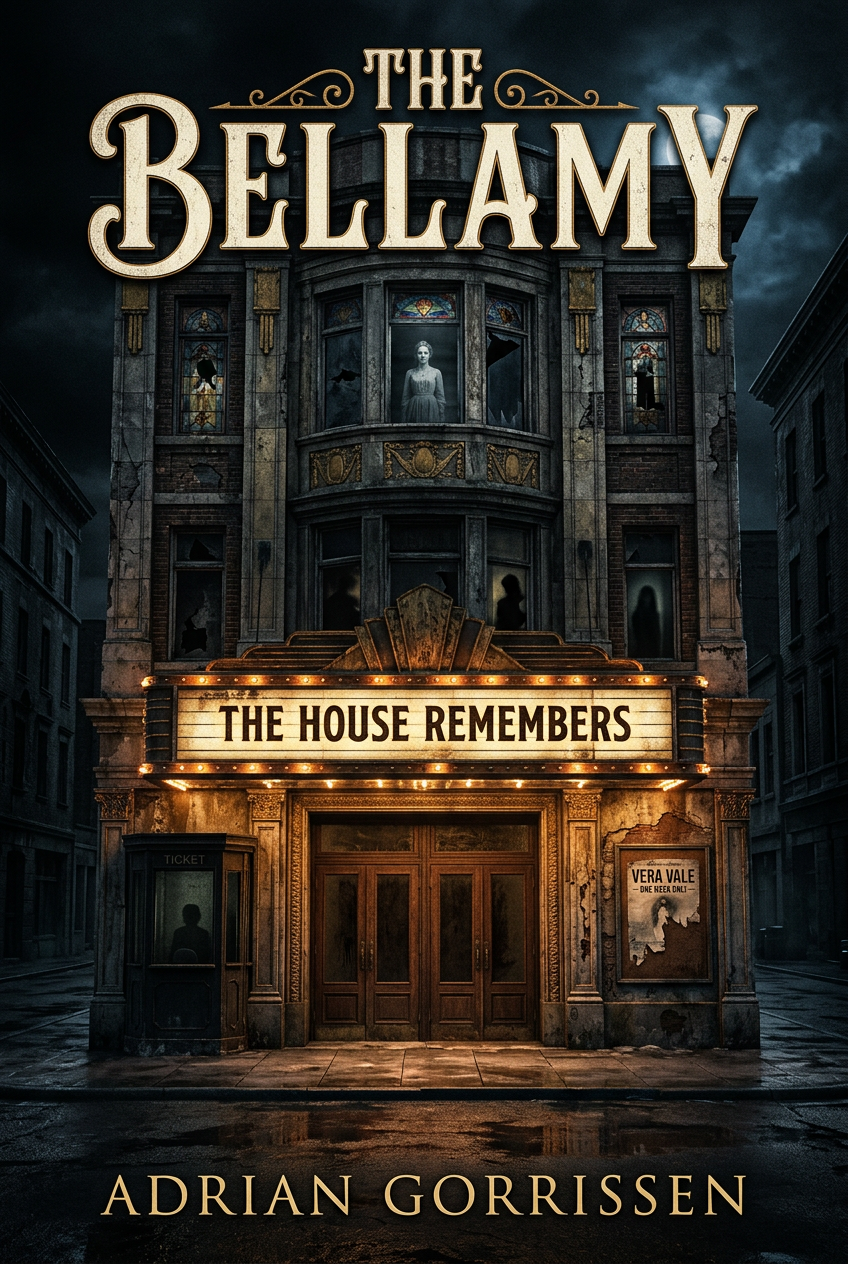
Novel · 30 chapters · 120,186 words
The Bellamy
Contents30 chapters
- 01Dead Bulbs Over Bellamy
- 02The Woman in the Dress Circle
- 03A House That Remembers
- 04Terms of Occupancy
- 05The First Night’s Footage
- 06A Fan of Vanishings
- 07East Hall Knocking
- 08Silas Bell Smiles Down
- 09Half-Light Rehearsal
- 10House Full of Teeth
- 11Vera’s Prompt Book
- 12The Shaft Below Center
- 13Frames No One Shot
- 14What Marcus Saw in the Wings
- 15The Benefactor’s Daughter
- 16Sellout Crowd
- 17Dress Rehearsal for the Dead
- 18Nia Breaks the Door
- 19Midnight Call Places
- 20The Audience Behind the Velvet
- 21Vera in the Mirror Glass
- 22Jules Keeps Rolling
- 23The Box Above the House
- 24Quill at Center Stage
- 25Final Bow
- 26Under the Boards
- 27How a Theater Dies
- 28Statement to the Press
- 29Vera’s Last Exit
- 30Dead Air
Chapter 1
Dead Bulbs Over Bellamy
By the time the van rolled to a shuddering stop at the curb, the Bellamy had already made up its mind about them.
Half the bulbs in the marquee were dead, and the rest glowed weak and jaundiced behind dirty glass, enough to spell BELL MY and leave the missing letters to the imagination. In the streetcase, a campaign poster had come loose at one corner; whenever a truck rolled down the avenue, it slapped the glass. The smiling magician on it was split straight through one eye and down his white-gloved hand, as if somebody had tried to cut him out and quit halfway. Weeds had pushed up through the seam at the curb, spreading in a tough gray-green fringe. Over the entrance, one of the carved stone babies had lost its head, and somebody had set a brown beer bottle in the stump of its neck.
Marcus killed the engine. The van coughed once more, petulant and wounded, then went still.
He kept both hands on the wheel. “Tell me again this isn’t trespassing.”
Lydia had the envelope from City Hall in her lap. The paper inside still smelled faintly of toner and the clerk’s spearmint gum. The theater doors were worn, the gilt around the arch flaked away, and above the old ticket window a black fan of grime spread where a generation of cigarettes had sheltered from the rain.
“It’s not trespassing,” she said. “It’s permitted access.”
“Permitted by who?”
“The city.”
Marcus turned to her. “That is not the reassurance you think it is.”
In the back, hard latches clicked. Jules was already unstrapping cases. He wore a knit cap though the evening was warm, a camera across his chest, his long hands moving with the impatient tenderness some people reserved for children or guns. “Can we argue inside?” he said. “Golden hour’s not waiting around while Marcus has a constitutional crisis.”
Nia, at the side door with a cigarette pinched between two fingers, leaned out and blew smoke toward the gutter. “He always has a constitutional crisis. It’s one of his little hobbies.”
Marcus said, “My hobby is preventing everyone from ending up on the news under the phrase local idiots.”
Lydia opened the envelope and took out the ring of keys. Old brass, heavy as a sinker. A white tag on one of them said BELLAMY EAST in faded block letters. Another had no tag at all, only a lump of green corrosion around the bow.
The forms in the envelope had been boilerplate until the clerk started talking. No open flames. No sleeping on site. Structural hazards. Do not enter any section marked unsafe. If doors swell shut, call the posted emergency number and wait outside. Then the clerk, a woman with a paper-dry face and a wedding set pinching at her knuckle, had finally looked up long enough to say, “If you hear knocking in the east corridor, don’t answer it.”
Lydia had smiled because that was what you did with town-office humor. The clerk hadn’t smiled back.
Now the Bellamy sat before them, its windows blind, its limestone stained, the slashed poster fluttering in the case, and the joke had gone stale.
She shoved the keys into her coat pocket and got out.
The sidewalk broke into buckled slabs, and the hem of her jeans caught burrs from the weeds at the curb as she crossed. The air held old fryer grease from the diner up the block, hot rubber off the avenue, and beneath both, the river smell the whole city wore in summer: metal, mud, and something rank under it. She climbed the theater steps, grit skittering under her sneakers. The doors stood beneath a stained-glass transom filmed over with soot. Even outside, she could smell the place through the cracks—wet plaster, old fabric, a cellar damp.
Behind her, cases thumped onto the landing. Marcus muttered as he lifted the battery pack. Jules set down a tripod and swept his phone up for a quick establishing shot. Of course he did. His lens found stories before people did.
“Wait,” Marcus said. “We should check for squatters before we haul everything in.”
“That’s what we’re doing,” Nia said.
“With twenty grand in gear?”
Jules didn’t look up from framing the shot. “Generous use of the word twenty.”
Lydia fitted the largest key to the right-hand door. It went in halfway and stopped. She pulled it out, wiped rust powder on her jeans, and tried again. The teeth caught this time. She turned hard and something inside the lock dragged, then slipped. The sound it made was ugly and intimate, like grit in molars.
“Come on,” she said under her breath, and shoved.
The door opened a crack and hit something. Less a hard stop of chain than a jam.
Nia flicked her cigarette off the steps. “Move.”
She came up beside Lydia and planted both palms flat on the painted wood. Nia had shoulders like a swimmer and the dark, watchful face of somebody who preferred action to all discussion of it. She pushed once. Nothing. Pushed again, harder. Something on the far side scraped over tile with a long, dry complaint.
Marcus stepped back. “That was disgusting.”
The gap widened. The first thing out of the Bellamy was its breath.
Dust. Mildew. Damp carpet. The sweet gone wrong smell of flowers left in water too long. Lydia had known some version of it in hospital corridors at three in the morning, when bouquets drooped in cheap glass vases and machines did the work of hope. The odor pressed against the back of her throat and for one moment she almost stepped away.
Instead she got her shoulder to the door and forced it wide enough to slip through.
Her shoe sank ankle-deep into a drift of soaked paper. Playbills, hundreds of them, pulped together and dried and gone soft again with years of leaks. The lobby rose around her in a dim amber wash from a pair of sconces farther in, light the color of old teeth. Twin staircases curled up on either side like something in a movie palace, balustrades furred with dust. A chandelier hung from the ceiling under a cocoon of grime. The box office grille had been punched inward long ago, its brass warped. On the floor, a cracked mosaic still showed in patches where debris hadn’t buried it: the comedy and tragedy masks, their features worn nearly flat by a century of shoes.
Behind her, Marcus made a muffled noise through the neck of his T-shirt. “There is no universe in which this passes inspection.”
Jules had gone quiet. Not a word.
He stepped in beside her and slowly turned, camera up now instead of the phone, catching the chandelier, the stairs, the dead concession stand with its clouded jars and paper cups collapsed into themselves. “This,” he said softly, “is production value.”
“For views,” Marcus said.
Lydia kept looking at the room. “For rent.”
Nobody spoke after that.
The silence in the Bellamy was not complete. It held little working sounds inside it, as if the building had joints that clicked when it shifted its weight. Somewhere deeper in, metal gave a single tick. Then nothing.
Nia crouched by the object that had blocked the door. It was a warped signboard on casters, the old kind with changeable letters. The black felt grooves were clogged with filth. A few white plastic letters still clung to it at random angles.
S O N I G H
“Tonight,” Jules said. “That’s promising.”
Nia stood and rolled it aside. “Or someone couldn’t spell.”
Lydia crossed to the box office, drawn there by the little square opening as if she expected a woman in cat-eye glasses to slide it open and ask for four adults. The counter had a fuzzy skin of gray dust. A mildewed ledger sat swollen on one side, cover buckled. Beside it lay a pencil nub chewed nearly to the ferrule.
She put two fingers on the ledger and stopped.
There were thumbprints in the dust.
Not fresh. Nothing that clean. These were shallow ovals where dust had settled back in, but differently, making darker pools inside the impressions. One on the ledge. One near the pencil. One on the brass edge of the grille where a hand might have steadied itself.
Her eyes were on Nia. “You got that face.”
“What face?”
“The one where you already know something and don’t want to say it first.”
Marcus had joined them. “What?”
Lydia stepped aside.
He stared at the ledge. “Those could be old.”
“They are old,” she said.
“That’s good.”
She glanced at him. “I didn’t say how old.”
Jules swung the camera in, zooming close. “Maybe linger there,” he murmured, half to himself. “Nice slow push. Dust prints. Good detail.”
Marcus looked from the prints to Jules. “If we find a dead body, do not shoot B-roll before calling somebody.”
“Depends how dead,” Jules said.
“That wasn’t a joke.”
“I know.”
Lydia left them to it and moved toward the inner doors. The lobby lights hummed faintly overhead. She hadn’t expected power to still be live in a condemned theater. City Hall had said a skeleton feed remained for security and emergency access, but she’d pictured a few naked bulbs over exits, not this weak half-life. It made the place seem less abandoned than paused.
Her whole plan depended on that pause. Not just the series—though she could already see the thumbnails, the caption language, the clipped gasp-and-run edits Jules would make sing. That was part of it. But so was the envelope from her landlord on the kitchen counter with PAST DUE stamped across it in red. So was the call she had not picked up from her sister. So was the account balance she knew to the dollar because at some point numbers stopped being abstract and turned into weather. She had pitched the Bellamy as a stunt because saying need aloud made people back away.
The inner doors were open. She put a hand on one; old varnish sweated through the dust, dragging at her skin.
Beyond lay the house.
Even expecting it, she stopped.
Photographs on fan sites had shown rows of seats and flaking gold leaf and all the usual romance people assigned dead places. In person the auditorium was another order of thing. It swallowed scale. The red seats poured downward in ranks toward the stage, faded to the color of old blood and filmed over with dust. The aisle carpets had gone threadbare in the center, exposing strips of tack. The proscenium arch loomed ahead, its molding split in one corner, paint blistered. Murals of clouds and plump children ringed the ceiling, browned by time until they looked less heavenly than nicotine-sick.
And the curtain.
It hung closed at center stage, immense and heavy, once crimson perhaps, now gone to a dark clotting maroon. Its folds were stiff with grime. Along the lower hem, a fringe of mildew had crept up from the floorboards.
Jules let out a low whistle behind her. “That is indecently good.”
Marcus said, “That curtain has seen things.”
Nia passed Lydia and headed down the center aisle without waiting to be invited, boots silent on the old carpet. “Yeah,” she said. “Probably us dying because the balcony falls in.”
“It’s structurally rated for limited access,” Lydia said automatically.
Marcus barked a laugh. “That sentence should not make me more nervous.”
She walked into the house, the carpet soft underfoot where leaks had soaked it and dried a hundred times. The seats smelled of dust and old upholstery and mouse droppings. Somewhere near the orchestra pit a board shifted under pressure and snapped back with a small crack. She set her gear bag in the front row and climbed the three steps to the stage.
The boards flexed under her. Hollow beneath. She adjusted her weight and took another step. A sharp creak answered near center, not loud, but specific enough to make her look down.
“Careful,” Marcus called.
Lydia lifted her chin and kept going until she stood near the curtain line, facing the house. From up here the seats became a dark field. Jules looked thin and avid with the camera against his face. Marcus had already gone practical, scanning the exits, clocking the wall damage, as if finding the routes a sane person would need in a hurry. Nia stood in the aisle with her hands on her hips, like she was waiting for the theater to amuse her.
Once, not so long ago that it should have felt like another life but somehow it did, Lydia had stood in black-box rehearsal rooms and fringe stages and one respectable regional house with a cracked loading dock and thought the wanting itself would count for something. She had waited tables, temped, lied to everybody who asked how things were going. Then there had been the pilot she nearly got, and the months after, when hope calcified into never. Now here she was in a dead theater with three people she trusted for reasons she could not explain to anyone sensible, trying to turn local ghost lore into ad revenue.
You work with the stage you get.
“Lyd,” Jules said.
He wasn’t looking at her. He was looking up.
His gaze drew hers up to the dress circle. A balcony curved above the house, gilt trim shedding flakes like fish scales. Most of the doors along the back wall were shut. One stood open.
A narrow black rectangle. Nothing in it. Just open.
Lydia frowned. “Did one of you go up there?”
“Nope,” Jules said.
“Nah,” said Nia.
Marcus had gone still. “I thought this place was locked.”
“It was.” Lydia stepped to the edge of the stage. “Maybe the city left something unsecured.”
Marcus looked at her as if he could hear how thin that sounded. “That sentence again. Less comforting every time.”
The house lights dipped.
Not out. Just a blink. A brief falter in the yellow glow, enough to make the seats darken and the curtain lose depth and everything in the room hold itself. Then the lights came back.
Nobody moved.
Jules’s camera was already trained on the balcony. “Tell me I got that.”
“You got it,” Nia said, though she never looked away from the open door.
The lights flickered again. Once. Twice. A faint electrical buzz crawled through the air, then ceased.
Marcus spoke first, too quickly. “Bad wiring. Old building.”
“Sure,” Jules said.
Lydia listened, though she couldn’t have said for what. Footsteps, maybe. Whispering. The scrape of a squatter shifting in the dark. But the Bellamy had gone intensely attentive. There was no other word for it. Their arrival had cut across some private business, and now the whole place waited to see what they would do next.
Nia started up the left aisle toward the stairs to the balcony.
“Hold up,” Marcus said. “We should not split up in the murder theater.”
She kept walking. “Then keep up.”
Lydia hopped down from the stage. The landing jarred her knees. She grabbed her flashlight from her coat pocket and thumbed it on. The beam cut a pale tunnel through drifting dust. She took three quick steps after Nia.
From above them came a small sound.
Not a footstep. More the click of a heel on wood.
Everyone stopped.
Jules whispered, “Please be there. Whoever you are, please still be there.”
Marcus rounded on him. “What is wrong with you?”
“A strong instinct for marketable content.”
Lydia raised the flashlight toward the dress circle, but the angle only caught gilt scrollwork, a rusted rail, a drooping strip of wallpaper peeling loose from the wall. The open doorway remained black.
Her heart was beating much too hard. Not from fear alone. Fear and something twinned with it, something hotter. If there was somebody in here—if this place gave them one real moment before midnight, one piece of impossible footage, one story with teeth—
That thought shamed her enough that she almost let go of it. Almost.
“Hello?” she called.
Her voice traveled out into the house and up into the ceiling murals and came back flatter than she liked. No answer.
Nia had reached the stairs. She put one boot on the first step.
Marcus grabbed for her elbow and missed. “Nia.”
“Relax.”
“That is not a plan.”
She glanced over her shoulder. “You got a better one?”
He did not.
The door stood open, watching them.
Lydia moved to the base of the stairs beside Nia. Close up, the carpet on the steps was split down the middle and the brass stair rods had gone green. Her flashlight beam trembled once across the banister. She tightened her hand around it until the shake stopped.
“On three?” Nia asked.
Lydia nodded.
Before either of them could move, a woman’s voice drifted down from the balcony.
Not loud. Not a shout from cover. Clear and cool. That easy carry trained voices have. Each word placed neat in the air. No strain. No breathlessness. As if whoever spoke had all the time in the world.
“You’re late,” she said.
Nobody answered.
The voice had not come from the open doorway. Lydia heard it in the room's hush and the set of his voice, and knew it then. It seemed to arrive from above and around them at once, as if the old room itself had shaped a mouth.
Marcus made a sound in his throat and took one step backward.
Jules, breathing through his teeth, kept filming.
Nia’s expression changed in a way Lydia had seen only a few times before, usually a second before somebody threw a punch. Not fear. Focus.
Lydia lifted the flashlight higher.
The doorway upstairs stood open and empty, black as a cut in the wall.
But something had moved behind the rail to the right of it. Not enough to call a shape. Only the faintest suggestion, pale against dark, there and then not there at all.
“Who’s there?” Lydia said.
Silence answered her.
Then, somewhere deep in the theater, out past the stage or under it or behind the walls where no audience had ever gone, something knocked once. Heavy. Deliberate.
And from the dark above, as if in reply, came the soft click of a heel taking a single step closer.
Chapter 2
The Woman in the Dress Circle
The knock seemed to leave a dent in the air.
Nobody moved for a beat. Lydia held the flashlight up, the white circle trembling across gilt trim and darkness, and the others took it in. The Bellamy listened too. That was the ugly part. The place was not empty after the voice. Something had taken it, in the oldest sense of the word.
Marcus backed another step down the aisle. “Nope.”
Jules didn’t lower his phone. “Don’t do that.”
“Do what?”
“Leave frame.”
Marcus stared at him. “I’m sorry my fear is inconveniencing your composition.”
Nia put her foot on the next stair. “You can wait down there if you want.”
Marcus looked at Lydia. It wasn’t a plea exactly. More an accusation with hope mixed into it. Be smart, it said. For once in your life, just once.
Lydia knew that look. She’d gotten versions of it from bank managers, from landlords, from her sister on the two occasions they’d spoken this year and both times about money. She hated how quickly it made her jaw set.
“She spoke to us,” Lydia said.
“Great,” Marcus said. “Then we have our opening line. We can go.”
Jules let out a dry little laugh that didn’t belong in the room. “We leave now, we’re idiots. We go up there, we’re either idiots or rich.”
“Or dead.”
“Still traction.”
“Jesus Christ.”
Another sound came from above. Not the voice this time. A small, precise tap, as if the toe of a shoe had found a loose board.
Lydia started up.
The stair carpet gave under her boots with a muffled, rotten softness. Brass rods, gone green with age, dulled under the flashlight beam. Nia stayed a step behind and slightly to Lydia’s right, close enough that Lydia could hear the faint rub of denim when she moved. Behind them came Jules with the phone held high and the hard case of his camera banging lightly against his knee. Marcus cursed under his breath, then followed because none of them, for all the things they said, were built to let the others vanish out of sight.
The temperature changed halfway up.
No draft, and not the ordinary pocket of cool air old buildings sometimes kept in their corners. This came sudden and mean. Lydia walked through it and the skin on her forearms pebbled under her coat, the cold tightening the inside of her nose with a smell of wet plaster and old face powder and something metallic underneath. Not blood. Something thinner. Coins maybe. Rain on iron.
“You feel that?” Jules whispered.
“Yes,” Marcus said. “I hate it.”
“Maybe there’s a busted window,” Lydia said.
Nia said nothing. That suited Lydia. Nia’s silence, unlike Marcus’s, didn’t ask for reassurance.
At the top of the stairs the dress circle curved away in a dim horseshoe, red seats rising behind a low ornamental rail thick with dust. Their footsteps changed up here. Down in the house the theater had swallowed sound whole. On the balcony boards it gave some of it back, not as an echo exactly but as a dry following rustle, like another set of feet just behind theirs trying not to be heard.
The open doorway stood twenty feet to their right.
Up close, the black beyond it looked less like darkness and more like material: a hanging depth, old velvet-dark. The wallpaper around the frame had lifted in strips. Somebody had once painted tiny gold leaves around the molding. Enough remained to catch the flashlight in spots, so for an instant the wall seemed to open and shut its eyes.
Jules circled left to get a better angle.
“Don’t,” Marcus said.
“Relax.”
“You relax. You’re one of those people in documentaries where they freeze on your face right before your mother says you always loved cameras.”
Jules grinned without humor and kept moving.
Lydia went toward the doorway. The boards under the carpetless aisle gave short complaining creaks. She told herself to watch the floor, to register hazards, nails, soft spots, the practical things. Instead she looked over the rail into the cavern below, where the seats sloped to the stage in rows of broken teeth. Her bag still sat in the front row. From up here it looked left behind by somebody who hadn’t meant to be away long.
The hallway beyond the doorway was narrow and unexpectedly elegant in a tired way. A runner had once lain there; now only a border of darker wood showed where sunless years had protected the floor. Framed production stills lined the wall, each one under glass fogged and blistered by damp. Names in flaking gilt clung beneath some of them. Men in tailcoats, women in feathered hats, chorus lines of girls with fixed smiles and calves pale as candle wax. One photo had slipped crooked in its frame, exposing a rectangle of wallpaper cleaner than the rest.
The cold thickened.
Marcus stopped in the doorway and hugged his elbows without seeming aware of it. “Okay. No. Nobody’s living back here.”
“How do you know?” Lydia said.
He gave her a look. “Because I’m not seeing sleeping bags, fast-food wrappers, or a guy named Trevor with a knife.”
“Maybe she keeps house,” Jules said softly, filming the wall of photographs. “This is incredible.”
Nia touched one frame with two fingers. “Dry on the front. Wet on the back.”
The glass wore a skin of dust, but along the bottom edge moisture had swollen the backing until the nails bowed out. The woman in the picture stared through gray bloom, one hand held to her throat as if at some important emotion the camera had interrupted.
At the far end of the hall a door stood ajar, no more than six inches. Faint light reached across the floorboards beneath it. House-light yellow. Weak and impossible.
Jules flinched. “That room was dark before.”
Marcus said, “There’s power in the building.”
“In one room?”
“The wiring’s old.”
“The wiring writes dialogue now?”
Lydia moved.
The hall tightened her breath. Small things came clear all at once: the scuff of her boot sole on lifted floor finish, the dry hiss of Jules’s jacket when he adjusted his grip, a smell of stale perfume trapped deep in the woodwork and let out by their passing. She lifted the flashlight but, in her mind, left the hall light on behind them. She needed that yellow strip under the door to stay ordinary.
The knob was porcelain, one chip missing near the brass stem.
She stopped with her hand an inch from it.
Nia came up on her left. “You waiting for an invitation?”
Lydia hated that she was. “No.”
She pushed the door.
It swung inward without resistance.
The room beyond had once been a dressing room or a private green room. The theater had many species of neglect, and this room carried a different one than the lobby. Less public. More intimate. Dust lay over everything in an even skin except where it had been disturbed. A narrow wardrobe stood against one wall with one door hanging open. A washstand held a crazed porcelain basin stained the color of weak tea. On a shelf sat powder tins and a hatbox collapsed in on itself. A row of bare hooks lined the wall. Against the far wall stood a dressing mirror taller than Lydia, its silver blackened in spots, one side cracked to a white spiderweb.
Before it sat a straight-backed chair.
Not toppled. Not shoved off at an angle by vandals. Pulled neatly into place, centered with the mirror, as if someone had sat there a minute before and risen when she heard them coming.
Lydia stepped in.
The cold in the room had teeth.
Her flashlight crossed the mirror and found the word at once.
VERA
The letters were traced through the dust with a fingertip. Not on the outside. The dust had been cleared from the other side of the glass. The strokes were reversed from where whoever made them had stood.
Jules stopped filming for the first time since they’d come in. The phone dipped a few inches.
Marcus said, very carefully, “How.”
Nobody answered him. Not a soul did.
Lydia went closer until the beam threw her own warped reflection back at her from between the cracks. Her face split and doubled and vanished in black patches where the silver had gone. The letters looked fresh in the sense that the line edges were clean. But that meant nothing. Nothing in this room made sense enough to date.
Nia leaned sideways, trying to catch the mirror from another angle. “Can’t write on the back unless—”
“Unless the backing’s gone,” Jules said, voice fast now, eager with fright. “Unless there’s access from behind, or somebody opened it somehow, or one of you did this while I was downstairs.”
Marcus let out one short laugh. “Oh, good. We’ve reached the accusing stage.”
Jules pointed at the mirror. “That is not a ghost. That is somebody messing with us.”
“From inside the glass?” Nia said.
“There’s a wall behind it. Probably hollow.”
Lydia swept the flashlight along the edges. The mirror was fitted into a heavy wooden frame bolted to the plaster. No obvious hinge. No gap but shadow. The wall to either side wore water stains the shape of continents.
“You saw me the whole time,” Marcus said. “I was downstairs trying to leave.”
“You could’ve come up before us.”
“With a can of fake dust and a backwards finger?”
“People do stupider things for clicks.”
Marcus’s mouth flattened. “Meaning Lydia?”
“Meaning any of us.”
That landed and stayed in the room awhile.
Lydia crouched by the chair. A film of dust lay over the seat except at the front edge, where something had smudged it recently enough that the wood showed in two faint half-moons. Fingers, maybe. Or the edge of somebody’s skirt brushing past. She put her own fingertips there. The wood was cold enough to sting.
“Lyd,” Marcus said. “Don’t.”
She ignored him and moved the chair aside. Its legs scraped lightly over the floorboards. Everyone flinched. The sound seemed too loud, indecent somehow.
Behind the chair, near the baseboard, something pale stuck out from under the hem of a radiator cover that had rusted through in one corner.
A folded paper program.
Lydia reached for it.
“Wait.” Jules was filming again, his voice hushed with greed and fear both. “Let me get that.”
“It’s paper, not a snake.”
She pinched it free. The stock was thick but gone soft at the edges, water-marked and foxed with brown. On the cover, beneath a sketch of the Bellamy’s facade in better years, black letters announced one week only and then a title in script so ornate she had to angle it to read it.
Midnight’s Children. Bellamy Players Revival. October 1978.
The paper smelled of mold and old glue. A pressed thing. A kept thing.
Marcus said, “That from here?”
Lydia opened it carefully. Cast list. Production credits. A note from management full of civic boosterism and stale grandeur. Her flashlight paused over the lead.
Vera Vale.
Nia leaned in. “You know that name?”
Lydia shook her head once. But there was a throb low in her chest that had nothing to do with recognition and too much to do with the particular way old stories wait around a town, unseen until the right name snags on them. She turned another page. A clipping had been tucked inside, folded twice. Newsprint, brittle as onion skin.
She eased it open and read enough to feel the room draw tighter.
BELLAMY STAR VANISHES DURING CURTAIN CALL
Below that, a grainy photograph: a dark-haired woman in stage makeup, one arm raised as if still caught in applause. Even in bad print she had a face built for light. Strong mouth. Large eyes. Not pretty in the fragile way. Pretty the way some knives are pretty.
Jules moved in so close his sleeve brushed Lydia’s shoulder. “Let me see.”
She read silently, skipping the throat-clearing first lines and dropping into the meat of it. Final-night confusion. Audience disturbance. Contradictory witness statements. Actress missing. No evidence of departure. Production halted. Investigation ongoing.
Marcus said, “Read it out.”
Lydia did.
The room stayed quiet through the last sentence. Even Jules let the silence sit a second.
Then he said, “Okay.”
Nobody asked what that meant.
He went on anyway. “Okay, so whoever’s in here knows local history. That’s all this is. Squatter, urban explorer, some asshole theater buff. They hear we got access, they get in first, prime the room, boom. Viral.”
Marcus looked at the mirror again and spoke without taking his eyes off it. “I heard heels.”
“So?”
“So across the boards. Above us.”
“We are above us.”
“No. Higher.” He swallowed. “Like a floor that isn’t there.”
Jules gave a little scoff, but it sounded forced now.
Lydia turned back to the article. The clipping named police, two stagehands, the producer—no one useful to her then. At the bottom, one line snagged hard enough to pull all her attention.
Miss Vale was last seen near the dress-circle stairs just prior to the final curtain.
Lydia looked at the doorway behind them.
The hall beyond it lay empty. Framed faces watched through swollen glass. The weak yellow light from somewhere overhead made the corridor look underwater.
Nia had drifted to the wardrobe. She opened it all the way. Inside hung nothing but a few wire hangers furred with rust. When she shut the door, it clicked with an oddly clean sound.
“Still think squatter?” she said.
Marcus said, “I think this building has more ways in than we know about.”
“That I’ll buy,” Jules said at once, relieved to have a sentence to stand on. “Passages, utility access, crawlspaces. Theaters are full of weird service routes.”
“Then find one,” Marcus said.
Jules lifted his chin. “Gladly.”
He moved to the mirror, testing the frame with one hand while keeping the phone up with the other. The wood didn’t budge. He crouched, checking the base, the wall, the seam where frame met plaster.
Lydia set the program on the chair and began searching with her light. There was a practical steadiness in it she badly needed. Same room. Same tricks. Hidden panel. Some stage-era access to feed gas lines or wiring. Something. She examined the washstand, the radiator cover, the wardrobe’s back panel. Water had bubbled the wallpaper in two places. She pressed one; wet plaster gave under the paper with a soft inward crumble.
“Careful,” Marcus said from the threshold.
“You can come help.”
“I am helping by keeping an eye on the only exit.”
Nia snorted. “That is not helping.”
“It absolutely is.”
Lydia crossed to the mirror and bent sideways, trying to see the wall behind its edge. Her flashlight found only dust and a dead spider in the upper corner. The crack-web in the glass caught her beam and flashed it back in shards. For a second the room seemed full of different small Lydias moving out of sync, one still bending, one already upright, one looking over her shoulder.
She stepped back.
“What?” Jules said sharply.
“Nothing.” But she had thought, for less than a heartbeat, that someone else had been standing in the reflected doorway. A pale shape. A shoulder perhaps. The trick of broken glass. She kept that to herself.
Marcus didn’t. “We need to check the doors.”
Jules, still probing the mirror frame, said, “What doors?”
“All of them.”
“Why?”
“So we know if somebody left.”
“That’s not how time works.”
Marcus straightened in the doorway and snapped, “I don’t care. I want to know whether there’s a person in here with us.”
Lydia almost told him no. Stay here. Keep looking. Don’t break the scene. But the article in her hand had changed things and she knew it. The easy explanation had become more necessary, not less. A flesh-and-blood trespasser was bad, but at least it was a kind he knew.
“We check,” she said.
Jules blew air out through his nose in disgust. “Fine. But if our prankster doubles back while we’re gone, that’s on you.”
“No splitting up,” Marcus said immediately.
“Obviously,” Lydia said.
They left the room with the chair still pulled slightly off-center and VERA pale in reverse on the mirror behind them.
Back in the balcony hall, Lydia took one last sweep with the flashlight. Production stills, swollen paper, the sheen of old water damage, a hairline crack running along the ceiling rose. No hidden figure. No retreating dress hem. No sound except the building working its old joints and the thin electrical hum of lights that shouldn’t have trusted themselves.
At the top of the dress-circle stairs Marcus hesitated and glanced upward.
There was no visible staircase above them. Only the high curve of wall rising into shadow, then decorative plaster and darkness.
“You really heard it up there?” Lydia said.
He nodded too fast. “I know what I heard.”
“Maybe from the stage house,” Jules said. “Sound carries weird.”
Marcus looked at him. “You don’t believe that.”
“No,” Jules said. “But I’d like to.”
They went down into the house, across the front aisle and through the lobby to the main doors. Lydia pressed the brass push bar. The doors held fast. Marcus bent to the lockset, then glanced at the deadbolt still sunk deep in its plate. Rust streaked his fingertips.
“These were locked when we forced them?” he asked.
Lydia pictured the first shove, the stick and scrape before the door gave. “I didn’t notice.”
Nia crouched beside him. “It’s been shut a while. Dust’s thick on the links.”
Marcus wiped his hand on his jeans and moved to the side exit beneath the stairs. It opened into a short corridor with cracked tile and a red EXIT sign glowing weakly overhead. The door at the end had a panic bar and, above it, a wired-glass pane painted black from the outside. Marcus shoved. Nothing. Nia tested the deadbolt. Thrown.
“All right,” Marcus said. “Loading door.”
They crossed backstage through a world of ropes, torn flats, and the mineral smell of damp curtains. Lydia’s flashlight picked up old set pieces stacked against the fly wall: a painted mantel, half a papier-mâché column, a moon with one eye punched through. The knock they’d heard earlier could have come from anywhere back there. It was the kind of space that made distance dishonest.
Jules kept panning, though his swagger had gone threadbare.
“You still think this is one of us?” Nia asked him.
“I think it better be.”
The stage door was at the end of a cinder-block passage with cast lists and notices still thumbtacked to a board under warped plexiglass. The metal door wore three locks. Two deadbolts and a chain. All engaged. Dust furred the threshold unbroken except for a narrow drag-mark near the jamb, old enough to have softened at the edges.
Marcus touched each lock like a man checking pulses. “No fresh scratches.”
“There could be another way,” Jules said.
“Then whoever used it didn’t come out this way.”
They checked the alley door by the loading bay. Same story. A bar across the interior brackets, padlock crusted shut. The basement hatch under the stage trap room was swollen into its frame and still sealed with a city tag brittle with age. Even Marcus stopped talking after that.
The walk back to the lobby dragged.
Lydia’s pulse had settled into something worse than panic: a working fear, low and continuous, that sharpened details instead of blurring them. A broken bulb in a wall sconce. Mouse pellets in one corner of the baseboard. The way Jules no longer strayed ahead with the camera but stayed close enough for his sleeve to brush her coat now and then.
In the lobby he said, “Maybe there’s somebody already here with keys.”
Marcus gave him a tired stare. “A person who locked every exit from the inside and then went where?”
Jules didn’t answer.
Lydia looked back toward the auditorium. The faint yellow house lights still glowed beyond the inner doors. From here the Bellamy seemed to have resumed its pose of abandonment, but she knew better now. The old thumbprints by the ledger. The chair at the mirror. The name. A line in an article that put a vanished actress near those stairs on the last night anyone admitted seeing her.
“Midnight’s our setup window,” Marcus said suddenly. “We can still walk.”
He was talking to Lydia. The others knew it and held their tongues.
He took a step closer. Dust streaked his jeans from kneeling at doors. There was rust on his fingertips. “We’ve got enough already. That voice. This room. We package it, come back in daylight with real equipment and maybe somebody from the city who knows the plans.”
Jules opened his mouth.
Marcus cut him off. “Or no. Better yet, we don’t come back. We put out what we got, say access got revoked, let the comments do the rest.”
“You’d love that,” Jules said.
“I would. Very much.”
Lydia folded the program and slipped it into her coat pocket.
That small motion changed the air between them. She caught it in the hush that followed. Marcus caught it too.
“No,” he said.
“We have one night.”
“One night to keep from turning into one of those stories strangers mangle online.”
Nia leaned against the box office ledge, arms folded, watching Lydia and not rescuing her.
Jules said, “If we leave now, we lose the thing.”
Marcus swung on him. “What thing?”
Jules pointed toward the auditorium with the hand holding his phone. “That. Whatever is happening in there. You know what people pay attention to? Not cold spots. Not creaky floors. A voice that knows you’re coming. A room with a name written where no hand should reach. Locked exits.” He looked at Lydia. “Tell me I’m wrong.”
Lydia didn’t.
Because this was the terrible truth of it: fear had not smothered the hot bright thing in her. It had fed it. Her rent was twelve days late. Her voicemail held two messages from a lender she’d stopped calling back. Her sister’s text from that morning—Dad’s worse. If you want to do this, do it soon.—still sat unread in the official sense, though she’d looked at it six times. She had come to the Bellamy to wrestle one salvageable thing out of a life that had lately refused her any clean edges. Now the place had looked back.
Marcus saw the answer before she spoke. His face closed.
“You’re making that face,” he said.
“What face?”
“The one where nobody else matters.”
That stung because it was close enough to true to hit bone.
Lydia said, “We do one full sweep of the upper level. Together. Then we decide.”
“We just did—”
“No. We found one room.” She looked toward the auditorium again. “There are more doors up there.”
Nia pushed off the box office. “I’m in.”
“Of course you are,” Marcus said.
Jules lifted his phone like a volunteer at a revival. “Absolutely.”
Marcus laughed once, without humor, and rubbed a hand over his mouth. For a moment Lydia saw him actually do it—turn and head back to the van, wrenching the keys from her hand if he had to. Instead he said, “If I hear one more pair of phantom high heels, I’m setting fire to your content plan.”
“No open flame,” Lydia said automatically.
For the first time since the voice, something like a smile twitched at the corner of Nia’s mouth.
Then it died.
From inside the auditorium came a sound not one of them had made.
A chair leg dragged slowly across wood.
Not backstage. Not the lobby. Up above them, in the dress circle, long and deliberate and patient as a blade being sharpened.
They all turned toward the inner doors.
No one spoke.
The sound came again.
One pull. Then a stop.
As if whoever had just sat down was getting comfortable and waiting for them to come back.
Chapter 3
A House That Remembers
The chair scraped again.
Not loud. That was the worst part. It came down through the auditorium doors as if carried in somebody’s cupped hands, a private little sound, wood skidding over old planks and stopping with care.
Jules already had his phone up.
Marcus caught his wrist. “No.”
“What do you mean no?”
“I mean stop acting like a raccoon at a buffet every time something awful happens.”
Jules yanked free. “You want this or not?”
Lydia was still looking at the doors. The yellow seam under them had gone thinner. One of the house lights in there must have died, or dimmed, or made up its mind to save strength.
“We already checked the exits. One more pass through the dress circle, all of us,” she said.
Marcus stared at her. “That’s your takeaway?”
“That’s the only useful one.” She turned to them. “If somebody’s moving around in here, we’re easier to manage if we stay in one group. If it isn’t somebody, same problem.” She pointed fast, as if speed could pass for certainty. “No splitting up. We do one full circuit of the upper level after the exit checks, then back to the lobby.”
Marcus made a disgusted sound in his throat. “Perfect. Horror movie interns with a schedule.”
Nia said, “Better than running in circles listening to furniture.”
Jules had started filming again, panning over their faces, catching the shine of dust in the lobby sconces. “Say the zones again.”
Lydia ignored the phone and kept moving. “Marcus, I want eyes on the electrical and the service corridors. Tell me what’s actually live and what only looks live. Jules, check the house. Aisles, boxes, that balcony rail—anything with any give. Nia, you’re with us on the exit checks. Then one more full sweep of the upper level, together. Nobody breaks off. Stay close enough that if you shout, I hear you.”
“And you?” Marcus asked.
“Basement access.”
“Absolutely not.”
“There’s a trap stair off stage left. I saw it in the old inspection drawings.”
“You saw those for five seconds upside down on a city clerk’s desk.”
“It was enough.”
Marcus looked at Nia, then Jules, hoping one of them would take pity and talk some sense. Nia rolled one shoulder. Jules was grinning with nerves, the bad kind that looked too much like joy.
Marcus said, “No one goes alone.”
“Then take Jules,” Lydia said.
“Why me?”
“Because you’ll film the breakers and make it useful.”
Nia pushed away from the box office. “I’ll take basement with her.”
Lydia shook her head before Nia had finished the sentence. “Backstage needs somebody who can force old hardware without ripping the whole place down. That’s you.”
“I’m touched.”
“You should be.”
Marcus folded his arms. “And if we find a locked door?”
“We call it out.”
“And if we hear—”
“We call that out too.”
A beat. The building held itself very still around them.
Jules said, “This is the part where we make a safe word.”
Marcus looked at him. “You have to know how much I hate you right now.”
“Fair.”
Lydia reached into her bag and pulled out two little LED lanterns, a coil of orange chalk line, and the cheap walkie-talkies she’d grabbed at a hardware store on the way over. They’d been on sale, and some part of her had always wanted to say copy that into the static. She handed them out.
Jules lifted one. “These are adorable. We’re going to die with sporting-goods accessories.”
“Channel three,” Lydia said. “If the signal craps out, shout.”
“And if one of us wants to leave?”
Marcus asked it without sarcasm this time. Just flat.
Lydia met his eyes. She knew what he was really asking. Not about zones or radios. About whether she meant to keep hold of this thing until somebody got hurt.
“Then we leave,” she said.
He watched her a second longer than he needed to. “You mean it now.”
“Yes.”
For now, he thought, though he left it unsaid.
The chair gave one final dry tug from beyond the auditorium doors, and Nia smiled without humor.
“Guess the house approves the plan.”
They moved.
The Bellamy was bigger in the bones than it looked from the street. The moment Lydia stepped through the wing door, she found a narrow stair dropping below stage level. The theater didn’t spread so much as layer itself—rooms jammed under rooms, corridors shouldering past dead-end closets, whole slices of building folded behind flats and plaster. A place made by adding one necessity to the next until it had become a secret to itself.
She clicked on her lantern and started down.
The air changed by the third step. Cooler, yes, but not clean-cool. Cellar cool. Wet mortar and mouse droppings and the rust smell that old pipes got when nobody had trusted them for years. Her beam swung over a handrail crusted with paint and a wall scored by scenery corners. At the bottom was a low landing with two doors: one hanging open on a bent hinge, the other swollen shut.
Above her, faint through the boards, came the muted thud of Jules crossing the stage and Marcus swearing at something metallic. It gave the emptiness overhead a shape.
“Basement,” she said into the walkie.
Marcus answered after a burst of static. “Service hall. Found your miracle power grid. It’s ugly.”
Jules cut in over him. “House center. I can see every seat from here and I hate all of them.”
Nia’s voice came last. “Backstage. If a rat asks for notes, I’m charging consultation.”
Lydia smiled despite herself. A small one. Then she pushed the hanging door wider and went in.
It had once been a workroom of some kind. Shelving lined the walls. Most of the shelves had collapsed into damp heaps of invoices, lamp housings, chipped teacups, a crate of stage screws fused with orange rust. On one wall, written directly over the flaking whitewash in grease pencil and paint marker and carpenter’s chalk, was a mess of arrows and names and numbers. For a second it was only random. Then her eyes began to pick the pattern out.
LX 4 HOLD 3 SECONDS.
SNOW DROP LATE STAGE R.
NO BLUE ON HER FACE.
WATCH THE CENTER BOARD.
Dates crawled among the notes. 1962. 1971. 1988. 1994. Some were underlined. Others crossed through. The oldest marks were faded almost to ghosting, but they were still there, one company on top of the next, like generations of hands had found the wall and left a warning or a favor.
Lydia went closer.
There were initials. Tiny sketches of blocking patterns. A penciled box around one note that read IF CURTAIN STICKS PULL ON TWO, NOT ONE. Somebody had drawn a smoking moon beside a line from a musical. Another had written SHE MISSES ENTRANCE IF YOU DON’T CALL HER TWICE.
Not actor. Not usually. Her.
Lydia touched the wall and the chalk came away on her fingertip, fresh enough to smudge. Not all of it. One particular line.
PLACES FOR V. BEFORE HOUSE OUT.
Below it, a date she couldn’t make out in the lantern light because some later hand had dragged a dirty palm over the numbers.
“Guys,” she said softly, then remembered to press the button. “I found something.”
Static answered. Then Jules: “Define something.”
“A cue wall. Notes from shows. A lot of shows.”
“Get close,” he said at once. “Film it.”
Marcus broke in. “Hold on. Did you say fresh?”
Lydia looked again at the chalk dust on her thumb. “Not exactly. Just… not all the same age.”
“Lydia.”
He said her name in that tone he used when he thought she was about to stick a fork in a socket. His jaw sounded tight, the radio pressed close to his mouth.
“I’m standing still,” she said.
“Good. Stay that way a second. I found the electrical room and it should not be live.”
A dull bang traveled through the building, somewhere off to her left. She froze before she could stop herself.
Nia came on immediately. “That was me.”
“What did you hit?”
“Cabinet.”
“By accident?”
“On purpose.”
Jules laughed into the radio, high and thin. “Team cohesion remains strong.”
Marcus kept talking over him. “There’s power coming into the house through a municipal patch panel with two splices newer than the rest. Newer by a lot. Someone’s been feeding this place enough current to keep emergency circuits and partial stage power. Breakers are wrong for the load. Half of them are bridged with copper tabs and wire nuts.”
Lydia said, “You’re telling me the city’s been keeping it alive.”
“I’m telling you if this building were a patient, a jury would convict.”
That sat with her a second. Alive.
She lifted the lantern and read more of the wall. Handwriting shifted across decades. Tight old cursive. Block capitals. The round impatient scrawl of somebody writing with a cigarette between two fingers. The Bellamy had trained people to leave messages where only the next set of theater hands would think to look. Not for the public. Not for history. For survival. For timing. For the little practical mercies that let a night happen without humiliation.
Then another line caught her.
DON’T LET HER WAIT IN THE DARK.
Her skin drew tight along her arms.
“Lydia.” Marcus again. Sharper now. “Did you hear me?”
“Yeah.” She stepped back from the wall. “I heard.”
“I’m coming to you.”
“No. Stay where you are and finish. We need to know what else is live.”
He inhaled hard enough that it crackled through the radio.
Before he could argue, Jules said, “Hey.”
Everybody went quiet.
“Jules?” Lydia said.
His voice came back lower. Not performing now. “One of the box doors just moved.”
“Moved how?”
“It opened about six inches.”
“Wind,” Marcus said.
“There’s no wind in here.”
“Old hinge releasing.”
“It released toward me.”
Lydia was already backing toward the basement door. “Get away from it.”
“I’m getting closer.”
“Jules.”
A brief pause. In her head, he did that slight guilty tilt of the camera, as if the lens were making bad choices instead of him.
Then: “There’s nobody in the box.”
“Of course there isn’t,” Marcus snapped.
“I know what an empty room looks like, man.”
Nia cut in. “Backstage clear so far. Found wardrobe racks and a lot of dead fake flowers. Also a prop cabinet with a swollen latch.”
“Leave it,” Marcus said.
A pry bar clanged faintly in the distance.
Nia said, “Guess.”
Lydia stepped back into the stairwell. It felt better there, even with the damp, because she had the direction of up. “Keep talking, all of you.”
She climbed.
Above, the stage boards complained under somebody’s feet. The sound crossed left to right and stopped. Jules, maybe. Or not.
By the time she stepped into the wing, the darkness was thicker than before, though that made no sense with the lights working. The backstage work lamp over the prompt corner buzzed and spat moth-eaten yellow across a coil of hemp rope, a half-collapsed false column, and two canvas flats painted as French windows from some forgotten farce. The set pieces leaned together in the dim like people making plans.
Nia was crouched in front of a tall cabinet with one door hanging loose. The pry bar was in her fist. She had braced one boot against the base and peeled the latch plate out of the wood.
“What’d you get?” Lydia asked.
Nia stood and pulled the door wide.
Inside, shelves marched back into shadow. Stage junk. Rhinestone necklaces green at the clasps. A velvet crown crushed on one side. Tin medals. A fan of yellowed opera gloves tied with pink ribbon gone brown. On the middle shelf lay a pile of lace collars and cuffs gone stiff and dark in spots that weren’t mildew.
Lydia reached toward one, then stopped short of touching.
“Blood?” she said.
Nia shrugged. “Or paint. Smells wrong for paint.”
On the floor of the cabinet, tucked against the toe-kick as if somebody had kicked it there in a hurry, sat a single child’s tap shoe. Black leather, strap snapped, toe plate dull under dust. Tiny enough to fit in Lydia’s hand.
“Jesus,” Jules said from behind them.
They all turned.
He had come in from the house side, phone mounted now on the little grip rig he used when he wanted steadier footage. His face was pale and bright at once, lit by his own screen.
“You were told to stay in the auditorium,” Lydia said.
“I brought evidence.”
He held up the phone. On the screen, shaky but clear enough, was one of the dress-circle side boxes. The little door at the rear stood half-open. As they watched, it shifted another inch inward with slow pressure, as if somebody inside had just leaned on it.
The image jumped.
“Keep rolling,” Nia said.
“I did.” He swiped. “Wait.”
Another clip. This one from the booth at the back of the house, aimed at the stage. Black frame, black frame, then a spotlight slammed on from high stage right, so sudden and fierce Lydia squinted even though it was only a recording. The white circle hit center stage like an accusation. Dust exploded through it. Ten seconds, maybe a hair more, then the lamp went out and the frame dropped back into murk.
Marcus came through the stage-left service door just in time to catch the end of it. He took one look at Jules’s screen and said, “Nope.”
“That’s helpful,” Jules said.
Marcus ignored him. His hands were blackened with old grease, and there was a crescent of fresh grime across his cheek where he’d wiped sweat without thinking. “The dimmer racks should be dead. The emergency panel only feeds aisle strips, work lights, and minimal exit signs. Nothing up there should have enough juice to strike a spot.”
“And yet,” Jules said.
“And yet somebody bypassed half the room with patch wire stolen off a city truck sometime this century.”
Nia pointed at the cabinet. “And somebody kept a nice little museum of stage crime.”
Marcus looked in. Whatever he’d been about to say dried up. His gaze dropped to the child’s shoe on the floor and stayed there too long.
Lydia made him read.
“You know something?”
“No.”
Too quick.
She let it go because the building had a way of punishing attention; the second you fixed on one thing it lifted another hand behind you. Across the stage the main curtain hung shut and heavy, its folds dead black where the work light didn’t hit them. Beyond that, the auditorium waited with all its seats aimed forward like teeth.
“Back to plan,” she said. “Short reports. Then upper floor together.”
Marcus laughed once. “You’re really married to the phrase plan.”
“It helps.”
“Does it?”
She looked at him. “Say what you want to say.”
He almost did. It rose, blurred, then slipped away. Instead he pointed toward the service hall. “Power’s wrong. Recent wrong. Somebody has maintained enough current to keep parts of the building reactive.”
“Reactive,” Jules repeated, delighted.
“I didn’t say haunted.”
“You didn’t have to.”
Nia lifted one of the lace collars on the pry bar tip. It hung stiff as bark. “This didn’t happen in one season of mildew.”
“No,” Lydia said.
She crossed to the prompt corner where an old callboard still hung on the wall, empty now except for a rusted pushpin and a strip of curling tape. Beneath it, half-hidden under a stack of warped script boxes, was a metal door in the stage floor no bigger than a coffin lid. She knelt and brushed away grit until the ring pull showed.
“Found our next stop.”
Marcus stared. “No.”
“Trap access.”
“Still no.”
“It’ll be quick.”
“You keep saying that like time is your pet.”
Nia came over, crouched, and slid her pry bar through the ring. Together they hauled. The hatch came up with a suctiony groan and a gust of colder air that smelled of old water and something trapped too long under wood.
Jules made a sound somewhere between a prayer and an orgasm.
“Don’t,” Marcus said to him.
Below the hatch, iron rungs dropped into a square shaft lined with brick. A faint light glimmered below, more reflection than electricity, catching on wet surfaces.
Lydia took the lantern from her bag again. “I’m going.”
Marcus stepped in front of the opening. For once he didn’t posture or argue from the edges. He just stood there, solid, stubborn, making her deal with him.
“No.”
“Move.”
“No. We regroup, we leave, we come back with respirators and hard hats and a tetanus fairy if they make one.”
“We don’t get a second first night.”
Jules murmured, “That’s a good line,” and when Marcus whipped around on him he raised both hands. “Sorry. It is.”
Lydia kept her eyes on Marcus. “Two minutes.”
“You said ten-minute zones. Then a short report. Then together upstairs.”
“I’m adjusting.”
“That’s what you call this?”
Behind Marcus, the auditorium gave off one soft popping sound as cooling metal somewhere settled. Or warming metal. Hard to tell.
Lydia lowered her voice. “If we walk now, all we have is scraps. A voice nobody can source and some bad wiring. If we stay smart, we get enough to prove this place is either being used or using us.”
Her mouth tightened. Something shifted in his face—not surprise, not exactly. More like grief wearing thin.
“For rent,” he said quietly.
She didn’t answer.
That was answer enough.
He stepped aside. Not because he agreed. Because there was nowhere left to put himself between her and what she had already decided.
“Two minutes,” he said.
Lydia went down the rungs.
The shaft opened into a low under-stage chamber webbed with joists and old rigging lines. Here the Bellamy smelled stronger than anywhere else, all its hidden breath at once: wet lumber, hot dust from lamps overhead, mouse nests in horsehair, the faint bitter tang of ancient smoke sunk into curtains and never let go. The lantern threw a yellow pool over packed dirt, bricks sweating mineral stains, a stack of rolled marley flooring tied with wire, and more writing.
Not one wall. All four.
Dates. Names. Cue numbers. Arrows. Notes layered over notes until the whole chamber looked flensed open to reveal its nerves.
Some were practical.
TRAP STICKS IN COLD.
CHECK WINCH BEFORE ACT II.
MIND THE NAIL BY PROMPT STEP.
Some were stranger.
HEAR HER? CALL PLACES ANYWAY.
IF SHE CROSSES, DON’T LOOK LEFT.
MAKE SURE THE SHOE IS SET.
Lydia stood very still.
There were older hands here than the wall upstairs. Blue carpenter’s pencil from some long-ago season. Burnt match scratches. White grease pencil. A lipstick note blurred by damp. A ballpoint pen line that must have come later, the ink spread into the limewash.
She lifted the lantern. The writing rose over one another decade after decade, not random graffiti but accretion, a conversation between crews who had never met and somehow addressed the same problems.
One message had been boxed in with furious strokes.
SHE HATES DEAD AIR.
Below that, in different handwriting, someone had added:
WHO DOESN’T.
Lydia laughed once before she could stop herself. It came out too loud down there and sounded like somebody else.
She moved deeper. The lantern found a chalked line at knee height running along the far wall, and above it a list of dates, each with a single mark beside it—check, slash, circle, question. 10/14/78 had been circled so many times the plaster had worn thin. Next to it: HOUSE FULL. NO EXIT.
Her heart gave one hard beat.
“Lydia?” Marcus called from above, muffled by boards and distance. “Minute.”
“Coming.”
But she stayed another second, lantern lifted, because there was something half hidden under a drape of old black masking. She hooked it aside.
A mirror.
Not big. Three feet high maybe, propped against the wall in a frame of peeling gilt. The glass was cloudy with age and spotted dark around the edges, but in the center somebody had wiped a circle clean enough to look through.
At her own face? No. The angle was wrong. The wiped place reflected the ladder shaft behind her and, farther up, a slice of stage light and the soles of shoes at the hatch. Marcus’s boots. Nia’s stance. Jules shifting his weight, unable to be still.
And in the clean patch of mirror, over Lydia’s shoulder, a woman stood where there was only wall.
Pale dress. Dark hair pinned high. No face at first, just that old-theater shape of somebody waiting in the wings for a cue.
Lydia spun.
The chamber was empty behind her. Bricks. Notes. Hanging lines.
When she turned back to the mirror, the woman was still there.
It wasn't clear. Not movie-clear. More like the image had to push up through years of grime and old silver to reach her. One hand rested at her throat. The dress wasn’t pale after all but once-white, gone smoke-gray with shadow. The features steadied by increments. Wide mouth. Hollowed eyes. A beauty mark high on the cheek like the woman in the clipping.
Vera.
The name rose in Lydia before she said it, and with it came all the stupid human machinery of recognition—the article in her pocket, the letters on the mirror upstairs, the way a vanished person could become an idea so fast you forgot she once had to breathe.
Above, Jules said, “What is it? Lydia?”
She took one step toward the mirror.
The woman in it moved too, but not like a reflection should. She leaned nearer from her side, urgent now, lips parting as if to tell Lydia something that had mattered for forty-six years and still mattered enough to scrape itself through glass.
Lydia raised the lantern.
“Vera?”
The whole theater answered.
Not with a voice. With action.
Overhead, every house light in the auditorium flared white-hot at once. The main curtain boomed on its track as if hit by both fists. Somewhere backstage, cabinets flew open in a chain of slams. The spotlight Jules had filmed struck again, brighter this time, and a woman above them began to run in hard, rapid heels across the stage where no one stood.
Marcus shouted her name.
The mirror cracked straight through Vera’s face.
Then, from somewhere deep in the building, beyond walls and stairwells and locked rooms they had not yet seen, came a knocking so heavy the dirt under Lydia’s shoes jumped.
Three blows.
A pause.
Then three more, louder, as if something behind a door had heard its cue and wanted in.
Chapter 4
Terms of Occupancy
Lydia put the waivers on the counter hard enough to wake the little brass bell.
The woman behind the plexiglass looked up from a mug full of pens. Same bobbed hair. Same pink readers on a beaded chain. Yesterday she had slid the Bellamy keys to Lydia with the dry look of somebody handing over a curse by interoffice mail. Today she took one glance at the signatures and said, “Records is downstairs.”
“You told me not to answer knocking in the east corridor.”
The clerk’s face didn’t change. She reached for the waivers, smoothed one flat with the heel of her hand, and found the line she wanted without seeming to read. USE AT YOUR OWN RISK. NO CITY LIABILITY FOR STRUCTURAL FAILURE, ENVIRONMENTAL EXPOSURE, OR PREVIOUS OCCUPANT CONDITIONS.
“Downstairs,” she said again. “Room B-12. Ask for Mr. Armitage.”
Nia leaned one shoulder on the counter. She had changed out of last night’s black jacket into a gray one with a busted zipper, but she still carried the same air, the one that made people check whether they were standing in her way. “Previous occupant conditions,” she said. “That’s cute.”
The clerk slid the forms back through the slot. “Elevator sticks. Take the stairs.”
“East side?” Lydia asked.
That got her. Not much, just a pause while she capped her pen.
“Basement stairs are central,” the clerk said.
Then she looked past them toward the entrance doors where a man in muddy work boots was coming in with rolled blueprints under one arm, and the interview was over.
City Hall’s basement had a smell all its own, not mold exactly and not clean either: paper, floor wax, damp cinder block, old coffee burned down to lacquer on a hot plate somewhere out of sight. Fluorescent tubes hummed above a corridor painted the color of dishwater. There were little metal signs screwed into the walls every twenty feet—ARCHIVES, PROCUREMENT, TAX LIENS, FACILITIES—and all of it had the same exhausted municipal look, as if the building itself had once believed in order and long since stopped.
Nia walked half a pace ahead, reading doors.
“You didn’t sleep,” she said.
“I closed my eyes.”
“That wasn’t the question.”
Lydia kept going. Her throat still felt raw from dust. Behind her eyes was the afterimage of the cracked mirror under the stage, Vera’s face divided by that sudden black line. She had not told Marcus or Jules everything. She had told them enough: old notes, hidden chamber, lights, the knocking from the east side. Not the feeling of being addressed. Not the instant before the theater broke into motion, when it had seemed to hold itself still just to speak to her alone.
At the end of the hall a wire-mesh door stood open on a spring. Stenciled across the frosted glass beyond it: RECORDS MANAGEMENT / GLEN ARMITAGE, SUPERVISOR.
Nia reached the knob first and opened it without knocking.
The office had no windows. There were steel shelves from floor to ceiling and bankers boxes stacked in columns against the far wall, each labeled in a different hand. Water damage had curled some of the cardboard lids into soft waves. A fan turned on a filing cabinet, not cooling anything so much as pushing around the smell of dust and old glue. Behind a desk sat a man in a short-sleeved white shirt yellowed under the arms, tie loosened, one cuff button missing. He was in his sixties maybe, though tiredness had a way of adding years where it liked. He was eating saltines over a legal pad and looking at a spreadsheet on a monitor too old to be flat.
He looked from Lydia to Nia to the papers in Lydia’s hand, his gaze pausing a beat on each, his expression tightening almost too slightly to catch.
“Can I help you?”
“Lydia Vance.” She laid the waivers on the desk. “You keep city property records?”
“I supervise retention and disposal scheduling.”
“Bellamy Theatre.”
He chewed once more, swallowed, brushed crumbs from his tie. “Planning and Development has parcel maps.”
“I’m not looking for parcel maps.”
“Then you want legal.”
“No.” Lydia tapped the signature line where the clerk had initialed the packet. “I want to know why your office has language in here about previous occupant conditions.”
His expression flattened in a professional way. “Standard indemnity language.”
“Standard enough to warn me about a hallway by name?”
Nia said nothing. She only wandered two steps to the shelving and let her gaze travel over the labels: FIRE MARSHAL, CONDEMNATIONS, CLOSED CLAIMS, INTERNAL.
Armitage folded his hands on the desk. They were broad, freckled hands, the knuckles mapped with old cuts. “The city advises caution in all condemned structures.”
“You ever been there?” Lydia asked.
“No.”
“Then who writes the cautions?”
He gave the nearest thing to a smile his face seemed built for. “Miss Vance, that building has been vacant a long time. Vacant buildings collect stories. Kids tell each other ghost tales, explorers sue when they step through rotten floors, and the city protects itself with paperwork. That’s my thrilling contribution to the process.”
He expected that to be enough. Lydia saw it in the set of his mouth. The practiced boredom. The low, flat voice saying nothing to see here. And if there had been, it was already filed under CLOSED.
She pulled out a chair without asking and sat. The metal legs shrieked over linoleum.
“We were inside last night.”
Nia remained standing.
Armitage’s eyes flicked to her, then back to Lydia. “I hope you complied with posted restrictions.”
“We heard a woman in the dress circle talk to us. We found a dressing room with Vera written on the mirror. Doors were chained from the inside. Under the stage there’s a chamber full of warnings written over decades, and when I said her name the whole place woke up.”
That last part landed. Recognition, if not quite fear. It tightened the skin between his brows before he could hide it.
Then he shook his head. “If this is about permission to film, media requests go upstairs.”
“It’s about why your waivers read like somebody took notes at a funeral.”
Silence. The fan clacked as it turned.
Nia moved at last. She stepped up to the desk, pulled a business card from her pocket, and set it beside the waivers. It wasn’t really a business card. Lydia knew because Nia had made it ten minutes ago with a convenience-store pen and the blank back of somebody else’s card. But if Armitage noticed the ink still looked fresh, he didn’t show it.
On the white side Nia had written:
M. Santos
Municipal Risk Review / Contract
Case Intake
A bluff, crude and beautiful.
Nia said, “If standard language is being used to bury known hazard reports, that becomes a disclosure issue. So you can either tell us this is superstition and I’ll note that, or you can save everyone a headache and point us to the actual incident files before this turns into a records request with names attached.”
Armitage stared at the card.
“Municipal Risk Review?” he said.
Nia shrugged. “Temporary contract. We go where the paper starts smelling funny.”
Lydia kept her face still by effort. Nia had not told her she planned to do this. Of course she hadn’t. If you asked permission, you gave people the chance to say no.
Armitage looked from the card to Lydia again. The fan clacked. Somewhere out in the corridor a copier started up and banged through a set of pages.
“Who told you to come down here?” he asked.
“The clerk with the pink glasses.”
“Mrs. Haskell should know better.”
“Maybe she’s tired too,” Lydia said.
Something in him hardened. Not anger. A tired man’s version of deciding.
He pushed his saltines aside, opened a desk drawer, took out a ring of keys, then did not stand up. “Officially,” he said, “the Bellamy came into municipal custody twelve years ago after receivership proceedings nobody wanted. Before that it passed through three ownership entities in nine years. Bellamy Arts Foundation went under. Bell Civic Holdings went under. A limited partnership out of Columbus bought it on paper, stripped what they could lease, then missed taxes for four straight years. Roof claims, asbestos disputes, one electrical fire in a wardrobe room that put itself out before the trucks got there. Every owner promised restoration. Every owner ran out of money or nerve.”
“You sealed complaints,” Lydia said.
His mouth tightened. “I archived complaints.”
“From who?”
“Contractors. Security firms. Temporary caretakers. Police officers called to trespass reports.” He said it as if listing weather events. “Most of it hearsay.”
“Most,” Nia said.
Armitage let out a slow breath through his nose. “People assigned overnight access reported knocking from the east corridor. Sometimes voices. Sometimes someone walking the dress-circle rail when the balcony was empty. A carpenter from Dahl & Sons swore a locked callboard kept changing its chalk notations between shifts. A patrolman claimed a woman asked him for the time from the stage-left wing and was gone when he answered. Do you know what happens when those reports make it into active public file? Channel seven vans. College kids with bolt cutters. Liability multiplied by idiots.”
“One man died,” Lydia said.
That one landed hard enough that he looked at her sharply.
“We didn’t tell you that part,” he said.
“No,” Lydia said. “You just did.”
For the first time Nia smiled.
Armitage leaned back and rubbed his eyes with thumb and forefinger. The room seemed to sag with him. When he dropped his hand, the old deflection was gone.
“His name was Walter Crease,” he said. “Maintenance. Not city staff—subcontracted caretaker during winter freeze season, back when they were trying to keep pipes from bursting outright. He was found at the bottom of the north service stair. Neck broken. Tool bag six steps above him. Rail intact. Treads dry. Coroner wrote accidental fall because there was no sign of struggle, and because once a place starts collecting stories, people prefer a staircase to admit what happened rather than themselves.”
“What did he report before he died?”
Armitage looked at the shelves instead of at them. “That something knocked in threes from behind the east wall. That he traced the sound one night and found no room where the plans showed one should be. That the house lights came on by themselves after midnight, same section every time, as if for late seating.”
Lydia thought of the auditorium flaring white overhead. Her scalp prickled.
“Where is that report?” she asked.
“In a box I was told not to prioritize.”
“By who?”
“City attorney then. Two mayors ago. Different people, same appetite.” He stood finally, took the keys, and crossed to the shelves with the careful gait of a man whose knees spoke up on stairs. “There are buildings a town folds into itself. It tells the pleasant version in brochures and the ugly version in bars, and anything in between gets boxed. The Bellamy is one of those.”
He unlocked a cage-front cabinet built into the back wall. Inside were older records, less uniformly labeled than the rest: theater permits, bond issues, event insurance riders, envelopes tied with cotton tape. He crouched, grunted once, and dragged out a long gray archive carton scabbed with mildew spots.
Dust climbed when he set it on the table.
Across the lid, in black marker gone brown with age, someone had written:
BELLAMY / HOLD - REVIEW PENDING
Armitage looked at Lydia as if offering a snake with a broken basket lid. “You can review this here. Nothing leaves the room. No photographs of names or city letterhead.”
“Jules is going to hate that,” Lydia said before she could stop herself.
“Jules can file a request.”
She lifted the lid.
Paper, thick and dry with age. Not the fresh scent of offices, but the attic odor of things that have soaked up decades from the air around them. Newspaper bundles bound with rusted clips. carbon copies on yellow onion skin. Maintenance tickets in triplicate. A manila folder stamped MISSING PERSON. Another marked POLICE CONTACT—UNFOUNDED. A stack of glossy publicity stills stuck half together.
At the top lay a clipping from 1981, folded small and then unfolded a hundred times. Bellamy Restoration Delayed Again, the headline read. Below it a photo of the theater with fewer weeds and more hope. Men in hard hats stood under the marquee smiling at nothing.
Nia pulled a chair over and sat beside Lydia. The metal rattled. Armitage remained standing, arms crossed, as if he had not decided yet whether this was confession or mistake.
Lydia sorted fast. Vera’s name first, because that was the thread she could feel in her hand.
The missing-person circular had been mimeographed; its purple letters had faded to lavender. VERA VALE, twenty-nine, actress, five foot six, dark hair, hazel eyes, beauty mark right cheek. Last seen October 14, 1978 at Bellamy Theatre following second act of Midnight’s Children revival. Wearing white stage gown, heeled evening shoes, pearl comb. Reported by stage manager after failure to answer call. Police foul play not ruled out.
Stapled to the back was a smaller note in a different hand: Mother notified. Husband unreachable. Check river wards.
Lydia read that line twice. Husband unreachable. Check river wards. The little administrative coldness of it made her want to put her fist through something.
Nia was already going through maintenance tickets. “Look at this.”
She slid one over. Municipal work order, 1997. Complaint: repeated banging inside east corridor after sealing. Inspectors unable to access due to collapsed plaster and unstable flooring. Recommendation: maintain closure; post no-entry signage. Under Remarks, in hurried handwriting: Sound ceased during inspection when officer present. Resumed after departure according to contractor.
Another ticket. 2004. Alarm call, motion detected dress circle. Responding unit found no intruder, one seat overturned, fresh heel marks in dust near Row C aisle. Photos attached—missing.
Another. 2011. Illegal power draw suspected after low-level current found on inactive stage circuits. Source not located. Service disconnected pending review. At the bottom, in red pen: reconnect authorized by Facilities per council event contingency.
“Council event?” Lydia said.
Armitage gave a short shrug. “They used the lobby for a campaign fundraiser once. Nobody went past the front doors.”
“Somebody reconnected power to a condemned theater for a fundraiser?”
“It was supposed to support emergency lights.”
Marcus had said the wiring was newer in places. Bypassed. A municipal splice. The pieces locked together in Lydia’s mind with a sour little certainty. Not one haunting. Layers. Money, vanity, neglect, and something underneath all that still taking attendance.
She dug deeper. Clippings from the seventies about the Bellamy in better years—touring productions, charity galas, smiling men in tuxedos beside women with lacquered hair. Then the later stories turned. Stagehand Injured in Fly Loft Mishap. Actress Missing; Performance Halted. Bell Family Estate Denies Financial Trouble. Local Theater Future Unclear.
One envelope held complaint letters from caretakers written on notebook paper, some barely literate, some neat enough to have come from schoolteachers. The same details surfaced and resurfaced as if the building had only so many tricks it preferred: knocking from the east hall, a woman’s voice asking questions from empty rooms, lights striking center stage, the feeling of a crowd in the house when the seats were bare.
Armitage said, “Most people lasted one shift.”
“Why keep hiring?” Nia asked.
“pipes. insurance inspections. tax inventory. politics.” He leaned against the table edge. “A condemned building still requires administration. It just doesn’t inspire volunteers.”
Lydia had found a thin packet folded inside the back cover of a ledger. No heading. No date. No signature. Typed on one page, then corrected in pen. The paper had a brown tide line across one corner where water had once come close and thought better of it.
INCIDENT REPORT, it began.
Officer response to anonymous call placed from pay phone at 11:42 PM reporting disturbance / possible injured person at Bellamy Theatre. Entry made by west stage access with Patrolmen H. Dyer and S. Molino. No persons located in house, lobby, or stage level rooms. Under-stage area accessed via center trap after observation of red fluid seepage between boards at downstage center. Approximate quantity at discovery: enough to stain sole leather and drip to lower joists.
Lydia stopped.
“What?”
She turned the page so Nia could read.
Further search delayed by equipment and low visibility. Detectives requested. On return with Detective Branch at 12:27 AM, no fluid visible on stage surface or under-stage supports. Previous observed staining not located. No odor. Boards dry to touch. Patrolman Dyer affirmed prior observation. Patrolman Molino declined supplemental statement. Scene released pending daylight examination. No evidence recovered.
At the bottom, written in blue pen so hard it had embossed the page: CHECK WHO LOCKED HOUSE AFTER.
“Jesus,” Nia said softly.
Armitage looked like he wished he hadn’t let that one out.
“Why was this unsigned?” Lydia asked.
“It shouldn’t have been in there,” he said.
“That’s not an answer.”
“It was copied with the police contact batch during transition inventory. Some things get swept together.”
“Blood under center stage and then not blood by the time detectives arrive.” Lydia kept reading, as if the missing lines might appear if she stared hard enough. “Anonymous call from a pay phone. No date.”
Armitage took the page, glanced at the top right corner, and tapped a faint stamp almost erased by water. “Nineteen eighty-two. Four years after Vera Vale.”
“Did anyone disappear that night?”
“Not quite.”
That word again. Not exactly. Lydia was getting a collection of them.
She lifted another folder and found old seating charts, concession invoices, a typed rehearsal schedule for Midnight’s Children, and three publicity stills. In one, Vera stood in profile under stage light, face turned toward someone off camera. The gown was the same shape Lydia had seen in the mirror below the stage, smoke-colored now only because time had smoked everything. Even in a still image there was a kind of expectation to her posture, the held-breath moment before an entrance. In one ugly flash, Lydia saw why a roomful of strangers would fall silent for this woman. Some people carried weather around with them.
A note paper-clipped to the still read: Bell family private archive duplicate—return if borrowed.
“Bell family,” Lydia said. “Silas Bell still owned it then?”
Armitage nodded. “Through trusts and shell arrangements and whatever accountants do to keep old names on new buildings. Official ownership gets muddy if enough money passes through it.”
“Was Vera involved with him?”
Armitage’s eyes came up. “You ask that because you know something, or because you’re fishing?”
“I’m asking because actresses don’t vanish between acts without everybody deciding very fast what story they prefer.”
That earned her a long look.
“At the time,” he said, “there were rumors. The sort that thrive where rich men sponsor art and pretty women need contracts. Nothing was ever proved. Her husband raised a noise for a few months, then quieter still. The stagehands talked. Society shushed them. As always.”
Nia had opened another file and let out a quiet huff. “Here.”
Inside were photocopied statements from contractors during an attempted renovation in 1993. Most were one paragraph. Left site due to unsafe flooring. Left site after equipment failure. Left site after repeated unexplained noises. One statement from an electrician ran three pages. He described feeding new wire through old conduit on the east side and hearing someone knock back through the wall every time he struck his fish tape. He swore he thought another worker was messing with him until he realized he was alone on that floor. He wrote that the knocking moved ahead of him, bay by bay, as if leading him somewhere. When he finally quit and came downstairs, the foreman asked why there was fresh chalk on his shirt. He had not seen chalk.
Lydia thought of the notes below the stage. Of messages layered by hands over decades. Don’t look left. Make sure the shoe is set. The building wanted pattern more than peace.
“Why would the city keep this sealed?” she asked.
Armitage spread his hands. “Define sealed. It isn’t classified. It isn’t erased. It’s archived in a basement under a box nobody requests because everybody in town already knows enough to stay out unless they’re young, broke, drunk, or convinced their camera will love them more than the place will hate them.”
Nia glanced sideways at Lydia. Not unkindly.
Lydia ignored it. “Who called in the pay-phone report?”
“If I knew, it would be in the file.”
“What about Patrolman Molino declining a statement?”
“He retired in ‘89 and died in Florida.”
“Dyer?”
“Also dead.”
Of course.
Armitage took off his glasses and polished them with a handkerchief that had once been white. Without them he looked softer, older, less armored. “Miss Vance,” he said, “I am not telling you there’s a ghost in that building. I am telling you there is a long paper trail of people who entered with practical concerns and left with stories they could not defend to supervisors. Some were liars. Some were drunk. Some wanted overtime. Some probably heard old pipes and made saints or devils out of acoustics. But a few were steady men. Women too. They wrote what they could bear to write and omitted the rest.”
“What did they omit?”
He met her eyes over the glasses in his hand. “The part where the building makes them feel expected.”
For a second nobody in the room moved.
A drop ticked in the pipes overhead, then another.
Lydia thought of the voice from the dress circle: You’re late.
Nia said, very evenly, “Who else has accessed these files recently?”
Armitage put his glasses back on. “No formal request in six years.”
“Informal.”
He hesitated. Wrong move.
“Who?” Lydia said.
“A local historian sometimes asks after theater parcels and permit ledgers—Kreel, Owen Kreel. A harmless nuisance. He smells faintly of library paste. He never signs for anything because he likes to call it research conversation.”
“Did he ask about Vera Vale?”
“Everybody who asks about Bellamy asks about Vera Vale.”
That was probably true. Still.
Lydia went back to the box. Near the bottom, under ledgers swollen by damp, sat a narrow envelope with no label. It held a single key on a rusted ring and a tag brittle with age. The ink had feathered, but she could still read two words.
PROMPT BOX.
Armitage saw what she was holding and snatched the envelope from her quicker than she’d have guessed he could move.
“That doesn’t belong in there.”
“Then where does it belong?”
He slid it into his shirt pocket. “Not with public review.”
“Is it a key to the theater?”
“No.”
“That’s a lie.”
“Miss Vance.”
“The prompt box is in the theater.”
“Not necessarily.”
She stood. The chair legs barked over linoleum. “You just told me the city doesn’t erase things, it archives them. Fine. Then archive this too: if somebody dies in there because you all decided folklore was easier to store than fact, I will not be gentle about it.”
Armitage’s face closed again, but not all the way. There was worry under it now, real and active.
“You’ve already been back once,” he said.
It was not a question.
Lydia didn’t answer.
He looked at Nia, maybe judging whether the fake municipal card came with real leverage after all. Then he sighed, reached into his pocket, and set the envelope back on the table between them. His finger stayed on it.
“The original prompt box was removed after the building closed. At least that is what the inventory says. This key was found in attached paperwork and separated from theater storage because nobody could verify what it fit. I kept it with Bellamy material because every few years someone asks the wrong question in the right tone and I’d rather know where the pieces are.”
“What wrong question?” Lydia asked.
“Not what happened there.” He lifted his finger from the envelope. “What’s still there.”
She picked up the key. It had weight. A little ornate for utility, with a bit cut in old-fashioned teeth.
“Where would the prompt box have been moved?”
“Could be warehouse storage. Could be estate dispersal. Could be nowhere. The city inherited a mess, not a map.” He gave the envelope a small nudge toward her. “I didn’t give you that.”
Nia said, “Of course not.”
Lydia tucked the key into her coat pocket. The shape of it settled against her hip like a choice already made.
She put Vera’s circular back in its folder, then stopped and slipped the publicity still of Vera from the stack. Armitage noticed, said nothing. Either he hadn’t seen, or he had decided some thefts were bookkeeping.
At the door Lydia turned back. “Walter Crease. The caretaker who died. Did he have family?”
Armitage frowned at the question, riffling memory. “Sister, maybe. Out on Mercer Road once. Why?”
“No reason yet.”
“Miss Vance.”
She waited.
“If you go back in that building, do not answer anything from the east corridor.”
Nia’s mouth twitched. “That sounds less standard.”
Armitage did not smile. “Standard gets edited for public forms.”
They went back up the central stairs because neither of them had any interest in testing the basement elevator. On the landing between floors a framed portrait of some dead mayor hung crooked above a dead ficus in a brass pot. Lydia stopped there, out of foot traffic, and pulled the Vera still from her coat.
Vera’s face looked up from the glossy paper, young and lit and finished for stage. On the back, in fountain-pen blue, someone had written a single line.
If the cue is missed, hold for the knock.
No date. No signature. Just that.
Nia read it over Lydia’s shoulder.
“That from Armitage’s magic box?”
“Back of the photo.”
“Production note?”
“Maybe.” Lydia slipped it away again. Her pulse had picked up in that fast, mean way that felt less like fear than recognition. “Maybe not.”
At the top of the stairs the lobby of City Hall spread out with its bulletin boards and folding chairs and people waiting under fluorescent patience. Mrs. Haskell was still behind the counter, sorting envelopes into slots. She looked up once as Lydia and Nia crossed toward the exit. Her gaze snagged on Lydia’s face, then dropped to the pocket where the key lay hidden.
A tiny beat. Enough.
Mrs. Haskell said, “You didn’t get that from me.”
Lydia stopped with one hand on the push bar.
“Get what?”
The clerk’s fingers went still on a stack of mail. “When you entered the Bellamy,” she said, “did you use the front doors only?”
Nia looked at Lydia. Lydia looked back at the clerk.
“Why?”
Mrs. Haskell’s eyes shifted to the security guard reading a racing form by the metal detector, then returned. “Because the stage door report from ‘82 says west access was padlocked from the outside before patrol arrived. That detail was removed from the incident summary sent upstairs.” She wet her lips. “And because if a building calls the police from a pay phone, somebody has to go out the back to make it do that.”
The lobby noise went thin around Lydia, as if somebody had cupped a hand over the room.
“Who removed it?” she asked.
Mrs. Haskell shook her head once. Not no. Don’t.
Outside, traffic hissed past the courthouse square. A bus sighed at the curb. Somewhere a siren climbed and faded. Lydia stood on the City Hall steps with the key in her pocket, Vera’s face against her ribs, and one fact knocking against all the others:
Something had been inside the Bellamy in 1982 after blood was seen beneath center stage.
Something with hands enough to lock a door from the outside and walk to a pay phone.
And if that something had been human, what in God’s name had it been keeping in?
Chapter 5
The First Night’s Footage
Jules slapped the side of the monitor with the flat of his hand and the picture steadied.
“Don’t start that in my house,” Lydia said.
“It responds to authority.”
“It’s a secondhand editing deck balanced on two milk crates.”
“Exactly. It respects strength.”
He dropped into the desk chair and woke the external drives one by one. Their tiny blue lights came on in a row beneath Lydia’s window, cold and insect-bright. The room she called an office had once been the apartment’s dining alcove; the crooked brass fixture overhead proved that much. There had been just enough space for a table, before life got expensive and the table got sold. Now there was a folding desk, a printer with a cracked tray, three hard drives, a spool of charging cables, and a stack of red-stamped envelopes she had turned facedown but not thrown away.
Nia leaned in the doorway with a paper carton of noodles hooked in one hand and a plastic fork in her mouth. Marcus stood by the radiator with his coat still on, like he intended to leave as soon as common sense could get a word in. He had already said the building should be boarded, blessed, and forgotten. Lydia had said fine, after rent.
That had shut him up for nearly six minutes.
“Tell me,” Marcus said now, “we are looking at this to confirm we had one bad night and not to make a trailer.”
“Both can be true,” Jules said.
“They absolutely cannot.”
Lydia crossed behind Jules and set her coffee on the windowsill. The mug left a dark ring on the chipped paint. Down in the alley below, a truck backed up somewhere with those patient electronic beeps, and from the next apartment came the wet, ugly cough of the old man with the oxygen tank. Everything in the room smelled faintly of stale heat and soy sauce and dust cooked by electronics.
Jules clicked through folders. BELLAMY_A_CAM. BELLAMY_B_ROLLING. BELLAMY_PHONE_PULLS. He had already copied everything twice, because that was one of his virtues and one of his sicknesses.
“Start with the lobby,” Lydia said.
He gave her a look. “You want atmosphere first.”
“I want to know whether something with hands locked us in.”
“Atmosphere,” Nia said around her fork, “is Lydia, for a start. That’s where it gets weird.”
Lydia ignored that. Marcus did not.
“Yeah,” he said. “That’s what I’m talking about.”
Jules hit play.
The lobby came up in a wash of shaky yellow. Playbills underfoot. The bent brass grille of the box office. Nia’s shoulder hitting the front door. Their own voices sounded too loud, trying on swagger and not fooling anybody. Onscreen Lydia watched herself move through dust and bad light with more certainty than she remembered feeling. That was one of the little frauds of cameras: they flattened hesitation if you kept walking.
“Pause,” she said.
Jules froze the frame on the ledger.
“The prints.”
He zoomed in. The image got grainy, then settled. Thumbprints in the dust beside the ledger’s spine. The little pencil stub. Swollen paper furred at the edges.
“Could be old,” Marcus said.
“Could be yesterday,” Nia said.
Jules scrubbed back a few seconds, then forward. “There.”
At the edge of frame, near the box office opening, a blur crossed low and fast.
Marcus pushed off the radiator. “What was that?”
“Rat,” Nia said.
“Too big for a rat,” Jules murmured, already frame-stepping.
The blur smeared into nothing useful. Maybe a coat edge. Maybe a shadow. Maybe exactly the kind of artifact people built whole internet careers around. The first mean spark of disappointment lit in Lydia. If all they had was nerves and pixels, then the Bellamy was just another rotting building with good acoustics and bad wiring.
“Keep going,” she said.
The auditorium. Jules’s camera found the room and lifted slowly, admiring it. The curtain. The balcony. The open door in the dress circle. That voice again: You’re late. The skin over her shoulders tightened.
Onscreen, Marcus muttered something she couldn’t catch. Nia moved into the aisle. Lydia climbed the stage. Jules panned across the seats, careless at first, then slower, drawn upward.
“Hold up,” he said to himself.
He backed the shot ten seconds and played it again. Their voices ran under it—her saying no one had gone upstairs, him saying nope, the buzz of house current somewhere in the walls. The camera crossed the center section of seats.
“Stop.”
Frame frozen. Empty rows. Dust on the aisle carpet. A pale shape near the middle.
“Forward one.”
He tapped the key.
There she was.
Row H, aisle seat. Not shadow. Not smear. A woman sitting straight with her hands folded in her lap, face turned toward the stage. Pale greasepaint or powder made her features seem unfinished, eyes dark and mouth darker. Hair pinned close to the head in a style too neat for anything living in 2024. The collar at her throat looked high and light-colored. Then the next frame, she was still there. In the third, her face had shifted just enough that Lydia had the ugly conviction she was looking directly at the lens.
The fourth frame was empty seat.
Nobody said anything for a moment.
Then Marcus said, very carefully, “No.”
Jules was grinning, but not from humor. His whole face had gone sharp. “Three frames.”
“That’s somebody sitting in the dark,” Marcus said.
“In a condemned theater we had just opened?” Nia asked.
“A trespasser. Squatter. Prank.”
“With foundation and period hair?” Jules said. “Come on.”
Marcus took a step closer to the monitor, squinting as if his eyes could bully the image into a simpler shape. “Could be motion blur making the face look wrong.”
“Motion blur over three frames that disappear clean?” Jules shook his head. “No way.”
Lydia kept looking at the empty frame after. Row H. Aisle. A body present and gone so fast none of them had clocked it in real time. She tried to remember whether she had felt eyes on her down there, but the truth was the whole building had pressed that feeling on her, every inch of it.
“Can you clean it up?” she asked.
Jules already was. He adjusted contrast, lifted shadows, isolated the row. The woman sharpened by degrees and got worse each time. White under the eyes. Lips drawn in a stage bow. The expression not threatening exactly. Expectant.
As if the delay annoyed her.
Marcus swore under his breath.
Nia set her noodles on the floor. “That makeup reads stage, not funeral.”
“Thank you,” Jules said.
“That wasn’t reassurance.”
Lydia looked away long enough to catch her own reflection in the dark window over the desk. Thinner than she wanted. Tired in the jaw. Her hair pulled back because she had stopped pretending there was time for vanity. Behind her reflection, the room hummed with machines and held its breath like the theater had.
“Keep going,” she said.
They watched the dress-circle approach. The hallway. The dressing room with the chair placed square to the mirror. Vera traced inside the glass. Jules had captured more than Lydia remembered seeing and less than she wanted. A drift of powder on the dressing table. The washstand pitcher with a crescent of brown in the basin. A pair of hooks on the wall, one bent downward as if something heavy had hung there for years.
“Wait,” Nia said. “Back that.”
Jules scrubbed backward. Lydia entered the dressing room in the frame, shoulders angled, flashlight down. She turned toward the mirror.
“Slower,” Nia said.
He slowed it to a crawl.
Lydia on the screen took two steps and pivoted. Her reflection pivoted after her.
Not much. Not enough to catch at full speed. Half a beat at most, a hitch small as a skipped thought. But once seen, it would not become normal again. Screen-Lydia moved. Mirror-Lydia finished the motion a fraction later, as if receiving the cue from another room.
Jules made a sound in his throat.
Marcus said, “That has to be lag.”
“From what?” Nia asked. “The nineteenth-century server farm behind the wall?”
“It’s a camera issue.”
“This is optical,” Jules said. He backed it up and played it again. Late turn. Again. “Look at the shoulder line. The body’s right, then the face catches up.”
A thin, unreal nausea stirred low in Lydia’s stomach. Not from fear. From recognition she could not file anywhere useful. That room. That mirror. The reversed writing. Vera. And now her own image answering late, like somebody else trying her shape on for size.
“Could someone be behind the glass?” Marcus asked.
Nia snorted. “And borrowing Lydia’s bones?”
No one smiled.
Jules clicked ahead. The footage from backstage was jitterier, his breathing loud as he moved through ropes and dead flats and the leaning graveyard of props. Dust flashed in the beam. At one point the spotlight struck center stage and the camera whipped so hard the picture bent.
“Here’s the flies track,” he said. “This is the part that’s bothering me.”
“More than balcony dead makeup lady?” Marcus said.
“Different category.”
He opened the audio panel. Their voices became blue-green lines across the screen. Below them, faint as thread, a second set of marks shivered.
“Production noise?” Lydia asked.
“I thought that.” He soloed the lower range. Static, then scrape, then a drift of sound too human to dismiss and too blurred to understand. “Listen.”
The room went still.
Out of the speakers came whispering. Not one voice. Several, laid over each other so that the consonants rubbed and canceled. Lydia could pick out nothing except cadence: low, urgent, practiced. Theater sound. Working sound. People speaking in the dark because the house could hear.
Jules ran a filter.
The hiss dropped. The whispers rose.
“...places...”
A second voice under it, female or maybe just thin with distance: “...beginners...”
Another, nearer than the rest, clipped and businesslike: “House to half.”
Nia’s fork hit the carpet.
Marcus said, “No.”
The speakers whispered again, the phrase folding over itself as Jules looped it.
Places.
Beginners.
House to half.
It came from beneath their own talking. Beneath footfalls. Beneath the hum of old current. No drama, no moaning, no ghost-show nonsense. The tone that moved crews and cast from one state into another. Five seconds before the thing starts. A voice in the dark making order.
Lydia had not known she remembered that sound until it reached into her chest and turned something.
Jules looked back at her over his shoulder. “You okay?”
“Yes.”
It came out too fast. Nia heard it. Of course she did.
“Lyd.”
“I said yes.”
Marcus folded his arms. “We are not posting any of this.”
Jules swung back. “We are absolutely posting some of this.”
“Not happening.”
“Marcus—”
“That thing in the seat, your haunted-mirror delay, whatever crypt-born bit of stagecraft it’s supposed to be—we are not posting it.” He pointed at the monitor like it offended him personally. “This is exactly how idiots become headlines. You put that online and every ghoul with a ring light is going to be at the Bellamy by sundown.”
“Good,” Jules said. “Attention means leverage.”
“For what?”
“For access. For sponsorship if this lands. For getting back in with something better than our phones and a flashlight from a hardware store.”
“For drawing out whatever is already there,” Marcus shot back.
Jules laughed once, thin and disbelieving. “Oh, now it’s whatever is there. Not a prank. Not wiring. Not squatters.”
Marcus didn’t rise to that. He kept his eyes on Lydia. “Say we don’t.”
The room shifted toward her. Even Nia, who liked to act as if nobody gave orders, waited.
Lydia rested both hands on the desk. The woodgrain veneer had bubbled up near the edge where somebody had once set down a wet glass too many times. Beneath her palm lay a stack of unopened bills and one notice from her landlord she had not allowed herself to read past FINAL. In the bedroom closet was a duffel with the last of her mother’s things from storage, because the storage bill had become one more thing she could not carry. In the pocket of the coat hanging on the chair by the door, the prompt-box key knocked softly when the radiator clanked.
She could feel all of it at once. Debt. Vera’s still. The phrase on the back in blue ink. Hold for the knock.
“People are already going to come,” she said.
“Not if they don’t know.” Marcus’s voice had gone flat with effort. “We can take this to the city. To cops. To—”
“And say what?” Jules cut in. “Hi, we broke into your liability nightmare and found a ghost with excellent skin? Great plan.”
“We didn’t break in,” Lydia said automatically.
Marcus barked a laugh that had no humor in it. “That your concern?”
“No.” She straightened. “My concern is that if there’s a human piece to this, attention flushes it. If there isn’t, attention buys us time and money.”
“Us?” Marcus said. “Or you?”
There it was.
Nia looked down at the noodles. Jules pretended to be busy with the timeline and failed.
Lydia met Marcus’s stare. “What is that supposed to mean?”
“It means you’ve been acting like the Bellamy owes you something since we walked in.”
The words landed hard because they were close enough to a truth she had kept faceless on purpose. She saw again the cue wall under the stage, chalk and dates and warnings that had known too much about the house and not quite enough about her. The old messages from her father came back to her, the ones she never played to the end, with his theater-voice turning promises rehearsed whenever he was sober enough to make them. And all the ways a building could become an inheritance without ever being left to you.
Nia said, low, “Marcus.”
But Marcus kept going. “I’m serious. This started as one stunt. Midnight drop, creepy local landmark, maybe we pay two bills and move on. Fine. Then we get in there and suddenly you’re making choices like—”
“Like what?”
“Like you’ve been waiting for that place to talk back.”
Silence. The old man next door coughed. Somewhere in the kitchen, the refrigerator motor kicked on with a tired rattle.
Lydia reached past Jules and paused the timeline on the frame of the woman in Row H. White face. Dark mouth. Waiting.
“You want to walk,” she said.
“Yes.”
“Then walk.”
Marcus’s jaw tightened. He did not move.
“You don’t get to come into my apartment and tell me what I’m allowed to want from this.”
“What do you want?”
The answer rose too quick, too hot. She swallowed it. Money, proof; her father wrong, her father right. A thing with a name. Vera looking out of silvered glass like she recognized her. Any of it would have been too honest.
“What I want,” she said, “is for this not to have been for nothing.”
Marcus looked at her for a long second, then away.
Jules let the quiet sit until it became painful, then cleared his throat. “Teaser,” he said. “Not full drop. Forty-five seconds. Enough to stake the ground before somebody else gets in there and starts selling our story back to us.”
“Somebody else?” Marcus said.
Jules nodded at the screen. “If there was a person in that building, then they know we were there. If there wasn’t, the Bellamy still has a fan club. Owen Kreel’s not the only ghoul with a filing cabinet.”
Nia finally picked up her carton again, though she didn’t eat. “He’s right about that part.”
Marcus stared at her. “You too?”
“I’m not saying post the weirdest thing. I’m saying the town already has rumors. Better our clip than ten fake ones by Friday.”
He looked at Lydia one last time. “And if posting it tightens whatever this is?”
Lydia thought of the whispers under the flies, matter-of-fact as stage crew at five till curtain. Not Leave. Not Run. Places. Beginners. House to half.
Something in the Bellamy had not wanted an audience-free death.
“Then we find out,” she said.
Marcus closed his eyes for a moment. When he opened them, he had that sealed look men got when they knew they'd lost the vote and stayed anyway.
“Fine,” he said. “But my face stays out of it.”
“Done,” Jules said at once.
“And no address.”
“No address.”
“And none of the mirror.”
Jules hesitated.
“None,” Marcus repeated.
Lydia said, “Not yet.”
That was enough to settle it.
The next hour went by in snips and arguments. Jules clipped the cleanest entrance shots, the marquee with its dead letters, the lobby push, a sweep of the auditorium that stopped one breath before Row H, the house lights blinking, the open dress-circle door. Over it he laid just enough of the cleaned whisper track to raise the hairs on anybody hearing it through a phone speaker at midnight. Not the full phrase. Just places and the edge of house to half before a hit of static. He wanted to end on the voice from above saying You’re late.
Marcus said absolutely not.
Lydia split the difference and ended it on the lights dropping a fraction and Jules’s own quiet “Did you guys hear that?”
“Cowardly,” Jules said.
“Survivable,” Marcus said.
Nia watched from the couch, boots on the milk crate that served as a coffee table, thumbs moving on her phone between comments. Once Lydia caught her looking at the coat by the door.
“You hear from Mercer Road?” Lydia asked.
Nia glanced up. “Caretaker’s sister? Left a message. Landline. No call back yet.”
“Try again tomorrow.”
“You already going back?”
Marcus made a disgusted sound. Jules kept trimming.
Lydia went into the kitchen alcove while the export bar crawled across the screen. The sink held two plates, three forks, a saucepan with tomato dried in a red ring. She shoved mail aside and found a pen under the fruit bowl. The notepad beside the phone had numbers on it in her mother’s hand from two apartments ago. Call insurance. Dentist Tues. Frank after 6. Lydia tore off the top sheet and wrote Walter Crease, Mercer Rd beneath it, as if making a list could turn any of this into ordinary work.
Her phone buzzed.
For one wild second, Mercer Road flashed through her mind. Instead it was an unknown number and a preview of text: This is Dennis Quill—
She locked the screen without opening it.
“Problem?” Nia asked from the doorway. Nia moved like that, silently for somebody with such physical certainty.
“No.”
Nia’s eyes went to the phone in Lydia’s hand, then to her face. She didn’t push. Just took the carton from Lydia’s untouched noodles, speared one with the fork, and ate it standing there.
From the other room Jules called, “Ready.”
They gathered around the monitor again. He played the teaser through.
Forty-eight seconds.
The Bellamy’s ruined face. The brass key going into the front lock. The lobby breathing mildew and old velvet. Flashlight beams over cracked gilt. The auditorium vast and red and wrong. A flicker from the balcony. Audio hiss, then whisper: places. The screen cutting to black before any answer came.
At the end, Jules had dropped a title card in plain white over black.
BELLAMY: FIRST ENTRY
Marcus looked offended. “That’s what we’re calling it?”
“For now,” Jules said.
“It sounds like a Bible study.”
“It sounds sober,” Lydia said. “That’s the point.”
Jules uploaded from the desktop because the apartment wi-fi was faster there if you wedged the router with a spoon and told everyone not to touch the microwave. Progress crawled. Seventy-two percent. Eighty-three. Ninety-nine. Lydia could hear her pulse in the pause before the final click.
“Live,” Jules said.
No thunder. No cracked ceiling. No voice from the dark. Just a posted clip sitting on the channel under their old salvage videos and one embarrassing failed food challenge Lydia had wanted deleted for months.
Marcus put on his coat for real this time. “If some idiot from town winds up in that place because of this—”
“They already go there,” Jules said.
“Not after hearing voices.”
Nia took her jacket from the back of the couch and stood. “I’ll call Mercer Road in the morning. And I want copies of all raw before you sleep, Spielberg.”
Jules made a salute without looking away from the view count. “Already backing up.”
Marcus lingered at the door. He looked older when he worried, lines cutting in around the mouth that sarcasm usually kept hidden.
“You should crash somewhere else tonight,” he said.
She almost laughed. “Because of a clip?”
“Because the whole thing started moving the second we came in.”
“That building is twenty blocks away.”
“That’s not what I mean and you know it.”
He left before she could answer. Nia gave Lydia a touch on the arm in passing, brief and unreadable, then followed him out. The apartment felt bigger with them gone, and shabbier too, all its compromises laid bare. The patched linoleum by the stove. The couch with one arm gnawed by a dog she no longer had. The window that whistled all winter unless you jammed a towel along the sill.
Jules stayed another half hour, pacing between the desk and the kitchen while the clip found its first viewers. Eleven. Twenty-nine. Forty-three.
“It’s gonna jump or die in the first two hours,” he said.
“Go home.”
“You sure?”
“Yes.”
He hesitated. “That mirror thing—”
“Tomorrow.”
He left carrying two drives in his backpack and talking already about waveform cleanup and captions. Lydia locked the door behind him and stood with her forehead against the wood for a second. The apartment settled around her. Pipes clicked. Somebody upstairs dragged a chair. Outside in the hall an infant began to cry, stopped, began again.
She checked the view count.
Seventy-one.
Pathetic.
She brushed her teeth in the bathroom sink under a medicine cabinet that wouldn’t close all the way, then came back to the office and sat down in the desk chair Jules had warmed. The clip kept ticking upward in small, stubborn numbers. Comments began.
fake as hell
where is this???
that audio is not right
my aunt used to usher there no thank you
row h at 0:21?????
Lydia’s hand stopped on the mouse.
She clicked back to the teaser. At twenty-one seconds there was nothing obvious, just the camera moving over the house. She played it again. And again.
On the fourth watch she caught what they had left out and still, somehow, let through: three pale pixels in Row H, perhaps nothing more than the seated woman’s afterimage, held there by compression and chance.
“Jesus,” she said to the empty room.
A new comment appeared while she watched.
don’t go back if it already gave you places
Her thumb hovered over the screen. User name: houselefton.
No profile picture. Brand-new account.
She clicked the channel. Empty.
The apartment felt cooler. Not by much. Just enough for the skin at her wrists to register it. She got up and checked the window latch, then cursed herself for doing exactly what Marcus would have expected. In the coat by the door, the prompt-box key gave a small metal chime as she brushed it.
When she checked the video again, the view count had jumped from ninety-two to four hundred and change.
Then to eight hundred.
Then, in the time it took the page to refresh, two thousand three hundred.
Her phone started buzzing in bursts across the desk. First Jules.
YOU SEEING THIS???
Then Nia.
call me now
Then a number she didn’t know, then another, then the locked-screen banner from the platform app:
Your video is performing 3,200% better than usual.
Lydia stared at that idiot cheerful sentence while the numbers climbed.
Five thousand. Seven. Eleven.
The comments multiplied so fast she could not read them all. People naming the Bellamy. People claiming cousins, grandmothers, stage-door hookups, dares, disappearances. A local account with fifty thousand followers had reposted a screen grab of the marquee. Then a horror roundup channel. Then someone had clipped the whisper audio and boosted it alone with headphones emojis and the caption LISTEN CLOSE.
The apartment was suddenly too small to hold what she had done.
Her phone rang. Jules again.
She answered. “What?”
On the other end she could hear traffic and his breathless delight. “We’re on the crawl.”
“What crawl?”
“NightThread. WeirdWatch. Somebody on TikTok looped the whisper and people are hearing more under it. Lydia, it’s blowing open.”
A message slid across her screen while he talked. Private. Unknown account.
You missed the cue once already.
She stopped hearing Jules for a beat.
“Lydia?”
Another message appeared beneath the first before she could touch anything.
Midnight tomorrow. Don’t be late.
She looked up from the phone to the black window over the desk.
In the glass, the room sat behind her in dim pieces: chair, cables, the hanging coat, the narrow hall. For one second that was all it was.
Then, near the doorway where the hall met the office, something pale seemed to take shape just at the edge of the reflection, as if a woman had stepped in and was waiting for her to turn.
Chapter 6
A Fan of Vanishings
The waitress set the coffee down hard enough to ring the spoon against the mug and said, “If he starts on the bridge deaths, I’m not refilling him.”
Lydia looked up. “Sorry?”
The waitress nodded toward the back booth without lowering her voice. “Your man with the binder. He gets rolling, nobody eats.”
“He’s not our man,” Marcus said.
The waitress gave Marcus a look, then slid a stack of laminated menus onto the table anyway. The place smelled like fryer oil, burnt toast, and river damp tracked in on boots. Through the big front windows the water moved slow and brown beyond the road, carrying a film of light under the noon haze. On the far bank the old mill sat with half its roof gone. A gull stood on a piling like it owned the county.
In the booth behind them, somebody coughed the wet cough of a pack-a-day habit. The jukebox by the pie case was dead except for one red bulb glowing under B7.
Nia watched the back booth over the top of her menu. “That him?”
Lydia turned.
Owen Kreel sat alone with his back to the paneled wall, a legal pad, a coffee cup, and a three-inch binder resting on the table in front of him like a religious object. The binder had once been black. Now it was a mottled color between tar and old dishwater, its spine wrapped in two bands of gray duct tape. He had one hand on it all the time, not possessive exactly. More like he thought it might bolt. He was in his late fifties maybe, though the deep drag under his eyes could have belonged to forty or seventy. Sparse hair, nicotine yellow near the ears. A sports coat with leather patches rubbed glossy at the elbows. He wore a bolo tie with a stone the color of dried blood.
Jules, already filming the sugar dispenser and neon beer sign and his own reflection in the window because he couldn’t help himself, muttered, “He looks exactly correct.”
“Put the phone away,” Lydia said.
Jules lowered it an inch. “It’s away adjacent.”
Marcus leaned in. “We don’t know this guy. We don’t know who sent you his address or why.”
“It wasn’t his address. It was his website.”
“That makes it better how?”
The printout lay folded beside her plate. The email had come at four in the morning, signed only O.K., with a link to bellamywitnessarchive dot net—a page that looked built in 2006 and abandoned by 2008. A black background, gray text, images loading half an inch at a time. There had been clippings, photos of old programs. A guestbook with two entries from 2019 and one from last night reading SHE LET YOU IN. Beneath that, a single line.
If you want the original floor, meet me where the river road bends. Noon. Ask for Owen.
So here they were.
“Five minutes,” Marcus said. “If he starts talking in codes or asks for money, we leave.”
“Fifteen,” Lydia said.
“Ten,” Nia said.
Jules grinned. “Democracy.”
Owen was watching them now, not pretending otherwise. His eyes moved over each face and stopped on Lydia as if checking her against a picture he’d already studied.
She stood. “Ten.”
Marcus caught her wrist lightly. “Lyd.”
She looked down at his hand. He let go.
Across the diner, Owen rose halfway out of the booth as she approached, then seemed to reconsider manners as something too expensive to waste. Up close he smelled faintly of clove cigarettes and the damp paper smell of basements.
“Miss Vance,” he said.
“You know me.”
“Everybody knows you this morning.”
His voice had a local flattening in it, vowels worn down by river counties and old tobacco towns. He looked past her shoulder at Jules’s phone and smiled with one corner of his mouth. “He filming me?”
“No.”
Jules, from the table: “Not actively.”
Owen sat back down. “Bring your people. If I wanted you alone, we’d be meeting in a cemetery.”
Marcus made a face. Nia slid in first opposite Owen, forcing Lydia in beside her. Marcus and Jules took the other side. The booth springs complained under their weight.
Owen touched two fingers to the binder. “I need to say something before you decide whether I’m useful or batshit.”
“That was quick,” Nia said.
“I’ve had practice.” He looked at Lydia again. “You put that teaser online because you wanted money, leverage, and maybe proof for yourself in that order. Fair enough. But now every scavenger between here and state line is sniffing after Bellamy. People who think ghosts are a pastime. People who think missing women are keepsakes. So either I hand this to you and trust you not to turn it into listicle bait, or I go home and let you rediscover twenty years’ worth of trouble one stairwell at a time.”
“Strong opener,” Jules said.
“Is he wrong?” Owen asked.
Jules shut up.
The waitress came over with a pencil behind one ear and not enough patience for the table. They ordered without looking too hard at the menus. Lydia took eggs she did not want. Marcus got coffee and nothing else. Owen asked for pie and black coffee and said, “If I stroke out, don’t let them call my ex-wife.”
When the waitress left, he opened the binder.
What Lydia saw first was not a document but order: tabs cut from cereal boxes, plastic sleeves gone cloudy with handling, notes in three colors linked by arrows and dates and cross-references. Newspaper clippings sat stacked beside Polaroids, and Xeroxed playbills lay marked with circles around names. It had the hard shine of obsession. Not the sort that starts with one bad week and a search engine, but the kind built year after year—through missed dinners, lost jobs, and the lie that it was still just a project.
“My father ran flies at the Bellamy in ’73,” Owen said. “Head carpenter? No. House electrician? No. Just flies. Ropes, weights, batten lines. He drank himself stupid by fifty and could not hear worth a damn by sixty, but when he got sentimental he talked. Men like him tell the truth only when they think it can’t hurt anybody anymore.”
He lifted a clipping free and slid it toward Lydia.
The headline read LOCAL ACTRESS STILL MISSING AFTER THEATER SEARCH. The photo beneath it was one she had already seen: Vera Vale in profile, dark hair pinned up, eyes aimed somewhere past the camera with a stage smile that did not touch the rest of her face.
“That one sells itself,” Owen said. “Pretty woman disappears, city gets ashamed, paper prints her every October for six years and then decides enough time has passed to let people forget. But Vera was not first.”
He turned another page. A grainy article from 1951. Smaller piece. Lower on the page. Stagehand Missing After Fire Scare at Bell Theatre. Not Bellamy then. Bell. The type was cramped and mean.
“Tom Arlen,” Owen said. “Carpenter. Twenty-eight. Married. Two girls. During a strike on a touring melodrama, there’s a smoke event backstage. Small one. Enough to clear the house. Everybody gets outside except Arlen. They search, but there’s no body, no hospital admit, no bus ticket bought in his name after. Wife says he didn’t run because he left his hearing aid on the kitchen table and never went anywhere without it.” He tapped the clipping. “Police called it desertion after a week.”
Marcus snorted. “That happens. Men walk out.”
“On supper? Sure. On a house they know inside out during a fire scare? With no wallet and no coat in February?” Owen shrugged. “Maybe.”
Another page.
1964. Dance Captain Leaves Production, Believed Distressed. A woman this time, smiling painfully in a rehearsal still.
“Lenora Wicks,” Owen said. “Official story: nervous collapse. She tells wardrobe she’s going for air during tech. Never gets to the alley. Her purse stays in the dressing room, lipstick uncapped on the counter. Husband reports her missing. Theater manager swears she’d been unstable. No proof. Three days later, the husband recants and says she came home and left again.”
“Did she?” Lydia asked.
Owen held her gaze. “No one ever saw her again.”
Jules had taken out his phone again, though he wasn’t aiming it, just typing notes with his thumbs moving too fast. Marcus noticed and said, “No names online.”
“Who said online?”
“You have a face when you’re lying.”
Jules didn’t bother denying it.
Owen turned another page.
1978 they knew. Vera. Then 1982. A photo paperclipped to a police brief: a boy, maybe seventeen, in a marching-band jacket with one sleeve half off his shoulder, grinning at somebody off-frame.
“Ricky Valez,” Owen said. “Usher. Summer repertory season. Goes down under-stage on a dare to retrieve a bottle of rye hidden by electricians. Doesn’t come back. Police search. Nothing. House closes for six weeks due to ‘structural concerns.’ Opens again with a donor gala.”
Nia said, “That’s the blood under center stage report.”
Owen’s brows went up. “You’ve been downtown.”
“Records Management,” Lydia said.
“Armitage let you in?”
“He didn’t have much choice.”
That pleased Nia; she sat back and folded her arms.
Owen nodded slowly, recalibrating them. “Good. Then you know the city kept a lid on what it could. What it couldn’t, it renamed. Breakdown. Walkout. Accident. Drunk and missing.” He slid out three more clippings at once and fanned them like cards. “I count four disappearances if you’re strict. More if you’re honest.”
Lydia looked.
One was a review excerpt with a paragraph boxed in red about an actor replaced after “an episode” during previews. One was a death notice for a wardrobe mistress who fell from the north service stair and broke her neck. One was a short article about a pit musician found wandering on Route 12 in house slippers, unable to say his own name for forty-eight hours.
“Accidents happen in theaters,” Marcus said.
“They do,” Owen said. “They happen more often in one theater when one man is running it.”
He dug deeper into the binder and brought out a glossy print Lydia recognized from the Bellamy lobby. Silas Bell in a high collar and white carnation, one hand laid on the back of a velvet chair as if blessing it. The same broad face, the same charming, patient eyes that had watched from behind dust and cracked varnish the night they entered.
In daylight, clear of the lobby gloom, the portrait looked worse. Not haunted. Deliberate.
“Silas Bell,” Owen said. “Patron of the arts. Civic pillar. Imported scenery from Italy. Paid for war bonds concerts. Smiled for every camera in three counties. He also had a run of productions where people bled, broke, disappeared, or came apart in ways no insurer likes to print.”
“You think he murdered them,” Lydia said.
“No.”
That landed heavier than yes might have.
Owen took a sip of coffee and set the cup down with care. “If this were simple murder, somebody’d have found a room full of bones by now and half my hobby would dry up overnight. What I think is uglier because it’s pious. I think Bell believed the stage was hungry.”
Jules stopped typing. Even Marcus looked up.
There it was, the turn. The place where all useful men with binders either became prophets or lunatics.
Lydia kept her face still. “Hungry for what.”
“Attention first. Fear second. Sometimes blood.” Owen rubbed his thumb over the duct tape on the binder spine. “Look, you can laugh. Better people than me have laughed. But houses collect habits. Churches do. Bars do. Courtrooms do. A theater’s no different except it asks for pretending as the price of entry. Bell understood that. Maybe too well. He built routines around it. Ritual if you want the dirty word.”
Marcus let out breath through his nose. “There it is.”
Owen ignored him. “There are ledger notes from his touring years before he bought the Bell. Not public. Not easy to source. Stage directions in the margins that don’t belong to any script. Phrases repeated from production to production. House to half. Hold the dark. Do not answer from the east. Keep sound in the boards. He wrote like a man trying to train a dog no one else could see.”
Lydia heard the phrase before she admitted it. Do not answer from the east. The city clerk’s joke-not-joke. Armitage’s warning. The knock they had heard from deeper in the building. Her coffee had gone untouched and was already cooling, a skin beginning to gather on the surface.
“Where’d you get that?” she asked.
“Widow in Hanover,” Owen said promptly. “Her brother did bookkeeping for Bell’s road company in ’39. Box in an attic. Mice got most of it. I got photographs of the rest before she sold the papers to a picker for two hundred dollars and a washing machine.”
“You’re asking us to believe one old producer built a haunted theater by treating it like a church,” Marcus said.
“No,” Owen said. “I’m asking you to believe he found a bad place and learned how to flatter it.”
The waitress arrived with plates. Eggs, toast, hash browns, pie. The smell of bacon briefly took over the booth. Nobody touched anything while she set it down. She eyed the spread of clippings and said to Owen, “You paying rent on this table?”
“Charge it to posterity.”
She snorted and walked off.
Nia reached for a strip of bacon, still looking at Owen. “Say Vera. Not the newspaper version.”
He nodded once, as if he’d been waiting for the right person to ask. “Closing night, October ’78, Midnight’s Children revival. House was oversold. There are reports of extra chairs in the rear aisles and people standing in the back under the exit signs. Vera had been complaining for a week.”
“About what?” Lydia asked.
Owen glanced down, found a page, and slid it over.
It wasn’t a clipping this time but a transcript, retyped from something older. Interview with M. Calder, wardrobe assistant, 11/03/78. Half the sentences were underlined in blue.
“She says Vera kept hearing cues no one else gave. Being called to places too early. Hearing footsteps in her room after lockup. Then—this is my favorite part because it’s either true or it’s somebody lying with excellent detail—Vera told Calder there were doors in the theater she had not seen before. Narrow ones. Painted the same color as the walls. Present one night, gone the next.”
Lydia’s shoulders tightened.
Owen saw it. “You’ve seen something like that.”
“Maybe,” she said.
“Mm-hm.”
Marcus cut in. “Or old buildings look different in bad light.”
“Sure,” Owen said. “And lipstick uncaps itself, and mirrors learn timing.”
Marcus’s fork stopped in midair.
Owen did not smile. “Your teaser showed less than you think.”
Jules said, very carefully, “What exactly did you see in it?”
“Enough to know the house noticed you.” He turned another page. “Calder says Vera found something in her dressing room mirror. Not writing. A seam. Then on closing night she went missing between second-act entrance and curtain call. House manager claimed she’d fled with a lover. Problem there was, her shoes were still in the room. Stage slippers with ribbons half tied.”
Nia chewed once, swallowed. “That gets us to famous disappearance. You said there were sealed passages.”
Owen’s hand went under the binder and came back with a tube tied with a red rubber band gone brittle with age. He set it in the center of the table.
For a second nobody moved.
The tube was old linen stock, cream gone brown at the edges, the kind architects used before blueprint paper got cheap and universal. A city permit stamp ghosted one end. Somebody had written BELLAMY ALTERATIONS 1949 in pencil, then crossed out BELLAMY and written BELL over it in fountain ink.
“Found in an estate lot,” Owen said. “Not online. Not in the city packet. I paid too much and almost got punched for it by a man who thought old paper burns cleaner than newspaper. Be grateful.”
Lydia reached first.
The rubber band snapped as soon as she touched it. The sound was small, but Marcus flinched. She unrolled the plan across the plates and coffee cups, and everybody had to grab a corner before it curled back on itself.
The drawing was dense with dimensions, stair symbols, walls erased and redrawn, penciled annotations in different hands: stage and house, fly gallery and dressing rooms, service stairs, basement storage, a trap room, under-stage machinery, some of it crossed out with thick Xs.
Owen leaned over and pressed one nicotine-stained finger to the dress-circle side. “Here. These rooms were original. Here, after the 1949 alterations, these walls thicken by almost two feet. That space goes somewhere. Doesn’t show on later city plans because it’s marked as chase void and mechanical. But there was no duct run there then. And here—”
His finger moved down, along backstage dressing rooms, to a slit of passageway sketched behind them.
Before he named it, a corridor too narrow for comfort ran like a hidden spine behind the mirrors and wardrobes.
“Service access,” Owen said. “Could be for gas, wiring, maintenance. Could also let a person move from room to room without using the public hall.”
Jules bent closer until his hair nearly brushed the page. “Jesus.”
“Don’t ‘Jesus’ yet. Keep looking.”
Owen tapped center stage.
The trap hatch Lydia had found was marked there, but beneath it the plan kept going beyond the reach of her lantern light. Under the stage floor lay a pocket of rooms and crawlspaces, some labeled storage, some unlabeled altogether, one long oblong chamber extending beneath center where the notes changed from architect’s hand to something rougher, later. A dark pencil mark circled it. Beside the circle, in cramped writing:
Prompt box relocated. Seal after final.
Lydia read it twice.
“Relocated where?” Marcus asked.
Owen spread his hands. “If I knew that, I wouldn’t be eating pie in a river diner. I’d be charging admission.”
Lydia was barely listening. Another note near the eastern wall caught her eye. Ink this time, not pencil. So faded she had to lean close.
No response door.
The eggs on her plate had gone cold enough to shine.
“Why didn’t you take this to the city?” she asked.
Owen laughed once, softly, with no humor in it. “The city has had eighty years to take itself things. City wants Bellamy quiet until it can become lofts or a parking deck or a memorial bench with all the names spelled wrong. Also, I enjoy not having my papers disappear.”
“Convenient,” Marcus said.
Owen turned to him. “You think I forged a prewar floor plan so I could trap four internet idiots in a theater?”
Marcus met his stare. “I think people get weird when attention gets near them.”
Owen considered that, then nodded. “Fair.”
He reached into his coat pocket and produced a folded envelope. From it he slid a photograph and laid it beside the plan.
The image was recent. Color. Flash glare blooming on one side. It showed a section of plaster wall painted theater beige. At first Lydia found nothing. Then the hairline rectangle emerged from the wall, the nearly invisible frame of a narrow door.
The paint across it had cracked at the seam.
“Taken six months ago,” Owen said. “Third-floor dressing corridor during one of those city ‘no unauthorized entry’ open-house tours they do for donors and people with hard hats. I slipped the line.”
Jules looked up sharp. “You got inside.”
“Not far. Security escorted me out before I could test it. But it was there. Two weeks later, after your video started making people curious, I checked photos from the same corridor posted by a historic-preservation account.”
He tapped the second print as if summoning it from memory.
“Door was gone.”
No one said anything.
Outside, a truck downshifted on River Road. Plates clinked at the counter. A child laughed too hard and got hushed by somebody’s grandmother. The world kept its same dumb shape while the booth narrowed around Lydia.
Nia touched the edge of the floor plan. “Useful if true.”
“Everything in here is true,” Owen said.
“That’s not what she means,” Lydia said.
Owen’s eyes came back to her. She could tell he'd taken her meaning. Useful men and dangerous men were often one and the same, right up to the moment a lock clicked behind you.
“You want to ask if I sent the message,” he said.
Lydia did not answer.
“Houselefton?” Owen asked.
Marcus straightened. “How do you know that name?”
Owen gave him a tired look. “Because I can read comments the same as everybody else. And because that phrase is old Bellamy language. House left on. Means work lights stay burning after lockup. Usually because somebody forgot. Sometimes because somebody wanted them on.”
Lydia said, “The private message. Midnight tomorrow. Don’t be late.”
At that, something changed in Owen’s face. Not surprise. Recognition, and underneath it something meaner—fear getting its boots on.
“Show me.”
She took out her phone. The messages were still there. She handed it across.
Owen read them without touching the screen, his own hands flattening on the table. For a second his mouth thinned so much it nearly disappeared. He looked up, then past Lydia to the window, as if checking whether the river was still where it belonged.
“That’s not from a troll,” he said.
“No kidding,” Marcus said.
Owen ignored him. “Midnight tomorrow. You know what date tomorrow is?”
Lydia didn’t. Jules did.
“Closing night,” he said quietly. “For Midnight’s Children.”
Owen nodded. “Forty-six years.”
“Anniversary ghost spam,” Marcus said, but there was less force in it than before.
Owen handed the phone back. “You need to decide whether you’re making a show or walking into a cue. Those are not the same thing.”
Lydia slipped the phone into her coat pocket. “Suppose I believe half of what you’re saying. Suppose I don’t buy hungry houses or altars or any of that church-basement stuff. The passages I buy. Hidden access, sure. Somebody moving around in there, staging things, maybe. Somebody who knows the place better than we do.”
Owen nodded. “Human hands count. Always. The dead don’t file permits.”
“Then give me names. Living ones.”
A faint smile touched his mouth and was gone. At last, here was a language he respected.
“I can give you one,” he said. “Dennis Quill.”
Nia’s gaze slid to Lydia. Dennis Quill had already appeared once on Lydia’s locked screen like a finger pressed to wet paint.
“Who is he?” Lydia said.
“Collector. Volunteer docent when there’s money in it. Grandson of a Bellamy electrician named Frank Quill, who worked summers and drank winters. Dennis runs tours, sells stories, hates me professionally. Thinks the Bellamy should be preserved exactly as is, rot and all. Also thinks he inherited stewardship of things no one actually left him.”
“Things,” Marcus said. “Meaning?”
“Keys. Access. Habits.” Owen leaned back as the waitress set down his pie. He thanked her absently and did not touch it. “Dennis talks about the theater like it’s a sick parent only he can care for. If someone’s been keeping power where power ought to be dead, if someone’s been in those wall passages, if someone knows what date matters and likes sending cues to actresses—”
“I’m not an actress,” Lydia said.
“Bellamy may not care.” He cut into the pie at last, though his appetite seemed gone. “It notices roles quicker than resumes.”
Jules made a soft sound, half admiration, half discomfort, and his gaze went a little distant, as if he were already matching the line to b-roll.
Lydia said, “Don’t.”
He looked at her. “I didn’t—”
“Don’t turn him into a trailer.”
Owen ate one bite of pie and winced like it hurt his teeth. “Your cameraman’s going to get you killed.”
“Get in line,” Marcus said.
That drew the first real laugh from Owen, short and ugly and alive. Then he became serious again. He took a pen from inside the binder and, with quick precise movements, marked the floor plan in three places: the hidden run behind the dressing rooms, the under-stage chamber, and a narrow cut at the east side wall she had missed on first look.
“What’s that?” Lydia asked.
“Not on official plans after ’62,” Owen said. “Service passage or response door, depending which old drunk you ask. My father called it the listening slit. Said stage managers used it to hear the house without being seen. Another man told me Bell stood there alone before performances with his hand on the wall like he was checking a pulse.”
“Comforting,” Nia said.
Owen capped the pen. “If you go back, don’t go in blind. And don’t go because the internet wants an ending.”
Lydia folded the marked plan carefully, crease by crease, while the others watched. It felt wrong in her hands, too light for what it altered. The pages made a dry whisper like costume silk.
“You’re giving this to us?” she said.
“I’m lending it,” Owen said. “If you vanish, I want it back.”
Marcus pushed his coffee away untouched. “That was supposed to be funny?”
“No,” Owen said.
The diner had filled while they talked. Men in reflective work jackets. Two women with courthouse badges. A family sharing onion rings. All at once, more than one person glanced their way and then glanced back. Maybe because of the paper spread. Maybe because Jules was incapable of seeming normal in public. Maybe because attention had widened around them since last night and would not narrow again.
Owen saw her notice. He closed the binder in one firm movement. “Last thing.”
He slipped a photograph from the back pocket and held it out to Lydia alone.
It was another recent shot, darker than the others, taken with no flash. Grain mottled the image. She almost handed it back before the image could sharpen, before it slipped away.
The Bellamy lobby.
The box office.
And there, in the dust by the swollen ledger where they had found those old thumbprints, the surface looked newly worried over—whatever sharper mark had been there before now blurred to a drag of fingers, with a small round dent beside it that might have been a cane tip or a narrow heel.
The timestamp in the corner was from two nights before they first entered.
“Who took this?” Lydia asked.
“I did,” Owen said.
“You were inside before us.”
“Yes.”
“You said security threw you out.”
“From the open house, yes. This was different.”
Marcus’s voice hardened. “How’d you get in?”
Owen looked at him, then at Lydia. “Through a door that shouldn’t have been there.”
Jules leaned in despite himself. “Did you see anybody?”
Owen took back the photograph, but not before Lydia caught the shake in his fingers.
“I heard somebody backstage say places,” he said. “And I left.”
He slid the photo into the binder, snapped the cover shut, and for the first time since they sat down, looked older than his years. Not colorful-old. Used-up old. Like a battery left too long in a drawer.
From the road outside came the high squeal of brakes, abrupt enough to turn heads all over the diner. A white utility van had stopped crooked at the curb across from the river. No logo on the side. No plate on the front. Through the windshield the driver sat motionless, both hands on the wheel.
Owen saw it and went still.
Nia turned in the booth for a better look. “Friend of yours?”
“No,” Owen said.
The driver’s door opened.
A man in a tan windbreaker got out carrying something long and flat under one arm, wrapped in black plastic and taped at both ends. He shut the door with his hip and stood for a moment facing the diner windows as if checking table numbers. Then he started toward the entrance.
Owen’s hand came down on the binder.
“Do not,” he said, very softly, “let him tell you he’s from the Bellamy Preservation League.”
Chapter 7
East Hall Knocking
By the time they killed the van’s lights at the alley curb, Lydia could already hear Bellamy at work on them.
Not a voice this time. No woman above the rail. Just the building settling into itself with little noises that should have meant nothing—tin ductwork ticking somewhere high up, a loose sign chain tapping brick, the faint insect hum of city current in wet air—and yet every sound seemed arranged. Set out.
Jules leaned between the front seats with his phone in one hand and a compact LED panel in the other. The screen glow made his face look thinner than usual, all cheekbone and teeth.
“Thirty-two thousand in six hours,” he said. “That’s without the mirror clip. If we’d posted the mirror clip, we’d be over a hundred.”
Marcus kept both hands on the wheel a second after the engine died. “If we posted the mirror clip, we’d also have cops, code enforcement, and every mouth-breather with bolt cutters lined up at the front doors.”
“Exposure is leverage.”
“Exposure is exposure,” Marcus said.
Nia shoved her door open. “Everybody save your marriage for inside.”
Lydia took Owen’s folded floor plan from her coat pocket before she got out. She’d opened it so many times in the last twenty-four hours the paper had gone soft at the creases. His pen marks still looked fresh, sharp blue lines against the ghost-gray drafting print: hidden run behind the dressing rooms, under-stage chamber, east-side cut. The listening slit.
Midnight tomorrow, the message had said. Don’t be late.
They weren’t waiting for midnight. Not this time. She had no intention of walking back into the Bellamy unprepared with cameras rolling and adrenaline doing most of the steering. Tonight was reconnaissance. Mapping. Fast, careful, useful. She had said those words three times on the drive over like they might pin reality down.
Then she looked at the theater, and the lie in them gave way.
The front doors they’d forced that first night stood shut under a light the city hadn’t bothered to replace. Nia killed her cigarette on the heel of her boot and tested the knob. Locked.
Marcus came up with the ring of brass keys. “You want to tell me again why we’re using the east side at all?”
“Because it’s on the plan,” Lydia said.
“That is not what I asked.”
She took the key marked BELLAMY EAST and fitted it into the side lock. It turned easier than the front had. Too easy. The latch clicked back with the delicate sound of something deciding to cooperate.
“Because if there’s a hidden service run,” she said, “I want it before Quill does.”
Nobody argued with that. Dennis Quill had become a shape at the edge of three different conversations since the diner. A man with tours and keys and too much Bellamy language in his mouth. Lydia hadn’t met him yet, but she already disliked the way his name kept entering rooms ahead of him.
The door opened onto a short masonry passage and a flight of narrow steps smelling of cold dust and mouse droppings. Their lights cut strips through the dark. Something shiny skittered along one baseboard and vanished.
“Great,” Jules said. “Free cast members.”
“Roll quieter,” Marcus muttered.
They moved in single file. Lydia first with the plan. Nia behind her carrying a crowbar and one battery lantern hooked through two fingers as if it weighed nothing. Jules with the shoulder camera. Marcus last with a toolkit bag, backup lights, and the expression of a man escorting his own bad decision.
At the bottom of the stairs the passage doglegged left, then opened into the east hall.
Lydia stopped.
The corridor was narrower than the plan suggested, perhaps because the walls had been papered so many times they looked swollen. Old floral print ghosted through newer coats. Vines and roses, then stripes, then some jaundiced cream with a pebbled texture gone slick in streaks where damp had worried it for years. In places the layers had bubbled outward into blisters you could have slit with a thumbnail. The ceiling sat low. Half the sconces were missing their glass shades. The floor runner, once red, had faded to a dirty liver color and puckered at the edges.
“Jesus,” Marcus said softly. “It’s like walking down somebody’s throat.”
Jules panned slowly. “Keep saying things exactly like that.”
Nia set down the lantern and pressed both palms against opposite walls. “Feel this.”
Lydia did. The wallpaper gave a little under her hand.
Not much. Just enough.
Padding.
Not literal, maybe, but close enough to make her stomach tighten.
Along the right wall stood three doors with old porcelain number discs fixed crooked near the lintels. 2E. 2G. No 2F. Across from them, a run of framed notices hung under furred glass: CALL TIMES, FIRE CURTAIN PROCEDURE, ABSENCE PENALTIES. Most were unreadable under mildew bloom, but the headings remained, formal and mean.
Her gaze met his. “That normal?”
“In theater?” Jules said. “Depends who’s paying.”
Lydia unfolded Owen’s plan under the lantern. “The cut should be past this stretch. Somewhere near the angle.”
“Meaning?” Marcus asked.
“Meaning we set light, mark the doors, sound the walls, and don’t split up.”
He gave her a long look. “Nice to hear you say it.”
“Enjoy it while it lasts.”
They got to work because work helped. Jules clamped a static camera to a pipe bracket by the hall entrance and aimed it back at them. Marcus checked the battery packs and cable runs with the care of a man who trusted hardware over luck. Nia drew a line of chalk along the floor where the runner met the baseboard. Lydia marked each door with blue tape and wrote the time in black marker.
The Bellamy let them do this in silence for almost four minutes.
Then came the first knocks.
Three slow, measured taps.
Not at the door.
From inside the wall.
The sound traveled through paper and plaster and old lath with a deadened, close-bodied thud that made Lydia think of knuckles against a coffin lid before she could stop herself.
Nobody moved.
Jules’s camera motor gave a tiny whine. Somewhere far off, maybe in the house, a board creaked under a weight none of them had placed there.
Nia lifted one finger without taking her eyes off the wall.
Silence came back. Full and listening.
Then six knocks answered from farther down the hall.
Not quick. Patterned.
Two.
Pause.
One.
Pause.
Three.
Marcus said, “Nope.”
His voice landed flat against the wallpapered corridor and seemed to die there.
Jules whispered, “Did we get that?”
“Shut up,” Lydia said, but quietly. She had stepped toward the sound before she knew she was doing it. Her heart was pounding hard enough to blur the edges of things.
The six knocks came again.
Two.
One.
Three.
Marcus shook his head. “That’s deliberate.”
“Maybe pipe expansion,” Jules said, and even he didn’t believe it.
“Pipes don’t count.”
“Someone could be behind there.”
Nia had already moved past them. She took the crowbar and rapped the wall with its curved end, working a few inches at a time. Most of it answered with a padded, chalky density. Then, near the bend where the corridor narrowed another foot and the floral paper changed to striped flock, the sound changed.
Tok.
Hollow.
Nia hit it again, higher.
Tok-tok.
She looked back at Lydia. “Here.”
Marcus set down his bag. “Before we start tearing city property apart—”
Another knock came from the other side of the hollow section.
One hard rap, as if to say yes.
That settled it.
Nia dug the crowbar’s flattened end beneath a bubbled seam in the paper. The first peel came away with a sticky sigh, taking plaster skim with it. Layers separated in curls and wet shreds. The smell that rose from behind them was stale and shut-in, not the broad rot of the rest of the theater but trapped air with old glue in it and something metallic under that.
Marcus trained his light over her shoulder. “There’s a frame.”
Under the paper and top coat was a wood panel fitted flush into the wall, its edges hidden by decades of coverup. No knob. No visible hinge. Just a rectangle of dark oak gone dull as a dead tooth.
Lydia knelt and brushed at the lower edge. Dust pasted her fingertips gray. “See if there’s a catch.”
Jules was filming inches from her shoulder. He breathed through his nose.
Nia worked the crowbar into the seam and leaned. The panel gave a quarter inch, then stuck. Marcus swore under his breath and joined her, taking the opposite side. Wood complained softly. Something inside shifted.
The floorboards gave her the sound before her ears did: a tiny settling inside the house, a box sliding on a shelf.
“Again,” she said.
They pulled.
The hidden panel swung inward in a shower of brittle plaster flakes.
The space beyond was hardly a room. More an alcove, deep enough for a desk, shelving, and one narrow stool bolted to the floor. A stage-manager’s station, boxed into the wall like a confessional. The back side had a slit cut at eye level, long since painted black, giving onto darkness beyond—either the stage through some impossible angle or another void inside the Bellamy’s guts. Dust lay thick on everything except one patch on the desk where something had been moved recently, leaving a clean square.
“No,” Marcus said. “Nope. Somebody’s been in here.”
He was right. The square showed fresh edges. A missing object. Ledger-sized.
Jules swung the camera inside. “This is insane.”
The desk held a dead black telephone with a rotary dial clouded by grime, a stack of cue books swollen by damp but intact, two pencil stubs, and a brass gooseneck lamp green with corrosion. Above the desk, nailed to cork gone black with age, was a grid of typed sheets under rusted tacks. Lighting cues. Entrances. Prop checks. Call order.
Nia ducked inside first. The dust took her bootprint sharply. Lydia followed as the temperature dropped two, maybe three degrees. Not dramatic. Enough to notice. Enough to make the skin along her wrists pebble.
The cue books were bound in cracking black cloth with seasons stamped on the spines in gold. 1976. 1977. FALL REVIVAL. One had split open and splayed its pages like a broken bird. Lydia touched the top volume and looked to Jules.
“Get coverage before I move anything.”
“Already rolling.”
She opened the nearest book.
The pages were lined in stage-manager’s hand, columns of cues in blue ink, standby marks in red grease pencil. House to half. Curtain in. Rail warning. Places act two. The language in the whispers beneath their footage was all there, plain and practical and suddenly much worse for being so common. No ghost gibberish. No random haunt-house theater. Work. Repeated until it had worn grooves.
Marcus took up the typed sheets and scanned them with his light. “These are fines.”
“For what?” Lydia asked.
He handed one down.
ABSENCE PENALTIES, the heading read in clean old type. LATE TO HALF-HOUR CALL: $5. MISSED ENTRANCE: $10. COSTUME DAMAGE CHARGED TO PERFORMER. FAILURE TO RESPOND TO STAGE MANAGEMENT INSTRUCTION SUBJECT TO SUSPENSION WITHOUT PAY.
At the bottom, added in harsher type from another machine: CONTRACTUAL DEDUCTIONS MAY BE APPLIED WITHOUT NOTICE.
“Jesus,” Nia said.
“That wasn’t unusual,” Jules said reflexively, then frowned. “I mean, some fines existed. Not—”
He stopped because Lydia had reached beneath the cue books and drawn out a torn ledger tied with shoe lace.
The cover board came away in her hand. Pages sagged loose at the sewing. Across the front someone had once written WEEKLY PAYROLL in block letters and then, later, underlined it twice in red pencil hard enough to score the paper.
Marcus swore softly. “That the thing missing from the desk?”
“No.” Lydia showed him the dust-free square. “This is too small.”
She opened the ledger on her knee.
Names ran down the left margin in fountain-pen script. Actors. Chorus. Stagehands. Dressers. Weekly sums beside them. Then deductions, some ordinary, some not. Missed call. Breakage. Wardrobe cleaning. Advance against wages. House doctor. Transport. Under remarks, red pencil marks stabbed through certain names, each mark followed by cramped notation.
UNCOOPERATIVE.
REQUIRES REMINDER.
HELD TO CONTRACT.
One page had nearly disintegrated where damp reached it, but the name still showed through.
VALE, VERA.
Pay due: 175.
Deductions: lateness, costume alteration, private coaching, promotional obligation.
Balance: 23.
In red, written diagonally across the column so hard it had torn the paper fibers:
DO NOT RELEASE WITHOUT BELL APPROVAL.
Lydia stared at it until the letters blurred.
Nia leaned over her shoulder. “Private coaching.”
Marcus said, “That means what I think it means?”
Nobody answered.
The ledger page crackled faintly in Lydia’s hand. She turned another.
A male lead from some earlier production carried deductions for “conduct.” A chorus girl had two weeks marked entirely withheld, with a red X and the word GRATELESS. Another performer’s line ended with TRAVEL ADVANCE RECALLED / ROOMS CHARGED BACK. The sums were brutal in their smallness. Death by teaspoons.
“Payroll and fines,” Jules said, but the excitement had leaked out of him. “You can force anybody with this.”
“Not anybody,” Marcus said. “People with nowhere else to go.”
Lydia looked again at Vera’s line. Promotional obligation. Bell approval.
The east hall seemed to tighten around them. The padded walls, the slit in the station, and the notices under glass in the corridor outside came into focus. The Bellamy had not just staged performances here. It had managed bodies. Kept books. Tallied obedience.
“What was the missing object?” she said.
Marcus glanced at the clean square on the desk. “Another ledger. Or a prompt book.”
“Owen’s prompt box note.”
““Could’ve been taken yesterday,” Nia said. “Or twenty years back.”
Jules panned to the telephone. “You know what this looks like, right? House discipline office. Somebody sat here and listened.”
The dead phone rang.
No buildup. No warning buzz. Just one shrill metallic burst that sliced the little station in half.
All four of them went still so suddenly Lydia felt her own knees lock.
The bell had an old-fashioned violence to it, not electronic, not modern. A hard twin-jangle from another age. Then silence dropped back in around it.
Marcus actually flinched backward into the corridor wall. “Absolutely not.”
The black handset sat in its cradle exactly as it had been, dust haloed around the base. A cobweb vibrated between the cord and the desk.
Jules whispered, “Tell me you got that.”
“Don’t touch it,” Marcus said.
The phone rang again.
This time Lydia moved before the others could stop her.
Not because she was brave. Because something hot and stupid rose in her when the bell sounded, something like stage instinct, the old poisonous thing that said answer your cue or lose your place forever. Her hand closed around the receiver.
It was colder than the room.
She lifted it to her ear.
For a second there was only a low oceanic rush, far away and grainy through dead wires.
Then the applause came.
Huge. Dense. Layer upon layer of it. Not canned, not from a speaker in the building, but crowd sound from a room so large it swallowed shape. Clapping, yes, but also the rise underneath it—the body-noise of hundreds on their feet, whistles, bravos blurred by distance, the rolling thunder of approval going on and on as though whatever had happened onstage deserved curtain calls with no end.
Lydia heard the room around it too. The vault of it. The reverb of an old theater. And beneath the applause, almost lost inside it, feet striking boards in a measured crossing from stage left to center.
She could not breathe.
“Lydia?” Nia said, from somewhere outside the rush. “What is it?”
Then, under the applause, a voice close to the line, intimate as breath at her ear.
Not the woman from the balcony. A man.
“Hold them if they balk,” he said.
The line clicked dead.
Lydia jerked the receiver away from her face so fast she struck the mouthpiece on the desk edge. The applause vanished. Empty silence flooded in behind it.
Marcus grabbed her elbow. “What did you hear?”
She swallowed once. Twice. “Applause.”
Jules looked offended by the word, as if it were too small. “From where?”
“I don’t know.”
“You sure it wasn’t—”
“A crowd,” she said. “A full house.”
Marcus looked at the dead phone, then the slit in the wall. “And?”
She almost didn’t say the rest. Not because she thought they would laugh. Because saying it would give the voice room in the air.
“A man said, ‘Hold them if they balk.’”
Nobody spoke for a moment.
Out in the corridor, one of the lanterns gave a faint battery chirp.
Nia reached past Lydia and took the receiver from her. She listened to the dead line, jaw hard, then set it back in the cradle with care. “No dial tone.”
Jules had already shifted into the mode he used when fear and opportunity arrived holding hands. “We need every page of this. Every line. We shoot inserts now, we bag what we can, and we—”
Three knocks sounded from the hall.
Slow.
Close.
They had not come from inside the station this time. They came from farther along the corridor, beyond the bend where the runner puckered and vanished into dark.
Nia swung the lantern toward the sound. “Something wants us out there.”
Marcus said, “Or something wants us away from this desk.”
Lydia stood and had to steady herself on the edge of the opening. The applause still lived somewhere at the base of her skull, huge and receding. Hold them if they balk. Not a ghostly phrase. A practical one. The kind of line a man might say while discussing cattle, debtors, actors.
She looked down at Vera’s red-marked name.
“What if this isn’t telling us who died,” she said. “What if it’s telling us how they were kept.”
Marcus stared at her. “Meaning what?”
“Meaning the Bellamy didn’t just trap people with locked doors.”
Jules trained the camera on the ledger page. “Financial abuse. Contract coercion. You put enough people in debt, you don’t need chains.”
“Unless you want both,” Nia said.
Another series of knocks came from down the hall.
Two.
One.
Three.
Marcus counted under his breath, face tightening. “Same as before.”
Lydia stepped out into the corridor again. The wallpaper looked different now that she knew what was inside it. Not decoration. Concealment. Every layer another choice made by hands that wanted the wall dumb and blank.
She walked toward the bend.
Behind her, Jules said, “Lyd—”
She kept going.
The corridor narrowed where an old radiator had been boxed in and forgotten. Her light found a patch of wallpaper split in a vertical seam. At shoulder height, six inches across, the paper was faintly darkened by touch. Not fresh oils. Many touches, over time.
She raised her hand and knocked once on that spot.
The answer came at once from the other side of the wall.
One rap.
Close enough that she felt it in her knuckles.
Nia was beside her in two strides. Marcus behind them. Jules farther back, camera trembling just enough to make the image useless unless he got hold of himself.
Lydia pressed her ear to the wall.
Cold paper. Damp glue. The muffled bloodstream rush of her own body.
Then, from behind the padded layers, a tiny sound. Not knocking.
A slide.
Like paper being pulled from beneath a stack.
She stepped back.
Marcus caught the looseness in the seam too. He put his fingernail into the split and peeled. This section gave easier, recent wetness not yet fully cured. Somebody had pasted over it in a hurry. Under the outer paper lay another. Under that, canvas. Under that, thin board.
“Tool,” he said.
Nia handed him the flat pry from his own bag without a word.
He worked it carefully under the board edge and levered.
A panel the size of a vent cover tipped outward and fell against his shin.
Inside the cavity sat a narrow shelf no deeper than a handspan.
On it rested a single card, cream stock gone foxed at the corners.
Lydia took it.
Printed on the front in old black type:
MIDNIGHT’S CHILDREN
Final Performance
October 31, 1978
Below the date, in red pencil, someone had written one line.
BALANCE DUE COLLECT AT CURTAIN.
On the back was a cast list.
Most of the names were ordinary enough. Then her light caught three of them at the bottom, written smaller, not among the actors.
Bell, Silas.
Quill, D.
Vale, Vera.
Marcus read over her shoulder. “D. Quill.”
“Could be his father,” Jules said.
“Could be him,” Nia said. “Depends how old he lies.”
The corridor gave a soft sound from somewhere overhead, not quite a footstep and not quite a settling beam. All of them looked up together.
Nothing.
Lydia turned the card over again. The red pencil had scored through to the back. Balance due collect at curtain. It had the ring of accounting. A threat, too. Worst of all, routine.
Jules said, very quietly now, “That’s what it’s trying to tell us.”
“What?” Marcus asked.
“That this wasn’t just hauntings and disappearances and spooky bullshit.” He nodded toward the hidden station, the fines under glass, the card in Lydia’s hand. “This place had a system.”
Lydia looked down the rest of the east hall, where the runner vanished into black and the walls bulged with all the years someone had papered over what they knew. The Bellamy was pointing, all right. Not toward a body. Toward leverage. Toward debt. Toward the ways men keep women in line when they own the room, the books, the role, the ride home, the story told after.
From deeper in the dark came another knock.
Not two-one-three this time.
Just one.
Then, after a long enough pause to make them lean in—
another.
And another.
A heel click followed, soft and unmistakable, moving toward them from the far end of the hall where no door showed on Owen’s plan at all.
Nia lifted the crowbar.
Marcus reached for Lydia’s sleeve.
Jules did not stop filming.
At the end of the corridor, where the wallpaper swelled over whatever shape the wall concealed, a thin vertical line of light appeared as if something on the other side had begun, very slowly, to open.
Chapter 8
Silas Bell Smiles Down
The first reel snapped twenty-two minutes in.
It broke with a dry little pop inside the microfilm machine, and Marcus jerked back so fast his chair squealed over linoleum.
“For Christ’s sake,” he said.
Over her glasses, the woman at the restricted desk took them in, found only them, and went back to stamping date slips, calm as someone who had spent thirty years among brittle things and knew everything failed in time.
Lydia pinched the bridge of her nose. The machine still hummed. On the glowing screen Silas Bell’s face had frozen mid-smile, split by a white scratch where the film had torn. He looked amused by the damage.
“Don’t touch it,” the librarian called.
Marcus held both hands up. “Wasn’t planning to.”
They were in the county library annex two blocks off the square, in a basement room the public never saw unless they came looking for plats, tax disputes, or old scandal. The place smelled like paste, dust, and cold coffee gone sour in somebody’s mug. Metal shelving ran to the ceiling. Gray archival boxes were stacked spine-out with labels typed decades ago and then corrected in pencil by other hands. A dehumidifier clicked in the corner and burped water into a bucket.
Lydia had been there since ten. It was now past two. Her eyes felt packed with lint.
The librarian shuffled over with the patience of an undertaker. Mrs. Wynn, according to the little brass pin on her cardigan. She had a seam in one stocking and nicotine-yellow fingertips. She opened the machine, fished out the broken end, and gave Lydia a look that was not quite accusing, but carried the weary knowledge of someone who had seen obsession all her life and found nothing in it to admire, least of all in the living.
“You advance too fast, it catches,” she said. “That stock’s from the sixties.”
Marcus leaned back from the table. “Good to know after the fact.”
Mrs. Wynn ignored him. “If you damage another reel, you sign a form and we stop helping you.”
Lydia said, “Understood.”
Mrs. Wynn’s gaze dropped to the stack beside them: three bound city directories, a tray of probate abstracts, two cartons of Bell family business papers, and a yellow legal pad gone dense with Lydia’s cramped notes. “You won’t find what you want in society pages.”
“Maybe not,” Lydia said.
Mrs. Wynn gave a thin, private smile. “That’s where people put it best.”
Then she took the ruined reel away.
Marcus let her go. “I can’t tell if she likes you or wants you exorcised.”
“She likes being right.”
“About what?”
Lydia tapped the legal pad with her pen. Names and arrows, dates circled, company shells crosshatched into one another until the page looked like a football play designed by a lunatic. Bellamy Theatricals. Bell Civic Arts Trust. S.B. Attractions. Vale Touring Management. A loan from one company to another, debt transferred, rent forgiven on paper and collected somewhere else.
“That none of this is where it says it is.”
Marcus scrubbed a hand over his jaw. He had shaved that morning and already looked rough again. Lack of sleep had a way of making him seem less like a man in his thirties and more like a tired teenager drafted into somebody else’s bad plan. “You’re doing it again.”
“Doing what?”
“Getting that look.”
She glanced at him. “What look?”
“The one where you stop blinking and decide if you pull one more thread the whole sweater’s coming apart.”
“This from a man who came here voluntarily.”
“I came because if I left you alone with old newspapers you’d end up stealing a ledger.”
Lydia said nothing to that because she had, in fact, considered it.
She turned back to the screenless machine while Mrs. Wynn threaded a new reel in. On the next table sat a cardboard photo file marked BELL, SILAS / EVENTS / PUBLICITY. She had saved it for after the papers because she didn’t trust photographs. Papers lied in one way. Photographs lied in another and smiled while they did it.
Marcus slid a bankruptcy filing across to her. “Look.”
It was for one of Bell’s companies in 1979, six months after Vera vanished. The paper had that thin, crackling feel of old onionskin. A whole page of creditors. Lumber. Costumes. Light rentals. Carpentry crews. A caterer owed almost twelve grand. Yet every clipping they’d found from that same season talked about sold-out houses, extra performances added, Bell bringing glamour back downtown.
Lydia read the numbers twice. They did not improve.
“He was packed and still underwater,” Marcus said.
“Or making sure it looked that way.”
“You think he was cooking the books?”
“I think men with his haircut do not enjoy paying taxes.”
That got a short laugh out of him, but he was still staring at the filing. “No. Look at this.” He pointed with one blunt fingernail. “Compensation disbursements. There’s a category here rolled into production expenses. No names, just initials and cash amounts.”
“How much?”
“Enough.”
She leaned over. The amounts varied. Some were small enough to be envelopes passed under a table. Some weren’t. D.Q. appeared twice. V.V. once, crossed through hard enough to dent the paper.
A tick touched Lydia’s neck. “Give me that.”
Marcus handed it over.
The line for V.V. had no amount beside it, only the strike-through and a note in different ink: settled by release.
“Release from what,” Marcus said.
“That’s the trick, isn’t it?”
Neither of them spoke for a moment. In the corner the dehumidifier clicked again. Upstairs, through the floor, somebody pushed a cart over tile; the rattle came down faint and institutional.
Mrs. Wynn returned, loaded the fresh reel, and left them to it.
The screen lit with a page of classifieds, then jumped forward under Lydia’s hand. Ads for draperies, a city council race, a trial over contaminated feed, then theater columns and opening notices. Photographs from charity galas where women in satin stood beside men in dinner jackets and all of them looked as if they had been told history was in the room.
Silas Bell appeared the way certain men do in archives: all at once, everywhere—breaking ground at one site, funding restoration at another, escorting a congressman through the renovated district, sending flowers to a hospitalized mayor, producing a Christmas benefit for the children’s wing, hosting a cast party on the roof garden of the Windsor. There he was at twenty-nine with a broad forehead and a smile that didn’t show all his teeth. At thirty-six, trimmer, more expensive. At forty, immaculate and heavy-lidded, standing beneath the Bellamy marquee with one hand tucked into his coat as though granting his own theater permission to exist.
“Jesus,” Marcus said softly.
“What.”
“He’s in everything.”
Lydia rolled forward. Review columns now. Bell’s productions described in the language small-city critics used when they wanted proximity to power and didn’t want to sound needy about it. Bold. Electrifying. Severe. A corrective to provincial taste. Again and again the same notes: his instinct, his refinement, his intolerance for compromise. Nobody called it cruelty. They never do when the money’s flowing and the champagne’s free.
Then the notices changed.
A soprano in a spring revue abruptly “departed for health reasons.” An actress in a Bell comedy “pursued opportunities out of state.” A featured dancer “withdrew from the company by mutual agreement.” Their names appeared in one paragraph, then not again. Lydia started writing them down.
Marcus noticed. “What are those?”
“Women who got erased politely.”
“You don’t know that.”
“No.” She underlined a name. “But I know the language.”
She moved ahead ten months. Two years. Another article, this one longer, illustrated with Bell beside the mayor in shirtsleeves at a groundbreaking for a parking structure nobody had asked for. The reporter treated him like a conquering prince. Bell had personally revived commerce on Alder, restored the Bellamy to its former glory, and insisted on standards no one else dared demand. There was a paragraph about his “legendary discipline” in rehearsal, recounted as charming anecdote. An actress missed a cue and Bell made the entire cast repeat the act from the top until dawn. The article admired the anecdote. Admired him for not tolerating mediocrity.
Marcus read over Lydia’s shoulder.
“They write this stuff now,” he said, “and people drag you to hell for it.”
“Now they wait till the man’s dead.”
“That too.”
She looked at the photograph beneath the column. Bell smiled down from the stage apron into a crowd of donors, one hand lifted as if blessing them. The angle favored him. Strong jaw. Clean collar. The theater’s gold plaster curling behind him like a halo. Lydia had seen versions of that smile before on landlords, on casting directors, on men who’d tell you they believed in your talent while moving their knee an inch closer under the table.
“You ever heard the phrase civic nostalgia?” she said.
Marcus snorted. “No.”
“It means rich men get remembered for the ribbon cuttings and nobody puts the bruises in the brochure.”
He glanced sideways at her. “Who said that?”
“I just did.”
She advanced again.
The machine stuttered. A wedding announcement. A perfume ad. Then there it was, October 1978, the paper browned at the edges on the screen. Midnight’s Children. Full-page ad with a moonlit staircase and a woman in white near the top, head turned away. Bell production. Final week added by demand.
Marcus sat forward.
Reviews first. One critic calling it “a fever dream controlled by a surgeon’s hand.” Another praising Bell’s instinct for dread and silence, his command of the audience’s breathing. Lydia disliked the review on sight. It seemed too proud to be manipulated.
She rolled to features, interviews, cast blurbs, column fillers. Most were fluff. Where actors liked to eat. What role challenged them. Bell on rigor and atmosphere and “surrendering to the logic of the stage.” His name came up more often than the play’s.
Marcus was in the second box by then, elbows deep in corporate records. “Lyd.”
“Mm.”
“Bell had liens against half the block by seventy-six.”
“From what?”
“Property improvements, private loans, tax disputes. And he kept buying anyway.”
She tore her eyes from the machine. “How?”
Marcus lifted one page, then another. “The city bent.”
He brought the folder over. Meeting minutes from some downtown development board, stamped RECEIVED and never meant for glamour. Bell asked for abatements. He warned that artistic investment required flexibility, hinted that if his companies failed the district would rot, and that the city would answer for it. One memorandum from a bank vice president mentioned “the Bell effect” as though he were a weather system. Another recommended additional accommodations because his success was “psychologically valuable to the municipality.”
Lydia almost smiled. “Psychologically valuable.”
Marcus didn’t. “They were afraid to let him fail.”
“Same thing.”
“No.” He tapped the page. “Not same thing. They knew what he was costing them and did it anyway.”
That sat between them.
She had brought Marcus because he trusted invoices more than apparitions and could look at a floor plan or a wiring bypass and see human decisions instead of curses. Lately the Bellamy had been pushing him toward uglier compromises. Now, when he read, skepticism gave way to offense. A ghost can frighten you. An entire town making room for a bastard was harder to classify.
She returned to the microfilm.
Near the bottom of page D3 she found a preview interview, two days before Vera disappeared. Not a feature. Just one of those little sidebar pieces newspapers ran to fill column space beside a larger article. A head-and-shoulders photo of Vera in costume, dark hair waved close to her face, one shoulder bare under painted moonlight gauze. She was not smiling. The reporter had probably asked her to.
Lydia bent closer until the machine glass warmed her forehead.
MISS VALE ON BELL’S DEMANDING NEW WORK
The piece was light in tone at first. Vera praising the ensemble, laughing off long rehearsals, saying audiences had never seen anything like the ending. Then a line near the bottom caught.
When asked whether the final tableau had altered significantly during the extended run, Miss Vale replied, “Mr. Bell likes improvement by repetition. I have done the scene once as written and once as revised, and I do not agree to perform it twice.”
Lydia read it again.
The quote sat there in plain type, almost hidden by its own coyness.
Marcus saw her stop. “What is it?”
She pointed.
He leaned in, close enough that she could smell coffee on him and the ghost of motor oil that never quite left his hands. His finger tracked the line.
“Perform it twice,” he said.
“That’s what it says.”
“Twice in one night?”
“Or once onstage and once for him.”
Marcus turned from the machine sharply, the chair legs chirring over the floor. “Jesus.”
Lydia kept looking at Vera’s picture. There was no fear in it. Or so Lydia read it. Something more controlled. A person trying not to hand the room what it wanted.
Under the quote was one more sentence from the reporter, easy and playful on the surface:
Miss Vale then asked that this remark be omitted, adding with a laugh that Mr. Bell “already thinks I miss my places on purpose.”
Lydia copied the line word for word.
Marcus was standing now, pacing two short steps and back because the aisle between tables didn’t allow for more. “So that’s it. Right there. That’s your ordinary explanation.”
“My ordinary explanation?”
“Powerful guy changes a scene, she pushes back, and then she’s gone. That doesn’t require dead phones.”
Lydia swiveled toward him. “And the rest?”
“The rest—” He stopped, forced a hand over his mouth, then lowered it. “The rest maybe somebody built to support the first part. Hidden stations. Listening slits. Locked exits. Control. You don’t need a ghost when a man has enough money and enough helpers.”
Mrs. Wynn looked over. Marcus lowered his voice.
“I’m not saying the theater’s clean,” he said. “I’m saying maybe whatever happened there started with people. Real, ugly, practical people.”
Lydia folded the legal pad back on itself. “You think I don’t know that?”
“You’re acting like I’m choosing sides.”
“I’m acting like you still want one answer that makes the others go away.”
He stared at her. The fluorescent lights put blunt hollows under his eyes. “What I want is something I can hit with a wrench.”
The words came out sharp, edged enough that they both heard it.
On the far side of the room Mrs. Wynn resumed stamping cards.
Lydia said, more quietly, “I know.”
Marcus rubbed the back of his neck. “Sorry.”
She looked again at Vera’s face on the screen. The grain of the image gave her cheeks a dusting the woman probably never had in life. There was a confidence there Lydia recognized and distrusted in herself—the confidence of someone who had already said no in private and was now deciding how much of that refusal to let the public see.
“She asked for it to be omitted,” Lydia said.
“And they printed it anyway.”
“Or Bell missed it.”
“Men like that don’t miss much.”
No. They didn’t. But papers did. Stringers did. Copy got moved around by bored editors and one true sentence survived because nobody clocked what it really was. Lydia had built half her life on that possibility.
She printed the page request slip and took it to Mrs. Wynn. “Can I get a hard copy of this?”
Mrs. Wynn adjusted her glasses and read the citation. “Three dollars.”
Lydia reached for her wallet. Mrs. Wynn stopped her with two fingers on the slip.
“This one’s already been requested.”
Lydia looked up. “By whom?”
Mrs. Wynn considered the question, then let the slip pass. “I can print the page or I can gossip. I don’t do both.”
“Was it recent?”
Mrs. Wynn gave no answer, which was answer enough.
By the time Lydia returned to the table, Marcus had opened the photo file.
There was Silas Bell shaking hands before floral arrangements the size of coffins. At a podium. With city councilmen, bishops, visiting television hosts, beauty queens, union men he probably loathed and needed. In one glossy eight-by-ten he stood in the Bellamy lobby beneath the chandelier, smiling toward someone off camera while a line of young performers clustered behind him in costume. Lydia recognized the lobby tile even under flash glare.
She set the fresh copy of Vera’s interview beside him.
Marcus slid another photo free. “Look at this one.”
It had no caption clipped to it, only a grease-pencil date on the back: OCT 78. Bell stood at center in shirtsleeves, tie loosened, not posing for a public event this time but caught in rehearsal or after. He was on the stage itself. The curtain behind him was half drawn. To his right, partly obscured, a woman sat in a straight-backed chair. Only her profile showed. Hair pinned up. One hand in her lap. The angle of her shoulders said she wasn’t resting. She was enduring.
Vera, maybe. Maybe not.
At the far left edge of the frame, nearly cut off, another man stood with a clipboard, his face turned down. Sharp nose. Dark sideburns. Young enough to be overlooked if you weren’t looking.
Marcus tapped him. “That could be Quill.”
“D. Quill?”
“If it isn’t him, it’s family.”
Lydia turned the photo over. Nothing but the grease-pencil date and a crop mark where some editor had once meant to use Bell’s face and nobody else’s.
“Can we copy these?” Marcus asked.
Mrs. Wynn called from her desk, “Not without a scanner waiver and gloves.”
“Of course not,” he muttered.
Lydia slipped on the cotton gloves from the box at the file’s edge and kept digging.
The pattern got uglier the longer they sat with it. Women pictured once, then never again. Bell named in connection with every triumph, never with the sudden replacements that followed. A review from November after Vera’s disappearance praised Midnight’s Children for its “new final image, sharper and more surrendering than before.” No actress named in the sentence, though the rest of the review found room for Bell three times in two paragraphs.
Lydia read that line aloud.
Marcus let out a breath through his teeth. “Surrendering.”
“Maybe the critic meant blocking.”
“Maybe the critic was an idiot.”
“Also true.”
She wrote down the date of the review. In the margin beside it: new final image.
Marcus sat across from her again, shoulders bowed now under the strain, as if he were trying to force together pieces that wanted to stay apart. “You know what the supernatural stuff does?” he said.
“What.”
“It makes everybody lazy.”
Lydia looked up.
He ran a thumb along the edge of the bankruptcy file, not meeting her eyes. “If the place is haunted, if it’s evil, if there’s some goddamn appetite in the walls, then people get to stop at that. Case closed. Nobody asks who benefited while all this was happening. Nobody asks who handed over keys or looked away or took the money.”
“You think I’m being lazy?”
“No.” He finally looked at her. “I think the city was.”
That landed harder.
Somewhere above them a child laughed in the public stacks, the sound thin through the vents and gone at once. Lydia thought of City Hall waivers. Of missing details in reports. Of Mrs. Haskell saying only that a detail had been removed from the summary, and of Glen Armitage warning her not to answer anything from the east corridor without ever saying why. People rarely preserved evil in its own name. They filed it under maintenance, under discretion, under don’t make trouble.
She reached for the last folder in the Bell file. Clippings, unsorted. Obits. Benefit notices. Bell’s death in a private hospital, described with syrupy reverence. Survived by foundations, by admirers, by a district he transformed. No mention of debt. None of vanished women. In retirement he had been called a patron, a visionary, an exacting giant of regional art.
The final item in the folder was not a clipping at all but a photocopy of a program insert. The reproduction was crooked and dark, perhaps made years ago before the original walked off. At the top: Midnight’s Children, Final Performance. Beneath it, a typed note on Bellamy letterhead.
Due to artistic revision, final staging subject to proprietary adjustment. Company members are expected to hold discipline regarding closure sequence. Discussion of alternate direction constitutes breach.
No signature.
At the bottom, initialed in pencil: S.B.
Marcus read it and sat very still.
“Closure sequence,” he said.
Lydia heard the stage-manager’s dead phone in her head, the roar of applause through a line that should never have worked. Hold them if they balk. Suddenly the phrase was no longer theatrical. It was logistical.
She flipped the insert over.
On the back was writing from the original sheet beneath it, faint with age and visible only because the photocopier had caught the pressure marks. Not all of it readable. A note impressed into paper.
...twice only if audience remains...
...do not let her leave in costume...
...Quill to lock west access after half...
Lydia stopped breathing for a second.
Marcus saw her face change and reached across. “What?”
She slid the page to him and traced the indentations with a gloved fingertip. His expression emptied, then hardened.
“West access,” he said.
Mrs. Haskell’s missing detail from City Hall. The removed line.
Lydia looked at the photocopy again, at Bell’s initials, at the bureaucratic language spread over whatever actual violence had been required to make art and coercion occupy the same sentence.
Ghost or no ghost, the house had learned from someone.
She stood up so quickly her chair clipped the table.
Marcus rose too. “What.”
“We need copies of all of this.”
“Can’t argue with that.”
“And we need Owen to look at the Quill face in that photo.”
“Agreed.”
Mrs. Wynn was already watching them. Lydia carried the stack to the desk with more care than she felt. When she laid down the Vera interview, the rehearsal photo, the review with the surrendering line, and the program insert with Bell’s penciled initials, the librarian’s eyes moved once across the spread and then lifted to Lydia’s face.
“You found your society page answer,” she said.
Lydia kept her voice level. “I need scans. If your waiver covers that.”
“It covers that.”
Mrs. Wynn reached for the scanner logbook. “You’ll sign that reproductions are for private research and not for publication without rights clearance.”
Marcus, behind Lydia, gave a humorless little sound. “Wouldn’t want to violate anybody’s rights.”
Mrs. Wynn’s mouth twitched. “The dead are litigious in their own way.”
While she logged them in, Lydia looked up at the wall behind the desk where the annex kept framed photographs of local benefactors. Three sepia faces. One mayor. Two women who had endowed reading rooms. And there, newest of the lot though still thirty years old, Silas Bell in profile with that same composed smile, chin lifted as if listening to applause only he could hear.
A small brass plaque beneath read:
SILAS BELL
For his dedication to the civic imagination
Lydia stared until the letters blurred.
Mrs. Wynn fed the first page into the scanner. Light swept beneath the lid. “You’re not the first person to come asking after him this month,” she said.
Lydia turned. “Who else?”
“Man in a tan jacket,” Mrs. Wynn said, eyes on the machine. “Wanted playbills, not filings. Smelled like rain and aftershave. He asked for Vera by name.”
Marcus and Lydia looked at each other.
“Did he leave a card?” Lydia asked.
“No.”
“Did he say what he wanted with her?”
Mrs. Wynn lifted the scanned page, stacked it neatly, and finally met Lydia’s eyes. “He said he was trying to set the record right.”
She set the next item on the glass: the rehearsal photo with Bell centered and smiling and the woman in the chair cut half out of frame.
The scanner light passed over them, slow and white.
On the wall behind Mrs. Wynn, Silas Bell kept smiling down, and Lydia wondered not what haunted the Bellamy, but who had taught it how.
Chapter 9
Half-Light Rehearsal
Jules was on the sixth ladder rung with a clamp in his teeth when the first argument of the night started under him.
“Higher,” he said around the metal.
Marcus had both hands on the ladder rails. “If you go any higher, the thing’ll skate and you’ll break your neck on Bell’s favorite seats.”
“They’re not seats, they’re coverage.”
“Coverage doesn’t need altitude sickness.”
Jules took the clamp out of his mouth and looked down with the patient contempt of a man explaining heaven to a dog. “If I want the house and the stage in one frame, I need the center beam clear of the chandelier line. Unless you want forty minutes of haunted crystal.”
“Tempting,” Nia said from the aisle.
She was moving down Row J with a stub of orange survey chalk, marking the armrests at the aisle ends and the floor at each exit lane: quick Xs, arrows, one circle where the carpet had buckled over exposed tack strip. She wore a black knit cap and had a box cutter clipped to the back pocket of her jeans. Every few rows she stopped, tested a seat back, looked up at the balcony, then moved on. Methodical. Calmer than that. More precise.
Lydia stood in the orchestra aisle, a coil of cable looped around one arm, eyes fixed on the stage. The main curtain hung there in its familiar wrong shade, dark maroon gone stiff with grime, like a hide left out in weather. Dust had settled in the pleats. Old velour, a hot extension cord, and the faint mineral stink of damp plaster filled her nose.
“Marcus,” she said, “let him hang himself artistically if that’s his process. Just don’t let him fall before midnight.”
Marcus glanced at her, then back up at Jules. “Hear that? I’ve been promoted to undertaker.”
Jules grinned, all nerves and appetite. “At last. A title.”
He clipped the camera to the balcony rail mount he’d jury-rigged from a super clamp and a bent aluminum plate, tightened it, then leaned out farther than Lydia liked and adjusted the lens by fingertips. The little monitor on his chest rig showed the house in fish-eye gray, rows swooping away from center like a mouth.
He had six static cams out tonight. Two on the dress circle. One on the back wall beneath the dead EXIT sign. One in the left wing, looking across the stage at the curtain line. One in the right wing, aimed at prompt corner. And now the balcony camera, trying to catch the whole shape of whatever happened if the Bellamy decided to perform for them again.
If.
Lydia hated how, at the smallest thing, her thoughts snapped back to that word.
She crossed down front and stepped onto the stage. It flexed under her heel in the same place it had before, a complaint from the boards near center. Marcus had marked weak spots with gaffer tape after the under-stage business, little silver tabs catching the work lights. They gave the stage the look of a body after surgery.
At upstage left, Nia had set a painter’s bucket full of sand and wedged glow sticks into it like church candles. Not lit. Just there if the house power died and they needed low light that wasn’t flame. By the prompt corner sat the milk crate with radios, extra batteries, a hard case of audio recorders, and the rusted-ring key to the prompt box in a zip bag Lydia had no business carrying around except that she didn’t trust leaving it anywhere else.
Marcus came up the steps with a battery pack in each hand and set them down beside the crate. “These are on isolated draw. If house power blips, camera rails stay live unless this place finds religion and swallows lithium too.”
“Comforting.”
“It’s not meant to be.”
He crouched, plugging leads into a small inverter, dark half-moons under his eyes. None of them had been sleeping right. Marcus had developed a habit of checking every door twice before turning his back to a room. Nia smoked more. Jules got louder when he was frightened, which meant lately he had barely shut up at all. Lydia kept catching herself listening for stage directions in ordinary noise: bus brakes sighing at the curb, a grocery freezer motor kicking on, somebody dragging a dining chair upstairs in her building.
Jules came down the ladder and dropped lightly to the carpet. “All right. House set. I want one handheld on Lydia.”
“No,” Marcus said at once.
Jules spread his hands. “How do you want to catch interaction, then? By guessing later?”
“We’re not strapping a live camera to the person most likely to do something impulsive.”
Lydia looked at him.
Marcus kept his eyes on the battery case. “That came out meaner than intended.”
Nia snorted. “No, it arrived exactly dressed for the role.”
Jules was already reaching into his gear case. “Chest rig. Light. Doesn’t block movement.”
Lydia stepped off the stage and put her hand on the case lid before he could pull it open. “Static only.”
He stared at her for a beat, then saw she meant it. “That’s the point of controlled conditions?”
“That’s the point of not turning myself into your favorite angle.”
Jules’ face shifted a fraction. Not guilt. Not even annoyance. Calculation slipping. “Fine,” he said. “But if something starts and you walk out of frame, don’t complain later.”
“I’ll try to haunt photogenically.”
He almost smiled. Almost.
From the auditorium doors came the small hollow pop of settling wood. Four heads turned. Nothing else followed.
Marcus rose, wiped his palms down his jeans, and said, “Let’s do this clean. We call times. Nobody answers voices unless we can see who’s speaking. If anything tells us to come closer, we do not. If anything knocks—”
“We know,” Nia said.
He looked at Lydia as he said the next part. “And nobody speaks back to the east hall if it starts.”
The warning sat there a second. Lydia nodded once. That was enough for him, or enough he could pretend to work with.
They spent the next half hour making the room smaller with procedure.
Jules called lens lengths and angles into his recorder in a low brisk voice. “Cam B, rear house, locked wide, stage full and first ten rows. Cam D, stage left wing, forty-eight millimeter, curtain line to center.” He set white balance off a sheet of printer paper and swore at the Bellamy’s yellowed work lights for making everything look jaundiced.
Marcus checked every backup twice, then ran thin cords along the apron and taped them down so nobody caught a boot and went through rotten boards. He had brought a laser thermometer and kept pointing it at walls, floor, railings, saying numbers under his breath as if one of them might confess. Once he aimed it toward the orchestra pit and frowned.
“What?” Lydia said.
“Pit lip is seven degrees warmer than the seats.”
“Draft?”
“Maybe.”
Nia took blue painter’s tape and marked the thresholds of every usable door at stage level, then did the same on the downstage edge: three strips where the boards changed tone, one by prompt corner, one at center, one at stage right. “If anything crosses, we know if it moved dust or if you did,” she said.
Lydia knew that too. Nia would take a line over a shadow any day. Better a thing that bent than a thing that slipped.
At 11:12 they killed their own portable lanterns and left only the house work lights and the faint amber sconces in the aisles. The Bellamy settled into that color as if it liked it there. It wasn’t dark, exactly. And it wasn’t honest either. A waiting-room yellow, old butter and nicotine and stage makeup worked deep into the towels.
Jules checked sync one last time. “Everybody say your name and clap once.”
They did. The sound bounced strangely. Marcus, dry and flat. Nia, sharp. Jules twice because he distrusted his first clap. Lydia last, hearing the smallness of herself fly up to the balcony and come back different.
When the room went quiet again, she became aware of the curtain behind her without looking. Weight has a sound. So does cloth a hundred times thicker than it should be hanging on an old line. The Bellamy’s main drape gave off the faint, nearly subaudible pressure of something suspended and patient.
Jules glanced at his phone. “We’re hot in two.”
Marcus said, “Nobody split up.”
“On a stage?” Jules said. “That’d be performance art.”
Lydia climbed the center steps and walked to the tape mark at dead center. Her boots left prints in dust where Jules had swept a clean square for reference. The boards there were smoother than the rest, worn by decades of crossing feet. She put her hands at her sides and looked out.
Even empty, the house had hierarchy. Balcony above dress circle, dress circle over orchestra, box seats like little teeth on either side. People had paid more to be watched watching. That was the shape of it. The Bellamy remembered.
“Lyd,” Marcus called softly. “Talk through baseline.”
She kept her eyes forward. “Center stage, eleven fifteen p.m. Ambient air feels warm under the curtain and cooler downstage. No movement visible in the house. No audible voices.” She listened. “Electrical hum from stage left. Maybe from our rig, maybe house feed.”
“Good,” Jules said. “Stay there.”
“Easy for you to say.”
His voice carried a smile through the dark. “That’s why I’m saying it from a seat.”
He had taken Row C aisle, handheld in his lap but pointed down, honoring the rule so far. Marcus stood at stage right by the battery packs. Nia stayed in the house left aisle near the inner doors, where she could see the stage and the main lobby entrance both. A bad set for trust exercises.
Time thickened.
It did not crawl; crawl implies progress. It pooled.
Lydia became intimate with little noises. A tick somewhere above the flies. Fabric cooling. Dust letting go and drifting from the curtain edge. Far back in the building, a thump that might have been pipes or somebody setting a case down in another century.
Jules whispered times every five minutes. Marcus answered with system status. Nia said nothing unless asked.
At 11:29 Lydia heard what she at first took to be paper rustling in the wing. A dry riffle, quick and polite.
“Nia?” she said.
“Not me.”
The sound came again. Upstage right, beyond sight line. Like someone thumbing a deck of cards.
Jules raised his head. “Camera four sees wing.”
“Sees what?” Marcus said.
Jules didn’t answer immediately. Lydia could picture him leaning toward his little monitor, pupils blown wide, hungry and careful. “Hold,” he said.
Then: “Nothing now.”
A seat somewhere in Row H clicked faintly as it eased against its own hinge.
The name came to Lydia before the thought did. Vera. The room had taught her that trick already—how to fill blank space with the nearest ghost.
She kept her breathing even. “Document it.”
“Already am.”
At 11:37 the air shifted.
Not colder. That would have been easier, more obedient to story. Instead a layer of warmth unpeeled from somewhere above and moved down the back of her neck, smelling faintly of lamp dust and heated rope. Theater smell. Old stage smell. Not rot. Work.
Marcus noticed at once. “Temperature just rose four degrees at center.”
“Maybe the grid’s heating,” Jules said, but his voice had gone too light.
Nia moved from the aisle to the front row and stood with one boot on the lip of the stage. “You feel sick, say it.”
Lydia nodded.
The first cue came at 11:47 p.m.
No board came alive. No switch clicked. Still, the work lights bled downward as though some invisible hand were sliding resistance under them. Bright amber thinned to a softer wash. The sconces in the aisles dimmed. Shadows lengthened behind the seats and gathered in the balcony boxes. The auditorium settled into half-light so exact it looked intentional, a stage manager’s setting called from memory.
House to half.
Nobody spoke for a second.
Then Jules, hoarse and thrilled: “Tell me you got that.”
“All cams rolling,” Marcus said.
Lydia stood very still in the middle of the stage while the Bellamy arranged the world around her.
The curtain behind her gave one small tug on its line, barely enough to stir the lower fringe.
Somewhere in the dark over the house, a pulley answered with a tiny metallic kiss.
Then came footsteps.
Not from the aisle. Not from the wings where an actual body would telegraph itself by shape or breath. The boards two yards to Lydia’s left took weight. Once. Again. A crossing pace, measured and light. Dust there lifted in crescents and laid back down around fresh marks no one was making.
Lydia turned her head.
The footprints appeared one by one out of absence, as if pressed from below. Narrow sole, slight heel. They came in a diagonal from upstage left toward center, then stopped in the clean square Jules had swept.
Jules made a sound she had never heard out of him before. Not fear, but reverence turned sour.
Marcus said, too loud, “Nobody move.”
That was when the fan snapped open in the wing.
A hard lacquer crack, then the dry shiver of pleats spreading. Upstage right, just out of view. The sound belonged to a wrist making a practiced flourish. Nia actually flinched, one hand going behind her toward the cutter in reflex, then catching herself halfway and dragging the hand back out empty.
“Wing camera,” Lydia said.
Jules was already checking. “I’m on it. Jesus.”
“What?”
He swallowed. “It’s there and it isn’t.”
“Helpful.”
“Something’s occluding frame. Like heat over asphalt. You can see the fan move through it.”
Lydia kept her eyes on the footprints. There were six visible now, dusty crescents laid over clean wood, facing her. Waiting. The air at center stage had gone warmer still. She could feel it through the soles of her boots, a breath rising from beneath.
Then from the pit came music.
One bar. Not even a full phrase. A handful of strings lifting into something minor and sweet and then breaking off as if the bow had snapped or the player remembered, too late, they were dead.
The sound was so clear Lydia’s skin pebbled from scalp to wrist.
The orchestra pit had been empty since before she was born.
Marcus stepped closer to the stage edge. “Lydia. Come off.”
She heard him. Louder still was the room, listening for her.
This, she thought with a flash of ugly understanding, was how it happened to people. Not by force at first. By invitation shaped exactly to fit the crack in you.
At her right ear, close enough that the stirred air grazed her skin, a woman whispered, “If they ask for sorrow, give them grace.”
Lydia’s heart slammed once, hard enough to blur the house.
She knew the line. It had been in the damp pages from Vera’s dressing room, a penciled revision at the margin of a scene that never made the printed program. Lydia had read it two nights ago at her kitchen counter with cold takeout beside her and the city envelope still unopened under a mug ring.
She turned, but there was no one there. Only the curtain’s edge and the dim suggestion of wing space beyond.
Nia’s voice came sharp. “What did you hear?”
Lydia should have said nothing. She knew that before the answer reached her mouth. Marcus was already on the balls of his feet, poised to haul her up by force if it came to that. Jules’ camera, though still lowered, had lifted an inch in spite of himself.
The line hovered in her head, intimate as a hand at the nape.
If they ask for sorrow, give them grace.
Lydia said, before caution could dress itself, “What if they ask for more?”
Silence hit like a dropped curtain.
Not absence of sound. Intake.
From high above, in the flies, something huge exhaled.
Warm air slammed down over the stage with the smell of dust, hemp rope, scorched gel, old perfume buried in fabric trunks. The curtain bellied against her back and sucked away. Somewhere overhead a line-set rattled. Nia swore. Marcus shouted her name.
And all six cameras moved.
Not together. Worse. In sequence.
From the rear house came the servo whine first, a tiny electric insect sound as Cam B panned off its locked wide and turned toward center stage. Then the left wing unit jerked, overshot, corrected. Then the right wing. Then the dress-circle pair, each giving a soft mechanical stutter as they abandoned their marks and found her. Last of all the balcony camera slid on its mount with a long scraping sigh, as if a hand had physically taken hold of it and pointed.
Every lens in the Bellamy looked at Lydia.
Jules had gone white around the mouth. “I did not rig remote pan. I did not rig remote pan.”
Marcus was on stage now, rule forgotten. He took three fast steps toward her and stopped dead at the first strip of blue tape Nia had laid.
The tape at center had lifted.
Not peeled by draft. Pressed up from underneath in a neat blister, one end fluttering. Beneath it the wood gave a tiny, deliberate knock.
Once.
Twice.
Three times.
Nobody moved.
Marcus’ face went stunned and rigid, like a man refusing what was right in front of him, holding himself still against the edge of panic. “Lydia,” he said, quieter. “Come to me.”
Easy words. Hard distance. A small cold shock ran through her: she did not know whether stepping off the mark would end this or satisfy it.
The footprints before her shifted.
A new print appeared half an inch ahead of the others, then another, as if the invisible figure had resumed its crossing and taken two steps closer. The fan in the wing snapped shut. Open. Shut. Impatient.
From the pit came the same thin bar of music, and this time underneath it, almost too low to hear, the murmur of a crowd settling into seats.
Lydia felt every eye in the auditorium whether there were eyes there or not.
Jules whispered, “Lyd, don’t feed it.”
Nia said, “He’s right.”
Marcus said nothing now. He had crouched slightly, hands spread, the way you talk down a horse in a thunderstorm or a person about to step out onto a ledge.
All at once Lydia understood: the Bellamy was not merely repeating itself. It was waiting to see whether she knew her mark.
The line from Vera’s page pulsed in her memory. Other scribbled bits from the dressing room, from cue sheets, from whispers in the footage. Places. Beginners. House to half. This was not random haunting. This was procedure. The dead had habits because the living had built them first.
Her mouth felt dry. “If I move,” she said, not taking her eyes off the prints, “do not come after me unless I tell you to.”
Marcus made a raw sound. “Absolutely not.”
Nia said, “Lydia—”
“I mean it.”
The room seemed to lean in.
She took one careful step backward.
Nothing grabbed her ankle. No trap opened. The boards held.
But from above came a rapid flutter across the fly space, like cue sheets loosed from a height, and one of the dress-circle doors banged open by itself. The camera mounted there trembled, recovered, and held center on her as if refusing distraction.
Another step. Off the tape mark now. The warmth thinned a little.
Marcus came forward instantly, seized her forearm, and pulled her to stage right. A human grip, human heat. She let him because the instant his fingers closed over her the orchestra murmur fell away, not gone but farther, like a radio in another apartment.
Nia was on the stage a beat later, eyes moving everywhere at once. “You with us?”
Lydia nodded, though she wasn’t sure what that meant.
Jules had his handheld up now, rule dead and buried. He filmed the center mark, the lifted tape, the tracks in dust. “Say again exactly what you said.”
“No,” Marcus snapped.
“We need it.”
“No.”
Jules lowered the camera a fraction but didn’t stop recording. “Lydia.”
She rubbed at the place on her arm where Marcus had grabbed her, more to feel the fact of being touched than because it hurt. “A line,” she said. “From Vera’s script pages.”
Nia looked at her. “Which line?”
Lydia said it.
The words sounded small now, almost embarrassing. Like something an actor says under rehearsal fluorescents with a coffee stain on the page. Not enough to have caused all this. Which made it worse.
Marcus stared out at center. “It asked. You answered.”
“It didn’t ask.” Lydia swallowed. “Not exactly.”
Jules, already trying to turn fear into leverage, said, “Then maybe it’s not call-and-response. Maybe it’s line recognition. Maybe it needed the right cue.”
Marcus rounded on him. “Do not say ‘needed’ like you’re helping a toddler with flash cards.”
Nia cut across them. “Both of you, shut up.”
In the silence that followed, the fan in the wing opened once more, gently this time, then was still.
Lydia walked to the edge of stage right and looked back toward center without crossing the tape. The fresh footprints remained. So did the lifted strip. On the curtain behind them, a section of fabric about shoulder height had darkened, as if a damp hand had rested there and then withdrawn.
She said, “We try one more thing.”
Marcus laughed once, harsh and unbelieving. “No.”
“We came for repeat conditions.”
“We got them.”
“We got reaction. I want limits.”
“You want to poke it again.”
She turned to him. “You want me to pretend we can leave this as maybe a power issue and maybe moving air?”
His jaw worked. He didn’t answer.
That was answer enough.
Jules, too quickly, said, “Controlled prompt. Small one. Marcus monitors temp and draw, I watch the cams, Nia stays on extraction—”
“Extraction,” Marcus said. “Listen to yourself.”
Nia was still looking at center stage. “He’s not wrong.”
Marcus looked at her as if she’d slapped him.
She shrugged once. “We know more if we know whether it’s her line or any line. Whether center matters or Lydia does.”
The last words stayed hanging between them.
Lydia felt them land.
Not center. Lydia.
She wished suddenly, fiercely, that she had told them less from the start. About the messages. About the way the mirror had singled her out. About the private panic beneath every practical decision—the bills, the pressure, her mother’s last voicemail still unheard because she couldn’t bear disappointment dressed up as concern. A theater like this could smell need the way dogs smell blood.
“Two minutes,” she said.
Marcus shook his head.
“Two minutes and then we stop.”
“You said midnight was a deadline,” Jules put in, glancing at his screen. “It’s 11:53.”
That shut everyone up.
Lydia heard the number inside herself like a latch turning. Whether the messages had come from a ghoul in a tan jacket, Dennis Quill with a burner phone, or something less easy to sue, they had named midnight for a reason. The Bellamy liked timing. The Bellamy liked cues.
Marcus scrubbed both hands over his face. When he dropped them he looked older than he had in the library that afternoon. “Fine,” he said. “Two minutes. Nobody says anything except what we agree first.”
Nia said, “And if this starts to tilt weird, I pull her whether she likes it or not.”
“That,” Marcus said, “I endorse.”
Jules moved back to Row C, camera shaking only a little now. “Ready.”
Lydia stepped forward again, but only to the edge of the downstage tape. Not the mark itself. She could feel the difference in the floor as if center had a temperature all its own.
“What’s the line?” Nia asked.
Lydia closed her eyes a moment and saw Vera’s penciled hand in the margin, the damp crease, the blurred makeup thumbprint on the page. Another line surfaced. Simpler. Earlier in the scene.
“I can miss an entrance,” she said, “but I won’t miss my cue.”
Marcus looked like he wanted to bite through a nail. “Cute.”
Jules said, “On your mark.”
Lydia kept her eyes on center stage and spoke the line into the half-light.
For one second, nothing.
For two, less than nothing: that poised theatrical stillness before somebody makes a mistake.
Then, from under the stage, a woman answered in a voice worn thin by distance and use.
“That depends,” she said. “Who’s calling places?”
The blue tape at center rose another inch.
And beneath it, from the dark between the boards, something pale pressed upward like knuckles.
Chapter 10
House Full of Teeth
By noon the comments had stopped being comments and turned into instructions.
Go back tonight.
Row H at 00:13.
East hall. East hall. East hall.
Slow the frame at 11:47.
She bowed.
Lydia sat at her kitchen table with her laptop open, her phone faceup beside a cold cup of coffee gone slick with an oil rainbow. The apartment had the stale smell of old radiator heat and dust baked off extension cords. Jules had clipped together a second upload before sunrise—against Marcus’s objections, under Lydia’s half-approval, and with just enough time at center stage to make people think they'd seen more than the clip ever showed. The numbers climbing the screen had gone past frightening into something unreal—until her phone started shaking in her hand every ninety seconds.
Eight hundred thousand views.
Then one point two.
A paranormal account with a million followers had stitched their clip and slowed the audio under the whisper. A local news desk had posted Bellamy exterior photos under the words CURSED THEATER CRAZE. Some woman with too-white teeth and a morning-show voice had called Lydia “the young documentarian at the center of the Bellamy mystery,” which would have been flattering if it hadn’t made Lydia want to throw something.
The email from Red Lantern Digital sat open in another tab.
EXCLUSIVE LIVE ACCESS NEGOTIATION
Talent Fee Attached
Talent. As if she were the act.
The amount at the bottom of the page kept trying to become rent, then debt, then breathing room. Not wealth. Nothing grand. Just enough to stop doing arithmetic every time she bought groceries. Enough to answer her mother’s voicemail without feeling like a child calling from the principal’s office.
Her phone buzzed again. Marcus.
She let it buzz twice before answering.
“Tell me you didn’t give anybody the address.”
“I didn’t give anybody the address.”
“That’s not what I asked.”
Lydia rubbed the heel of her hand over one eye. “What happened?”
“I’m on Madison. Two cars just rolled past me with phones out and one of them yelled Bellamy girls forever, which I don’t even know what that means and I hate all of it.”
Despite herself, a short laugh got out. It died fast.
That was enough to sharpen Marcus. “Don’t.”
“Sorry.”
“No, you’re not. You think this is momentum.”
“It is momentum.”
“It’s idiots with ring lights.”
The email still sat open. Talent fee attached. “It’s leverage.”
“It’s a condemned building.”
“We know that. We’re not putting out an invite.”
“You already did.”
That landed clean. She had no good answer to it, only angles. They’d blurred street numbers on the teaser. Cut around the side entrance. Said Bellamy’s name because not saying it would have been theater in itself. But the building had been sitting in plain sight for seventy years. Any half-drunk kid with a search bar could find it.
Marcus kept going, voice clipped the way it got when he was trying very hard not to start shouting. “Jules posted a clip of the lobby. Somebody in the comments matched the tile pattern to an old preservation blog. There’s a Reddit thread pinning entrances and arguing over whether the east access is boarded or bricked. Do you understand what people do when they think a place is famous for one night?”
“They show up.”
“They break things. They get hurt. Then they tell a reporter whose idea it was.”
Lydia stood and took the phone to the window. Across the alley a dented dryer drum sat beside the dumpster with rainwater in it from three days ago, reflecting a hard white patch of sky. “So what do you want me to do?”
“Take it down.”
“No.”
A beat.
Then Marcus said, very quietly, “I know that tone.”
She did too. It was the one she used when she’d made a decision for reasons she couldn’t defend in daylight.
“It’s already mirrored,” she said. “You know that. Even if Jules yanks the original, people have reposted it everywhere.”
“Then we stop feeding it.”
“Marcus—”
“No. Listen. We stop. We do not go back tonight, we do not give exclusives, and we sure as hell do not let strangers turn that building into a carnival ride.”
A pigeon bullied another off the fire escape rail. Tiny vicious bodies, all entitlement. “Tonight matters.”
“Every night matters to you once you’ve decided the machine needs more coins.”
She almost snapped back, but Nia buzzed in downstairs and cut the moment.
“I’ve got Nia,” Lydia said.
“Good. Ask her what she saw outside the Bellamy twenty minutes ago.”
Lydia straightened. “What?”
Marcus exhaled through his nose. “Just ask her.”
He hung up.
Nia came in without knocking, carrying a paper sack darkening at the bottom with grease. She set it on the table, pulled out two breakfast sandwiches, and looked once at Lydia’s face.
“What did he say?”
“That you saw something outside the Bellamy.”
Nia peeled back wax paper with neat, hard fingers. “Three somethings. College boys by the look. One drone. One bolt cutter they were pretending was a camera tripod.”
Lydia’s stomach went cold at the hungry smell of sausage and burnt cheese. “This morning?”
“Half an hour ago.” Nia took a bite, chewed, swallowed. “I did a drive-by after Marcus started blowing up my phone. They were on the west side trying to decide if a plywood panel was load-bearing.”
“Did they get in?”
“No.” Another bite. “Not from lack of stupidity.”
Lydia sat down slowly.
Nia met her gaze. “You get an offer?”
Lydia turned the laptop toward her.
Nia scanned the email. Her brows went up just once. “That’s not nothing.”
“No.”
“You considering it?”
“I’m considering oxygen.”
Nia leaned back in the chair and looked at the ceiling for a second. “Marcus is going to throw up blood.”
“He thinks I invited a mob.”
“Did you?”
Lydia said nothing.
That was enough answer.
Nia folded the email closed with one fingertip and pushed the laptop back. “Money’s good. Attention’s bad. Attention with money attached is both.”
“Helpful.”
“You want helpful? Here.” Nia pointed the sandwich at her. “If some streamer breaks his neck climbing a side wall, the city chains the whole block and maybe files something with your name on it. If enough people keep saying Bellamy and showing up with cameras, whoever’s been hiding access and power in there loses dark. Maybe that’s useful. Maybe it gets meaner first.”
Lydia picked up the sandwich and put it back down. “You think it reacts to attention.”
Nia shrugged. “It reacts to pattern. Cue, response, audience, timing. That place doesn’t feel empty to me. It feels occupied by habit.”
Habit. That was worse than haunted. Haunted suggested grievance, maybe even pain. Habit suggested appetite.
The phone rang again, unknown number this time. Los Angeles area code.
Nia smiled without humor. “Answer that and I’m leaving.”
Lydia answered.
A man introduced himself as Brent Halvorsen from Night Current Media in a voice varnished with caffeine and false intimacy. He loved what they were doing, which meant what it might become once it was boxed right. Bellamy had “cross-platform urgency.” Audiences wanted authenticity, but only if it came with structure. By the time he was through, he’d said six figures.
Lydia pressed the phone tighter to her ear and stared at a crack in the plaster above the sink shaped like a branching river.
“We would need exclusivity,” Brent was saying. “Some live windows, first rights to your raw pulls, maybe an on-camera sit-down with the core team. You in the frame, obviously. You’ve got the right look for this. Tired but not dead-eyed.”
Nia, hearing only Lydia’s side, mouthed: throw him out the window.
Lydia turned away. “And if I say no?”
“Then I wish you luck controlling the narrative once everyone with a flashlight and a channel name starts camping on your doorstep.”
“My doorstep?”
“The Bellamy’s doorstep, Lydia.” He laughed as if they were on the same side. “Though if this keeps popping, the two may not stay separate.”
Typing on his end, or maybe nails on glass. “Why Bellamy?”
“Closed systems make great television. Old buildings keep secrets better than families do. And your clip has what all the faked stuff lacks.”
“What’s that?”
He didn’t even pause. “It wants something.”
Lydia looked at the dead coffee. A pulse jumped in her throat.
Brent lowered his voice a shade, enough to imply sincerity. “I’ve been doing this twelve years. Usually you can smell the fishing wire. This? Whatever happened in there, it’s either real or close enough that the audience won’t know the difference. Call me before five if you want the offer to hold.”
He disconnected first.
For a minute neither woman spoke.
Then Nia said, “I changed my mind. You should have let me talk.”
Lydia sat back down. “He’s not wrong.”
“He’s paid to be not wrong in profitable directions.”
“He says if we don’t get in front of it, we lose control.”
Nia tore the corner off her wax paper and rolled it into a tight pellet. “Lydia. There is no control. There’s just earlier and later.”
By four, earlier was gone.
Jules posted that someone had scraped together the Bellamy’s old blueprints from public records and dropped them in a message board thread full of arrows and skull emojis. Marcus sent photos of two different TikTok accounts promising a midnight challenge at the theater. Lydia got a voicemail from a woman at Channel 8 asking for comment on “recent paranormal allegations surrounding the Bellamy property.” A second unknown number texted a photo of the marquee taken from the curb fifteen minutes earlier.
BELL MY, it said in the slanting afternoon light.
Below it, someone had typed: House left on.
Lydia grabbed her coat.
Marcus was already outside when she got there, his hatchback crooked at the curb behind the van, driver’s door hanging open. He had one yellow city barricade in the trunk and a coil of plastic chain that looked insulting against the job it was meant to do.
“You brought caution tape,” Lydia said.
“I brought what Home Depot had.”
Nia slammed the van door and came around with a pry bar through her belt loop. “Jules?”
A horn sounded once from up the street. Jules rolled down his window with one hand and lifted a camera in the other. “Present and exploiting.”
“Great,” Marcus said. “Our strongest skill set.”
The sun was down by the time they reached Bellamy, though the west still held a little bruise-purple light over the rooftops. The crowd came before the theater itself: knots of people on the sidewalk, headlights slowing in passing cars, phone screens glowing blue-white against faces tipped toward the marquee. A pair of girls in thrift-store prom dresses were taking turns fainting theatrically against the ticket booth glass while their friend filmed. Two men with chest rigs and baseball caps were arguing about EMF meters. A folding camp chair and a cooler had been left there. On the curb, in messy chalk, WE HEARD HER.
Marcus made a noise like a cough breaking wrong. “Jesus.”
“This is twenty, maybe thirty people,” Jules said, and was already filming through the windshield. “That’s not a mob.”
“Wait an hour.”
They pulled up along the opposite curb. Heads turned. A few people recognized the van and pointed.
The attention hit Lydia like heat off an oven door.
“Do not get out smiling,” Marcus said.
“I wasn’t going to.”
“Your face doesn’t always ask permission.”
Nia opened her door before the car stopped moving all the way. “I’m doing a perimeter.”
Lydia caught her sleeve. “Don’t start fights.”
Nia looked at her hand until Lydia let go. “Depends what they start.”
Then she was gone into the crowd.
Marcus rounded on Lydia the second the doors shut behind them. “This is what I meant.”
“I know.”
“No, you don’t. If you did, we wouldn’t be here.”
“Then why are you here?”
He stared at her. In the theater’s dead bulbs and the spill from passing headlights, his face looked carved and tired and ten years older than it should have. “Because if you’re going to step in front of a train, I’d like the chance to drag you back.”
Jules lifted his camera. “Can we save the divorce energy for after I catch B-roll?”
Marcus batted the lens down. “Try being a mammal for one minute.”
A boy in a black hoodie detached from a cluster near the steps and came toward Lydia with his phone held out. Sixteen, maybe. Red ears, acne stippling his jaw, trying on all the courage in the world while his friends watched.
“Hey,” he said. “Are you the Bellamy girl?”
“No.”
“You totally are. Did you fake the smiling woman?”
“We’re not doing interviews.”
“What happened to the actress?” He moved closer, camera still up. “Is that your blood under the stage in part two or—”
Marcus stepped between them. “Go home.”
The boy gave him a disgusted look he’d learned online. “We’re on public property.”
“That’s true,” Lydia said. “So hear this in public. The building’s unsafe. Stay off the steps, stay away from the doors, and if your friend brought bolt cutters he can walk them back to the car.”
The boy’s face changed at that. A quick glance over his shoulder gave away too much.
Marcus saw it too. “Who’s got them?”
Nobody answered.
From the side street Nia’s voice cracked out sharp as a slap. “Hey.”
Heads turned.
A skinny kid in a denim jacket was halfway up the west wall, one sneaker jammed onto a pipe bracket, fingers hooked into the frame of a broken side window patched with plywood from the inside. Nia had him by the ankle.
He kicked once, more surprise than malice. “Get off me!”
She yanked him down hard enough to peel him from the wall, not hard enough to break him. He landed on both feet and stumbled backward into the trash-choked alley mouth. His friends whooped, loud enough to drown out the fear.
Nia stepped in close, speaking low. Lydia couldn’t hear the words. She didn’t need to. The kid’s face went from cocky to pale in three seconds. He nodded too fast and backed away.
The crowd loved it. Phones lifted higher. Someone yelled, “Do east hall!”
Jules swung his camera toward the alley. “Got it.”
Marcus looked like he might put his fist through Jules’s expensive teeth.
Lydia climbed the theater steps before either of them could start. “Listen up.”
That worked better than she expected. Even the idiots with the ghost gear quieted a little.
She stood under the dead marquee and heard the building behind her settling in its rot—one distant tick, a soft complaint of wood, the faint electric hiss they knew too well now. Lobby glass reflected the street in broken pieces.
“This place is closed,” she said. “You’re not getting inside tonight. You’re not getting inside any night. If you came because of the videos, fine, but you stay on the sidewalk and you don’t touch the building.”
A man in a flannel jacket called, “Then why’d you post?”
Lydia looked straight at him. “Not for you.”
A murmur moved through them. Some laughed. Some didn’t.
One of the girls in prom dresses raised her phone and said, “Can you at least tell us if the voice is real?”
Lydia opened her mouth.
From inside the Bellamy, something struck the front doors.
Not a knock. Not the dry little rap from the east wall or the formal three-count of a cue. This was force. Wood shuddered under it. The handles clashed once against their plates.
The whole crowd jolted as one body.
Then all three sets of lobby doors boomed at once.
Glass rattled in the ticket booth. Dust slipped from somewhere high in the stonework. Someone laughed in a high helpless burst and someone else said oh shit with total conviction.
Marcus was already halfway up the steps, one hand on Lydia’s arm. “Back.”
The front doors hit again.
And again.
This time the side service entry joined in, a deep hollow battering from beyond the wall to the left, followed almost immediately by a crash from the alley loading door around back. The sound ran through the facade like a pulse under skin. For one impossible instant it seemed the whole building was pounding to get out.
People started filming harder. That was the grotesque part of it. Fear had not yet broken into flight; it had sharpened into a single, ravenous need. Phones lifted like votive lights.
Jules whispered, thrilled despite himself, “Jesus Christ.”
“Stop recording and move,” Marcus snapped.
But Jules didn’t. None of them did, not right away.
Because behind the lobby glass, where there had been only reflected streetlight and the drowned gold of old sconces, shapes began to cross.
Not one. Many.
Dark human outlines passed through the lobby from left to right and right to left, overlapping, clipping through each other in the old warped panes. Hat brims. A woman’s narrow shoulders. A broad man pausing as if to check his watch. The blur of someone smaller running close to the floor. Not ghosts in sheets. Not blue glows. Just occupancy, brisk and purposeful, the kind you saw through restaurant windows before opening.
The theater looked open for business.
A woman in the crowd gasped and backed into a parked car. The two men with the EMF meter forgot their equipment entirely. Somewhere out on the curb a guy was narrating into his phone in a voice gone thin and urgent.
“Okay, okay, you guys see this? You guys see them, right? There’s movement in the lobby, there’s definitely movement in the lobby—”
The ticket booth light came on.
Not bright. A jaundiced bulb somewhere under the counter, enough to throw the bent brass grille into relief and show the little square of the booth window as a lit mouth in the dark.
Something moved behind it.
Lydia couldn’t make out a face. Only the angle of one arriving where no one had stood a second earlier. It leaned toward the grille.
The livestream guy on the curb took three quick steps forward for a better shot. Baseball cap backward, beard trying to happen, phone on a stabilizer stick. “Can you see that?” he said breathlessly. “Somebody’s in the booth. Somebody’s—”
He stopped.
Even across the distance, whatever performance he’d been holding up slipped. His arm dropped. The stabilizer sagged. His mouth came open around a sound that did not get all the way out.
Then he screamed.
Not for effect. Not for his followers. A raw animal noise torn up from the middle.
He flung the phone into the street like it had stung him and ran blind through the crowd, shoving people hard enough to spin them. A girl fell. Somebody started crying. The camera on the pavement kept streaming, its screen turned up at the marquee while feet chopped through the frame.
Marcus swore and launched down the steps to stop a crush before it started. Nia moved with him, catching the girl under one arm and hauling her clear. The crowd broke the way crowds do—not all at once but along fault lines. Half surged back. Half leaned in, drawn by the chance to see it up close.
The pounding got faster.
Every entrance. Front doors, side doors, alley access, somewhere high above in the dress circle windows. The blows no longer lined up like a signal. They stacked and tumbled, a whole house in uproar. Bellamy sounded hemmed in, and furious.
Lydia stared at the ticket booth.
The lit square behind the grille had dimmed. For a second, there in it, she saw what the man had seen.
Not a full face. Less. Worse.
A mouth too wide for the angle it occupied, teeth catching the weak booth light in a tight, patient row, as if whoever stood inside had leaned down and smiled through the brass.
Then the light went out.
The lobby shapes vanished with it.
Dark glass again. Street reflections. Nothing.
But the pounding continued.
Jules had gone white under the sodium-vapor wash from the streetlamp. Still filming, because of course he was, but now the camera trembled visibly in his hands. “Did you get that?” he said to nobody. “Did anybody get that?”
“Yes,” Lydia said, though she didn’t know if that was true in any sense that mattered.
A bottle broke somewhere at the curb. Tires squealed as one car peeled away too fast. One of the prom-dress girls was sobbing mascara into both hands. The boy who’d called Lydia Bellamy girl was gone. Vanished into the general wisdom of running.
Marcus shouldered back up the steps and grabbed Lydia so hard his fingers hurt through her coat. “We are leaving.”
She kept looking at the doors. The pounding had shifted now, lower, more concentrated, as if something inside had found one specific point and set to work on it. The right-hand door bowed inward a fraction. Weathered wood, rusted hinges, screws sunk deep in tired frames.
“Nia,” Marcus shouted, “van. Now.”
Nia had already started driving people back from the steps with both arms spread, no finesse left in it. “Move. Move your ass. Off the stone, all of you.”
A shape struck the lobby side of the glass case holding the ruined poster. The pane starred from the center and held.
The crowd screamed as one this time.
That did it. Whatever idiotic courage social media had lent them snapped. They scattered into the street, onto sidewalks, behind cars, anywhere but in front of the theater. Someone yelled call 911. Someone else yelled no, fuck that, just go. The streamer’s phone still lay in the road, recording the underside of a pickup truck and the chaos of feet.
Lydia let Marcus pull her down the steps. She twisted once to look back.
Above the marquee, where the stone cherub without a head kept its bottle-neck offering, the dead bulbs flickered. Not enough to spell the full name. Only enough to wake pieces of it in sequence.
BELL
MY
BELL
Like a bad stutter. Or a summons.
Nia hit the van’s remote and the locks thumped up. Jules dove for the side door. Marcus shoved Lydia toward the passenger seat. On the far curb, two latecomers were jogging up with cameras, smiling, still not understanding what they were arriving to.
The right-hand front door of the Bellamy burst open three inches against its chain with a gunshot crack of splintering wood.
From the gap came a darkness deeper than lobby dark, crowded with motion.
And over the noise—over the panicked street, the pounding doors, the squeal of someone trying to reverse out too fast—Unmistakable. Female. Pleased.
Applause.
Not from inside the van. Not from the crowd. From the theater itself, as if somewhere beyond those doors a full unseen house had risen to its feet.
Marcus shoved her into the seat and slammed the door.
As he came around the hood, Lydia looked once more through the windshield at the Bellamy, at the people still stumbling away from it, at the streamer’s abandoned phone glowing in the street.
Its bright little screen, tilted toward the theater, flashed and flickered as comments raced by too fast to make out.
Chapter 11
Vera’s Prompt Book
Nia had one knee on the warped upstage platform and both hands under the lip of a hatch that did not want to be found.
“Don’t pull on three,” Lydia said. “It’ll jump.”
“It already jumped.”
The wood gave with a wet little crackle. A rectangle of old black-painted floor lifted half an inch, stuck there, and breathed out cellar cold. Not mildew this time. Colder than that. Iron and soaked dust and the trapped smell of costumes shut in trunks before anybody had the decency to bury them.
They were in the trap room behind the main set wall, a tight box of timber framing and counterweight ropes where the Bellamy’s bones showed through. Somebody had once labeled everything in white paint—TRAP 2, UP RAIL, FLY LOCK—but time had thinned the letters until they looked like old bones under skin. A bare work bulb hung in a wire cage near the ceiling, dead. Their lanterns made hard islands of light and let the rest stay crowded with beams, ropes, and old canvas flats stacked like coffins.
Lydia crouched opposite Nia and set both palms on the hatch.
“You sure this is the one?”
Nia jerked her chin toward the folded floor plan tucked in Lydia’s jacket pocket. “Owen drew a box under a box and wrote prompt? with four question marks. Either this is it or he’s a better liar than I think.”
“Could be both.”
“That’d be a talent.”
They pulled together. The hatch came free in a rush and nearly took Lydia backward with it. Underneath was not a shaft but a shallow cavity lined with sheet metal, scarcely bigger than a child-sized box. Water had gotten in long ago and then, somehow, not enough. The compartment was damp but not ruined. A squat green-painted metal case sat wrapped in rotted canvas and ringed with clots of black insulation, its brass corners gone almost brown.
The handle on top still had its leather.
For a second neither of them moved.
Then Nia let out one soft whistle through her nose. “Well.”
Before Lydia laid a hand on it, it told her what it was. Not because the city key said PROMPT BOX, or because Owen had circled this room three times in red pencil, but because it had the ugly practicality of theater work. Built to be carried by somebody who never got thanked. Heavy enough to survive stairs, drops, panic. A box that lived in the wings and heard everything.
She reached down.
The metal was slick with cold.
Nia caught her wrist. “Gloves.”
Lydia looked at her.
“Humor me,” Nia said. “Rust and dead mice aren’t on my list tonight.”
Lydia pulled nitrile gloves from her pocket and snapped them on. The sound was small and obscene in that cramped room. She lifted the case carefully onto the floorboards beside the opening. Water dripped from one corner and made dark coin marks in the dust.
The brass latch was held shut by a stubby padlock furred in orange rust.
Lydia took out the key Armitage had given her. The brittle tag had torn off days ago; she still kept it wrapped in a pharmacy receipt in the same pocket as her phone. The key looked wrong for the lock—too clean, too narrow—but it slid home on the first try.
“Of course,” Nia said.
Lydia turned it.
A click.
Nothing loud or dramatic—only the sound an old thing made when the person it had been waiting for finally touched it.
She lifted the lid.
Inside, wrapped in waxed cloth gone stiff at the folds, lay a book the size of a trade paperback, a stack of folded cue sheets tied with black string, a china pencil, and a pair of reading glasses with one arm bent inward. The lenses had filmed over white with age. Tucked into the lid’s straps was a tarnished metal whistle on a lanyard so dry it looked flammable.
Nia peered over her shoulder. “That all?”
“For now.”
Lydia set the lid back against its hinges and took out the book.
Black cloth cover. No title stamped outside. The corners swollen a little where damp had kissed them. When she opened it, the spine complained and a smell came up that she knew before she named it: wet paper, pencil lead, old face powder, the mineral sweetness of pages kept too long in a closed space.
On the inside cover, in a slanted quick hand:
Vera Vale
If lost, return to my dressing room and do not let Bell touch it.
Nia read it upside down. “That feels specific.”
Lydia said nothing.
The first pages were the printed script for Midnight’s Children, mimeographed on cheap cream stock with the purple ghost of old duplicator ink still visible under the penciling. But this was not the stage manager’s neat command copy they’d seen in fragments before. No blocking in careful capitals, no tidy columns of cues. Vera had attacked these pages. Notes shoved into every margin, lines crossed out and restored, arrows like frantic flight paths, words dug so hard into the paper the page below bore the bruise.
At first it was ordinary actor work. Emphasis marks. Breath notes. Circle around “wait here.” Underline under “don’t turn too soon.” Then farther in, the tone shifted. Little practical notations gave way to warnings.
Door does not open on second bell if they have changed it again
ask Tommy to check west passage before Act II
no one leave costume unattended
Lydia turned pages carefully, one gloved thumb under the edge to keep them from tearing. Her pulse had begun to knock in her throat, a private answer to the building all around them.
Nia moved off a little, lantern in hand, giving Lydia room and keeping watch through the trap room door at the dark backstage beyond. The Bellamy had been too quiet since they got in through the side access. No crowd now. No thrill-seekers. No crush at the doors. After last night’s circus and panic and the gleeful mouths online, Marcus had wanted police tape and six months of distance. Jules had wanted to go live from the parking lot. Lydia waited until both of them were busy being right in opposite directions, then called Nia and said, “Come now.”
Nia had only asked, “How many batteries?”
That was an hour ago. They’d slipped in through the east service stair with Owen’s marked floor plan, two lanterns, a pry bar, a socket wrench set, and the feeling—hard to justify, harder to shake—that the Bellamy expected them back after the encore.
Lydia turned another page.
A margin note hooked her eye and held it.
Bell says ending is stronger if house not released between scenes.
Not legal? Doesn’t care. Says truth reads better when they fear being late.
She read it twice.
Below that, in darker pencil:
He told Quill to lock west after half and let no one out in costume.
I asked if he meant audience or company and he laughed.
Somewhere high in the flies, a pulley ticked once. Both women looked up instinctively. Nothing moved except dust.
“Read me the important parts,” Nia said quietly.
“It’s all important.”
“Pick your poison.”
Lydia kept going.
A page from late in Act I had a long diagonal slash through one of Vera’s monologues. Beside it:
Changed entrance again. New cue from behind drape, not prompt side.
Who is behind drape if I am already on stage?
Another:
House applauds early three nights running.
Not audience. From upstage. Before curtain.
Another, lower on the same page, the graphite smeared as if by a sweaty thumb:
If they begin before the line, do not answer them.
D. says let Bell handle it.
D. lies for wages.
“D. Quill,” Lydia murmured.
“What?”
“Nothing.”
But it wasn’t nothing. Not with the cast card from the east hall. Not with Dennis Quill’s name hanging around the Bellamy like stale cologne. Family, maybe. Or just rot passing neatly down the generations.
She turned pages faster now. Vera’s hand became familiar in the way a stranger’s fear can become familiar if you read enough of it. Where she pressed too hard. The way her t’s clipped sharp when she was angry. The odd, absurd human scrap still lodged in the middle of dread:
New hem scratches left ankle
Find better powder, house makes everyone look green
Silas smiling in mirror before call. Not in room when I turned.
Then the notes crowded thicker.
Second scene change—east door fastened from outside again
someone in box repeating my line before I speak it
audience knows turn before turn happens
Bell says that means they are with us
Bell says play the ending truthfully no matter what happens in the house
Lydia stopped there.
The sentence sat in the margin beside a page break, underlined three times, the last stroke ripped through the paper.
Nia had come back to stand close enough to read over her shoulder again. “What house?”
Lydia glanced up into the dark as if the theater might volunteer. “This one.”
“Cute.”
“No. I think he meant it literally.”
Nia was silent a beat. “Read on.”
Lydia did.
Midway through Act II the notes stopped being useful and began sounding like a person trying not to be made crazy by a room. Lines from the play were boxed and connected by arrows to things happening around them. Vera had numbered sounds. Marked timings. There were little floor sketches, rough and fast, of backstage doors with Xs at the hinges and blackened squares where someone had shaded in blocked passages.
One sketch showed the upstage wall and the rear crossing behind scenery. Three doors. One note under them:
1 opens to hall
2 opens to hall if watched
3 no longer opens where it should
Another page bore a smudged thumbprint and a sentence Lydia had to tilt the book toward the light to read:
He says if crowd rises, keep speaking. He says they are not for me.
Nia looked away first.
The lantern made a soft electric buzz. Beyond the trap room doorway, rope tails stirred slightly though there was no air on Lydia’s face. She turned another page.
Closing week.
The handwriting changed at once. Smaller. Meaner. The page edges had stuck together here and she had to tease them apart carefully, terrified of losing any of it. Vera had written between printed lines, into the gutter, around cue marks. The text of the play nearly vanished under her.
Monday—house light flared before top of Act I.
No electrician called it.
Bell told front to seat them anyway.
Tuesday—I heard applause behind curtain before overture.
No one else admitted it.
D. would not meet my eye.
Wednesday—man in Row H mouthed my next line.
Had not yet spoken.
When I stopped, others hissed like I had forgotten.
The back of Lydia’s neck tightened.
Row H.
She looked up automatically toward where the auditorium would be through walls and stage braces and hanging drops. As if she could see the seats from here. As if one of them might be occupied now.
“Keep going,” Nia said, but softer than before.
Thursday—west locked at half.
Bell said it was for crowd control.
I heard someone striking the inside of the corridor panels in threes.
No one opened.
Friday—I found my mirror covered after dinner.
Not sheeted. Covered from behind.
Asked who had gotten in and Bell smiled.
Said theater remembers who serves it.
Saturday matinee—child’s shoe in prop cabinet. Not ours.
Told wardrobe mistress. She crossed herself.
Then, on the next page, larger and more ragged, the pencil line wobbling:
Closing night.
Audience knew lines no one had spoken yet.
I swear this by God.
They breathed with me before breath.
Laughed before joke.
Cried before grief.
Bell stood in the wing and watched them learn me.
The next margin note had been written so hard the page tore under the final word.
He promised the theater would remember anyone who gave it enough.
Lydia sat back on her heels.
Nia said, “Enough what?”
Lydia almost answered money. Blood. Years. Name. Then she looked at the pages again. Everything.
There were only six or seven pages left. Vera’s script notes broke apart entirely here. The printed dialogue became irrelevant. Whole sections were crossed through, replaced by directions to herself that had nothing to do with acting.
If lock clicks after second curtain call, do not go to room
If D. says Bell wants a word, run
Do not let them take costume pins
There was a cramped drawing wedged into the bottom of one page. At first Lydia thought it was another backstage door sketch. Then she saw the circle at center, the rectangle around it, the ladder marks beneath. Not a door. A vertical cutaway. She held the lantern lower.
Center trap under center mark.
Old shaft.
Not on fire plan.
Storage below? Vault? Bell showed D. and said no inspector has seen it.
Can hear movement under boards even empty house.
An arrow pointed down.
Another line, squeezed beside it:
Access from trap room under false bottom if pulley weight released first.
Nia swore under her breath. “There it is.”
Lydia flipped back and forth, hunting for anything else. Vera had drawn a second sketch on the final full page, this one rougher, almost shaking apart. Upstage trap room, where Lydia and Nia now crouched. A square under the floor. A line running from it toward center stage and then dropping steeply into blank shaded space. She had written three words in the dark space.
Not a cellar.
Then, below, half off the page:
He said if I played the ending truthfully I would never be forgotten.
I think he meant buried inside it.
Lydia went still.
The last page had come loose from the stitching and was folded back on itself. When she opened it, a small thing slid free and landed against her glove with no more weight than a dead moth.
A photograph.
Vera in costume, head turned halfway from the camera, one hand on the dress-circle rail as if someone had just called to her. Young. Alive in the flat old way photographs make the living look especially doomed. On the back, in the same hand as the book but steadier, almost formal:
If this is found before I am, do not trust the applause.
Nia was already reaching for the final page.
“What’s it say?”
Lydia handed her the photograph instead and read.
The writing had gone angular and sparse, as if every word cost effort.
Curtain not yet up and they are clapping.
From both sides now.
Behind red.
Under stage.
Inside wall.
Bell says keep my place.
Bell says ending is hungry.
Bell says house full.
Then a line scratched so violently it nearly vanished into the torn paper:
There is someone below center.
Below that, lower on the page, squeezed into the last strip of space:
If I cannot get out, go down.
Nothing after.
No graceful sign-off. No plea for rescue. Just the directive. Go down.
Nia read over Lydia’s arm this time and exhaled once through her teeth. “That’s our shaft.”
Lydia didn’t answer. She was looking at the page edge, where a wash of brown had feathered into the fibers. Not ink. Not water. Too dark at the center, too uneven. Old blood, maybe. Or rust from the box. It had dried in a thumb shape.
Vera writing while applause was already breaking out where it had no business being. A man in the wing smiling as he asked for truth. The Bellamy battering its own doors last night, as if trying to get at the crowd or get out to greet them.
Nia tapped the sketch. “We came for proof. That’s proof.”
“We came for this.” Lydia turned pages back to the shaft drawing and looked again, memorizing the angle, the note about the false bottom and pulley release. “There are vaults under center.”
“Allegedly.”
“Vera saw them.”
“Vera also thought the audience knew the future.”
“They might have.”
Nia gave her a flat look. “You hear it?”
“Yes.”
That was the problem. She did. She sounded like Owen on his worst day. Like Jules when the views climbed. Like all the people online begging the dark to perform for them. But the book sat in her hands with its panic and pressure and practical little stage notes about hems and powder and men who lied for wages. None of that felt imagined. Fear had a texture. Vera’s was in the paper.
A sound came from beneath them.
Not from the corridor. Not from the wing. Under the floor.
A single knock.
Both women froze.
Then another, farther off below the boards, deep enough to come up through joists and into Lydia’s knees where she knelt. Not the peevish rapping they’d heard in walls before. This had weight to it. Distance. A hand or fist striking something buried and answering through timber.
Nia reached automatically for the pry bar.
“Don’t,” Lydia said.
“I wasn’t inviting it to dinner.”
A third knock.
Then silence again.
Lydia looked down at the open compartment where the prompt box had sat hidden all these years under a false floor in a room nobody entered unless they knew exactly what to lift. Vera had left a path. Maybe not for rescue. Maybe only for witness. But she had left it.
Nia was watching Lydia now the way one watches a fuse burn toward a hand.
“Say the smart thing,” Nia said.
Lydia slid the photograph back into the book.
“The smart thing is we leave.”
“Good.”
“We bring Marcus, shore the boards, camera everything, and come back in daylight.”
“That was more than one smart thing. But yes.”
Lydia looked once more at the final page. If I cannot get out, go down.
Nia saw her looking and said, sharper this time, “Lydia.”
“I said we leave.”
“Your face says otherwise.”
“My face is thinking.”
“That’s what worries me.”
Another tiny sound came from somewhere in the ropes overhead. Not movement. More like strain released after a long pull. One of the hanging lines turned a fraction and stopped.
Lydia closed the prompt book carefully. It fit under her hand with ugly intimacy, warm now from being held. Vera had touched this in fear. Bell had maybe wanted it. Somebody had hidden it where damp preserved the paper and the box and the bent reading glasses as if the theater had kept a shrine for its own instructions.
She did not want to leave it here.
She scarcely reacted.
Nia saw her choose. “No.”
“If we walk out and somebody else gets in—”
“Nobody else knows where this is.”
“Owen does. Dennis Quill might. Half the internet wants souvenirs.”
“Then we don’t announce it.”
Lydia slipped the book inside her jacket.
Nia’s mouth tightened. “Lydia.”
“It comes with us.”
“The box?”
“No. Just the book.”
“Stealing from a haunted theater. Great sentence. Love where it goes.”
Lydia reached for the cue sheets, reconsidered, left them. Too much. Too slow. The prompt book mattered. The rest could wait a day, if a day was still something the Bellamy recognized.
She lowered the lid of the metal case.
The moment the book left the box completely, something under the stage moved.
Not a knock this time. A vast, slow mechanical release, as if weight long held by a brake had suddenly been trusted to gravity. It came from center stage and traveled outward through the whole structure: clank, rushing chain, a bass groan of timber settling into a new intention.
Dust sifted from the joists above their heads.
Nia was already on her feet. “Move.”
The floor under Lydia’s knees jumped. She slammed the prompt box shut, snatched the lantern, and lurched after Nia into the narrow backstage passage just as somewhere ahead the main curtain boomed once on its track.
Not opening.
Drawing tighter.
One more chain run. One more drop of hidden weight.
Then, from the auditorium beyond the wall to their left, the house lights came up all at once.
Yellow glare cut through cracks in scenery flats and the seams around the stage door. Their shadows sprang tall and black across old rope and dust sheets. Somewhere beyond, seat hinges began to chatter, one after another after another, a stuttering wave racing through the empty house as if rows of unseen people were standing.
“Don’t run blind,” Nia snapped, but she was moving fast, one hand on the wall, pry bar in the other.
Lydia kept up as best she could. The book thudded against her ribs under her jacket. At the turn into the crossover, a voice came through the boards beneath their feet, muffled by stage timber and distance and still unmistakably female.
Not Vera’s frightened scrawl now.
A speaking voice. Clear enough to hear the smile in it.
“That was mine,” it said.
Nia stopped dead.
Lydia did not.
She grabbed Nia’s sleeve and dragged her into the passage as the first hard blow struck from below center stage and the floor in front of them split open along a seam nobody had seen five minutes earlier.
Chapter 12
The Shaft Below Center
The flat bar slipped, caught, and then bit under the split seam with a noise like a tooth being tested.
“Easy,” Marcus said.
Nobody gave an inch. Nia braced the bar in the gap up to the crook, boots wide on either side of the warped boards at center stage. A few feet back, Jules crouched with the work light turned low, his camera on his shoulder. On her knees, Lydia kept Vera’s prompt book open beside her, one hand pinning the page where a pencil sketch marked a square under center and an arrow pressed so hard the lead had ripped the paper.
If trapped, release first weight. False bottom below. Go down.
Marcus stood over all three of them with a socket wrench hanging from one hand and the expression of a man who had agreed to help move a couch and found himself assisting a grave robbery instead.
“The joists under here are older than my father,” he said. “Maybe older than his father. The city catches us opening structural flooring in a condemned building and you know what happens? Best case, they pull the permit. Worst case, one of us goes through and they zip somebody into a black bag on local news.”
Jules kept filming. “Great quote. Can you do it once more but angrier?”
Marcus turned on him. “Try me.”
“Boys,” Nia said.
She leaned her weight into the bar. The board gave a little, then sprang back with a dry complaint from somewhere deeper down. Dust puffed up around the seam. Under it, the stage smelled as it always did now to Lydia: old glue, damp wood, hot wiring, mouse nests. But each time they worried the crack open, another smell rose through it, thin and metallic and sweet at once. She had caught it before, in the trap room, in the east hall after the phone rang, in the dress-circle dressing room when the air went cold enough to make everyone look at one another.
Flowers in bad water. Iron under the tongue.
Marcus hated that inhale even more. “Lyd.”
She didn’t look up. “We’re already committed.”
“We are committed, yes. In the clinical sense.”
“You can wait upstairs.”
“And leave you three idiots to open a secret hole under center stage? Absolutely not.”
That came out before he could sand it down. Nia’s mouth twitched. Jules gave a faint little huff behind the camera. Marcus shot them all an irritated look, then dropped his gaze, jaw tightening at himself.
Lydia slid her fingers into the seam and felt rotten splinters give under her nails. The split from the night before hadn’t been random. In daylight, with the stage lamps and the work light and Marcus’s borrowed brace lanterns arranged around the mark, the line was clearer: not a crack, not exactly. A fitted cut. A square hidden under swollen paint and years of patching, made to disappear unless the boards shifted just right.
Vera had known.
That sat in Lydia’s chest like a lodged fishbone. Not just that Vera had known there was a way down. That she had written it anyway, for whoever came after, and then hidden the words where damp and time and city neglect wouldn’t kill them. She had left instructions the way people leave blood on walls.
Marcus crouched at last, because protesting and helping were two muscles in him wired too close together. He set down the wrench and ran a measuring tape over the split edges. “At least let me do this without the whole stage dropping into the floor.”
“You saying yes?” Lydia asked.
“I’m saying I’d prefer to survive being right.”
He rose again, crossed to the pile of gear they’d hauled in from the van, and came back with two short lengths of oak and a steel jack meant for lifting doorframes. City code, salvage work, side jobs—Marcus always had equipment that made his personal life look less like a life and more like a perpetual workaround. He wedged the oak under the boards beside the seam, slid the jack into position, and started cranking.
The stage answered with small, buried noises. Pegs releasing. Nails objecting. Something under there shifting its shoulders after a long sleep.
Jules moved closer.
“Don’t crowd me,” Marcus said.
“I’m getting the lift.”
“You can get it from ten feet back.”
Nia put a palm against the board as Marcus cranked. “There.”
The square rose half an inch. Enough for light to slice into the darkness below. Enough for that smell to come up stronger, not gusting but breathing.
Lydia bent close. The beam from the work light fell into a narrow drop lined in old brick. Iron rungs ran down one side, black with age. The air below seemed thick. Stupid thought; air didn’t have shape. But this did. It stayed.
Jules said softly, for once without showmanship, “Jesus.”
Marcus stopped cranking. “We document, we measure, we come back with proper masks and harnesses. That’s the adult decision.”
“No,” Lydia said.
He laughed once through his nose. “Amazing. Good. Great. Why ask?”
“Because if we walk away again, it changes.”
“What changes?”
She almost said everything. Instead: “The house.”
Marcus stared at her. Nia did not. Nia was still looking into the opening as if somebody might look back.
Jules lowered the camera and rubbed a hand over his mouth. “You got the masks?”
Marcus jerked his chin toward the gear. “Half-face respirators. Four.”
“And rope?”
“Climbing line. Not for idiots.”
Jules nodded. “So we use those.”
Marcus looked from him to Nia. “You too?”
Nia shrugged, her usual sign that she’d settled it ten minutes earlier and everyone else was only just catching up. “If there’s film or records down there, they’re not going to survive another hundred people breaking in because somebody online thinks there’s a demon under the stage. We either see it now or we lose it.”
Marcus jabbed a finger at Lydia. “Her reason is bad.”
“My reason’s better than your reason,” Lydia said.
“I don’t have a reason. I have objections.”
“Bullshit,” Nia said.
Marcus opened his mouth, closed it, bent down, and put both hands under the raised edge of the square. “Help me.”
Between the three of them they lifted the false bottom free. It was heavier than it looked, built from thick timber cross-braced underneath with iron straps. Not a simple hatch. A lid. They dragged it back across the stage and laid it flat with a boom that rolled through the empty auditorium and came back from the balcony a second later, smaller and uglier.
Below was a shaft maybe three feet across and dropping straight down beyond the reach of their first light. Brick all the way, old handmade stuff with pale mortar squeezed fat between courses. The iron rungs were set into the wall at uneven intervals. Some had thick tears of rust running below them. Some looked newer, but not new enough to matter.
Lydia clipped on the respirator. The rubber smelled faintly of someone else’s breath and the inside of a toolbox. Marcus knotted the rope around one of the stage braces and then around her waist with quick angry fingers.
“I should go first,” he said.
“No.”
“You don’t know what’s at the bottom.”
“That’s why I’m going.”
“Lydia.”
She met his eyes. Don’t make me haul you out of another bad choice. It flashed through her, hard and clear, and the look on his face made her wonder if he’d only just heard it himself. Maybe that was the trouble.
Nia took the end of the line. “She goes first, I’m second.”
Marcus made a sound deep in his throat, disgusted by democracy. Jules was already fitting his own mask on and clipping a small lamp to the side of his camera rig.
“For the record,” Marcus said, “this is where every documentary about idiots in a hole gets stupid.”
Jules’s voice came muffled through rubber. “For the record, all documentaries about idiots in a hole start with one sensible guy and end with his interview clip.”
Lydia swung her legs into the shaft before Marcus could think of another way to stop her. The first rung was colder than she expected, and slick, not with water exactly but with a skin of long-kept damp. She found the next, then the next. Brick closed around her shoulders. Above, the stage became a bright square with three heads around it and lengths of old scenery rope crossing in silhouette.
The smell thickened fast. No sewage, no mold. Something stale, shut in. Penny-bright rust, rotten bouquets, and a faint powdery note beneath that reminded her of dressing rooms after a matinee—face paint, dust, stale perfume. The sort older women dabbed from glass-stoppered bottles. It clung to curtains and cuffs and paper programs.
“How far?” Marcus called.
She shone her lamp down. The beam found brick, rungs, a bend of shadow, then finally a floor glimmering with grit maybe twelve feet below.
“Not bad,” she said.
“People always say that before it gets bad,” Marcus called back.
Her boot touched packed dirt and cinders. She ducked out of the shaft into a low chamber and stood still long enough for the rope to slack around her waist. The lamp shook in her hand from effort or adrenaline; there was no point deciding which. She turned slowly.
Sub-basement was too ordinary a word for it.
The room had never been finished for municipal use. There was no poured slab, no conduit, no painted cinder block. It predated all that: brick piers, a hard dirt floor tamped nearly smooth, timbers overhead black with age. The air moved so little her own breath seemed to hang in front of the lamp.
“Lydia?” Nia called from above.
“There’s floor,” Lydia said. “Come down.”
Nia descended fast, controlled, like she trusted the rungs less the longer she touched them. Marcus came after her with a lantern clipped to his belt and the rope still in hand. Jules was last, lowering the camera on its strap and then himself, muttering every third step because the rig kept catching on the brick.
When all four of them stood below, the Bellamy over their heads felt less like a building than a weight.
The chamber ran farther than Lydia had expected. The first room opened into a second, then a third, divided only by makeshift walls—stud frames and hanging drapes gone stiff with dust, not formal masonry. To the left stood a row of costume racks under yellowed shrouds. The cloth had the waxy body of old funeral linen, and where one corner had slipped, sequins lay dead as fish scales, a sleeve of silver lamé blackened at the fold. Beyond the racks sat trunks banded in metal, their leather handles curled and split. White paint on the lids named shows in a neat hand.
THE WINTER BRIDE - 1956
SUMMER KING - 1962
MIDNIGHT’S CHILDREN - WARDROBE B
Lydia moved toward that one before she knew she was moving.
“Hold up,” Marcus said.
He caught her arm, not rough, but hard enough to mean it. “We look for floor damage, doorways, vermin, loose load. We do not just go touching things because they have names.”
Lydia looked down at his hand. He let go.
Nia swept her lamp over the floor. “No water line. No recent tracks.”
“Good,” Marcus said. “Means if the air’s bad it’s been bad for years.”
Jules had already started filming the trunks in slow, hungry passes. “Can you stand there again?” he asked Lydia. “Just where you were.”
She didn’t answer him. She listened.
Not for a knock. That would almost have been a relief. Instead, cloth gave a small, dry stir somewhere deeper in the room. Nothing else. No pipes, no street vibration, no city hum. Down here the outside world had been reduced to a rumor.
Nia stepped to the wardrobe trunk and brushed the lid clean with her glove. More letters emerged below the title, smaller, fainter.
NOT FOR RELEASE
“Same language,” Lydia said.
Marcus heard it and said nothing.
They fanned out by instinct, though not far. The space discouraged it. Everywhere the lamp beams ended in more hanging cloth, more trunks, more piled flats and old cane chairs with seats punched through. A cracked plaster moon leaned against one wall beside a basket of papier-mâché fruit. Someone had stacked stage swords in a corner and wrapped them in burlap. The shapes under that wrap were too narrow and too many.
Jules found the first cabinet.
“Here,” he called.
It stood against the far brick wall half-hidden behind a dropped backdrop painted with a garden terrace. The cabinet was oak, waist-high, with wire-mesh doors gone cloudy from rust. A brass plate had once held a maker’s name and now held green corrosion instead. Inside, on three shelves, sat round black canisters stacked like pies.
Jules’s whole body changed when he saw them. The cynical edge left his face and something almost boyish took its place, naked as a wound.
“Film,” he said. “Actual film.”
He tried the handle. Locked.
Marcus came over. “If these are nitrate—”
“They don’t look nitrate.”
“You can tell by looking?”
“No,” Jules snapped, then checked himself. “No. But the cans are wrong for early nitrate stock.”
“Comforting.”
Jules crouched and peered through the mesh. Somebody had chalked numbers onto the lids in looping white strokes. On one can, nearly erased, Lydia made out a word.
DRESS.
Another below it: HOUSE.
A third with a date she felt rather than read before her lamp steadied and gave it to her plain.
10/31/78
Jules let out a breath that fogged the inside of his mask for a second. “We’re not leaving those.”
“We may have to,” Marcus said.
“No.”
Lydia had moved on.
The next partition gave onto a room more deliberately made than the others. No storage room. No overflow closet. A place meant to be entered. A single door stood open against the brick wall, painted black once and now flaking to red primer beneath. Marcus went ahead and set his light over the frame before anyone crossed.
“Only one way in,” he said.
There was a rusted slide bolt mounted on the inside at shoulder height. Heavy. Old. The kind fitted to warehouse doors and meat lockers, not theater annexes. Rust had bloomed around the screws and dripped down the wood in orange trails.
Marcus touched it with one finger. “This was used.”
“How can you tell?” Jules asked.
Marcus gave him a look. “Because rust doesn’t wear shiny where nobody ever grabbed it.”
The room beyond was smaller than Lydia expected and stranger by inches. A faded carpet had been laid over the dirt floor, cut too narrow for the space. At its center sat a club armchair with the stuffing gone sharp in the arms and a crescent worn into the cushion. It faced a flared speaker horn mounted on a stand, throat aimed directly at the chair. Beside it rose a black velvet curtain on a brass track fixed between two posts. The velvet had gone brown at the folds but still drank the light where it hung deepest.
Not a room built for comfort. A room built for attention.
Nia stopped beside Lydia. “What the hell is this?”
No one answered. Above the chair, high on the wall, someone had fixed a small square of mirror glass at a downward angle. Not for vanity. For observation. A person sitting in the chair would see the curtain and the horn. Someone elsewhere could see the person.
Lydia stepped in before Marcus could object. The carpet exhaled dust under her boots. There was a little table beside the chair with a ring stain on it and the remains of a water carafe filmed white inside. On the floor near the chair leg lay a button, mother-of-pearl, clouded with age.
Jules swung the camera toward the curtain. “Do not tell me to open that,” he said, almost pleading.
“Open it,” Nia said.
“Of course you’d say that.”
Marcus came in behind them and took in the horn, the chair, the mirror, the bolt. He did not try for a joke. “No stage access in here,” he said quietly. “No vent worth calling one. If somebody shut that door and dropped the bolt from outside—”
“There is no outside bolt,” Nia said.
“Didn’t say there was.”
Lydia had gone to the wall.
At first she thought the brick was scratched. Random scoring, maybe. Mice. Furniture dragged across it. Then the lamp hit from the side and the marks stood up in little shadows. Lines cut by metal or nail or stubborn fingernails, grouped in fives over and over and over. Vertical strokes crossed by a slash. Some ran clean and straight. Others slanted down. Some were cut deep. Some barely scored the plaster over the brick.
Tally marks.
Hundreds of them.
Not all by the chair, either. More near the doorjamb. More lower down, where someone sitting on the floor might have reached. Whole constellations of waiting.
Jules stopped filming for the first time since they’d come down. The camera sank against his chest.
“Oh,” he said.
Lydia lifted her hand toward the wall and stopped short of touching it. There were newer cuts over older ones. Different heights. Different pressure. More than one hand. More than one person, unless the same person had spent enough time here to change how they stood, how they counted, how hope thinned out in the wrist.
Marcus went to the door and examined the edge. He crouched, ran his glove along the lower panel, then along the threshold.
“Here,” he said.
They gathered.
At the bottom of the door, on the inside face, wood had been gnawed into ridges by repeated scraping. Not animal damage. The marks were too parallel, too deliberate. Something hard had worried there over and over. A buckle tongue. A ring. A spoon handle. Anything a trapped person might use once fingernails gave out. In one groove a thread remained caught under old varnish, dark and crisp as a hair.
Nia swore under her breath.
Marcus pressed two fingers into the bolt and slid it home. The iron moved with a gritty cough and dropped into its keeper on the frame. The sound changed the room. Made it smaller at once.
“Don’t,” Lydia said.
He looked at her and slid it back. “I wanted to hear it.”
None of them said what they all heard in that sound: enough weight to matter, enough metal to hold against fists.
Jules turned away and put the camera back to his shoulder because that was his way of not being in a thing. He aimed at the opposite wall, then frowned. “There’s more.”
Set low in the brick on the far side of the room, almost hidden by the curtain’s spill, was a narrow grille no bigger than a register vent. Painted black. Behind it, not ductwork but emptiness. Lydia knelt and shone her lamp through.
The beam went farther than it should have.
“A passage?” Nia asked.
“No,” Marcus said. He took the light from Lydia, angled it, studied the opening. “A slit. Sound carry, maybe sightline too. That horn isn’t broadcasting into here. It’s receiving from somewhere else, or feeding out.”
“The east hall,” Lydia said.
“Maybe.”
She turned to the curtain then. She couldn’t help it. Vera’s notes, the phone applause, the voices cued through walls, the chair in the dressing room placed exactly before the mirror—it all seemed to lean toward this little square of velvet like filings to a magnet.
Nia saw and said, “If something jumps out, I’m blaming your taste in hobbies.”
Lydia took the edge of the curtain and pulled.
The track squealed overhead. Behind the velvet was not a stagelet or a hidden compartment or a body hanging in old cloth. It was glass. One broad pane, dusty but intact, set into the wall at chest height.
Observation glass.
On the other side lay only blackness until Marcus raised his lantern higher. Then a shape came up out of it slow as a photograph in a chemical tray: the back of a proscenium wall. Timber lath, rigging shadows, a slivered view into the narrow dead space behind the stage house. Not enough to escape through. Plenty enough to watch.
Watch the boards overhead. Watch feet cross center. Watch someone step onto a mark they never knew was a mark.
Jules whispered, “Somebody sat in that chair and listened through the horn and watched the stage through the glass.”
“Or somebody was sat in it,” Nia said.
That landed.
Lydia looked back at the wall of tally marks. The worn crescent in the cushion. The water ring. The bolt. The scratches at the door bottom. A room hidden under the stage where the theater could keep a person close enough to hear applause and too buried to reach.
Not haunting now. Not rumor. Construction.
Marcus went very still beside the door. Then he set the lantern down and bent to something near the jamb. When he straightened, he held it pinched between thumb and forefinger.
At first Lydia thought it was a nail. Then the lamp caught the curved white edge.
A piece of fingernail.
Human, she thought, before she could stop herself. Human and old and still here.
Marcus did not say the word. He set it silently on the little table beside the chair as if putting back evidence at a crime scene no one had yet agreed was one.
From somewhere beyond the room, out among the trunks and draped costume racks, came a sound.
Not loud. Just a single soft knock.
Then another, from farther away.
Jules swung the camera toward the door. Nia drew the pry bar up in both hands. Marcus killed the slide bolt’s small remaining rattle with his palm and listened.
Lydia stood in the stale dark under the stage, looking at the tally marks cut by many hands into old plaster, and thought: how long do you count before numbers stop helping?
The third knock came not from the storage room at all but from the other side of the glass, out in the black beyond the velvet, as if something behind the stage wall had heard them find the room and was asking to be let in.
Chapter 13
Frames No One Shot
Jules nearly dropped the canister on the concrete.
Lydia caught it against her coat with both hands; through the rusted tin came the dry little shift of something that had survived too long underground.
“Jesus,” Marcus said behind her. “Maybe don’t juggle the evidence.”
“It’s not evidence yet.” Jules snatched the canister back, defensive now. His hair stood up in damp points from running his hands through it all afternoon. There was dirt still ground into the heel of one palm from under the stage. “It’s film. Maybe. If it hasn’t fused into soup.”
He’d brought them to a service alley behind a storefront tax office and a nail salon. Third door in. No sign on the glass, just a peeling sticker that said VIDEO TO DVD, as if the world hadn’t already moved on. Inside, the air had a hot-electronics smell and the sweeter chemical bite of developer. Metal shelves sagged under labeled bins. A dead monitor sat on the floor with a mug ring on top of it. Somewhere in the back a machine ticked and wound down with a sound like a sewing motor giving up.
The man at the counter wore a gray cardigan shiny at the elbows and a jeweler’s visor pushed up on his forehead. He looked at the canisters the way a doctor might look at somebody arriving with a hand wrapped in a towel.
“You told me old reels,” he said to Jules. “You didn’t tell me burial goods.”
“Leon—”
“I said no cops in my shop, no university, and if this stuff comes apart in the bath you don’t stand there making that kicked-dog face at me.” Leon reached for the nearest canister. His fingers were nicotine-yellow and steady. “What gauge?”
“We don’t know.”
“Then we know less than nothing.”
He took the lid off one with careful pressure and peered in. A smell came out, sharp and vinegary enough that Marcus turned his head.
Leon’s mouth flattened. “Acetate decay. Bad, not hopeless.” He lifted a few inches of brown film by the edge, held it toward the light, and for a second tiny boxes held trapped black and silver, some clear, some crowded with shapes too small to name. “Thirty-five by the look. No sound stripe. Home-processed, maybe. Or stripped. Who stored these, moles?”
“Can you do it?” Jules asked.
Leon glanced up at him. “You still owe me for the quinceañera tapes.”
“I brought those drives back.”
“You brought back two drives and a promise. That’s not the same species.” He looked at Lydia, then Marcus, then Nia, her shoulder against the doorframe, her flat, measuring stare taking in the room. “You people the Bellamy kids?”
Nobody answered fast enough.
Leon sighed through his nose. “’Course you are.”
Nia said, “You say that like we’ve got a scent.”
“You’ve got the internet.” He carried the open canister through a half-curtain into the back room. “Bring the rest. If one of you touches anything with a roller, I’ll break your fingers in a useful order.”
They crowded in after him. No one was eager to linger in the front office with the silence and whatever their imaginations made of it.
The lab was smaller than Lydia expected. Two steel sinks. A drying cabinet with a cracked Plexiglas door. Rewinder arms bolted to a workbench scarred with razor lines. Glass bottles with handwritten labels. A fan turning in the window and not moving much air. Leon cleared a place with the side of his hand and began laying the canisters out by their penciled marks.
DRESS.
HOUSE.
10/31/78.
One marked only with a grease-pencil slash and an old thumbprint.
Jules hovered so close Leon finally pointed to a square of tape on the floor.
“Stand there,” he said.
Jules stood there. He vibrated in place.
Leon opened the second canister, then the third. His expression shifted by degrees. Not fear exactly. Something closer to respect, if she was reading his face and the set of him right.
“These weren’t shot for any public release,” he said. “No edge code punched where I’d expect. Some stock older than the cans. Splices all over. Whoever handled this was either careless or in a hurry.”
“Can you clean them?” Lydia asked.
“I can try not to kill them.” He squinted at the strip in his hand. “Question is whether you want image or artifact. If I baby it, maybe we save more but see less. If I push, we get picture and lose pieces.”
Jules said, “Picture.”
Marcus said, “Save it.”
They looked at each other. The room held that a second.
Leon gave Lydia the deciding glance.
She thought of the chair under the stage. The tally marks. The fingernail on the little table. How many things had already been lost in the Bellamy because somebody had chosen caution and called it wisdom afterward.
“Picture,” she said.
Marcus made a sound in the back of his throat and looked away.
Leon nodded once, as if he’d expected no better from her. “Then everybody gets patient very fast.”
They were not patient. Jules least of all.
He fetched distilled water. He handed over lint-free cloths. He ran for coffee nobody drank. Leon had him logging each reel, photographing the can labels, noting shrinkage with a little metal gauge Jules held like a communion wafer. Marcus stayed by the bench until Leon swatted his hand away from a cracked splice and told him engineering instinct wasn’t the same thing as film sense. Nia wandered only once, found a locked cabinet with old projector heads in it, rattled the handle, and came back with a private smile that said the room had passed inspection.
Lydia stood where there was room and watched pieces of 1978 pass through Leon’s hands. She liked him better when he worked. Talking, he had the suspicious meanness of certain small-town men who had spent their lives collecting favors and bruises in equal measure. Working, he went quiet and exact. He softened warped loops over a low heat plate. He repaired torn perforations with tape so fine Lydia could barely see it. He muttered to the reels under his breath, not words so much as the cadence of somebody coaxing a skittish animal.
Evening bent itself around the shop windows. The nail salon next door shut. A mop bucket squealed over tile in the tax office. Leon fed the first salvageable reel through a tabletop scanner the size of a suitcase and the machine answered with a low mechanical whine.
On the monitor, gray snow flickered. A frame seized. Tore. Re-formed.
Jules leaned so far over Leon’s shoulder that Nia hooked a finger in the back of his belt and drew him back before he climbed onto the bench.
The image on-screen jumped twice and steadied.
For one breath Lydia couldn’t make sense of what she was seeing; she had only ever known the Bellamy in ruin. Her mind kept trying to rot the picture for her, to add mildew and missing plaster, to deaden the velvet and dim the gilt. But there it was: the auditorium alive and lit, house seats rich red instead of brown-red, brass polished, the proscenium whole. Men in shirtsleeves moving ladders down an aisle. Somebody crossing the stage with a coil of cable over one shoulder. A woman laughing with her head thrown back near the first row.
Jules made a noise Lydia had never heard from him before. Not a joke. Not a comment. More like grief landing wrong.
“Holy shit,” Marcus said softly.
The clip lasted maybe six seconds before a burst of scratched emulsion ate half the frame. Then another view replaced it—stage left, rehearsal, dancers in partial costume marking steps while a pianist pounded invisible sound out of a pit they could not hear. A director or stage manager off-camera clapped for attention. One of the girls broke rank and mugged shamelessly at the lens, making Nia laugh despite herself.
More cuts. More fragments. A comedian in greasepaint smoking beside sandbags. Two chorus boys fencing with rolled posters. A prop sword breaking over somebody’s knee to general hilarity. It might have passed for charming. It didn’t. Not quite. There was haste in the edits, and greed in them. Whoever held the camera wanted everything. Not scenes. Not publicity stills. Slips. Breaks. The seconds when people forgot the performance and became expensive animals in a cage.
Leon stopped the scan and leaned back. “This is a mess,” he said, but something in his voice had shifted. He wanted the next reel every bit as badly as Jules.
“How old?” Lydia asked.
He rubbed his thumb against the frame edge frozen on-screen. “Stock says late sixties on this segment, maybe earlier. But that doesn’t mean it was shot then. Some people shoot expired. Some people hoard. Some people are cheap.”
“Silas Bell strikes me as all three,” Nia said.
Leon flicked her a look and loaded another strip.
They stayed until closing, though closing had stopped meaning anything. Then they stayed later still, after Leon pulled down the security grate over the front door and told them that if any of this turned into a news van parked outside, he’d deny knowing every one of them.
By the time he had copied the digital files onto two drives and wound one reel for projection, Jules burned with fever. His hands shook as he capped the drives. From hunger, not fear.
“Come to mine,” he said. “Wall’s bigger.”
Marcus said, “Of course that’s your standard.”
It was full dark when they climbed the stairs to Jules’s apartment above a locksmith and a barber shop. The hall smelled of old frying oil and somebody’s dryer sheets. Inside, his place looked as if a camera store and a pawn shop had collided hard enough to leave survivors. Light stands in one corner. Milk crates of cables. A sofa with one arm gone and a Mexican blanket thrown over the wound. The kitchen sink full of mugs with coffee dried to varnish in their bottoms.
Jules shoved magazines off the coffee table with one sweep and set the projector there. “Don’t touch that wall,” he said as if any of them planned to. “It’s the flattest one.”
“Your standards get better by the minute,” Nia said.
He ignored her. He killed the lamp, then the string of yellow bulbs over the kitchenette, and the apartment sank to projector-dark. A strip of streetlight still leaked around the blind and crossed the wall low like dirty water. The projector clicked alive. Its beam cut the room and filled with motes.
The first image fluttered up huge and unsteady over paint seams and a thumb-sized hole where somebody had once hung a shelf.
There was the Bellamy again, younger than any of them had seen it. Not the grand front, not the stage. A corridor backstage with exposed pipes overhead and a stack of flats leaned against the wall. Men passed in and out of frame carrying pieces of the world. A woman in curlers ate from a paper carton with one hand while pinning up the hem of a costume with the other. Somebody behind the camera was walking. The frame bobbed with it. It felt illicit at once—too close to dressing and fuss and the body of a production before it put on its public face.
Jules sat on the floor six feet from the wall, elbows on knees, remote in one hand. Marcus took the sofa edge. Nia remained standing. Lydia leaned against the doorjamb and watched the Bellamy before it died.
The footage came in uneven bursts: rehearsal under work lights, stagehands mugging for the camera, a little boy in tap shoes asleep on a folded drop, dust pressed into one cheek. At that, Nia straightened but said nothing.
Then the angle changed.
No bobbing walk now. No operator breathing the frame alive. The shot looked down into a dressing room from high in one corner, far too high for a man standing, too oblique for any ordinary fixture. The mirror bulbs threw a hard white halo around a woman removing false lashes. Two others crowded behind her, one speaking fast, one laughing around bobby pins held in her teeth. None of them looked at the camera. More than that: there was nowhere for a camera to be.
Marcus leaned forward. “Pause.”
Jules did.
The image juddered and held.
“Where’s the lens?” Marcus asked.
“Ceiling vent maybe,” Jules said.
“There aren’t vents in that room. We were in there.”
“It could’ve been before—”
“Before architecture?”
No one answered. Lydia moved closer to the wall. The women on it remained frozen in their private exhaustion, one hand midway to her face, mouth open on a joke no one would ever hear again.
“Run it,” she said.
They watched three more dressing rooms from wrong angles. One from a slice beside a wardrobe cabinet. One through mirror glass that should have reflected the operator and didn’t. One from a height so narrow and steep it made Lydia think of the black listening slit in the east hall and the horn under the stage.
“Hidden apertures,” Marcus said.
“Bell built peepholes,” Nia said.
“He built routes,” Lydia said.
On the wall, a man in shirtsleeves came into one of the dressing-room frames carrying roses wrapped in white paper. He set them on a vanity and left before the woman using the mirror turned from dabbing cold cream at her throat and found them there. She looked toward the doorway, smiled automatically for whoever she thought had sent them, and then the film cut away so quickly the smile felt stolen.
Jules was no longer making comments. He clicked through the projector reel by reel, then shifted to the digital files on his laptop when the repaired fragments became too brittle to trust to sprockets. They watched with the ugly blue light of his editing software washing their faces.
More impossible views.
The fly loft looking down through rigging on center stage.
A cramped service passage behind dressing rooms where one wall had a black rectangle no wider than a ruler.
The east hall from inside the wall, wallpaper seams visible at the edge of frame like flayed skin.
Leon had been right: some of it came from older stock, some not. The splices were rough. The chronology swam. A practical joke with a fake severed head gave way to a solemn line of costumed children waiting in profile. An usher asleep in a plush aisle seat was followed by a close shot of a woman’s gloved hand worrying the hem of a curtain until a knuckle split and left a dark spot no one in the frame seemed to notice.
Then Jules opened the file labeled 10_31_78_final and the apartment seemed to draw itself inward around them.
He did not announce it. He did not need to. The first frame did.
Backstage. Crowded. Fast. Men moving too quickly and not laughing now. A cue sheet taped crooked to a wall. Someone carrying a coil of rope. Somebody else slamming a door and throwing the frame off balance. This operator was running, or being jostled as if the crowd had forgotten he was there.
Lydia stepped away from the wall as if space mattered.
The footage cut to stage right. Vera stood half-seen in profile near a flat painted to look like a nursery window. Her costume was pale and old-fashioned, lace at the sleeves, dark ribbon at the throat. Even through scratches and blown highlights Lydia knew her. Not because of the stills from the records box. Because she had seen that shape already in mirrors, in reflections, at the edge of frame where no one sane wanted a second look.
Vera turned as if someone had called to her. Her face came almost fully toward the lens.
The splice jumped.
She was gone from the frame.
“Go back,” Lydia said.
Jules scrubbed backward. Forward. Back again.
It wasn’t a clean removal. More like a wound in the film itself where those frames had torn out years ago. Vera in profile. A bright slash. Empty boards beyond.
“Somebody yanked that,” Marcus said.
“Or it burned,” Jules muttered.
“It didn’t burn.”
Lydia heard it in her own voice: too certain. But there it was.
The next cut showed center stage from the house. Curtain down. Work lights dim behind it. For three or four seconds nothing happened except a faint movement in the curtain pleats, a nervous shiver. Then the whole heavy expanse swelled inward toward the stage as if a lung behind it had taken breath.
Nia said, “No draft does that.”
Nobody corrected her. On-screen the curtain bellied farther, then fell back. Again. Once more, harder. The bottom fringe lifted from the floor in one long line.
“Freeze it,” Marcus said.
Jules did. The fabric bulged toward them, impossible and intimate.
Lydia moved so close the projector heat licked one side of her face. “Can you sharpen?”
“Not really. I can enlarge.”
“Do it.”
The curtain filled the wall. Grain broke apart. Scratches became weather. But there in the dark gap at floor level, where the fringe had lifted, was something that made Lydia’s stomach go hollow.
Shoes.
Not audience shoes. Not visible in seats. Leather soles close together on the stage side of the curtain, as if somebody stood inches behind it waiting for a cue.
“Jesus Christ,” Marcus whispered.
The film jolted onward before Jules could stop it. The frame canted left, snagged a slice of wing, then found Silas Bell stepping toward the lens.
Lydia had seen him in clippings and newspaper smiles, but those had flattened him into history. This man had weight. He wore a dinner jacket and a white carnation gone slightly limp in the heat. His hair shone with something oily. His face—God, that face—was handsome in the way certain expensive knives are handsome. Built to charm in the hand and open a person cleanly.
He looked not at the stage. Not at the actors crossing behind him.
He looked into the camera.
Not performing for it. Addressing it.
His mouth moved. Slow. Deliberate. Three words.
Jules let the clip run past in shock. Bell left frame. Someone behind him pulled at a rope line. A woman rushed by with one hand over her mouth. Then the picture burst into white flare and jumped to darkness.
“Back it up,” Lydia said.
Jules was already there, dragging the playhead with shaking fingers. “There’s no sound.”
“Further.”
Silas Bell returned, large and silent on the wall. His lips moved.
“What’d he say?” Nia asked.
Jules enlarged the image until Bell’s face lost detail at the edges. He played the motion half-speed, then frame by frame. The mouth kept forming itself in a mute loop. Keep. Roll. Something.
Marcus tried first. “Get moving?”
“No.”
“Don’t stop?”
“No.” Lydia was staring so hard her eyes watered. Bell’s mouth was elegant even then. Too practiced. He enunciated for the benefit of the man behind the lens, the way one speaks to hired help or frightened stock. “Again.”
Jules dragged it back and they watched Silas Bell speak from the dead.
This time Lydia got it.
A strange little chill went through her, not in the skin but behind it, in the place where recognition and dread share a room.
“Keep rolling,” she said.
Nobody spoke for a beat after that. The projector fan hissed. A siren passed three streets over and diminished.
“Why?” Marcus said at last.
As if the film had been waiting for the question, Jules found the next few seconds Bell must have believed no one would ever study.
The image dipped, not cut. Lowered. The operator had obeyed but not stopped. The camera pointed at the boards for a moment, caught shoe leather, hems, a dropped program, then tilted just enough to see beneath an arm and through a partly opened backstage door.
A corridor.
People moving.
One man at the far end with his back half turned, one hand braced on the jamb while another figure struggled past him.
Jules stopped the frame. The apartment went silent except for the machine.
“Can you make that bigger?” Nia asked.
He enlarged. Pixel and grain fought him, but the shapes clarified by degrees.
The man at the door wore shirtsleeves and suspenders. His profile came clearer when he looked over one shoulder. A long face. Receding hairline. Clipboard tucked under one arm.
D. Quill, Lydia thought before she had proof, because Vera’s notes had already written him into her head.
Not alone.
The struggling figure between him and the door wore pale lace at the cuff.
Vera.
One hand was clamped hard around her upper arm. Not stage business. Not blocking. You did not have to hear silent film to know the difference between acting and a person trying not to be moved somewhere against her will. Her body leaned the wrong way. Her free hand was on the frame. Her mouth was open wide enough to be calling or crying out. D. Quill looked not frightened but irritated, the way a man looks when a piece of equipment resists.
And behind him, just visible in the slice of doorway opening deeper into dark, was Silas Bell again.
Watching.
Not helping hold her. Supervising.
Lydia heard Jules suck in breath through his teeth.
Marcus stood up so abruptly the sofa springs barked. “That’s it. That’s a crime. That’s not ghost crap, that’s—”
He broke off because the clip was still not done.
Jules hadn’t touched the controls. The image advanced one frame, then another.
Vera vanished through the doorway.
D. Quill followed.
Silas Bell remained where he was just long enough to turn his head toward the lens again, as if he felt the camera still catching what it should not. His eyes narrowed. Then he reached out and the frame slammed black.
Not faded. Covered.
Jules replayed it. Then again slower.
On the third pass, Lydia saw something else.
“Wait.”
He froze it where Bell’s hand was coming toward the camera.
“Not him. The door.”
Marcus and Nia moved in close. Jules enlarged until the grain looked like ash floating in water.
At the edge of the frame, on the painted wall beside the partly opened backstage door, was a placard. White letters on dark.
WEST ACCESS
Below it, another sign half blocked by Quill’s shoulder. PRIVATE.
The room went very still.
Mrs. Haskell’s low voice in the City Hall lobby came back to Lydia then, all at once, with the buzz of fluorescent lights over it: that detail was removed. Somebody took it out of the summary.
Marcus said, “You have got to be kidding me.”
Nia folded her arms tight, one hand coming up to rub her mouth. “No. No, that’s why it disappeared upstairs. Because it tied a person to a place.”
“Bell,” Marcus said.
“Bell and Quill,” Lydia said.
Jules did not look away from the wall. His voice came out thin. “There’s more after the cover.”
He scrubbed forward through black leader, scratches, overexposure, nothing. Then three frames flashed by too fast to see.
He backed up and stepped through them one at a time.
Frame one: darkness thinning. A blur of floorboards and the worn arm of a chair.
Frame two: the room beneath the stage.
No maybe. No near match. The one beneath the stage. The little table. The bolt-shadow at the door. The same worn armchair they had stood beside, now occupied.
A woman sat in it, bent forward, face hidden in both hands. Dark hair hanging. Shoulders shaking.
Frame three: gone. White flare. End of reel.
Nobody moved.
Lydia’s mouth had gone dry. She could taste old pennies there.
“That room was hidden,” Marcus said finally, but the sentence came out wrong, as if he’d started halfway through an argument with the world. “That room was hidden. Who shot that?”
No one had an answer worth saying.
Jules backed up again to the chair. Held it.
“She never turns,” he said, almost to himself. “Not in any of it. All the impossible shots, if there’s a woman alone, she never looks into camera. Like whoever was filming didn’t want the face. Or couldn’t get it.”
Lydia stepped closer to the wall until the grain broke over her features too. The woman in the chair had one shoe visible beneath the hem of costume or slip. Narrow. Stage shoe. Her wrists showed where her sleeves had fallen back. One wrist looked dark at the cuff, maybe from shadow, maybe something else.
Evidence or spectacle, Owen had asked in his own way without asking it. Whether all this was just another appetite. Another set of pictures people could pass around with wide eyes and no cost to themselves.
On the wall, a dead woman—or a living one not yet dead—sat in a chair under a stage, weeping while somebody kept the camera running.
Nia said, “We duplicate everything now.”
Marcus said, “And then we go to the police.”
Jules laughed once. It had no humor in it. “With what? A half-rotten reel from nineteen-seventy-eight and a haunted-theater channel?”
“With this,” Marcus snapped, pointing at Bell frozen beside the west-access sign. “With a man forcing a woman through a door she doesn’t want to go through.”
“Dead man,” Jules said. “And another dead man, maybe. Or a father. Or an uncle. You think they don’t hear crazy before breakfast?”
Lydia kept staring at the chair.
In the grain around the woman, in the black beyond the edge of the frame, there was something else. Not motion. Not exactly. A shape the size of a person standing just outside the spill of light, one shoulder or maybe a hanging coat, impossible to tell. It might have been damage in the stock. It might have been the room itself. Yet the more she looked, the less it seemed an artifact and the more it felt like company.
“Lyd?” Marcus said.
She didn’t answer.
Jules nudged the frame forward and back between the last image of the chair and the flare that erased it. In the white burst after, for one fraction of a second, another image surfaced like a face under pond water.
Not 1978. Not the old room. Newer grain. Sharper edge.
Their own center-stage tape square.
Blue against old boards.
Jules jerked his hand away from the trackpad as if it had burned him. “That’s not possible.”
“Do it again,” Lydia said.
He did. Chair. Flare. Blue tape.
One frame only.
A frame no one in that room had shot onto that reel. A piece of their own night cut into the old film like the Bellamy had reached forward through fifty years and laid claim.
Marcus swore.
Nia took one step back from the wall.
Jules whispered, “How the hell is that in there?”
Lydia looked from the blue tape to Silas Bell’s hand reaching for the lens, to Vera half dragged through the west-access door, to the woman in the under-stage chair folded around her own grief, and understood, with a sick steadiness, that the film had not come out of the Bellamy preserved by accident.
Not storage. Not souvenirs.
Records.
She turned toward Jules just as his phone began to ring on the kitchen counter.
None of them moved for it at first. The sound was wrong in the room, bright and ordinary and therefore obscene. It rang again. Jules glanced over, frowned, and crossed to snatch it up.
His face changed as he looked at the screen.
“Unknown number,” he said.
“Don’t answer,” Marcus said at once.
Jules already had. “Yeah?”
They listened to him listen.
The blood left his face in a visible wash. His eyes lifted from the floor to the wall where the blue tape frame still trembled, frozen in projector light.
On the phone, faint but unmistakable even at that distance, applause broke over the line.
Then Jules said, hoarsely, “No. We didn’t post this.”
A pause.
He swallowed.
“What do you mean, house to half?”
His hand loosened. The phone slipped, banged the counter, and swung on its charging cord. From its tiny speaker, tinny and far away, a man’s voice said, clear as a cue called from the dark:
“Places, please. Camera B to west access.”
Chapter 14
What Marcus Saw in the Wings
Marcus almost took the side mirror off a parked bakery van on Hanover because his eyes closed for one stupid, treacherous second.
The van’s blue flank jumped at him out of nowhere. He yanked the wheel, clipped the curb hard enough to bounce his coffee into his lap, and brought the car up with both hands white on the steering wheel while the engine knocked under the hood.
Behind him, somebody leaned on a horn.
Marcus put the car in park beside a fire hydrant and sat there breathing through his teeth. Coffee soaked through the front of his jeans, hot at first, then merely wet and ugly. On the passenger seat, a plastic organizer tray full of batteries and SD cards had spilled open, little black rectangles and AA cells rolling into the floor well.
He let his head fall back against the seat.
The dream lay exactly where it always did now, just under the skin. Not a proper dream even. More like a room he kept stepping into by mistake.
Rows of seats, like the Bellamy’s except cleaner. The velvet looked dark and wet, and every seat was full—men in dinner jackets, women in gloves and pinned hair, kids in Sunday shoes with their laces dangling. Faces smooth as kneaded dough. No eyes, no mouths, no noses, just the suggestion of features pressed from underneath. All of them looking at the stage until, one after another but too fast to count, they turned toward him.
Not the stage manager’s stand. Not the aisle. Him.
As one.
He opened the car door and was sick into the gutter.
A dog walker on the opposite sidewalk glanced over, then very deliberately turned away. Bless city manners. Marcus spat, wiped his mouth with the back of his hand, and stared at the thin brown stream of coffee running around crushed leaves and an old lottery ticket toward the storm drain.
His phone buzzed in his jacket pocket.
He almost let it ring. Then he dug it out and looked.
Nia.
He picked up.
“Tell me you’re not driving,” she said.
Marcus looked at the bakery van, the hydrant, the coffee stain blooming down his leg. “Technically I’m not.”
“You sound like hell.”
“I feel very decorative.”
A pause. Street noise came through at her end, and the crosswalk signal slapped time. “You sleep?”
“Some.”
“You’re lying.”
“Thanks for the confidence.”
“Where are you?”
“Hanover.”
“Closest lie or real answer?”
He closed his eyes. “Outside a bakery. Nearly hit a parked car. Happy?”
“No,” she said. “Send location.”
“I can drive.”
“You can send location.”
He nearly said no on reflex. Pride, habit, whatever mean little animal still bit when he was cornered. Then another horn blared behind him and his fingers moved before the rest of him could object.
He sent it.
“Stay there,” Nia said.
“What, so you can lecture me in person?”
“Maybe. Maybe I bring you a towel for your pants.”
The line clicked dead.
Marcus dropped the phone into the cup holder. His hands trembled. Not a violent shake. Nothing theatrical. Just enough to tell the truth, if you were watching.
He thought about turning the key and leaving before she got there. He stayed where he was.
Ten minutes later Nia pulled up in her battered Honda with one headlight cloudy from age. She came over carrying a paper sack and a rolled hoodie. When she opened his passenger door, batteries spilled farther into the footwell.
“Jesus,” she said.
“Good morning to you too.”
She set the sack on the dash, bent, and started collecting batteries. Not hurrying. Not making a fuss. Her hair was tied back with a red elastic band that had lost its stretch. She wore yesterday’s black jeans and one of Lydia’s old production hoodies with the print half cracked away.
“You puke?” she asked.
“Very maternal question.”
“You puke.”
He looked out the windshield. “A little.”
“Mm-hm.”
She handed him the rolled hoodie. “Tie that around your waist if you want to preserve your dignity.”
“Bit late.”
“Marcus.”
There was something in her voice then that cut sideways under the jokes. Not gentle exactly. Gentler than he’d expected from her, but enough.
He took the hoodie.
“Lydia knows?” he asked.
“Not yet.”
“Yet.”
Nia leaned against the open passenger door. “You want her finding out because you put us through somebody’s front window?”
He almost snapped something back. Instead he looked at the paper sack. Grease was soaking through the bottom in dark circles.
“What’s in there?”
“Two egg sandwiches and a bottle of water.”
“You bribed me.”
“I assessed conditions.”
He laughed once despite himself, then winced because even that felt frayed.
Nia watched him another second. “Move over,” she said. “I’m driving.”
He didn’t argue.
They ended up at Lydia’s apartment because of course they did. The place had become headquarters by neglect rather than intention. The dining alcove was still an editing station: folding table, monitor, external drives with strips of masking tape on them, one lamp with a crooked shade, coffee cups breeding in corners. Jules was asleep on the couch with a blanket twisted around one ankle and yesterday’s Bellamy footage paused on the muted screen above him. Onscreen, the west-access corridor sat in grainy black and white like a throat.
Lydia was at the little kitchen counter in wool socks and a stained T-shirt, feeding pages through the printer one at a time because the tray jammed if you trusted it. She looked up when they came in. Her eyes went straight to Marcus and stayed there.
“What happened?”
“Coffee happened,” he said.
“Cute.”
Nia shut the door with her heel. “He almost nodded off at the wheel.”
That landed in the room with a weight all its own.
Lydia set the papers down. “How long?”
Marcus hated the question because it sounded fair. “Since last night.”
“Last night was ten hours ago.”
“Thanks, I know how clocks work.”
Jules snorted awake on the couch. “What?”
“Nothing,” Lydia said.
Jules blinked at the room, saw Marcus, and sat up. “You look embalmed.”
“Appreciate the support.”
Lydia came around the counter. “How long since you actually slept?”
Marcus shrugged.
“Marcus.”
The room seemed to draw in. Not the walls. The pause after his name, the eyes turning, the air going tight.
The paused image on the television held him instead of any of them. “Every time I drop off, I get the same thing.”
No one spoke.
He wished somebody would make a joke. Jules didn’t. That was how bad it had gotten.
Marcus said, “Audience full of mannequins. No faces. They all turn and look at me.”
Nia asked, “Every time?”
“Yeah.”
“How long’s it been happening?”
He rubbed his eyes. Grit under the lids. “A couple nights.”
Lydia’s expression changed by degrees. First concern, then a measuring look. Her gaze flicked away for a beat, as if she were already sorting through the Bellamy’s calendar, trying to fit this into place, weighing cost against cause.
“A couple nights,” she said. “And you didn’t mention it.”
Marcus gave a thin smile. “Sorry, should I have raised my hand during all the other impossible nonsense?”
Lydia folded her arms. “If you’re getting targeted, yes.”
The word hung there. Targeted. Not stressed. Not sleep deprived. Not having a rough time.
Jules sat forward on the couch, blanket falling away. “Targeted how?”
Marcus stared at the floorboards. One plank by the radiator had split at the nail head. He’d noticed it a dozen times and never cared until now. “Because it’s not just the dream.”
Lydia was very still. “Go on.”
He shook his head once before he could stop himself. Reflex. Childish. Pointless.
Nia came to the table, pulled out a chair, and sat in it backward, arms folded over the top rail. She didn’t tell him to sit. Didn’t tell him to calm down. Just made the chair available, like she expected he might use it if he had any sense.
“When?” she asked.
Marcus lowered himself into the other chair because his knees had started to feel unreliable. “First night.”
Jules frowned. “At Bellamy?”
“Obviously at Bellamy.”
“Why didn’t you say anything then?”
Marcus looked up at him finally. “Because you had your phone out whispering about engagement, Lydia was trying to keep the lights on in here, and I had exactly one look at something that should not have been there. You tell me how that conversation goes.”
Lydia opened her mouth.
Then shut it.
Good, he thought meanly. Let her work for it.
He put both hands flat on the table, fingertips spread. “I was checking exits. House right, then crossing behind the stage line. It was dark back there but not pitch. Spill from the work light you’d set near the first row, some amber house bulbs, whatever was leaking through from the wings. A shoe scuffed stage left, and I turned.”
Too easy again. Not dream-blurred. Not movie grain. Clean as a fresh cut.
“There was a kid standing just inside the leg curtain,” he said. “Twelve, maybe. Thirteen. Small. Thin. Wearing one of those usher jackets old theaters used to have. Maroon or maybe black, with braid on the cuffs. Brass buttons. He had a flashlight in one hand. The long metal kind, not plastic.”
Jules had gone pale around the mouth.
Marcus kept going because if he stopped now, he might not restart. “He wasn’t lit right. That’s the best way I can say it. Like the air around him belonged to a different room. He looked straight at me. Not scared. Not surprised. He put one finger to his lips—”
Marcus lifted his own finger and the room seemed to contract around the gesture.
“—then he pointed toward center stage.”
Nobody moved.
“And then?”
Marcus swallowed. His throat was raw from coffee and bile. “Then I followed his point. To Lydia. She was onstage. When I turned back, he was gone.”
Jules said, too quickly, “Could’ve been a squatter kid.”
Marcus turned on him so hard the chair legs skidded. “In a pressed usher jacket from 1958 carrying a chrome flashlight? Sure, man. Totally ordinary vagrant child behavior.”
Jules lifted both hands. “I’m saying maybe there’s a real thing before a ghost thing.”
“There wasn’t any place to go,” Marcus said. “That wing was dead-ended by flats and debris. No footsteps. No beam moving off. Just gone.”
Lydia had not sat down. She stood at the end of the table with one hand braced on the chair back, knuckles whitening.
“You saw that on night one,” she said, “and let us go back in. Again and again.”
There it was.
Heat rose in Marcus’s face. Shame always came dressed as anger for him; he knew that much. “Don’t do that.”
“Do what?”
“Act like I kept a gas leak from you. I saw one thing for three seconds in a condemned theater with bad wiring and mold in the walls and an entire local ecosystem of urban legends. I made a call.”
“A terrible one.”
He stood up so fast the chair tipped backward.
Jules jerked to his feet too, automatic.
Nia said, “Sit down, both of you.”
Nobody listened.
Marcus leaned over the table toward Lydia. “You want the truth? Fine. I thought if I said there was a dead usher kid in the wing pointing at you, it would sound like exactly what it sounds like. Crazy. And I wasn’t ready to be the weak link.”
Lydia’s jaw tightened. “This isn’t about weak.”
“It is to me.”
That quieted her for a second.
Nia got up and righted the chair with one hand. “He told you now.”
“Because he’s falling asleep standing up,” Lydia said.
“Because he can’t carry it anymore,” Nia said.
Marcus looked at her. She didn’t look back with pity. Thank Christ. Pity would have broken something in him. What she had was worse and better at once: recognition.
Jules said, “Usher jacket.”
Lydia turned to him.
He was already crossing to the desk, digging through one of the stacks. “Wait. Owen had clippings on staff incidents. Not just performers. He was obsessed with disappearances, right? Front of house too.”
He found the photocopied packet from Owen’s binder, thumbed too fast, swore, and started again more carefully.
Marcus sank back into the chair because the room had tilted half a degree.
Nia slid the bottle of water toward him. “Drink.”
He did.
Jules pulled out a page with county archive stamp ghosting across the top and laid it flat. “Not this one. Not this— ah. Here.”
Lydia bent over his shoulder.
“What?” Marcus asked.
Jules read. “Bellamy Theatre evacuation drill disruption, April nineteen sixty-one. Partial newspaper item. Small piece. Listen.” He cleared his throat. “‘During a routine civil defense and fire egress exercise, confusion arose when several juveniles attached to Bellamy page and usher service could not be accounted for in the alley assembly. All but one were recovered within ten minutes. Thomas Wren, age fourteen, employed part-time as page, remained unlocated at press time.’”
The skin along Marcus’s arms pebbled.
“Keep reading,” Nia said.
Jules scanned lower. “‘Management declined to comment on rumors of nonpublic access passages. Family requests privacy.’ That’s it. Clipped short.”
“Tommy Wren,” Lydia said.
Nia had gone to the printer stack. She shuffled pages, found a yellowed scan from the library annex, and brought it back. “There was a union complaint packet in the Bell stuff. Front-of-house uniforms listed against theft deductions. Page jackets, usher jackets, flashlight charges.”
Marcus looked up at her.
She put the sheet in front of him.
The inventory line was blurred at the edges but readable enough. PAGE JACKET, BRAID TRIM. FLASHLIGHT, METAL, 2-CELL.
Something cold touched the back of his neck and stayed there.
Lydia said, “We need more than a clipping.”
Marcus let out a short laugh. “Good. Great. Let’s go dig up the dead kid’s personnel file.”
She ignored the tone. “We need to know if this was a one-paragraph tragedy or part of Bellamy’s habits.”
“Everything’s part of Bellamy’s habits,” Jules muttered.
Nia looked at Marcus. “Can you walk?”
He nearly said yes out of spite. Chose honesty because he was too tired to decorate. “Probably.”
“Then we go find the rest before you decide this didn’t happen.”
Lydia had already grabbed her coat from the hook by the door.
They split the morning between City Hall and the library annex because that was what they did now: move from one stale room full of paper to another, trying to out-stubborn the dead.
Marcus rode with Nia again. He didn’t remember three of the turns she took.
In Records Management, the basement air smelled of old cardboard and floor sealer. The fluorescent tubes hummed overhead with the patience of headaches. Glen Armitage was not pleased to see them. That was his baseline expression anyway, but today it had acquired edges.
“You again,” he said from behind the counter in Room B-12.
Lydia held up a folded copy of the clipping. “We need staff records on a Bellamy page. Thomas Wren. Nineteen sixty-one.”
Armitage took the clipping, put on his glasses, and read without any visible rush. “Juvenile employment records won’t be in a public box.”
“Can you tell us if they exist?”
“I can tell you people only start caring about old paper when it becomes exciting.”
Marcus leaned against a steel shelf to keep his knees from telegraphing too much. “Can you tell us if they exist,” he repeated, “without the sermon?”
Armitage’s eyes moved to him then. Took in the bad shave, the bloodshot whites, the frayed wire of him. For a second Marcus thought the man might say no on principle.
Instead Armitage turned, disappeared into the shelves, and came back with a ledger wrapped in gray office tape.
“Supernumerary and juvenile payroll supplement,” he said, setting it down. “No photographs. No removals. If a page falls out, I did not see it.”
Lydia peeled the tape. Dust rose off the cover in a dry puff.
The pages inside were onion-skin thin and handwritten in blue-black ink gone brown. Names, hours, deductions—the shoe deposit, late arrivals, a damaged torch battery. Marcus stood over the ledger with the others and let his eyes track down columns that belonged to another century and still somehow smelled like fresh control.
Nia touched the page. “Here.”
WREN, THOMAS T. age 14. Page/Usher relief.
Under that: hours, initials, deductions for jacket, replacement lamp, and one neat note in red pencil.
Transfer to house service by Mr. Quill instruction.
Marcus said, “Quill.”
Lydia’s finger moved lower.
The final line for that month had no wages entered. Only a remark cramped in the margin as if whoever wrote it had run out of room and patience both.
Not present at assembly. Check lower west.
Armitage said from across the desk, “There were follow-up memos once. Missing now.”
“Missing how?” Lydia asked.
Armitage gave her a dry look. “If I knew that, they wouldn’t be missing.”
Nia said, “Lower west.”
A pulse kicked at Marcus’s temple. West access again. Always some west-side mouth opening where it shouldn’t.
Lydia asked, “Any incident log on the drill itself?”
Armitage considered. “Possibly in Facilities overflow or Public Safety duplicates. Or chewed by silverfish twenty years ago. The city preserved Bell when it feared scandal. It did not preserve it well.”
He shouldn’t have said more, maybe. He did anyway.
“My father worked ushers there in college,” he said, almost grudgingly. “Said pages were told not to roam during blackout drills because the house liked tricks in the dark.”
Nobody spoke.
Armitage cleared his throat, irritated with himself. “That is not an official statement.”
Lydia copied the ledger lines by hand. The red pencil note thickened in Marcus’s vision until it looked carved into the page instead of written.
Check lower west.
On the way back upstairs, the basement corridor lights flickered in sequence behind them. Not all at once. One, then the next, then the next, as if a signal was being passed wall to wall.
Marcus didn’t mention it. Nia, walking beside him, reached out and pressed two fingers briefly into the sleeve at his elbow. Not grabbing. Just there.
At the library annex Mrs. Wynn was on duty at the restricted desk, chain on her glasses, cardigan buttoned wrong by one hole. She looked from Lydia to Marcus and did a tiny reassessment, some librarian instinct for trouble and sleep deprivation.
“We’re looking for Bellamy local pages,” Lydia said. “Nineteen sixty-one. Drill, disappearance, anything after.”
Mrs. Wynn sniffed. “People vanish in archives too if they don’t fill out request slips.”
They filled them out.
While the files were brought from back storage, Marcus sat at a microfilm station with his hands clasped between his knees and tried not to close his eyes. The machine smelled faintly burned, hot dust and old wiring. Through the glass partition he could see Nia at the copier feeding nickels into the coin box because the card reader never worked. Jules, who had finally turned up after promising he was “right behind,” filmed nothing for once. He only took notes in a spiral pad and chewed the cap of his pen to rags.
Mrs. Wynn wheeled over a gray cart stacked with boxes. “Your little theater keeps excellent ghosts,” she said.
Marcus looked up. “Excuse me?”
“Records,” she said, as if that settled it.
It did not. But she was already gone.
They found Tommy Wren in pieces because that was how the Bellamy gave people back: clipped, partial, sideways.
An honor-roll mention from January school. In a church bulletin, Thomas Theodore Wren listed among the acolytes for Easter service. And a blurred staff photo from the Bellamy lobby, six adolescents in jackets standing shoulder to shoulder beneath a cardboard moon advertising some summer operetta. One of them might have been him. Might have been any narrow-faced boy from 1961.
Then Nia made a small sound from the opposite microfilm station.
Not a gasp. She wasn’t built for gasps. More a catch.
“Here,” she said.
They crowded behind her.
Onscreen was a continuation article from three days after the drill. The print crawled under scratches and foxing marks, but the gist was clear enough. Mrs. Wren insisted her son knew the building better than any manager. Theater officials denied negligence. Police searched boiler rooms, alleyways, roofline, and cellar access. No evidence of abduction. No remains.
At the bottom, almost an afterthought: one witness, unnamed, reported seeing the boy “in usher dress near the left stage entrance after the all-clear whistle.”
After the all-clear.
Marcus leaned one hand on the machine because his legs had turned liquid again.
Lydia pointed at the line. “After.”
Jules said, “So either the witness was wrong or Tommy didn’t make assembly and was still inside.”
Mrs. Wynn, passing with another cart, paused long enough to say, “There were rumors at the time that management wanted the search contained. Easier to lose a boy quietly than admit hidden passages during a civil defense inspection.”
“Who said that?” Lydia asked.
Mrs. Wynn adjusted the cart handle. “Women folding programs in church basements thirty years later. Which is as good a source as most men in office.”
She moved on.
They kept digging.
By midafternoon Marcus’s temples throbbed in time with the fluorescent lights. He found a later mention in a police blotter digest so small it was almost ashamed of itself: presumed runaway theory abandoned; Wren case left open pending evidence. Then nothing. Not a body, not a false sighting, not a tidy end.
Nia came back from a side file cabinet with a manila envelope she had somehow coaxed out of Mrs. Wynn and laid a black-and-white photo on the table.
“Found in ephemera,” she said.
The photo showed the Bellamy’s lobby during some children’s matinee promotion. Cardboard cutouts of clowns. Balloons tied to the brass rail. Two usherettes, one older man in a monkey suit, and at the edge of the frame a boy in a braided page jacket holding a flashlight at his thigh like it mattered.
The face was grainy. The jacket wasn’t.
Marcus’s chest gave one heavy thud.
“That’s it,” he said.
Lydia looked at him. “You’re sure.”
“Yeah.”
“How sure?”
He nearly bit her head off. Then he heard what lay beneath the question. Not accusation this time. Something closer to need.
“Enough,” he said. “Same cuffs. Same buttons. Flashlight too long for a kid’s hand. He held it low. Like that.”
He demonstrated before he thought about doing it, fingers curled around invisible metal.
Nia watched him and said quietly, “Okay.”
Just that. Okay.
The kindness of it almost undid him.
Jules took the photo to the light. “If he pointed you to center stage, why?”
Marcus sank into a chair by the table’s end. The room had that late-archive hush to it now, papers soft, everyone running on coffee and grime. Through the high basement window he could see only a strip of daylight the color of dishwater.
“I don’t know,” he said. “Maybe Lydia was there. Or because the center is where everything opens. Or because he wanted me looking anywhere but at him.”
Lydia was still staring at the photo. “Or because he was trying to warn us where not to stand.”
Nobody said anything for a moment.
Then Marcus asked the question he’d been carrying around all day.
“What if I’m done?”
Three heads turned toward him.
He kept his eyes on the photo because their faces were harder. “I’m serious. What if this is where I tap out? You want batteries changed, lines run, doors checked, fine. I can do useful. But if every time I sleep the house sends me a matinee from hell and some dead kid’s decided I’m his preferred messenger, maybe I’m not helping anymore.”
Jules looked down at his notebook at once. Coward or courtesy; with Jules it could go either way.
Lydia opened her mouth, then closed it again, and Marcus knew the first answer she'd nearly given hadn't been the right one.
Nia pulled out the chair beside him and sat. “You want permission?”
He gave a humorless laugh. “Do I need it?”
“No.” She rested her forearms on the table. “But that’s not what you asked.”
Across from them, Lydia set both palms on the manila envelope. “I’m angry,” she said. “I’m still angry you kept it quiet.”
“I know.”
“I’m also not interested in feeding you to that building because you don’t want to look weak.”
Marcus let out a breath he hadn’t known he was holding.
She went on. “If you step back, you step back. I’ll hate it for practical reasons. I won’t hold it against you.”
Jules murmured, “I might hold it against you a little.”
Nia kicked his chair without looking at him.
Marcus almost smiled. It hurt less than it should have.
Lydia said, “But if you stay, no more omissions. Not one. You see something, dream something, smell something, you say it. I don’t care how stupid it sounds.”
“Nothing smells as stupid as Bellamy,” Jules muttered.
Another kick. Harder.
Marcus rubbed a thumb over the edge of the photo. The paper had started to curl where time had dried it out. Tommy Wren, or a boy who had once answered to that name, stood forever at the frame’s margin with his flashlight lowered and his body angled as if somebody had just called to him from somewhere offscreen.
Stay. Go. Both had the shape of fear.
He said, “I need one night without that place.”
Lydia nodded once. “Take it.”
Nia said, “Not alone.”
“I’m not a suicide risk.”
“That’s not what I said.”
He looked at her then. Really looked. She looked back with the kind of steadiness that left no room to perform inside it.
“All right,” he said.
Mrs. Wynn appeared beside the table so quietly Marcus jumped anyway. She set down one final folder. “You missed one.”
Lydia opened it.
Inside was an internal Bellamy memo on onion-skin paper, copied long ago from some source nobody had bothered to document. The header read HOUSE SAFETY / YOUTH STAFF. Most of it was routine nonsense about drills, aisles, and customer courtesy. Near the bottom, typed in uneven capitals, was a line someone had underlined twice in pencil.
IF A PAGE REPORTS SEEING AN UNSCHEDULED CHILD IN THE WINGS, REMOVE HIM FROM DUTY AT ONCE AND DO NOT SEND HIM BELOW.
Marcus read it once, then again.
Jules said, very softly, “Unscheduled child.”
No one laughed at the phrase. There was nothing funny left in it.
Lydia lifted the page closer to the light. “How many pages reported it?”
Mrs. Wynn said, “If there had been only one, they wouldn’t have typed a policy.”
The library room lengthened and hollowed around Marcus, like one of Bellamy’s hidden corridors had quietly laid itself over the floor plan of the annex.
He looked back at the photo of Tommy Wren.
Behind the boy’s shoulder, at the edge of the image, a dark slice of doorway opened onto somewhere the camera could not explain. He had thought it was damage before. A streak. Shadow. Now, under the microscope of fear and repetition, it looked more like depth.
A person could stand in there. A person could wait.
Marcus lifted the photo with two fingers and brought it closer.
Behind Tommy, in that sliver of black, something pale floated at shoulder height. Not clear enough to be a face. Not blur enough to dismiss. Just the suggestion of features where no features should be, pointed toward the boy as if watching him listen.
“Lydia,” he said.
She came around the table. Nia with her. Jules leaning in over their shoulders.
The pale shape in the doorway stayed where it was, patient in the grain, half made and half hidden.
Jules whispered, “Was that there before?”
Marcus didn’t answer because at the same moment his phone, face down beside the file folders, began to ring.
Not vibrate. Ring.
Bright, ordinary, obscene.
Unknown number.
All four of them stared at it while the sound went on and on. Then, from somewhere deep in Marcus’s memory—close to the dream, if not part of it—he heard a boy’s voice, speaking around a shushed breath:
Don’t send him below.
The phone kept ringing.
Chapter 15
The Benefactor’s Daughter
The nurse with the peppermint badge said, “She does not take interviews,” and put her palm flat on the sign-in sheet as if Lydia might lunge across the desk and steal it.
Behind her, a television bolted high in a corner played a game show to six people who either couldn’t hear it or had given up trying. The room smelled of lemon cleanser and steamed carrots. Through the long windows at the back, the river moved past in a brown, patient strip, carrying a skin of light on it.
“I’m not press,” Lydia said.
The nurse looked at her canvas messenger bag, her boots, her face. “That’s usually how press starts.”
“I’m not here for a quote.”
“Then what are you here for?”
Lydia had learned that a lie only worked if you kept it smaller than the truth. “Family history.”
The nurse’s expression didn’t change.
Lydia took a folded page from her bag and slid it over. It was a copy of a county marriage index: Eleanor Bell to Martin Sloane, years after the Bellamy name and the papers, after all those years when a daughter’s name could help her father. Nia had found it in forty-five minutes with a courthouse login and an attitude problem.
“I’m tracing a branch,” Lydia said. “I was told she might remember some people my grandmother knew.”
“Your grandmother’s name?”
“Vale.”
That was instinct, not plan. It left her mouth clean and quick.
The nurse looked down at the paper, then up at Lydia again. Somewhere behind the desk a call light chimed twice, thin and irritated.
“Mrs. Sloane has good mornings and poor afternoons,” the nurse said.
“It’s eleven.”
“That’s not always the same thing.”
Lydia kept her hands loose on the counter. “Five minutes. If she doesn’t want me there, I leave.”
The nurse tipped her head and studied her a final beat. Then she took the sign-in sheet back, uncapped a pen with her teeth, and pointed to the line below VISITOR NAME.
“You upset her, I end it.”
“I don’t want to upset her.”
“That, too,” the nurse said, “is how the press starts.”
She led Lydia down a corridor with handrails the color of weak tea. Doors stood open on small, careful lives: afghans over chair backs, framed grandchildren, one room with a shelf full of porcelain collies all turned toward the hall. A man in a cardigan slept with his mouth open beneath a wall print of mallards. Another woman sat by a window, working at the fringe of a blanket as if she could untangle time by pulling one thread.
At the end of the corridor was a glassed-in sitting room with potted palms gone dusty at the tips. Eleanor Bell Sloane sat near the windows in a wheelchair with a navy blanket over her knees and a china cup balanced in the tray. Her hair had been set recently. It made a soft white cap around a face that might once have been handsome in a severe way. The bones were still there. The mouth knew how to turn hard.
The nurse bent. “Mrs. Sloane? You have a visitor.”
Eleanor didn’t look up from the river.
“Mrs. Sloane.”
A blink. Then a small frown, as if the sound had reached her from farther away than the room.
The nurse touched Eleanor’s wrist lightly. “This is Miss Vance.”
Lydia stepped forward.
Eleanor’s eyes moved to her, pale and clouded, then past her shoulder to the palms, to the windows, to nowhere Lydia could follow. “You’re late for tea,” she said.
The nurse gave Lydia a look that said, There, you see?
Lydia crouched a little so she wasn’t standing over her. “I won’t keep you long.”
Eleanor’s gaze settled again, not on Lydia’s face but on the silver zipper pull of Lydia’s bag. “Journalists always say that.”
“I’m not one.”
“No?” A faint tilt of the head. “You’ve got the shoes for it.”
The nurse almost smiled despite herself. “Five minutes,” she told Lydia, then went out, leaving the door open three inches.
Lydia took the chair opposite. Between them sat a low table with a bead puzzle nobody had touched in years and a bowl of wrapped candies stuck together in their twists. Up close she could smell powder on Eleanor, lavender and something medicinal underneath.
“My grandmother was in theater,” Lydia said. “Local stock. Touring now and then. She mentioned Bellamy once.”
Nothing.
Eleanor lifted her cup, found it empty, set it back with a porcelain click.
Lydia said, “Her name was Vera.”
It wasn’t enough.
So she said, “The Bellamy Theatre.”
The change was so abrupt it made Lydia’s skin tighten.
Eleanor’s eyes sharpened. Not all at once; more like bulbs catching current down a hallway, one after another until the line was live. She sat straighter against the wheelchair back. One hand closed over the edge of the blanket.
“Who told you where I am?”
Lydia said, “County records.”
“Those fools promised—” Eleanor stopped herself, breathing through her nose. “What do you want?”
“I want the truth.”
That earned her a thin smile with no warmth in it. “And if I had it, why would I hand it to a stranger?”
“Because the men who buried it are dead.”
“Not all of them.”
The game show audience exploded in canned applause from the common room beyond. Eleanor flinched so hard some tea spattered onto the tray.
Lydia said, quietly, “Dennis Quill’s alive.”
The old woman went still.
Outside, a tug shoved upriver, making a low engine-throb that the windows turned soft. Eleanor looked toward the sound and back again. “You shouldn’t say his name in places where people are listening.”
“Who’s listening?”
Eleanor’s eyes went to the open door.
Lydia rose, crossed to it, and pushed it shut with her fingertips. The latch caught with a tiny mechanical snick. When she turned back, Eleanor was watching her with a new kind of attention.
“Not press,” Eleanor said.
“No.”
“Then what are you?”
The editing deck sat on her table, the drives beside it, pages clipped in place, Marcus’s face gray in the library light, old dust coating the back of her teeth the way Bellamy left it there even after she’d been away all day.
“I’m somebody that building noticed,” she said.
For a moment Eleanor’s face went blank. Then fear moved in, settling there like something that knew the place.
“Oh,” she said. “Then you are late.”
Lydia sat again. “Late for what?”
Eleanor ignored that. “Has it started using the cues on you?”
Lydia did not answer.
“That means yes.” Eleanor’s fingers worked at the blanket seam, bunching wool under her nails. “My father used to say a good house trained people faster than schools, churches, or prisons. Make them wait in the dark, he said, and they would surrender the rest themselves.”
“What kind of people?”
“Any kind. Audience first. Then staff. Then the poor girls who needed wages.”
“Vera?”
A pause.
“She was not poor,” Eleanor said. “That offended him.”
Lydia let that sit. The room had gone very quiet around them, except for the television laugh track muffled through the door and the river sound behind glass.
“Tell me about your father.”
Eleanor’s mouth tightened. “No.”
Then, after a beat: “Silas Bell liked to call himself a benefactor. Men with ugly appetites always learn the right word for the newspaper. He paid for uniforms and hospital wings and holiday baskets. He gave speeches about culture as if he’d invented refinement and meant to donate it to the city one subscription seat at a time.” Her hand trembled once, then stilled. “He thought people did not come to the theater for illusion. Not really. He thought they came to watch something be taken and be absolved for enjoying it.”
The hair rose along Lydia’s forearms.
Eleanor went on, voice flattening in the way some people do when the memory arrives too whole to ornament. “He used to stand in the back of the house during rehearsals and listen to mistakes the way another man listens to rain. A cracked note. A missed mark. A girl crying after she was corrected. He had a room under the stage with a hearing horn fixed to the wall. Did you know that?”
The chair, the velvet, the horn waiting like an ear grown out of the dark.
“Yes,” she said.
“Of course you did.” Eleanor looked down at her own hand, the skin thin and folded over blue veins. “I was twelve the first time he took me there. He said a theater had a stomach and a spine, and if I meant to inherit anything worth having I needed to understand both. There was a chair in that room for him. Always a chair, because he liked the posture of judgment. Sound came through the horn from somewhere above—corridors, dressing rooms, underboards, sometimes the boxes if Quill adjusted the feeds. My father listened to girls sob through brass and called it discipline. He said suffering improved timing.”
Lydia said nothing. She didn’t press when a witness finally started to open up.
Eleanor’s gaze drifted briefly to the windows. For a moment, Lydia thought Eleanor had slipped away. Then the old woman said, “There were private rehearsals.”
“Who came?”
“Men who paid in checks large enough to have no names attached after. Bankers. A judge once. Two state men with wives who hosted charity luncheons. My father seated them in the side boxes or behind the mirror glass, depending on what he wished them to hear without being seen.” She gave a dry, brittle laugh. “He sold patronage as intimacy. Come behind the curtain, gentlemen. See how hard art works before it earns your applause.”
“And the girls?”
Eleanor looked at her sharply. “Not all of them were girls.”
Lydia waited.
“A page. A chorus woman. One acrobat from a summer company. A pianist who drank. A dresser who knew too much and got sent west with a letter of recommendation that must have looked very handsome folded in her purse.” Eleanor lifted one shoulder under the cardigan. “Sometimes they reappeared after a few days. Sometimes after a week. My father would let rumor fatten itself in town. Missing, vanished, fled, seduced, murdered—people tell richer stories when they’re afraid. Then, if it suited him, the person came back with a cousin’s funeral or a sick mother or a sudden marriage. It made the Bellamy feel dangerous in a profitable way.”
“Staged vanishings.”
“Yes.” Eleanor’s eyes found Lydia’s and held. “Publicity that could bleed.”
The phrase sat between them with weight.
Lydia said, “And when it didn’t suit him?”
Eleanor did not answer at once. She put two fingers on the rim of the cup and turned it a fraction, porcelain rasping softly on the tray.
“When people obeyed, he rewarded silence. When they balked…” Another small lift of the shoulder. “The city was easier to manage then. Morals charges. Drunkenness. Vice. Theft. A girl in paint and silk does not fare well against a man in a pressed suit telling policemen she is unstable.” She looked away. “Quill was useful at the edges. Locks. Schedules. Deliveries. He had the gift of making cruelty sound procedural.”
Lydia thought of typed notes, underlined memos, all that calm office language papering over human terror. She said, “Vera found out.”
At Vera’s name, something moved across Eleanor’s face that wasn’t fear and wasn’t exactly grief. Shame, maybe. Grief’s older, meaner cousin, the one that survives after grief has worn down.
“Yes,” Eleanor said.
“How?”
“My father liked to be admired by women too intelligent to admire him honestly. It made him careless.” Eleanor pressed her lips together. “Vera was not one of his frightened little strays. She read things. She listened when men forgot a woman was in the room. She knew Quill lied badly when cornered. She began asking questions after one of the wardrobe girls was gone three days and came back with a split lip and an envelope of cash. Then there was the boy.”
“Tommy Wren?”
The name seemed to strike the air itself. Eleanor shut her eyes. Her mouth moved once before sound came out.
“I told them not to use children,” she whispered.
Lydia leaned forward. “What happened to him?”
But Eleanor had veered off, slipping on some unseen patch of time. “They said page boys were invisible. That was the advantage. Nimble, quiet, grateful. My father talked about children the way butchers talk about size.” Her eyes opened again, furious and vague at once. “Do you know what he served in the box after opening night? Tiny eclairs with gold leaf on top. He thought that was wit.”
“Eleanor.”
“I’m tired.”
“No.” The word came out sharp, and Lydia pulled it back. Softer, she said, “Please.”
The old woman stared at her. Then, unexpectedly, she said, “You have her mouth.”
A small hollow opened in Lydia’s stomach. “Whose?”
“Vera’s when she had decided not to be handled.” Eleanor gave a minute nod to herself, as if that settled something. “She came to me in the wardrobe passage. Not dressed for stage—half dressed, one earring missing, powder still on her throat. She had a leather folio under her arm and said, ‘If I ask you a question, will you answer as a woman or as a daughter?’” Eleanor’s fingers found the blanket seam again. “I hated her for that. Even then.”
“What was in the folio?”
“Payroll pages. Copies of settlement letters. A photographer’s contact strips. Notes in Quill’s hand about release dates and rumor placement. One card from the newspaper city desk with a list of names to hold until after final bows.” Eleanor’s voice had steadied into something hard and exact. “She had enough to understand the pattern. Not everything. Enough.”
“And she tried to leave with it.”
“Yes.”
“How do you know?”
Eleanor looked offended. “Because she told me.” Then more quietly: “Because I was supposed to help.”
Lydia sat very still.
“Vera knew they were watching the stage door and the alley,” Eleanor said. “Girls who intended to bolt were always watched there. My father considered exits an insult. She said if she changed routes after half and carried the folio in costume, Quill might hesitate to search her in front of house staff. She meant to go out by west access and straight to a reporter she believed was still decent.”
“Was he?”
“I don’t know. Most men begin decent in youth. It doesn’t always take.”
“Did you help her?”
The hand on the blanket stopped.
“I gave her my father’s duplicate ring for the west passage,” Eleanor said. “And I told her which service stair still stuck at the landing so she could avoid it.” She swallowed. “Then my father asked if she had spoken to me.”
“And?”
Eleanor’s eyes filled, but the tears did not fall. They simply sat there, making her look more awake.
“He never asked directly if he already knew the answer. That was one of his refinements. He asked whether I seemed upset. Whether Miss Vale was behaving strangely. Whether I’d seen a folio.” A humorless breath left her. “He made disobedience feel theatrical. Childish. You wanted to prove yourself a serious person to him. Isn’t that vile?”
Lydia did not trust herself to speak.
“I said she seemed hurried,” Eleanor whispered. “I said she was carrying something.” The tears stayed bright and useless in her eyes. “That was enough. Quill took the key from her before she reached the landing. They changed the route. Locked west sooner than posted. My father called it an adjustment.”
Silence settled heavy in the room.
Beyond the door, a cart squeaked by and someone coughed, a wet smoker’s bark. The world had not stopped. Lydia hated it for that.
“What happened after?” she said.
Eleanor stared at the river. “My father said Vera had gone hysterical and left under doctor’s care. He said women of talent often mistook attention for persecution. He said the public was greedy for scandal but owed artists privacy.” Her mouth twisted. “Then he sold tickets on the gossip for three more weeks.”
Something cold and metallic moved through Lydia, not panic, not exactly anger anymore. Anger had heat. This was cleaner than that.
“Where’s the folio now?”
Eleanor blinked as if the question had come from a great distance. “Which folio?”
“The one Vera had.”
“Gone.”
“Gone where?”
“She made copies.”
Lydia leaned in. “Of what?”
“Enough,” Eleanor said. “Enough to shame him if shame were a thing men like that possessed. She did not trust paper in only one hand. Clever girl.” The old woman looked suddenly sly, almost young for a second. “She gave me one set because daughters know where fathers won’t search first.”
“Do you still have it?”
The slyness vanished. Confusion came in behind it like fog over water. Eleanor looked at the cup, the blanket, Lydia’s face, as if all three had changed places.
“I had a canary once,” she said. “My mother hated the feathers.”
Lydia closed her eyes briefly. When she opened them, she kept her voice level. “Eleanor. Listen to me. Did you keep Vera’s copy?”
Eleanor’s gaze drifted toward the window again. “He came after Martin died,” she murmured. “Not my father. The other one. Gloves in summer.” Her hand rose, fluttered near her throat. “Said he was making an inventory for the family. There was no family left but me.”
“Quill?”
A tiny nod.
“Did he find it?”
“No.” This, at least, arrived with force. “No. I was not entirely stupid.”
Her pulse ticked in her wrists.
“Where is it?”
Eleanor frowned at her own lap as though the answer might be stitched there. Thirty seconds passed. Forty. The radiator hissed and clanked behind the palms.
Then Eleanor said, “My room.”
Lydia waited, scarcely breathing.
“In the sewing basket,” Eleanor said. “Under the tissue patterns. Blue lid. Not the good basket, the ugly one with the split handle.” She looked up, alarm flooding back into her face. “If it’s still there.”
Lydia was on her feet before she meant to be. “Show me.”
The old woman grabbed her sleeve with surprising strength. “If you take it, he’ll know.”
“Who?”
But Eleanor only tightened her grip. “My father always knew when paper moved. Quill learned it from him. Men like that count by absence.”
Lydia gently freed her sleeve. “Then I won’t leave absence.”
That satisfied one of Eleanor’s old, cramped rules. She pointed a trembling finger toward the hall. “Second door after the nurses’ station. Left side. Wardrobe with the sticky hinge.”
Lydia went to the door, opened it, and nearly collided with the peppermint nurse coming back with a blood pressure cuff dangling from one hand.
“I was just—”
“Five minutes,” the nurse said, not unkindly. “That was ten ago.”
“Mrs. Sloane wants something from her room.”
The nurse looked past Lydia to Eleanor. “Do you, hon?”
Eleanor had already gone softer around the edges again. “My bird,” she said.
The nurse sighed through her nose. “There hasn’t been a bird in there since Christmas decorations.” To Lydia: “Quickly, then.”
The room was small and warm, with one narrow bed, a dresser, a cabinet television, and a wardrobe veneered in a fake cherry grain that had bubbled near the bottom from years of mopping. A sweater hung from the wardrobe knob. On the dresser stood three framed photographs: a wedding couple gone sepia at the edges, a man in a naval cap, and a younger Eleanor in pearls beside a smiling brute. Lydia knew him from newsprint and film before her stomach named him: Silas Bell. Silas Bell had his hand on his daughter’s shoulder like ownership.
There were two sewing baskets. One was oval wicker with brass latches. The other was cheap blue vinyl, the lid split at one corner, the handle repaired with yellowing tape.
Lydia took the blue one to the bed and opened it.
On top lay exactly what Eleanor had said: folded tissue patterns gone soft with age, a tomato pincushion, spools of thread, a packet of needles in rust-flecked paper. Under a square of cotton printed with tiny roses lay a flat bundle wrapped in a flour-sack towel and tied with white ribbon gone the color of teeth.
Her hands started to shake then, not much, just enough to annoy her.
She untied the ribbon.
Inside was a brown document envelope swollen with old paper. A brass key fell out onto the bedspread with a dull clink. The fob attached to it was blackened and oval. She rubbed it with her thumb.
WEST ACCESS.
For one second the room seemed to tilt inward around that little piece of metal.
Then she opened the envelope.
A sheaf of folded carbons, three glossy contact strips in plastic sleeves, a payroll sheet scored in red pencil, and a city desk memo. And on top, clipped separately, was a letter on Bellamy stationery, in a woman’s hand she did not know but recognized at once as hurried, as if there were no longer time for neatness.
If I do not leave tonight, Miss Sloane is to deliver this packet to Mr. Halberd at the Sentinel by noon tomorrow. Do not trust any statement issued by Mr. Bell or D. Quill regarding my health, departure, or temperament. They have done this before.
Lydia read that line twice.
They have done this before.
A shadow crossed the threshold.
She looked up.
The peppermint nurse stood there, not entering, her expression altered in some small but total way.
“Miss Vance,” she said. “There’s a gentleman at the desk asking whether Mrs. Sloane has had any visitors today.”
Lydia slid the letter back into the envelope.
The nurse’s eyes dropped to the key in Lydia’s hand, then lifted again. “He says his name is Dennis.”
Lydia closed her fist around the brass until the edges bit her skin.
“Did you tell him I’m here?” she asked.
The nurse didn’t answer right away.
From the hall came the soft squeal of cart wheels, the murmur of voices, and under it all, approaching at an unhurried pace, the measured tap of a cane on linoleum.
Chapter 16
Sellout Crowd
By the third voicemail from Los Angeles, Lydia stopped deleting them.
She stood in her kitchen with one bare foot on a chair rung, phone pressed between shoulder and ear, as the cheap electric kettle shivered toward a boil and never quite got there. On the table behind her lay three printouts from gossip sites she had not printed on purpose—Jules had brought them over and spread them out like warrants. One showed the Bellamy marquee with the dead bulbs ghosting BELL MY over a headline that called it AMERICA’S HUNGRIEST HAUNT. Another ran a still from their footage of the center-stage tape blistering upward and circled it in red. A third had found Vera’s name and misspelled it twice.
The voice in Lydia’s ear said, “Ms. Vance? Brent Halvorsen again. I’m going to keep trying because the window is closing and I don’t believe you’re stupid.”
The kettle clicked off with a tired little snap.
Lydia took the phone off her shoulder. “That’s a charming opener.”
A beat. Then Brent laughed, pleased with himself. “So you do answer. Good. That saves us both theater.”
He had the kind of voice conference calls had pressed flat, the Midwestern vowels scoured clean, a smile set carefully over top.
Through the greasy kitchen window, the street came into view. Across from her building sat a white cargo van, its sides blank, a dish antenna folded flat against the roof. Two men smoked beside it, both pretending not to look up at her floor. There had been two others that morning from a cable show out of Chicago. A freelance stringer before that. Somebody with a ring light and false eyelashes yesterday evening who’d asked Marcus if he “felt chosen by the demon architecture.”
“Say what you’re calling to say,” Lydia said.
“We want exclusivity,” Brent said. “Live. Overnight. Full access. We finance the build, your crew, legal, insurance riders, generators, security perimeter, uplink truck, the works. You give Night Current the event and first rights on all derivative episodes after.”
He let that sit.
It had numbers attached to it. Numbers big enough to pull her rent current. Big enough to pay Leon what she owed him, with some left over. Big enough for proper masks, structural engineers, a lighting package that hadn’t come out of a pawnshop, a lawyer. Big enough to make old shame lean in and start talking sense.
“How much?” she said.
When he told her, the room got very quiet. Even the refrigerator seemed to stop groaning.
Lydia sat down.
On the other end, Brent left the silence alone. A life raft tossed to a drowning woman, with his name painted plain along the side.
“What’s the catch?” she asked.
“Besides cameras in a haunted theater? You’re the on-camera lead. We bring in a host for continuity and audience management. Minimal interference. We reserve the right to cut to sponsor break if someone bleeds out.”
“You think that’s funny?”
“I think live broadcast has parameters.”
Through the wall, her downstairs neighbor started shouting at somebody in Spanish, then a baby cried back at him, shrill as a teakettle. The ordinary noise of people staying alive in small rooms filled the place. Lydia stared at the water stain above her sink, at the shape it made in the buckled ceiling, at the rusting pipes and the brown spreading slow above the dish rack. Late notices sat folded under a magnet. She still hadn’t opened the credit card bill. An email from storage threatened auction on the camera cases she had never admitted she was no longer paying for.
Brent said, softer now, “You can either let ten million people watch this happen somewhere else through clips and thieves, or you can control the frame.”
Control the frame. Jules would like that one enough to embroider it on a pillow.
“Send terms,” Lydia said.
“Already in your inbox.”
When she hung up, her hand had gone damp around the phone.
Marcus was in the doorway, hearing enough to make a face and not enough to throw a glass. He held a grocery sack by the handles—coffee, bagels, aspirin, whatever peace offering he’d stopped for on the way up.
“You took the call,” he said.
“Congratulations on your detective career.”
He set the bag on the counter harder than it needed. “Tell me you didn’t say yes.”
“I said send terms.”
“That’s yes wearing lipstick.”
Before Lydia could answer, the buzzer at the building entrance rasped. Once, twice, then in a petulant burst. Jules, probably, because Jules never touched anything once if five times would make a better entrance.
Marcus went to let him up.
Lydia opened her email.
The contract sat there fat and shining in legal language. Night Current Media. Event acquisition agreement. Performance compensation. Image rights. Force majeure. Embedded talent requirements. She scrolled and scrolled and found the figure again just to make sure it hadn’t changed while she wasn’t looking.
Below that sat three new messages from unknown addresses.
OPEN IT LIVE.
LET THEM SEE.
ENCORE AT MIDNIGHT.
She closed the laptop before Marcus came back in.
Jules arrived carrying a pastry box and his grin, both too wide for the room. Nia came behind him with a cardboard records carton hugged against her ribs and a look that had no grin in it at all. She nudged the door shut with her heel and said, “We should stop meeting here. There’s a woman downstairs pretending to walk a dog with no dog.”
“Reporter?” Marcus said.
“Either that or she lost something invisible in the hydrangeas.”
Jules smelled the air. “Did somebody make coffee or just think about making coffee?”
Nobody answered him. He looked from Marcus to Lydia, saw whatever lay between them, and his eyes sharpened. “What happened?”
“Night Current happened,” Marcus said.
Jules put down the pastry box so fast the lid sprang open. “They called again?”
“They emailed terms,” Lydia said.
Jules made a noise like he’d just been told he was going to the moon. “Holy shit.”
“Exactly,” Marcus said.
“No, not exactly. Holy shit in the good sense.”
“There isn’t a good sense.”
“There is if they’re offering actual money instead of exposure and a tote bag.”
Nia set her carton on the table, moved Jules’s box aside with two fingers, and said, “Before we auction our souls, look at this.”
Inside the carton were photocopies, deed abstracts, city meeting packets, and a manila folder from Planning and Development with a coffee ring on the corner. Nia had tagged pages in yellow, pink, and blue tabs, because when Nia wanted to make an argument she came armed enough to start a small war.
She pulled out a stapled agenda. “Emergency subcommittee next Tuesday. Historic hazard review. Closed session with recommendation powers.”
Marcus frowned. “Recommendation for what?”
“Demolition.” She tapped the page. “Not official yet. But a developer has been leaning on the city ever since the crowd incident. Says the building is a nuisance, public danger, attractive hazard, all the phrases lawyers get hard over. Wants the lot cleared and folded into a hotel expansion.”
Jules blinked. “A hotel?”
“Riverfront boutique,” Nia said. “Exposed brick, local art, six hundred bucks a night for tourists who like murder podcasts.”
Lydia held out her hand. Nia gave her the packet.
A cover letter from a firm downtown, with assessments attached. Condemnation photographs she’d never seen, taken from angles no one on their team had used: the fly loft, the boiler room, the roofline, a long basement corridor where the brick sweated black damp. There was a penciled notation on one engineering summary: NO FEASIBLE ADAPTIVE USE IDENTIFIED.
Under that, a name she recognized.
Quill Preservation Holdings, LLC.
Marcus caught it the same moment she did. “No.”
Nia nodded once. “Dennis may be an antique, but somebody in his family learned paperwork. Quill’s tied into the developer through an easement shell and a nonprofit arm. The Preservation League isn’t trying to save the Bellamy. They’re trying to own what falls out when it dies.”
Jules let out a low whistle. “That’s…wow. That’s a thing.”
“It’s a theft,” Lydia said.
Her voice came out flatter than she meant, but everybody heard the edge under it. She flipped pages. More notations. Fire concerns. Liability. Structural urgency. Public relations burden after viral incident. One memo from the city attorney’s office suggested that documented cultural value or funded public use could justify delaying action thirty days pending review.
Thirty days.
The number Brent had given her seemed to come back into the room and stand there with its arms folded.
Nia watched her face. “That line is why I brought this here before I emailed it.”
Marcus rubbed a hand over his mouth. “Of course it is.”
Jules leaned over Lydia’s shoulder, reading fast. “Documented cultural value or funded public use,” he said. “That’s us.”
Marcus turned on him. “No. That’s bait.”
“That’s leverage,” Jules shot back. “If we mount something official, if there’s financing, press, a platform—”
“Then we put a crown on the thing and ask it to sing,” Marcus said. “How many clues do we need? Hidden prompt rooms. Audience cues. Quill locking people in. Bell treating terror like blocking notes. The whole damn building was built to turn fear into performance.”
Jules spread his hands. “And what have we been doing so far, Marcus? Filing taxes?”
“That’s not the same and you know it.”
“No, it’s smaller. Which is maybe why it keeps escalating. Maybe the only way to pin it down is to give it enough eyes that it can’t hide.”
Nia snorted. “You think ten million people are holy water.”
“I think evidence matters.”
“To who?” Marcus asked. “The internet? The same people who brought chalk and bolt cutters and wanted an encore while the front doors tried to eat them?”
Jules’s jaw tightened. “Don’t do that.”
“Do what?”
“Talk like I wanted that.”
Marcus looked as if he might say something worse. Instead he picked up one of the tabloids from the table and slapped it down in front of Jules. Vera’s name, butchered in giant print. Lydia half-turned in a freeze-frame under the headline THE STREAMER AND THE STAGE OF THE DEAD.
“This is what they do,” Marcus said. “They flatten it. They package it. They make the missing into content. Bell did it in tails and cuff links. Brent does it with a sponsorship deck. Same teeth.”
The room went still after that. Even Jules.
Lydia kept reading the city packet because it gave her hands somewhere to go.
Adaptive use.
Public benefit.
Hazard mitigation through managed cultural event.
The phrases stank. They also opened a door.
She thought of the Bellamy with its doors chained, windows boarded, rooms filling with damp and rumor until some man in development renderings turned it into a lobby with indoor trees and brass fixtures that imitated age without ever having earned any. She thought of Dennis Quill walking through the emptied shell and choosing what records vanished next. What walls came down before anyone got to the west access. What happened to the observation room, the film cabinet, Vera’s prompt book, the shaft below center.
She thought, against her will, of a sold-out house.
That old pulse. Not applause exactly. The breath before it. The feeling of the room leaning toward one point. A current you could stand in and mistake for love.
Something tightened in Lydia. Nia said quietly, “Don’t.”
Lydia looked up. “Don’t what?”
“Lie to yourself while I’m in the room.”
Jules shifted, uncomfortable. Marcus folded his arms and said nothing. That was worse.
Nia rested both palms on the table. Scar along the knuckle. One chipped black thumbnail. She never wasted body language; when she leaned in, she meant to pin you where you stood.
“You said this started because you wanted the truth on record before somebody buried it,” she said. “I believed you. I still mostly do. But lately every time this thing offers you a stage, you get that look.”
“What look?”
“The one that says maybe this time they’ll have to watch.”
The baby downstairs started crying again. Somewhere in the hall a door shut and the building answered with its plumbing knocking through the walls. Lydia let Nia’s words hit and settle where they wanted. The ugly part was not that Nia was wrong. The ugly part was that she was only partly wrong, and partial truth can cut deeper than accusation if it lands clean.
“I don’t care about being watched,” Lydia said.
Marcus let out a short laugh, dry as a bark.
Lydia rounded on him. “Say it.”
“You want me to?”
“Yes.”
He pushed off the counter and crossed to the table. Color rode high in his cheeks now, a sure sign he was past caution and into anger.
“That’s what you think?” he said. “Fine. Then why do all of this in episodes? Why keep cutting teasers? Why keep reading comments you pretend not to read? Why answer Brent at all? We have enough already to go to police, to state investigators, to every paper in the region.”
“And say what?” Lydia asked. “There’s a ghost with production notes under a condemned theater? A dead actress left us directions? An old film reel recorded last week before it was developed forty years ago? They’ll take the physical evidence, lose half of it, classify the rest until the building’s rubble, and Quill will be on some advisory panel explaining that grief distorts memory.”
“Maybe,” Marcus said. “But a live event inside that place is not journalism. It’s not justice. It’s bait. And if the Bellamy is what every scrap says it is, then bait is exactly what it wants.”
Lydia looked at the contract email still glowing behind her closed laptop. She did not need to reopen it to see the number. It sat behind her eyes now, steady as an EXIT sign.
Jules said, more gently than before, “It also gives us resources we don’t have. Security, medics, proper signal, more cameras than we can carry, fixed angles, thermal, drones outside the perimeter. If something happens live, nobody gets to say we edited it.”
Marcus rounded on him. “You’re talking like a kid in a candy aisle.”
“I’m talking like a documentarian with six hundred dollars in his checking account and the biggest story of his life half-captured on consumer gear.”
“The biggest story of your life,” Marcus said, “might also kill somebody.”
Jules didn’t answer. He looked at Lydia instead. He knew where the real vote lay.
Nia reached into the carton again and handed Lydia another sheet. “There’s more.”
It was a permit inquiry filed that morning. Night Current Media, preliminary location survey, Bellamy Theater. Fast work. Brent had not been waiting to hear her say yes; he had been waiting to see if she failed to say no.
Below that, in a different hand, a city notation read: PROVISIONAL APPROVAL POSSIBLE IF OWNER/REPRESENTATIVE CONSENTS.
Owner/representative.
Dennis Quill, maybe. Or whoever wore his keys now when his hand got too old to close around them.
A chill moved over Lydia’s scalp and down her back. Not fear exactly. Recognition.
“Did he know?” she asked.
Nia frowned. “Who?”
“Brent. About demolition. About cultural-use delay.”
“Maybe. Maybe somebody in city hall sold him gossip for free lunch.”
“No.” Lydia tapped the page. “He called this morning saying the window was closing.”
Marcus’s face changed a little. “You think Quill is pushing this.”
“I think Quill pushes anything that gives him a stage and paperwork to hide behind.”
“And that makes you want to do it more?” Marcus asked.
She opened the laptop.
Marcus closed his eyes for a second. Jules exhaled, almost a prayer. Nia did not move.
Lydia pulled up the contract and turned the screen so they could all see it. Clauses crawled by. Sponsorship language. Indemnity. Talent wardrobe approvals. Platform moderation rights. A briskly worded clause about suspended transmission in cases of mass casualty made her want to put her fist through the machine.
Then the number again.
Jules whistled under his breath.
Marcus stared at it and looked briefly sick.
“That solves your apartment,” he said.
“It solves a lot.”
“And buys what?” Nia asked. “Time? Or permission?”
Lydia sat back.
The answer was there in pieces and none of them looked noble alone. Money, evidence, a stay on the demolition, access—and more eyes on Bell and Quill than they had ever faced. And under that, lower and harder to admit, the old ache of proving herself right at a scale too large to be ignored.
She thought of Vera writing fast because there was no time left for neatness. Do not trust any statement. They have done this before.
Done what? Disappeared women. Managed exits. Issued versions. Turned private damage into public spectacle and called it culture.
If the Bellamy came down in thirty days under some smiling civic statement, if the records vanished into private boxes, if Quill or his heirs sold sanitized tours of the site for another twenty years, then all they had done so far amounted to knocking on the lid of a coffin from the inside.
Lydia said, “If we do this, it’s not a haunted-house stunt.”
Marcus made a disgusted sound. “That sentence already tells me you’ve decided.”
She ignored him. “It’s an evidentiary event. We bring in structural people, medics, legal observers, archivists. We pre-release copies of what we’ve found to places that can’t bury it all at once. We map the west access. We force Quill into the light. We use their money to expose everything Bell built.”
“Their money,” Marcus said, “is how they buy your shape.”
“Not if I hold the terms.”
“You think Brent can’t smell that sentence on you from three states away?”
Jules was already leaning over the contract. “We can ask for editorial lock. Raw archive duplication. Simulcast backups. If they want the event, they’ll move.”
Nia looked at Lydia, not the screen. “And when the house starts treating the cameras like cues?”
Lydia answered too fast. “Then we document that too.”
Nia’s mouth flattened. “That wasn’t my question.”
No, it wasn’t.
The room seemed to draw tight around the table. Contract pages and tabloid covers, deeds and engineering reports, coffee cooling in paper cups—the whole ugly little empire of money, attention, and old crimes pressed in until there was hardly any air left between them.
Marcus said, quieter now, “I need you to hear me before you do this. The Bellamy doesn’t just keep secrets. It casts people. Every file, every room, every trick under that stage says the same thing. Bell turned a building into a machine for making people hit their marks. If you give it a live audience and midnight, you are not exposing the pattern. You are stepping into it.”
Lydia looked at him.
Marcus rarely spoke like that. Practical Marcus, battery Marcus, exits-and-duct-tape Marcus. When he reached for language this close to belief, it cost him.
For a second she nearly faltered. She could feel that brink beneath her feet. A life in which she called Brent back, said no, took the packet to a lawyer, found a state investigator who still had a spine, watched the city raze the Bellamy while she stood behind a barricade with a hard drive in her coat pocket and told herself the truth mattered more than the house.
But that life also had Quill choosing the terms of the obituary.
“Maybe,” Lydia said. “Or maybe it’s the first time we choose ours.”
Marcus stepped back from the table as if she had actually struck him.
Jules said, “Lyd—”
“Don’t,” Marcus snapped, and then at Lydia, “There. That’s it.”
“What is?”
He pointed at her with a stiff forefinger, not angry now, but something worse. Precise. “You didn’t say maybe it’s the first time we tell the truth. You said maybe it’s the first time we choose ours.”
The baby downstairs had stopped crying. The sudden quiet was so complete Lydia could hear a siren several blocks over and the tick in her kitchen clock that always ran half a second slow.
Nia looked away first, as if the glance had told her what she needed to know.
Jules said nothing at all.
Heat rose up Lydia’s neck. For an instant she wanted to deny it, argue semantics, turn it back on Marcus for listening like a prosecutor. She didn’t. There was no point. He had heard what she heard a beat too late.
Choose ours.
A story. A version. A shape.
Applause, whispered Nia’s voice from a minute ago, though she hadn’t said it aloud then.
Lydia put both hands flat on the laptop and made herself speak before anybody else could.
“I’m doing it,” she said.
Marcus laughed once, softly. He picked up his coffee without drinking it. “Of course you are.”
“Listen to me.”
“No.”
“You said it yourself. If we walk away, Quill gets the rubble and the records and the story. I’m not giving him that.”
Marcus headed for the door.
Nia caught his sleeve. “Don’t leave mad.”
“I’m not leaving mad.” He looked at Lydia over his shoulder. “I’m leaving because if I stay in this room another minute, I’ll start saying unforgivable things, and some of them might still be true.”
He pulled free and went out. A second later the apartment door slammed hard enough to rattle the spoons in the drawer.
Jules flinched. Then, because he was Jules and momentum always seduced him faster than shame could slow him, he leaned back toward the laptop.
“If we’re really doing this,” he said carefully, “we need to negotiate deliverables before they smell blood. Camera count. Closed archive mirror. Independent upload path. No platform-only custody on raw. I know a guy who can build us a shadow feed.”
Nia stared at him. “You’re already making a shopping list.”
He met her eyes and for once didn’t grin. “I’m trying not to imagine Marcus being right.”
Nia turned back to Lydia. “Last chance.”
Lydia reached for her phone.
The Los Angeles number sat near the top of recent calls. Her thumb hovered over it. Her pulse thudded in the pad of it, stupidly hard, as if she were standing in the wings waiting for a cue.
Truth or applause.
Maybe there was no clean line between them once a camera came out. Maybe every witness wanted an audience or they would have kept their mouth shut and gone home. Maybe that was the ugliest useful fact she knew about herself.
She hit call.
Brent answered on the first ring. “Tell me you came to your senses.”
Lydia looked at the demolition packet, Vera’s copied letter, the contract, Nia’s face gone still as stone, Jules already reaching for a legal pad.
“I’ll do the live overnight,” she said. “But my terms first.”
Brent’s satisfaction came through the line like heat off wiring. “Now we’re talking.”
As he began to speak, something in the apartment answered him.
Not from the phone.
From the laptop speakers, though the sound settings were muted. A dry little burst. Static, almost. Then a hiss like old house wiring waking in the walls.
Jules froze. “Did you hear that?”
Brent kept talking, unaware. Delivery vehicle. Preliminary scout. Host options. Protected perimeter.
The hiss sharpened into a voice so faint Lydia thought for a second it might be memory.
Places, please.
Nobody moved.
Then the kitchen light dipped once, twice, and held at half-brightness, staining all their faces a tired yellow.
On the black laptop screen, over Brent’s contract text, the outline of a packed house reflected behind them, row after row, every seat filled.
Chapter 17
Dress Rehearsal for the Dead
By four-thirty the Bellamy had a loading zone, a security cone line, and two diesel generators squatting at the curb like ugly animals brought in for a fair.
Their engines made the sidewalk shiver. Thick black cable rolled out from them in loops and crossings, up the cracked steps, through the half-jawed front doors, over marble gone soft with grime. Men in branded windbreakers carried flight cases where mourners should have carried flowers. Somebody from Night Current had hung laminated badges on lanyards from a folding table in the lobby. They swung in the stale air beneath the chandelier, as if the place had finally remembered what it was for and was trying, badly, to rise to the occasion.
Lydia stood just inside the entrance as a production assistant taped neon arrows across the floor mosaic.
Comedy. Tragedy. Gaffer tape over both.
A woman with a headset tucked under a knit cap came up beside her, smelling of peppermint gum and hot electronics. Mid-thirties, square-jawed, clipboard scarred with old coffee rings. The badge on her chest said RHEA / FIELD PROD.
“We need your people in wardrobe in an hour,” she said, already looking past Lydia toward the auditorium. “Host arrival at six-fifteen. Final camera sync at seven. Legal wants your team mic’d from first lock-in.”
“Host?” Lydia said.
Rhea glanced at her as if checking whether this was performance or stupidity. “Brent didn’t mention talent?”
“He mentioned not putting some true-crime ghoul in my building to explain my own footage to me.”
Rhea gave a brief, bloodless smile. “Then you’ll be thrilled to hear compromise happened above my pay grade. No celebrity host. Just a moderator on remote if standards gets twitchy.”
“It’s my building,” Lydia said, though the city would not have agreed, and the Bellamy almost certainly wouldn’t.
Rhea checked something on her clipboard. “Right now it’s a location with three dead corners, unstable sightlines, and an internet backbone we had to park in an alley. So if you’ve got sentimental feelings, maybe keep them out of my cable runs.”
She walked off before Lydia could answer.
Behind Lydia, Jules let out a low appreciative whistle. “I kind of love her.”
“Of course you do.”
He had three lanyards around one wrist and a Pelican case open at his feet. His hair was trying to escape the elastic he’d used to tie it back. There was already dust on his jeans, on his jaw, on the lens cloth tucked into his pocket. He looked happy in the way some people only ever look in the minute before the car actually goes off the road.
Nia came through the doors carrying two packs of bottled water by the plastic rings. “Outside’s a zoo.”
“How bad?”
“Half the block. Phones, signs, one idiot in a velvet cape.” She dropped the water on the box-office ledge with a heavy clack. “Private security’s pushing them back but everybody knows this starts at midnight, so they’re nesting.”
Jules grinned. “Nesting. Nice.”
She cut her eyes at him. “You sleep with one fan account and all of a sudden you think this is funny.”
“I did not sleep with—”
“Not on camera,” Lydia said.
That landed. Briefly.
From deeper in the building came the metallic rattle of stands being opened, the squeal of a cart wheel, a man cursing because he’d put a hand somewhere mold had turned the wall damp as tongue skin. The Bellamy swallowed each noise and returned it altered. Everything came back theater-sized.
Marcus arrived ten minutes later through the front doors, carrying a hard case and a paper sack darkening at the bottom with grease. He set both down without looking at Lydia.
“Breakfast-for-dinner peace offering,” he said to the room at large. “Anybody who wants an egg sandwich, take one before it goes rubber.”
No one moved for a second.
Then Nia took the bag, peered inside, and handed one to Jules. “Congrats,” she said. “You’re the cease-fire.”
Marcus shrugged out of his jacket and crouched by the nearest cable junction, opening his case. He had brought the good multimeter and the compact DSLR he used for ugly practical things—insurance photos after basement floods, hail damage on church roofs, crawlspace rot for landlords who argued with tenants until confronted by evidence. Lydia had seen him use that camera on the Bellamy before. He aimed it the way other men might aim a shovel. To expose. To cut.
She went to him. “You came.”
He plugged in a tester, watched the reading settle, and said, “You still need backup power on your local recording path if their uplink hiccups. And because I’m not letting those people from L.A. set one live circuit in this place without somebody checking where it bleeds.”
It was not forgiveness. It was work. He was offering the shape he could live inside.
“Thank you,” Lydia said.
Marcus capped the tester with a click. “Don’t make a thing out of it.”
“Wouldn’t dream of it.”
He glanced up at her then, truly seeing her, and whatever he found in her face made his mouth tighten. “That’s the problem.”
He stood and walked toward the auditorium with the camera in one hand and the sandwich bag in the other.
A pair of stylists came in at five carrying ring lights and zipped cosmetic cases. One of them, a young guy in a leather overshirt, took one look at the lobby ceiling and muttered, “Nope,” under his breath, but followed Rhea anyway. The other was a woman in her forties, maybe, with iron-gray hair in a sharp bob, one of those compact women who seemed born annoyed. Her badge read TONI / HMU.
“Which one’s Lydia?” Toni asked.
Lydia lifted a hand.
Toni gave her a hard once-over. “Good bone structure. Terrible sleep. Sit somewhere with a plug.”
“I’m not going on beauty camera.”
Toni snapped open a case. “Honey, this whole thing is beauty camera. Sit.”
They ended up in a dressing room off stage left because it still had a strip of bulbs around the mirror that glowed if you hit the switch twice and waited. Half of them were out. The live ones burned a tobacco yellow that made Lydia look embalmed.
On the counter lay old powder dust fused to the laminate, a cracked comb with amber teeth, a rust halo where some long-ago cold-cream tin had bled into the surface. The room smelled of hair spray, mouse droppings, and the chemical sweetness of setting powder as Toni unpacked.
“You don’t need much,” Toni said, rubbing moisturizer briskly into Lydia’s cheeks. “Just enough to stop the dead-house effect.”
Lydia almost laughed. “That a technical term?”
“It is now.” Toni leaned in with concealer. “You got a bruise trying to happen under your eye.”
“Occupational hazard.”
“Uh-huh.”
Through the wall came the muffled thump of boots on stage, men calling lens lengths, a coil of cable slapping boards. For one ridiculous second it felt normal. Theater normal. Crew normal. Pre-show nerves, practical voices, people making order out of panic with lists and tape and timing. Pour enough money into the Bellamy, enough lights, and it ought to behave like any other venue. A place could be overwhelmed by use. Sanitized by procedure.
Toni was brushing down flyaways when she paused.
“Did your phone just ring?” she said.
Lydia looked at the bare counter. “No.”
Toni frowned. Somewhere farther in the dressing-room corridor a thin electronic trill started up. Not loud. Not close. The kind of ringtone somebody leaves on because they haven’t gotten old enough yet to find it embarrassing.
It rang once. Stopped. Rang again.
Toni set down the brush.
“One of your crew back there?”
“Probably production.”
But Lydia was already standing, because the sound was coming from the wrong direction—from deeper inside the dressing-room hall where the Bellamy’s narrower rooms hunched behind warped doors and old costume racks. Rooms they had only skimmed past. Rooms that still held, in places, makeup puffs gone to powder, shoe forms, half a fan, water-stained scripts swollen shut.
The ringtone stopped.
Then a woman’s voice said, clear as if she stood in the next room with a phone in her hand, “Eight-six-four, two-zero-nine, four-four-one-seven.”
Toni went perfectly still.
Lydia turned to her. “What?”
Toni had gone the color of dry paper beneath her makeup. “That,” she said, and her voice came out stripped. “That’s my number.”
Nia appeared in the doorway almost at once, a pry bar still hooked through her belt. “You heard it too?”
Toni took one step back, then another. “No. Absolutely not. I don’t do this.”
“It’s somebody screwing with us,” Lydia said, though the hairs had climbed on both arms.
Toni was already closing her kit. Fast, practiced motions. Bottles, brushes, palette, zipper. “I don’t care if it’s ghosts, interns, or a guy in a crawlspace with a phone directory. I’m done.”
Rhea came in from the hall, headset askew. “What’s the hold?”
“Your haunted Sears dressing room just recited my cell number to me,” Toni said, hoisting the case. “Find somebody else to powder your stars.”
Rhea looked at Lydia. “Please tell me this is content and not payroll.”
“I didn’t hire the building,” Lydia said.
“That’s exactly what you did.”
Toni brushed past them, hard enough that the ring light shuddered on its stand. In the corridor her heels struck a rapid, angry beat, then faded toward the lobby.
Rhea pinched the bridge of her nose. “Fantastic.”
“Tell legal the supernatural is non-union,” Nia said.
Rhea gave her a look sharp enough to skin fruit, then turned and went after Toni.
Lydia stood in the weak bulb-light with half a face finished and half not. In the spotted mirror she looked split down the middle. One woman prepared for camera, one dragged out of a tunnel.
“Cute,” Nia said softly, but there was no humor in it. “How many people know her number?”
“No idea.”
“You believe that was random?”
“No.”
They looked at the dark door at the back of the dressing room. It opened on a short passage lined in once-red paper now browned to liver. Lydia had been through it only once, fast, flashlight low. The rooms on that side had all been locked or swollen shut.
She thought of Eleanor’s packet in her apartment. The key ring in her coat pocket. WEST ACCESS. Bell’s handwriting threaded through other men’s hands. Systems inside systems. Rooms meant to hear and rooms meant not to be heard from at all.
“We keep moving,” Lydia said.
Nia nodded, but her hand rested on the pry bar as they went back toward the stage.
The auditorium had become a machine.
A camera rode a compact track laid across the rear aisle. Another hung from a truss tower built where dust had draped the seats that morning. LED panels glared white against the old red upholstery and made the gold trim above the proscenium look diseased. A technical director in a fleece vest counted down color checks from front row center while a remote operator answered through a headset from somewhere not in the building.
“Feed B, tilt down.”
“Audio return on three is dirty.”
“Who patched this? I’m seeing ghosting on six.”
Lydia almost smiled at that last one, but the man who’d said it wasn’t joking.
Jules sat cross-legged on the edge of the orchestra pit with two laptops open, three capture drives blinking at his knees. He was building something ugly and redundant out of Night Current’s software and his own. The screens painted his face a cold aquarium blue.
“You see Toni bail?” he asked without looking up.
“She had reason.”
“She always did.” He tapped a key, frowned, tapped again. “Hey. Come here.”
Lydia stepped down beside him. One laptop showed a grid of active feeds: front house wide, balcony left, stage right wing, handheld corridor roamer, loading entrance, sub-basement access. Little boxes full of Bellamy angles, all timestamped and live. The second screen held the broadcast software panel and switching interface.
At the bottom of the feed list another source kept appearing, graying out, then returning.
HOUSE CAM.
Jules clicked it. The source field opened, empty where device path should have been. No hardware ID. No ingest location. No signal origin.
“That’s been happening since they tied us into the uplink,” he said. “I delete it, it comes back. Rename it, it reverts. Disable auto-detect, still shows up.”
“Can you trace where it’s pulling from?”
“That’s the fun part. It says nowhere.”
He opened it full screen.
For a second the monitor just rolled with white static lines. Then an image steadied. No angle Lydia recognized. And not one of Jules’s cameras. The Bellamy auditorium, yes—but restored, or remembered, or seen through eyes that belonged to no one on the production crew. Every seat was full: men in dark suits and broad ties, women with lacquered hair and gloves folded in their laps. Near the aisle sat a soldier in uniform; two rows behind him, a child swung patent shoes. All of them facing the stage in patient expectation.
No one moved much. A blink here. A shift of shoulder there. The small motions only made it worse.
Jules whispered, “Jesus.”
Then the image tore sideways and became modern again: empty rows, cables, a PA carrying bottled water down the aisle. HOUSE CAM vanished from the list.
Lydia looked up into the real auditorium. Empty seats. Work lights. Dust hanging in the heat from the LEDs.
“When did it first do that?” she asked.
“Twenty minutes ago. Maybe twenty-five. I thought some archive file had gotten nested in the ingest by accident.” He glanced at her. “That was not an archive file.”
“No.”
He rubbed both hands over his face. “I can sandbox the software. Keep it from talking to anything outside our local. Maybe.”
“Do it.”
“I am doing it.”
“Do it harder.”
That got the quick huff of a laugh she’d aimed for, but it died fast.
Across the house Marcus was under the right balcony with his DSLR and a flashlight, taking methodical photos of a relay box Night Current’s electricians had mounted near older conduit. He moved a step, clicked, crouched, clicked again, then wrote something in a small black notebook. Proof for police, he’d said. He still talked like there would be a chain of custody sane enough to receive it.
Lydia climbed to the stage. From there she could see how the Bellamy had been dressed for this false resurrection—work lights in the wings, comms clipped to old ropes, black drape hiding unstable wall sections, fresh hazard tape along a seam no one on the stream was meant to admire too closely. The building looked ashamed and excited at once.
Rhea came up the center aisle waving a clipboard. “We’re locking public access at eight-thirty. After that nobody in or out without my say-so. Your people need final positions before then.”
“My people are not extras,” Lydia said.
“Then tell them to stop wandering into frame.”
Lydia stepped off the stage into the front row. “I need access to the upper boxes.”
Rhea blinked. “Why?”
“Because I have keys to rooms no one here can open, and if we’re transmitting from this building tonight, I want every private perch checked first.”
Rhea started to argue. The schedule, the liability, the impossible client all flashed across her face—and under it, the look of someone who knew not one of her hired crew wanted to be the one to tell the woman whose haunted theater paid them no.
“Ten minutes,” Rhea said. “Take one of our security guys.”
“I’m taking Nia.”
“That is not what I said.”
“Nia or nobody.”
Rhea drew a breath through her nose. “Fine. If you disappear, I’m billing your ghost.”
Nia joined her at the foot of the right staircase. Marcus caught sight of them and crossed the aisle.
“Where?”
“Upper boxes.”
“With what?”
Lydia held up Eleanor’s key ring. Brass and steel keys hung from it, and among them the one she knew already: the WEST ACCESS key from the sewing basket. Marcus’s expression shifted, barely. Not surprise. Something closer to dread, because Lydia only reached for the hidden routes when she’d already made up her mind.
“I’m coming,” he said.
“You’re documenting hardware.”
“I can document hardware after I document you doing something reckless with inherited access.”
Nia said, “That’s almost sweet.”
They climbed.
The dress-circle corridor held the old smell stronger than downstairs: mouse nests, damp velvet, stale perfume that had lived too long in wood. Their flashlights slid over gilt trim, peeled wallpaper, framed production stills silvered blind under cracked glass. Several box doors stood open already for cable checks and sightline planning. Others were padlocked. Others had no knobs left at all.
The key Lydia chose for the first locked door didn’t fit. The second scraped and turned. Inside, six narrow seats faced the stage behind a low rail. Dust, mouse droppings, a dropped opera glass green with corrosion. Nothing else.
The next box was stripped to plaster ribs and splintered floorboards. The one after held campaign signs from a city election three mayors gone. The Bellamy had swallowed local history the way other attics swallowed Christmas.
At the end of the corridor stood a door different from the rest.
Heavier. Paneled. A bronze plate the grime hadn’t fully hidden, engraved with a single B. The lock assembly was newer than the hinges around it and older than the hallway bulbs by decades. Someone had wanted that door secured after the rest of the floor stopped mattering.
Nia touched the plate with one fingertip. “Rich-man nest.”
Lydia tried the black iron key first. It slid in as if the lock had been waiting on it.
Marcus made a low sound in his throat. “You’ve got to be kidding me.”
The mechanism turned with a deep, expensive click.
The room beyond smelled sealed. Not just shut up—kept. Dust lay over everything, but the dust was thinner here, more delicate, as if fewer drafts had disturbed it over the years. The private box curved out over the auditorium like the lip of a shell. Crimson wall panels, gone brown in the dark. Two velvet chairs with carved lion heads on the arms. A narrow sideboard with crystal gone cloudy. And mirrors. Mirrors everywhere.
Tall panels framed in gilt. Mirror-glass set between pilasters. One broad plate angled toward the stage so that a man seated in the rear chair could see without being plainly seen from below. Lydia stepped inside and her flashlight found herself in fragments: an eye, a hand, the white slash of her badge, Nia doubled and Marcus tripled in the warped silver.
“Jesus,” Marcus said softly. “He sat in here and watched them watching him.”
Nia moved to the side wall. “And listened.”
She had found the grille.
At first it looked like decorative fretwork beneath the panel molding, painted to disappear. Then the mesh behind it resolved, and beyond that an old rotary volume dial sat flush in the wood.
Marcus came up beside her. “Don’t touch anything yet.”
Too late. Lydia’s gaze had already gone to the ports, the cables, the clean logic of the room.
A second grille near the floor. A bundled cable path hidden in carved trim. A conduit drilled through the baseboard and patched over, the patch now cracked with age. In the corner behind the lion-head chairs stood a cabinet only eighteen inches wide, its little door disguised with mirror molding. She opened it.
Inside sat a rack assembly fitted with old switches, vacuum tubes, transformer housings, and a nest of cloth-insulated wire descending through the floor. The labels, typed on brittle tape gone yellow, were still legible in her light.
HOUSE.
WEST ACCESS.
LOWER WEST.
UNDER STAGE.
PROMPT.
For a moment nobody said anything.
Then Marcus lifted the camera and started shooting in quick silent bursts. Cabinet, labels, tube rack, cable route, grille, volume dial. He changed angle, took more. His breathing had gone thin.
“This is it,” he said. “This is literal. This is physical. This is—”
“Proof he could hear everything below,” Lydia said.
“And speak back, maybe. Route sound. Monitor it. God knows what else.” He snapped another series. “This wasn’t theater gossip and paranoia. This was a built system.”
Nia crouched by the lower grille, shining her light. “Mesh is newer on this one. Replaced at some point.”
Lydia stepped to the broad angled mirror facing the stage and wiped a line through the dust with the side of her hand.
The auditorium opened below, all the network lights and black-draped scaffolds made strange by height. Crew moved like stagehands in a dream. Her own face floated over them in the glass, pale and cut in pieces by old scratches. If Silas Bell had sat here, he could have watched center stage without anyone onstage reading his expression. He could have heard the under-stage chamber. He could have listened to the east hall if the wiring carried that far. He could have held whole sections of the building inside his reach while keeping his hands clean in public.
A voice crackled from far below through somebody’s comm: “Check one, lower west.”
Every hair on Lydia’s neck rose.
Marcus heard it too and looked up from the camera. “Say that again?” he shouted reflexively, but the voice below had already moved on to another channel, another note, another boring technical instruction.
Nia said, “I don’t think they know what they’re saying.”
“They don’t,” Lydia said.
Her gaze still snagged on the labels inside the cabinet. HOUSE. WEST ACCESS. LOWER WEST. UNDER STAGE. PROMPT.
Not ghost words. Not omens. Routing designations.
A hand had named those lines. A contractor had pulled them. Someone had signed invoices. Someone had sat in this mirrored box and listened to girls cry in the rooms below—to cues, to panic, to pleading, to applause—piped in where it was needed and cut off where it was not.
Marcus took one last photo and lowered the camera. “I’m sending these to three places right now.”
“Signal in here?”
“Comes and goes. I’ll go to the landing.” He looked at Lydia. “Do not start opening hidden panels while I’m gone.”
“Specific.”
“Earned.”
He left with the camera in one hand and his phone already out.
Nia ran her fingers along the cabinet’s side edge. “False back?”
Lydia joined her. The right interior wall had a give to it, slight but real. She found the catch by accident, pressing where the mirror molding had split. A narrow panel sprang inward.
Behind it was not another amplifier bank or some priest hole of documents. Just a speaking tube mouthpiece mounted on a bracket, blackened with age where mouths had touched it, and beneath it a labeled lever:
HOUSE CAM SHUTTER.
Jules’s voice came ragged over Lydia’s radio from downstairs. “Lyd. Lydia, now.”
She snatched the handset from her belt. “What?”
“Get back down here.”
Something in his voice made the room smaller at once. Not excitement this time. Not even fear in the broad easy sense. This was the sound of a man who had found a wire where no wire should be and didn’t yet know whether to cut it.
“We’re coming,” she said.
They moved fast, mirrors catching them and throwing them ahead in flashes. On the landing Marcus was standing with his phone up, no service bars, the unsent photo icon pulsing uselessly in one corner. He fell in behind them without a word.
The auditorium looked brighter when they reentered it, though the lights had not changed. Rhea was arguing with a sound tech near the pit. Two security men stood by the lobby doors watching the street. Someone had brought in folding cases of energy drinks. Everything normal, busy, arranged to suggest control.
Jules did not look normal.
He stood behind his laptop station with both hands braced on the table, shoulders up, face gray under the screen glow. One monitor showed the switching interface. The other, full-screen, showed the Bellamy auditorium from a fixed high angle no camera in the room occupied.
Not today’s Bellamy.
A full house. Men and women in old clothes. Motionless rows. Waiting.
The image was sharper than before.
“That came back on its own,” Jules said. “I pulled the software off the network, and it reappeared. I killed device discovery, and there it was again. I unplugged the damn control surface, and it stayed.”
Lydia looked behind her, up toward the back wall, balcony, projection line. No visible source. No secret lens glint. No new hardware.
On-screen, the seated audience watched a dark stage with its curtain shut.
Then, one by one, heads began to turn.
Not toward the stage.
Toward the camera.
Nobody in the real auditorium moved for a beat. Even the Night Current tech nearest the pit had gone quiet, sensing something by contagion if not by comprehension.
Marcus reached over Jules’s shoulder and touched nothing. “Can you kill power to the monitor?”
“Try me.”
Marcus pulled the strip plug.
The screen went black.
For half a second there was only generator hum, audience murmur from the street outside, and somebody’s heel tapping two rows back.
Then the dead monitor came on again by itself.
Not startup blue. Not a brand logo. An image, immediate: the house full of waiting faces, closer now.
Rhea had come down the aisle without Lydia noticing. “What the hell am I looking at?”
Jules laughed once, high and ugly. “Great question.”
On-screen a man in the front row lifted one white-gloved hand and pointed, not at the camera but past it, toward the rear of the house.
Toward the doors.
All three entrance doors slammed at once.
The sound hit the auditorium like a dropped steel sheet. Rhea swore. One of the security men shouted from the lobby. The generators outside kept thudding on, oblivious and faithful.
Lydia turned. The doors had not merely swung shut. The old brass panic bars were depressed from the outside, held in, as if hands leaned on them there. Several hands. Enough pressure that the wood shivered in its frame.
Nobody in the lobby was visible through the glass.
Marcus said quietly, “No.”
The panic bars released.
Then depressed again, together, slow and deliberate.
On the monitor, the seated audience did not clap. They did not smile. They only watched, and somewhere inside the building, carried through old wire or older intention, a voice cleared its throat with patient courtesy and spoke into the nearest speaker.
“House,” it said, “is ready.”
No one in the room answered.
The software did.
At the bottom of Jules’s screen, source by source, every live feed relabeled itself in a blinking cascade:
STAGE LEFT became CALL PLACE.
SUB-BASEMENT became BELOW.
WEST CORRIDOR became HOLD.
AUDITORIUM WIDE became HOUSE.
And at the top of the stack, above every camera they had brought into the Bellamy to tame it, a new line appeared in red.
FINAL DRESS.
Jules stared at it.
Lydia felt the key ring in her pocket like a second pulse.
Then the house lights, every one of them, sank in unison to half.
Chapter 18
Nia Breaks the Door
The first cigarette hit her in the old way, before anything came into view.
It wasn’t the sight of smoke. It was the smell—fresh tobacco under mold and mouse-nest wool, a warm, acrid thread cutting through the Bellamy’s usual dead breath. Somebody had lit up recently—not twenty years ago, not last week, when the place was full of trespassers and idiots and true believers with ring lights, but a minute ago, nearby.
Nia stopped at the end of the dress-circle passage and listened.
Below her, through layers of plaster and stage timber, the building carried its noises the way old bones carry weather. Generator thud from outside. A burst of feedback. Somebody calling for cable tape. The live crew had spread through the lower floors in hard cases and branded windbreakers, trying to make the Bellamy behave by inventorying it. All of that came up blurred.
This was different.
A soft tap somewhere ahead. Then the faint squeak of metal under weight.
She slipped her phone from her pocket and killed the screen. Light was useful until it made you a target. Her other hand went to the Maglite hanging from her belt. Not switched on. Just there.
The corridor beyond the velvet-box landing had been sealed on old plans and half-sealed in reality, patched and repatched over decades by men with bad lumber and hurry in their hands. One side held a line of wardrobe rooms with frosted transoms and flaking gold numbers. The other had mirrored panels gone black at the edges, her own shape sliding between them in dull fragments. At the far end, a length of chain still hung from a door the city had tagged years ago. SEAL COMPROMISED, the old orange sticker said. Someone had sliced it neat and folded it back down as if politeness counted.
“Cute,” Nia murmured, and started forward.
Under her boots the runner gave up little coughs of dust. The air changed by inches. Colder near the exterior wall. Warmer near the seam of the next door, where a weak gray ribbon lifted and disappeared.
There.
She reached the door and laid two fingers against the panel. Warm. Not from sun. The Bellamy got no sun in here.
Nia leaned, eye to the crack.
Dark interior. Ranks of hanging shapes under canvas shrouds. One naked bulb further in, off but still faintly silver with recent heat. The cigarette was stronger now, with something else layered under it: sweat dried into wool, wet rubber, cheap aftershave passing for soap.
Not crew. Rhea’s people wore expensive citrus and panic.
Nia took the chain in one hand and eased it free of the hasp so it wouldn’t clang. The padlock had already been cut. Nice clean bite through the shackle. Bolt cutters, probably. Maybe the “tripod” from a few nights ago hadn’t gone home disappointed.
She opened the door enough to fit through and pulled it nearly shut behind her.
The wardrobe hall was long and low, built like a service artery behind the dress-circle boxes. Rolling racks stood in cramped rows, some draped with striped dust sheets, some still holding the limp remains of costumes under plastic skins gone opaque with age. A pair of white chorus shoes sat neatly side by side beneath one rack. A hatbox had collapsed inward. Sequins glinted in the dust like fish scales.
Nia crouched by the nearest patch of ash.
Not old: the gray cone had broken fresh, one flake still dark at the center. Someone had pinched the cigarette out under a boot heel. She checked the floor around it and found a wet crescent, almost gone. Saliva, recent enough to shine.
“Okay,” she said to no one.
She moved deeper.
One rack had been shoved aside hard enough to score the floorboards. Behind it a service door stood ajar, painted municipal beige sometime in the nineties and never loved. STAGE MAINT. was still visible under drips of newer white. There was a broom handle jammed through the push bar from the inside, but not all the way; the improvised lock had been lifted and reset in a hurry.
Nia put her shoulder to the door, nudged it, then stopped when it bumped against something soft.
A backpack.
She let the flashlight come on this time, thumbed low. The beam slid over a nest.
Two sleeping bags, military surplus and damp at the foot. Six plastic water bottles, three empty and crushed, three full. A grocery sack full of protein bars and canned Vienna sausages. Extension cords. A hand-crank radio. A bucket with a contractor bag fitted inside. Beside it, lined up with ugly care on an overturned paint pail, were four burner phones and a spiral notebook wrapped in a dry-cleaning bag.
Nia’s mouth tightened.
No ghost packed snacks.
She stepped fully inside and shut the door to a slit. The little room had once held tools; pegboard still covered one wall in a halo of cleaner paint where hammers and pipe wrenches had hung. Somebody had made it into a hideout. Temporary. No life at all. A blind. A stakeout post. There were thumbtacks in the molding where paper had been pinned and taken down. On the shelf above the sleeping bags sat a theater binocular case, cracked and empty.
The notebook came apart sticky where damp had gotten through. Every page was written on.
Not journaling. Not loose madness, though there was plenty of that too. This was ordered: dates, time stamps, headings.
EP. 1 LOBBY ENTRY
HOUSE RESPONSE TO NAME USE
MARKS ON STAGE CENTER
BOY IN WINGS / LOWER WEST MATCH
L.V. SUSCEPTIBLE IF ADDRESSED IN ROLE
M. RESISTS BELOW INSTRUCTION
J. ENCOURAGES FEED
N. INTERFERES WITH TIMING / REMOVE IF NECESSARY
Nia stood very still.
There were pages and pages. Tight slanted handwriting, some lines cramped into the margins, others cut through with furious strokes. Notes on when Lydia had answered Vera’s line. Notes on the crowd outside, with little marks like scorekeeping beside phrases from the comments they had all seen go feral online. A list of usernames. A rough map of the Bellamy with circles around WEST ACCESS, LOWER WEST, UNDER STAGE. Beside the words FINAL DRESS he had written, not once but three times: DO NOT LET THEM ABORT.
He had annotated their footage like scripture.
Tucked in the back was a program from 1978 in a plastic sleeve, the Bellamy logo browned with age. Vera Vale’s face on the cover, smiling in a pose that looked less like joy the longer you stared at it. Across her printed cheek somebody had drawn, in the same hand as the notebook, a small pencil X.
Nia set the book down very carefully and picked up one of the burners. Dead battery. The next one lit.
No contacts. No photos. Just call logs.
Unknown numbers in clusters. Outgoing calls around every incident they’d lived through. Some to media outlets. Some to city offices. Some to numbers she did not know and didn’t need to. There was one labeled only B.
Brent? Bell? Below? She didn’t know.
Her own pulse had gotten into her throat now, thick and mean. Not fear exactly. That came later. This was the click when a shape finally sealed itself.
Someone had been feeding this.
Not just watching. Guiding it.
She lifted her phone to take pictures. One shot of the notebook. Another of the phone logs. She angled for the floor, the supplies, the whole room, and the tiny sound behind her was nothing more than cloth brushing paint, but it carried all the way up her spine.
Nia turned.
The slit of the door had widened.
A man stood in it with his head bent to clear the frame.
He was tall in the ruined way some men are tall, all hinge and rope. An old leather stagehand’s harness crossed his chest over a gray work shirt gone black at the cuffs. One suspender hung loose. On his head sat an usher’s cap that might once have been navy, its braid green with mildew, the visor cracked in half. The cap was too small and perched there absurdly, but nothing else about him was funny. His beard came in white around a mouth gone slack from bad teeth. One eye watered constantly. The other fixed on her with naked dislike, no showmanship in it.
“Put that back,” he said.
His voice was educated once, maybe. Flattened now by cigarettes and talking to himself.
Nia lowered the phone without obeying. “Dennis Quill?”
His face changed, but only a little. A tiny inward pull, as if a hidden thread had cinched.
“People say that name too easily,” he said. “You’ve all gotten careless.”
His right hand hid behind the door frame. It was not empty.
“Marcus was right,” Nia said, buying half-seconds. “There was always going to be a person in this.”
He smiled at that, and the smile made him look briefly younger, which was worse. “There are always persons in it. That’s what service is.”
Nia shifted her weight.
“You’ve been calling people,” she said. “Stirring the crowd. Pushing the stream.”
“You brought the stream.” His gaze flicked to the notebook. “I only kept the time.”
He moved fast for a man his age, not with grace but with commitment. His hidden hand came out holding a short length of pipe wrapped in frayed electrician’s tape, and he swung for her wrist.
Nia jerked back. The pipe clipped the phone instead of her hand and sent it skidding into the shelf. She was already inside his reach then, driving the flashlight up under his chin. The aluminum barrel hit bone with a blunt crack. He reeled, cap tipping, one hand flying to his face.
She kicked the door full-open and went through him.
The narrow service hall outside turned the fight ugly at once. No room for distance. No room for clean hits. Only elbows, wall edges, old brass knobs, the hard rattle of breath. Quill caught a fistful of her jacket and slammed her shoulder into the mirrored paneling. Glass crazed in a white flower beside her head. His other hand came in again with the pipe. She trapped his wrist, felt dry tendons grind under skin, and drove her knee up. He grunted but didn’t fold. Old men on missions could surprise you.
He smelled like wet wool and nicotine and something medicinal beneath, ointment maybe. Not homeless exactly. Maintained just enough to keep moving.
“You should have left it shut,” he hissed, and bit for her hand.
Nia swore and smashed her forehead into his nose.
That did it. A wet pop. A burst of blood down his lip. He lurched backward, stunned, one hand groping for the wall. She stripped the pipe out of his grip and threw it end over end down the corridor. It clanged away into the dark.
“Stay down,” she said.
He laughed blood through his teeth.
From somewhere below, through the body of the theater, applause rattled briefly and stopped.
Both of them froze. Both turned, involuntary, toward the floor.
Quill used the beat. He came off the wall with a wrenching shove that drove her into the opposite door. The old latch burst. Wood split with a sound like a branch snapping, and they went through together into a wardrobe room full of dead clothes.
They crashed into a rolling rack loaded with military coats from some forgotten production. The rack slewed sideways, wheels shrieking, then toppled. Hangers exploded. Dust and camphor burst up in a choking cloud. Nia rolled clear by instinct. Quill did not. One end of the rack hit his thigh and pinned it briefly; he tore loose with a snarl, dragging a wool coat with him like a dead animal.
He was stronger than he should have been. Or maybe stronger than she wanted.
He came at her barehanded now, pipe forgotten, and there was something devotional in it that made her skin crawl. Not rage. Not simple self-preservation. He was trying to correct an arrangement. Set a chair back under a table. Put the wrong things where they belonged.
“You don’t understand your place,” he said.
Nia snatched a hanger rod from the fallen rack and swung. The metal bar caught him across the collarbone and rang off the wall. He staggered, but the words kept coming.
“She was told. She was shown. We kept the sequence and she broke it. She tried to leave before the curtain call.”
“Vera?” Nia said.
The name hit him harder than the rod had.
His head jerked. Blood dripped off his nose onto the lapel of a moth-eaten uniform coat. “You don’t say her name as if you knew her.”
“I know she wasn’t yours.”
At that, he charged.
They hit another rack. This one still stood. Dresses under milky plastic sheeting slapped around them, ghost-pale and slick with dust, tangling his arms. Nia hooked one cover over his head and yanked down. He cursed, half-blinded, and she drove him backward with all of her weight. The rack rolled, wheels bumping over warped seams in the floor. They slammed into the far wall hard enough to shake loose a row of old hatboxes from the shelf above. One burst at their feet, spilling silk flowers and a tiara blackened to bronze.
Quill tore the plastic free and lunged again. His nails raked her cheek. She answered with two short punches to the throat and sternum, then a boot to the knee. This time he buckled. Not down, but enough.
Enough mattered.
Nia got behind him, one forearm across his chest, the other at the back of his neck, and drove him sideways through the broken door into the corridor again. The split panel scraped and gave. His shoulder hit frame, then wall, then the floor with a full-body crash that shook dust from the transoms. She was on him before he could turn, knee in his spine, fishing for anything she could use as a restraint.
The usher cap had flown off. Without it he looked less theatrical and more dangerous, just a hard old man with fever in his eyes.
“You call Brent?” she said, breathless. “You feed the comments? You’re the one telling people to open the doors?”
His face mashed against the runner. He laughed into it.
“Not me alone.”
The answer was too quick, too proud.
Nia grabbed the back of the harness and hauled, dragging him toward the toppled rack in the wardrobe room. He clawed at the carpet, heels thudding. The harness was old stage gear, thick leather straps with rusting D-rings and a faint stencil on one shoulder: BELLAMY HOUSE CREW. Prop, maybe. Or preserved family relic. With men like this there wasn’t much difference.
He twisted abruptly and caught her in the ribs with an elbow. White pain flashed. She nearly lost him. He rolled onto his side, one hand diving for his waistband.
Knife.
Only the glint caught her.
Nia stomped his wrist before the blade cleared cloth. There was a crack, maybe the knife handle against bone, maybe bone against floor. He screamed, not loud but sharp and outraged. The little folding knife skittered under the rack.
“Bad choice,” she said.
“You already made yours.”
He spat blood at her boot and tried to rise again. Nia snatched the fallen rack by the uprights and heaved. It was heavier than it looked, iron frame and swollen costumes and all. It tipped, teetered, then came down across Quill’s middle with a booming metallic groan. The crossbar caught him at the hips and folded the rest of him into the carpet. Air went out of him in a sound like a punch through wet paper.
He thrashed. The wheels spun. A sleeve in sequined chiffon wound itself around one of his boots.
Nia planted a foot on the frame and pulled her phone from her pocket.
Gone.
Right. Knocked somewhere back in the closet.
Quill looked up at her through strings of costume beads and loose wool. His nose bled steadily. One eye was already puffing.
“You’re late,” he said.
The line scraped her nerves raw. The same damn words from the dress circle on the first day. She hid the reaction and crouched enough to search his shirt pockets. Pens, a lighter, a little brass key tagged with yellowing tape: HORN. In the breast pocket, folded so many times it was nearly cloth, a clipping of Silas Bell shaking hands under the Bellamy marquee.
Footsteps pounded in the passage.
Nia pivoted, grabbed the hanger bar off the floor, and had it up like a spear before Marcus skidded into view.
He stopped dead at the doorway, chest heaving, one hand still around the little can of orange marking paint he’d apparently been carrying when he heard the noise. His eyes took in the room in a sweep: broken door, split mirror glass out in the hall, dust cloud still falling, old man pinned under a rack, Nia with blood on her cheek.
“Oh,” Marcus said. Then, sharper: “Oh, hell.”
“Phone,” Nia said. “Mine’s somewhere. Call Lydia. Call somebody useful.”
He was already moving. He stepped over a heap of military coats, dug out his phone, then looked down at Quill and froze, recognition dawning a piece at a time.
“You,” Marcus said.
Quill’s mouth worked into something smug. “Archivist.”
Marcus’s face went blank in that dangerous way his did when the panic got translated into function. “Tan jacket,” he said. “Library annex.”
Quill blinked at him through blood. “You remember details. Good. House likes that.”
Marcus did not dignify it. He backed two steps, got signal enough or didn’t care, and shouted Lydia’s name into the phone before the call even connected. The phone rang. His voice tightened when it finally did.
“Upper wardrobe hall,” he said. “Now. And security if you’ve still got any that aren’t decorative.”
Quill bucked under the rack. Nia leaned more weight into it. Somewhere in the movement something in his pocket cracked with a plastic snap.
Marcus ended the call and pocketed the phone. “You okay?”
“She had worse mornings,” Quill said.
Nia looked at him, then looked again.
Age sat strangely on him. He might have been sixty. Might have been seventy. Hard mileage made liars of numbers. Under the blood and beard there was still a family resemblance to some old publicity face, maybe Quill from the rehearsal stills, maybe another crewman on the edge of history holding a rope and pretending he didn’t matter. The Bellamy had kept that type. Men who served near power until proximity became religion.
Now Marcus saw the harness. The cap on the floor. The key clenched in her hand. His jaw tightened.
“Dennis Quill,” he said.
The old man’s swollen eye found him. “Not the first. Not the finest. Near enough.”
“Quill,” Marcus said, mostly for Nia. “Vera’s D. Or says he is.”
Quill smiled, pink in the gums. “My grandfather knew what this place was. Bellamy knew. My father knew enough to keep quiet and collect what he was due.” Then everyone got soft. Preservation grants. Tours. Plaques.” He gave the last word the sound of rot. “They thought paint and pamphlets were service.”
Nia crouched near enough to smell the blood in his beard. “So this is service? Hiding in a closet with burners and protein bars?”
“This is stewardship.”
Marcus gave a short disbelieving laugh. “You’ve been stalking us.”
“I have been monitoring cues.”
“Same thing.”
“No.” Quill’s face sharpened with genuine contempt. “You still believe events happen because people choose them. That’s your little modern disease. Choice.” He tried to push up against the rack and failed. “The house calls. Some hear it and answer correctly. Some get used by it without understanding. Some think they can put logos on equipment and own the frame.” He turned his head toward Nia. “Your friend with the camera. He opened it wider every time.”
From below came another muffled burst of activity—someone shouting in the auditorium, then the screech of feedback. The generators outside kept their heavy beat. Time was getting short. Whatever “hours before” had meant when the day started, it had narrowed.
Nia lifted the notebook from where it had slid under a coat hem and held it up. “How many are there?”
A flicker. Small, but there.
Marcus saw it too. “Who else?”
Quill shut his mouth.
Nia thumbed through the pages in front of him, letting him see how much she had. Notes on comments. On calls. On their movements. On Lydia’s susceptibility. On Marcus resisting “below instruction.” One page near the back held a list of names, some crossed out, some circled. RHEA had a question mark. BRENT twice underlined. HALBERD written and then slashed to shreds with the pen. At the bottom, in heavier strokes: ELEANOR BREACHED.
Marcus went white around the mouth. “Jesus.”
“You went to see her,” Quill said, and there was sudden fury in it now, the first clean thing he’d shown. “After all that care. After years keeping fools away from what she carried in her skull. He told us to protect the daughters from the consequences of seeing too much, and she opened her mouth for a stranger with a platform.”
“He?” Marcus said.
Quill didn’t answer. He didn’t need to. The pronoun sat in the room like a smell.
Nia leaned closer. “You were at the facility.”
Annoyingly, he seemed pleased. “Not inside. I’m not stupid. Corridors, reception, delivery men, sons who never visit until there’s paperwork. People tell you what you need if you let them believe they’re still useful.” He swallowed blood and smiled up at her. “That’s service too.”
Fast footsteps again. More than one set. Lydia’s voice, distant, sharp as snapped wire. Rhea behind it, angrier and more frightened. Good. Let them come. Let them see what had been moving in the walls with a pulse in it.
Quill heard them too, and urgency tightened his whole body under the rack.
“You have no idea what you’ve done,” he said.
“We’ve got a rough outline,” Nia said.
“The audience had thinned.” His voice went lower, almost intimate, as if explaining a household problem to a child. “Do you understand? It thinned. It was hungry and unfocused and repeating itself in scraps. Then she”—he jerked his chin in the general direction of Lydia, though the ceiling stood between—“came in wanting proof, wanting witness, wanting to be seen seeing it. That matters to places like this. To houses built for appetite. And then the camera boy fed it shape, and the little clerkly one found the names, and you kept breaking the sequence just enough to make it reach harder.”
Marcus said, “Stop talking like the building’s a board of directors and answer the question. How many people?”
Quill ignored him. He was looking only at Nia now. “Vera failed because she mistook exit for refusal. She thought if she could get through west access before the end she would still belong to herself. But once they’ve taken house count, once the audience remains—”
He stopped.
Not because he was finished. Because something answered him.
Three knocks.
Not from below. Not from the auditorium. From inside the maintenance closet down the hall where Nia had found the sleeping bags and phones.
All of them heard it.
Marcus and Nia turned together toward the corridor. The sound came again: knuckle to wood, patient, almost courteous. Then a little rattle of the push bar as if someone inside wanted out.
Nia looked back at Quill.
For the first time since she’d seen him, his confidence had a crack in it. Not fear exactly. Offense. Like a stagehand discovering a cue had been taken early by the wrong actor.
“You said you weren’t alone,” Marcus said quietly.
Quill’s breathing had changed. Faster now. More shallow under the rack’s iron weight.
Nia stood, hanger bar still in one hand, notebook in the other. Lydia’s footsteps were nearly at the door.
Inside the closet, one of the burner phones began to ring.
Chapter 19
Midnight Call Places
The red tally light on Camera Three came on while Lydia was still arguing with a lawyer in an earpiece.
“I’m telling you there’s an active police matter,” she said, keeping her voice low because three different microphones were already live in the room and Jules tracked the levels behind her. “There is a man in custody upstairs who attacked one of my crew.”
On the other end, somebody in Night Current’s legal chain breathed paper and said, “Security on site has not advised shutdown conditions.”
Lydia looked across the auditorium at the two hired guards by the lobby doors, hands clasped in front of them in a show of calm, their eyes skittering everywhere but the stage.
“He was under a rack with a knife,” Lydia said.
“Understood. We have your statement. At this time the platform is proceeding. If local law enforcement assumes command, we’ll revisit.”
Revisit. Like rescheduling a haircut.
Rhea stood below the stage with a headset crooked over one ear, one hand pressed to the side of it so hard the cartilage had gone white. Her face looked powdered and sick under the work lights. Beyond her, cables snaked down the center aisle in black loops, crossing old carpet gone threadbare at the edges. The generators outside kept their heavy diesel pulse. House left, a monitor on a rolling stand showed the live holding slate and the viewer count climbing in obscene little jumps.
12,814.
12,972.
13,106.
Jules glanced at the number, then looked away, color rising in his face.
Marcus came up the side steps to the stage with a coil of extension cord over one shoulder and stopped when he saw Lydia’s face.
“They’re still doing it.”
It wasn’t a question.
Lydia pulled out the earpiece hard enough to sting. “They say unless the cops walk in and physically shut it down, we’re live.”
Marcus laughed once through his nose. No humor in it at all. “Of course they do.”
Nia appeared from the stage-left crossover, one sleeve torn at the wrist where Quill had grabbed for her, a purple mark coming up along her jaw. She had changed nothing else about herself. Blood had dried in a brown thumbprint on the front of her T-shirt and she seemed not to know it was there.
“Security’s got him zip-tied to a radiator in the wardrobe hall till police get through.” She looked at Lydia. “Tell me you killed this thing.”
Lydia didn’t answer fast enough.
Nia shut her eyes for one beat, opened them, and said, “Fine.”
Behind them, one of the hidden monitors flickered and replaced the holding graphic with a black-and-white image of the Bellamy’s own lobby, empty except for dust and the bent brass grille of the ticket booth. Jules swore softly and stabbed at his tablet.
“I killed that source twice.”
“Can they hear us?” Marcus said.
Jules gave him a look. “Who’s they?”
Nobody liked that enough to keep talking.
Rhea mounted the stage in a hurry, headset wire bouncing against her shoulder blade. “We’re at ninety seconds. Lydia, we need you at mark. Marcus, if you’re not on camera, clear the visual plane. Nia, either commit to frame or stay out of frame. I don’t care which, but pick it.”
“That man upstairs tried to split my head open with a pipe,” Nia said.
“I know.” Rhea’s mouth twitched. “I truly know. We are still rolling.”
Her professionalism had started to fray in strips. It showed in the way she kept checking the wings, not for crew notes or cue lights but like a woman listening for something moving in the walls.
Jules came up with Lydia’s phone in his hand. “Chat’s already open. Don’t read it.”
She took the phone anyway. Onscreen comments leaped by too fast to settle.
SHOW US THE BASEMENT
WEST ACCESS OR FAKE
if she goes center again I’m out
No, you’re not
Anyone else hear humming???
There were blue checks in there now. Media accounts. Horror channels. A woman Lydia dimly recognized from daytime television had posted a story with the words LIVE CURSED THEATER LOCK-IN and a screaming emoji. The thing had spread beyond anything any of them had intended, farther even than Brent had promised.
A feed producer counted down in Lydia’s ear through the backup IFB Jules had clipped to her collar.
Ten.
Rhea backed away, one hand in the air.
Nine.
Marcus stood his ground at stage right like he could still stop this with posture alone.
Eight.
Nia crossed to him and stayed there, arms folded, chin lifted toward the dark house.
Seven.
Jules ducked behind the camera cage he and the Night Current crew had built from tripods, monitor arms, and sandbags.
Six.
Lydia walked to center stage.
The tape mark from rehearsal was gone. No blue square now. The floorboards had been cleaned for the stream, but not well enough. Old dust still silvered the seams. There, if you knew where to look, was the faint ridge where the hidden panel sat below.
Five.
She put her feet on either side of it.
Four.
The curtain behind her gave a tiny settling sigh.
Three.
Her pulse was beating everywhere at once.
Two.
The red light on Camera One steadied.
One.
Rhea pointed.
Lydia looked straight into the lens and said, “My name is Lydia Vance, and this is the Bellamy Theatre. For the past few days, my team and I have been documenting evidence tied to a string of disappearances, hidden spaces, and historical records connected to this building and the families who controlled it.”
Her voice came back to her from the house with a hairline delay. Not enough to throw her, just enough to make the room sound bigger and less empty than it was.
“We’re not here tonight to sell you jump scares,” she said. “We’re here. We’re here because the Bellamy may hold physical evidence of crimes that were ignored, buried, or turned into local folklore. If anything happens tonight, it happens on record.”
A seat hinge clicked in the third row.
No one else reacted. Maybe she alone had heard it.
She kept going. “With me are Marcus Hale, Nia Alvarez, and Jules Mercer. We’ve recovered archival materials, film elements, and written records suggesting that on or around Halloween night, 1978, a performer named Vera Vale disappeared inside this theater under circumstances that were never properly investigated. We also have evidence linking those events to Dennis Quill—”
From somewhere in the dress circle, a man coughed.
Lydia’s mouth closed on the next line.
She looked up.
The balcony rail sat in its usual bands of shadow and weak amber spill. Empty, as far as the eye could tell. But not blank. There was a difference. Empty was a church before service. This was the held breath before curtains.
Rhea hissed from the floor, “Keep going.”
Lydia drew air back in. “—to a pattern of concealment that reaches into the present day.”
The comments were spooling up faster, visible on the side monitor Jules couldn’t entirely block from her.
something moved upper right
Balcony left there’s literally a man there
No there isn’t, that’s paint
rewind 00:42 and tell me I’m crazy
The house lights dipped so slightly it might have been a voltage change. The old sconces along the side walls went from jaundiced to bruised.
Jules said into comms, too sharp, “Did anybody touch dimmer control?”
A tech on the floor answered, “Negative.”
Marcus came one step onto the stage. “Lyd.”
She put up a hand without looking at him. Not yet.
She shifted into the evidence package. The packet from Eleanor. The names. The date on the film canisters. The hidden under-stage observation room. She did not mention ghosts. She said coercion, witness intimidation, restricted access, undocumented juvenile labor. She said west access and lower west and private box wiring. She spoke the language she hoped could hold the night together, the language of facts and chains of custody and criminal possibility, and for almost three minutes it seemed to work.
The viewer count crossed twenty thousand.
Then the sound system crackled.
Older than feedback, drier. A needle touching groove. The hidden speakers in the walls sighed alive one after another, as if a line of sleeping lungs had opened.
Jules’s head jerked up from his monitor. “That’s not us.”
A music cue bloomed from below the stage: four bright notes from a pit orchestra that was not there, a little comic flourish gone moldy with age.
Chat erupted.
THIS IS STAGED
No way
PIT MIC???
whoever did sound design on this deserves a raise
The flourish cut off. Silence rushed back in hard enough to hear the generators outside through the brick.
Marcus said, “End it.”
Lydia’s mouth went dry. If she stopped now, if she looked frightened and made a run for the exits in front of twenty thousand strangers, then everything they’d brought to light got folded back into content. Hysteria. Marketing. A woman with a dead career trying to make herself into a haunted headline.
If she stayed, she might be handing the house exactly what Quill said it wanted.
Both choices had teeth.
Rhea was listening to somebody bark in her headset. She looked up at Lydia and made a slicing motion across her own throat. Then, a second later, she got another instruction, stiffened, and changed it to a frantic point at Camera One instead. Keep talking.
Of course.
Lydia said, “You’re hearing unexplained audio from beneath the stage. We have no musicians in the pit and no active playback routed through—”
Bang.
Every auditorium door slammed at once.
The noise lifted people off their feet. It hit with the force of a car wreck multiplied by walls. The lobby doors, the side exits, the rear house entrances, the access doors under the balcony—all of them. The impact rolled through the Bellamy in a circle and came back underfoot. Dust shook from the cherubs painted above the proscenium. One of the Night Current crew on the floor screamed and dropped her clipboard.
Jules shouted, “Feed’s still up!”
As if anybody had asked.
The hired guards ran for the lobby. One hit the panic bar. Nothing. The other threw his shoulder into the door and bounced off old wood that should have splintered and didn’t.
Nia was already moving. “Marcus!”
They split without discussion—him toward the rear stage-left exit, her for the nearest house door. Rhea stumbled after the guards, still clutching her headset. The techs on the floor broke formation in a dangerous little scatter, each one bent on not being the first to panic and failing anyway.
Lydia stayed where she was for two stupid seconds. The whole theater had gone still after the slamming, and in that silence something turned toward her.
Not from cameras.
From the seats.
She stepped backward.
Rows of red upholstery sloped away into half-light. A few seat bottoms had tipped themselves down as if recently vacated. Or newly taken. She couldn’t tell. In the sixth row, center left, the nap of the fabric looked disturbed around a shape no brighter than shadow, but too solid to be mistaken for it.
Blink and it was only seatbacks again.
Her phone vibrated in her pocket like an insect trapped in cloth. She ignored it.
Jules called up from his station, voice high now, “Lydia, do not look at chat.”
That got her looking.
THE SEATS
row F house left
there are people there
why are they saying empty when we can see them
The stream image on the side monitor lagged half a second behind the room. In that version of the auditorium, the darkness between rows broke around pale shoulders, foreheads, the clean oval blur of a face lifted toward the stage. Dozens of them, maybe more, and each one gone when Lydia glanced from monitor to house and back again.
Marcus hit the stage-left crash bar with both hands. Metal clanged. The bar depressed, snapped back. Didn’t open.
Nia cursed from the center aisle. “These are dead.”
One of the guards drew a collapsible baton, as if the building might negotiate after a show of force.
Then the house lights dimmed.
Not out. Worse. They slid down by measured degrees into the exact half-brightness Lydia knew now too well, the light a stage manager would choose if she wanted to see enough to hit your mark and not enough to judge what waited beyond it.
The hidden speakers breathed again.
A woman’s voice said, very calm, very near and very far at once, “Places, everyone.”
No echo. No strain. Just a room-sized instruction laid down over them like a hand.
The words came from the walls, the balcony, beneath the seats, behind the torn scrim of the main curtain, and somehow also from the air at Lydia’s shoulder. She felt the syllables there, warm as if someone had leaned in.
Everyone on the floor froze.
Not from obedience. The sound seemed to hit some buried nerve, and the whole room went still at once.
The voice went on.
“House is full.”
On the monitor, chat became a cataract.
OH NO
she said house is full
behind marcus behind marcus
viewer count 31,447
why are there children in the front row
Marcus turned in a slow circle, searching for the speaker. He had gone white clear to the lips. Nia was facing the audience now, feet planted wide, like she expected something to come up the aisle she could hit.
Jules whispered, “No, no, no,” not to the room but to his equipment. His fingers were flying over controls. Camera feeds were changing labels faster than he could cancel them.
HOUSE.
CALL PLACE.
LOWER WEST.
BELOW.
HOLD.
The same words from the hidden cabinet in the private box.
Rhea backed toward the stage, headset hanging useless against her collarbone. “Control? Control, do you copy?” She listened, flinched, then ripped the set off entirely. “They’re sending me program audio. Nobody’s answering. It’s just that voice.”
“Kill power,” Marcus said.
“We tried that already,” Jules snapped.
The woman spoke again, a touch sharper this time. “Stand by.”
Somewhere above them a pulley ticked.
Lydia turned.
The main curtain, which had hung motionless all evening, twitched once at the hem. Dust dropped from the pleats in a red-gray veil. Then it began to rise.
Not jerked by motor. Not dragged by human hands. It went up with smooth old confidence, velvet lifting through its own years. The counterweight system overhead should have shrieked in protest after decades of disuse. Instead there was only a faint shushing sound, cloth against cloth, like someone drawing open a bed to show who was hidden inside.
The stage behind it was not bare.
A set stood there.
Lydia heard somebody on the floor make a choking noise. Maybe Rhea. Maybe herself.
The Bellamy had built a room on its own stage. Not illusion, not projected image. A room. Dressing table with round bulbs glowing honey-soft around a mirror. Garment rack holding pale costumes in muslin covers. A chaise with one carved foot missing. Makeup jars and powder puffs and a cut-glass perfume bottle on a tray. Stage-right, a narrow door with WEST ACCESS stenciled above it in black letters half obscured by age.
The dressing room from the film.
Not inspired by it. Exact.
A white script page lay on the floor near the vanity as if dropped in the act of turning.
Marcus had come back toward center without meaning to. “That was not there.”
Nia said, “Nobody could build this in here in an hour.”
No one answered her because everyone could see the bare boards, no platform wheeled out, no crew footprints in the dust around the set’s legs, no cable run feeding those mirror bulbs. It simply occupied the stage the way a memory occupies a face when it changes under your hands.
The audience monitor showed the scene from three angles at once, though Jules had not cut it that way: one from the house, one from upstage through the slats, and one from inside the dressing room mirror—impossible, too close.
Jules made a sound Lydia had never heard from him before. It struck her like something forced loose in him.
In the stream chat, people were typing in all caps, then no caps, then strings of symbols where language quit.
This isn’t live
That set just appeared
there’s a woman in the mirror
Lydia stared into the dressing-room glass.
At first there was only bulb glare and the vague shape of the stage beyond. Then a smear moved through the silvering. Not in front of the mirror. In it. A figure passing behind the reflected chair where no passage existed.
She stepped forward before anybody could stop her.
“Lydia,” Marcus said.
She kept moving.
There was a line here, she thought wildly. A point at which you either ran from the script or took it by the throat. Quill had built service around cues and appetite and managed revelation; the platform wanted spectacle; the Bellamy wanted obedience or reenactment or blood, maybe all three. Fine, fine. Then she would force the hand. Put herself where it had to show what it meant.
Center stage.
Every time.
Nia came with her at once. Marcus swore and followed because there was no world where he let her walk into that alone now. Rhea stayed where she was, ashen and rooted. Jules kept one hand on the camera rig, the other on his tablet, and did not let go of either.
Behind them in the house, something rustled through the rows: fabric brushing fabric, programs being lifted as people settled in.
Lydia reached the lip of the revealed set and stopped just short of the script page. Up close, the thing was worse. Better built than it had any right to be. The vanity smelled faintly of cold cream and face powder gone sweet with age. The muslin covers on the rack had yellowed at the folds. One greasepaint stick sat uncapped, the brown-red pigment mashed blunt by a thumb. On the tray, beside the perfume bottle, rested a pair of spectacles with one arm bent inward.
Vera’s.
Or a perfect lie told in objects.
The woman’s voice said, softer now, “Places for Act Three.”
Marcus caught Lydia by the elbow. “No.”
“If this is a reconstruction, it wants us to see it.”
“If this is a trap, it wants exactly that too.”
Nia had her head turned, listening behind them rather than ahead. “We’ve got another problem.”
Lydia looked back.
The wardrobe hall camera feed on the side monitor had gone white with motion blur. Then it settled.
An empty radiator against cracked plaster. A pair of cut zip ties on the floor.
Quill was gone.
At the same instant, something moved in the revealed dressing-room doorway.
Not a full entrance. A suggestion of one. Black sleeve. Pale hand touching the jamb and withdrawing.
Marcus saw it and made a sound that was half warning, half prayer.
“Jules,” Lydia said without taking her eyes off the door, “tell me that’s on camera.”
“All of it’s on camera,” he said. “That’s not helping.”
The hidden speakers clicked, switching source.
A different voice came through this time. Male. Thin with age and theater-trained precision.
“Miss Vale to stage.”
Silas Bell from the film reel. Or something wearing him.
The house answered.
Applause rose from the dark seats, not thunderous at first but polite, expectant, hands coming together in easy social agreement. It rose in waves from occupied and unoccupied rows alike. Dust trembled loose from the armrests. The sound had body to it, warmth, cloth and skin and rings striking palms. Lydia felt it hit her face.
On the monitor, the seats were no longer arguable. Bodies filled them. Men in dark coats. Women with gloved hands folded over handbags. Children sitting too straight. Heads turned to the stage in a field of patient hunger.
Empty to the naked eye. Full to the lens.
Then the front row center folded down all by itself, one seat after another, making room.
Nia backed up a step. “Lydia.”
The WEST ACCESS door on the set swung inward.
Inside stood a woman in pale stage silk with one side of her hair coming loose, as if somebody had grabbed her by it. Not ghost-pale, not transparent. Solid enough that the lamplight found the seam at her sleeve and the wet shine in her eyes. One hand clutched a sheaf of pages to her breast. On the other wrist, dark finger marks were rising.
Vera Vale looked out at them as if they were the ones out of place.
And from somewhere just behind Lydia, close enough to raise the hairs along her neck, Dennis Quill said almost tenderly, “There you are.”
Lydia spun.
He was not on the stage a heartbeat before. Now he stood three feet away at center mark, one wrist bleeding where the tie had cut him, shirt torn open at the throat, smiling with that administrative patience he wore like a second skin. The applause swelled around him. In his hand was not the knife Nia had taken, not the pipe, but a brass whistle on a black cord.
Vera made one abrupt movement backward into the dressing room.
Marcus lunged for Quill.
Quill blew the whistle.
No sound came out of it that human ears should hear. The room answered anyway.
Every occupied seat in the monitor image rose as one.
And something under the stage hit the boards from below with enough force to lift Lydia off her feet.
Chapter 20
The Audience Behind the Velvet
The boards kicked under Lydia’s shoes and she went down hard on one knee, palms slapping painted floor. The stage gave a deep chesty thud from somewhere below, as if a giant had struck the underside with both fists.
Marcus caught himself on the corner of the false dressing-room wall. Nia stayed upright by grabbing a vanity stool and flinging it aside. Jules did not. He sat down on air and landed against a cable trunk with the camera rig still somehow cradled to his ribs like a child he didn’t trust anybody else to hold.
Quill remained standing at center mark.
That was the first thing Quill made impossible to mistake.
The boards had bucked. Flats trembled. Dust came down in pale streams from the proscenium crack. Even the practical lamp on the vanity shivered on its base. But Quill stood in the middle of it with his patent shoes planted and his bleeding wrist hanging loose, balanced as if he knew exactly when the movement would stop because he had heard the cue in advance.
The applause on the other side of the dark swelled and broke and swelled again.
“Cut the feed,” Marcus snapped at Jules.
“I’m trying.”
“Try with your hands instead of your face.”
Jules jabbed at the tablet. The side monitor flashed: the audience. Static. Then a view from high above the stage no camera they owned could have fed. Then Lydia in close-up, on one knee, hair in her mouth, eyes wide and white-ringed in the heat of the lamps.
She stared at her own gaze staring back.
The angle shifted again.
Now it was behind the dressing-room set, peering through a slit between painted flats. Her own shoulder, the back of Marcus’s neck, Quill’s black shape at center, and beyond them all, the house in gray bars of signal noise. It was an angle from inside the wall.
No operator. No rig.
The stream chat, running in a corner, climbed too fast to read. White text boiling up over white static. A few phrases stuck and were lost.
there
behind
don’t let her
bow bow bow
“Jules,” Lydia said.
He looked up from the tablet with his face leached nearly colorless. “We don’t have that camera.”
Quill smiled at him as if rewarding a bright child.
“Witness,” he said.
Jules flinched.
Lydia heard it then—not with her ears exactly, but with the same inward flinch that told her when someone stood behind her in an empty room. Little relocations happening all over the theater. Assignments being made. The hidden speaker system clicked. A relay chattered in the walls. Somewhere overhead a pulley or old motor answered.
A voice, not Quill’s, came through the house.
“Stand by, prompt.”
Another click.
“Stand by, witness.”
Jules made a strangled sound. “No. Nope.”
Another.
“Stand by, manager.”
Marcus’s head came up sharply, like a dog hearing its name from too far away.
Then:
“Stand by, call.”
That one landed on Lydia so cleanly her stomach dropped.
Nia turned in a full circle, looking for the source. “If something speaks my job title I’m quitting.”
Quill laughed softly. “No, Miss Alvarez. You’re not labor. You’re force.”
The word hit the room and stayed in it.
Nia’s jaw tightened. Her hand went to the folding knife clipped at the back of her belt, maybe forgetting for a second how useless a blade had already proven against what the Bellamy could do and what it could simply decide not to notice.
“Take one more step,” she told Quill, “and I’ll force you flat.”
He gave her a little bow from the waist. It would have been mocking if it hadn’t been so sincere. That was the worst of him, Lydia thought. Every rotten thing in him came wrapped in office manners.
Behind them, the WEST ACCESS door on the stage set eased wider.
Vera stood inside it, one shoulder to the jamb, pages pressed tight in one hand. She was watching Quill, not Lydia. Watching him the way a rabbit watches a mower crossing the field toward it.
“Vera,” Lydia said.
Vera’s eyes flicked to her. Dark, exhausted, alive with a miserable intelligence. She opened her mouth.
The house applauded before she spoke.
Not because it knew what was coming. As if it had been waiting for it.
The realization clicked into place beside the others Lydia had been collecting all week. The comments online. The cues over the phones. The old film cutting the present into the past. The audience on the monitor leaning forward before anything happened, as if they weren’t watching so much as remembering. The Bellamy wasn’t a memory palace. It wasn’t trapped in one old crime, playing it over like a scratched record.
It was mounting a production.
And it had not been waiting for the dead to come back.
It had been waiting for replacements.
Marcus was moving sideways now, slow and unwilling, toward stage left. He stopped himself, planted his feet, and then took another half-step anyway. His face had gone hard with the effort of resisting it.
“Lyd.”
She looked at him. “What?”
His mouth worked. “I know where I’m supposed to stand.”
Quill’s eyes brightened. “Of course you do.”
Marcus swore and backed up from whatever pull had taken hold of him, but his right hand had already come up in a shape she had seen a hundred times from old production stills and stage-manager diagrams—fingers curled as if around a calling flashlight, elbow tucked, ready to give the quiet signal from the wing.
“Don’t,” Lydia said.
“I’m not doing it on purpose.”
“None of us are,” Quill said. “That is the beauty.”
Nia moved toward Marcus, but the dressing-room wall between them shuddered and slid three inches across the stage with a dry wooden groan, cutting her off. Not fast. Deliberate. A scene shift performed by invisible grips.
“Back up,” she said, shoving at the flat.
It did not move.
Jules still had the camera rig. With a queer, detached clarity, He had not let go. He kept filming as if the camera could hold him on the safe side of events, on the observer’s side, even now. The monitor proved the lie at once. It cut from the impossible angle in the wall to a close-up of Jules’s own face, eyes blown wide, lower lip glossy with the blood where he’d bitten it.
A title crawled in over the image, white block letters trembling with analog jitter.
WITNESS CAM
“No,” Jules whispered.
The monitor changed again.
Marcus, caught from the wing, profile stark as a coin.
MANAGER
Then Nia, framed low through the legs of a chair, all tendon and readiness.
ENFORCER
Then Lydia.
Not her face this time. Her hands. Empty.
CALL
She went cold from the scalp down.
Quill spread his arms to the house, black cord and whistle hanging from one hand. “There. You see how gentle it is? It tells you what you are needed for. It always has.”
“You drugged girls and locked doors,” Lydia said. “Let’s not dress it up.”
His smile twitched but held. “That was service. This is grace.”
From behind the dressing-room set, from beneath the stage, from inside the walls themselves, Bellamy mechanisms began to answer one another. A latch snapped somewhere in the rear passage. A trap banged shut. Then another opened. Air moved under the boards in a long damp exhale that smelled of old soil, rust, stale perfume, and the mineral cold of rooms never given windows.
The under-stage passages were opening.
The seams in the floor changed color before Lydia saw them. Black lines widening between old boards. Not at center yet. Elsewhere. Upstage. In the wing. Under the edge of the set where the dressing-room carpet stopped and bare stage began.
Through one narrow split, brick showed.
Through another, stairs descending at a pitch no inspector would ever permit.
From the darkness below came a run of footsteps moving too quickly for someone cautious and too evenly for someone panicked. Not crossing. Circling.
Nia heard it too. “There’s someone under us.”
Quill tilted his head. “Many someones, if one is counting generously.”
“Shut up,” Marcus said.
He had drifted another step toward stage left.
Lydia went to him, but a burst of static screamed through the hidden speakers so suddenly and so loud she clapped both hands over her ears. The side monitor rolled. For an instant the stream showed not the auditorium but a corridor under the stage, brick walls wet with old seepage, low bulbs in wire cages, a red stripe painted along the baseboard and disappearing around a corner.
Then the image lurched as if whoever held the camera had been yanked sideways.
Jules saw it too. “Freeze that.”
“I’m not operating this!” He hit buttons anyway. “It’s choosing.”
The monitor flashed to another impossible angle. Through a tear in painted canvas, just beyond the visible set wall, Darkness gathered in folds. Not open-stage darkness. Fabric darkness. Heavy black velvet hung in swags from a hidden track, and behind it—
Seats.
Rows and rows of them.
Not in the house. Not the Bellamy’s real auditorium. These were tucked into a pocket of space where no architecture should have allowed more than plaster, lath, and exterior wall. Narrow chairs with dark wood arms. Faces pale in half-light. A woman in a hat with mourning netting. A boy sitting with his hands on his knees. A man in evening clothes leaning forward, teeth showing through his smile long before anything amusing had happened.
They were waiting behind the scenery like rich patrons seated backstage for some private obscenity.
One of them turned and looked straight through the tear at Lydia.
Its hands began to clap.
The others joined in at once.
Not after a line. Before it.
Hungry.
Lydia staggered back from the rip in the flat and hit the vanity. A cold cream jar rolled, hit the floor, and cracked with a faint porcelain sound.
“Did you see that?” she asked.
No one answered quickly enough.
Nia looked over, then recoiled with a hard curse. Marcus saw and made a noise Lydia had never heard from him before, not fear exactly but disgust so deep it sounded wounded.
Jules, fool or worshipper or both, swung the camera toward the tear.
The monitor erupted in snow.
Out of the static came another label.
HOUSE BEHIND VELVET
Then the image resolved for half a second, enough to show the hidden audience applauding with awful politeness, before bars of interference ripped them away again.
Quill had turned toward that invisible annex of seats with tears in his eyes.
“You kept them waiting,” he said. He wasn’t speaking to Lydia now, or to Vera. He was speaking upward, reverently, to the unseen rows beyond the flats. “Forgive the delay. We’ve had substitutions.”
Vera made a small sound from the doorway behind her. Lydia looked.
Vera was shaking her head.
Not at Quill.
At Lydia.
The pages in Vera’s hand trembled. One slipped free and skated over the stage. Marcus bent automatically to snatch it, and the hidden speakers barked, “Places,” so sharply that he jerked upright as if slapped.
“Don’t touch anything,” Lydia snapped.
Too late. His fingers had already brushed the paper.
For a second he went still.
Then he looked toward stage left with bleak certainty. “Prompt entrance on my cue,” he said.
The words weren’t his. Or they were his mouth’s words with somebody else’s timing inside them.
He grabbed the side of his own head as if he could squeeze the line back in.
Nia lunged around the shifted flat and caught his wrist. “Stay with me.”
He looked at her and for an instant came back. “I’m trying.”
Quill took one measured step toward Vera’s doorway. He wore black tie now.
Lydia had not seen the change happen. One blink he was in the shirt torn up in the fight upstairs, collar ripped open, blood down his wrist. The next he stood in dinner black with a white shirtfront and studs glinting at his throat. The cuff over his injured wrist had gone dark where the blood seeped through. He looked ridiculous and ceremonial and wholly at home.
Delirious happiness lit him from inside.
“The house corrects presentation,” he said. “It does not care for slovenliness on a final night.”
“Final for who?” Lydia asked.
He turned his head. “That depends on whether you cooperate.”
Vera gave a tiny frantic shake of the pages. Not an invitation. A warning.
Lydia still had Vera’s prompt book jammed into the back of her waistband under her jacket, where she’d shoved it when everything had gone wrong too fast for sense. The cover bit into her spine now. She pulled it free.
Quill’s expression changed at once. Desire. Fear. Something uglier than both.
“Ah,” he said. “There you are.”
“You said that before.”
“Yes, but then I meant the actress.”
He took another step. Nia moved to intercept, and one of the seams in the floor snapped open between them with a crack like a rifle shot. A slit six feet long, two inches wide, showing blackness and the flash of moving pulley chain below. Nia skidded to a stop at the edge.
“Back off,” Lydia said.
Quill obeyed, oddly enough. Not because Lydia had frightened him; he only glanced toward the house, as if waiting on its leave.
Lydia opened the prompt book with fingers she could not quite feel.
The pencil notes she already knew were there crowded the pages: cues, corrections, warnings, D. underlined until the lead had torn the paper. Margins turned black with revisions. Marks beside WEST ACCESS and LOWER WEST and HOLD. Vera’s hand getting less tidy, then desperate.
A loose page, half-tucked into the back cover, slid down against Lydia’s thumb.
She pulled it free.
It wasn’t one of the original pages—different paper, thinner, torn from somewhere else, folded small and hidden inside the binding, either tucked there on purpose or shoved in fast and never pulled back out.
On it, in the same cramped hand, was a cue list for the scene they were standing inside. Short, practical, all bones.
House rises half.
Miss V from West.
D. at center.
Manager hold till call.
If she falters, below opens.
And under that, separated by a line pressed so hard it nearly cut through:
DO NOT LET THEM TAKE THE BOW.
Lydia looked up.
The hidden audience behind the velvet had gone still in the monitor image, every face tipped toward her.
The applause had stopped.
They were listening.
“What does it mean?” Jules asked.
He had seen it over her shoulder. His voice came thin, unbelieving, but his camera never lowered.
Quill’s pleasantness vanished. It fell off him as fast as a dropped cloth.
“It means,” he said, “that she lied to preserve herself.”
Vera made a sound like No, but it came out broken and too far away.
Quill pointed the whistle toward Lydia, not blowing it yet. “Read the next line.”
“There is no next line.”
“There always is.”
Lydia scanned the cue page. At the bottom, partly obscured by a smear, one line remained. Not instruction. Dialogue. Written in quotation marks.
I am ready to be seen.
Her throat closed.
The hidden speakers hissed. Somewhere above, a lamp popped and filled the air with hot metal stink. The house beyond the footlights gave a rustle of expectant movement, all those not-bodies adjusting in their seats together. On the monitor, the audience behind the velvet leaned in.
Quill’s voice gentled again. “That is all. A line. Then she takes her place, and they are satisfied.”
“Who takes her place?” Marcus said.
Quill did not look at him. “The one called.”
Vera backed another step into the dressing room. Her eyes were on Lydia and full of a terrible apology.
So this was how the lie had stayed alive. Not by replaying one woman’s death forever. By requiring the next woman to say yes to it in language clean enough to count as consent.
“No,” Lydia said.
Quill’s hand tightened on the whistle. “Miss Vance.”
“No.”
The house lights snapped down one notch.
Marcus inhaled sharply. His right arm jerked up at his side as if pulled by string.
“Lydia,” he said, but his tone was wrong again, formal, forced through clenched teeth. “Stand by.”
“Don’t say that.”
“I’m not—”
“Manager,” said the hidden speakers.
Marcus doubled over with a cry and slapped one hand against the shifted flat. The wood answered him like a live thing, shivering under his palm. Lydia saw blood bead along the heel of his hand where a splinter or nail had gone in.
Nia reached him first. “Look at me.”
He did. Barely.
Quill’s voice came low and fervent. “If you make it drag you there, it will not be kinder.”
“Kindness from you,” Lydia said. “That’s rich.”
“It is not from me.” His eyes shone. “I only maintain order.”
The line on the page seemed to darken under her stare.
I am ready to be seen.
She thought of the online comments, the stitched clips, Brent’s contract language, the audience numbers exploding upward while the thing inside Bellamy pawed at doors. She thought of Silas Bell speaking directly to camera from forty years ago and of the film showing what no one had shot. Seen. That was the currency here. Not haunting. Not revenge. Presentation.
Behind the set wall the other audience began to clap again, softly now, out of time with itself. A coaxing rhythm.
Lydia folded the loose page once, sharply, and tucked it into her fist.
“I’m not saying it.”
For one full second nothing happened.
Then the theater lost its temper.
Not with a scream. With force.
The floor split at center stage.
This time it did not open in a neat seam or hiss its warning through the cracks. The boards burst apart in a jagged line running from Quill’s shoes straight toward Lydia. One plank kicked up and struck the vanity, blowing the mirror into silver fragments. Bulbs popped. Glass fanned through the air. The dressing-room set lurched sideways as if the whole stage had taken a shoulder hit from below.
Marcus shoved Lydia and she went clear just before the split widened under her last step.
Something whipped past her face.
Marcus made a short astonished sound.
Lydia hit the stage on her side, rolled, and came up to see a length of broken lath or sprung trim buried across Marcus’s shoulder just below the collarbone, driven through jacket and shirt by the force of the break. Not deep enough to pin him to the floor. Deep enough to drop him to one knee.
Blood went bright at once.
Nia was on him, snapping the wood short with both hands so he could move. Marcus bit down on a shout, teeth bared white in his dust-grayed face.
Jules was yelling something. The camera had gone sideways but kept broadcasting, the monitor now a canted view of shoes, shattered mirror, and the black mouth opening in the middle of the stage.
Quill had stepped back from the rupture untouched. Of course he had. He stood at its edge in black tie, looking down with reverence into the widening dark, and raised the whistle to his lips.
Vera screamed.
Not theatrically. Not for effect. In warning.
Lydia pushed up and saw why.
Hands were reaching from below.
Not climbing. Not all human hands either, not all of them. Pale wrists. Black sleeves. A child’s forearm. Fingers sheathed in evening gloves. Bare knuckles smeared with earth. They crowded the broken edge from beneath as if an entire second house had been seated under the stage and had finally been told intermission was over.
“Move!” Nia shouted.
She hauled Marcus by the good arm. He got one foot under him and nearly blacked out. Lydia caught him on the other side and together they dragged him backward as the split widened another inch with a raw splintering groan.
Quill blew the whistle.
Again Lydia heard it—not with her ears exactly—and the passages under the stage answered. Doors banged in sequence beneath them, racing away into the dark. Left, right, below, hold. A cue run. A calling pattern. The flats behind the dressing-room set tore away from one another, revealing narrow corridors between them where there had not been room a moment before.
One of those corridors shone with mirror glass.
Another glowed with red bulbs over dressing-room doors.
Another opened onto black velvet and rows of waiting seats.
The scenery had stopped pretending to be scenery.
It was access.
“Lyd!” Jules screamed.
She looked.
The monitor had found her again. Her face, huge and grainy, eyes wild. Across the bottom of the feed new text trembled into place.
CALL MISSED
Then:
TAKE HER BELOW
The hidden audience behind the velvet surged to its feet in the static. On the main house monitor, the seated crowd in the real auditorium did the same. Hundreds rising in silent anticipation before the sound reached them. The applause hit a beat later, violent now, no manners left in it.
Quill pointed the whistle at Lydia.
“Last chance,” he said.
Vera was no longer in the WEST ACCESS doorway. She stood deeper in the set, half-seen beyond a new angle of corridor and mirror, shaking her head, pages to her chest, tears standing bright on her face. Behind her, reflections multiplied the room into impossible repetitions.
Lydia saw the path and knew it was a trap.
She went for it anyway.
“Nia, get him out!”
Nia’s head snapped up. “Lydia—”
“Get him out!”
Marcus grabbed for her with his good hand and got a fistful of jacket. It tore free. Blood ran down his forearm and dripped from his fingertips to the stage in fast bright spots.
“Don’t,” he said. “Don’t send yourself below.”
Too late for that, Lydia thought.
The floor heaved again. One of the reaching hands caught the hem of her jeans and ripped fabric at the knee before she kicked loose. Quill moved to cut her off, but a falling flat clipped him hard across the back and drove him sideways with a grunt of offended surprise.
Jules was still filming.
Of course he was.
He stumbled after her along the edge of the collapsing set, camera up, tears and static and applause all over his face. The mirror corridor ahead reflected him once, twice, six times, until it looked like an entire crew of Juleses coming to witness the same ruin.
Vera lifted one hand and vanished around the corner of impossible glass.
Lydia ran after her.
Behind her, over the roar of the crowd and the groan of breaking stage timbers, Marcus shouted her name in a voice torn raw enough that for one second she almost turned back.
Then something heavy crashed down where she had just been, and the corridor of mirrors swallowed the light.
Chapter 21
Vera in the Mirror Glass
The corridor bent when she ran.
Bent, not turned.
One second Lydia had a straight shot between flats and splintered framing, red work-lamps trembling in brackets overhead, and the next the passage drew sideways like soft metal under a torch, the angles of it giving up and remaking themselves around her. Her shoulder clipped a doorjamb that should not have been there. A dressing-room door flashed past with a cloudy oval number plate screwed on crooked. Another opened onto a room lit by a bare bulb: a powder table holding a foxed hand mirror, a cake of greasepaint gone rust-color, and a wig block with no wig.
She kept going.
Behind her the applause rolled through the walls in hard waves, then thinned, then came back from somewhere else as if the house had developed lungs in all its empty spaces. Once she heard Quill’s whistle, muffled now, no more than a needle in the ear. Once Nia shouted, or the corridor took the sound and stretched it thin until it was only steam hissing from a pipe.
“Vera!”
Her own voice came back wrong. Not an echo. More like several women in adjoining rooms trying the same line and failing to agree on the tone.
She passed another open door. Costumes hung inside on wire hangers: bead-fringed dresses furred in dust, a navy page jacket with brass braid gone black, a pair of men’s patent shoes set neatly heel-to-wall beneath a chair. In the mirror above the makeup counter she caught herself for half a second—blood on one wrist, hair half torn loose, plaster dust whitening her face—and behind her, just over one shoulder, another pale face.
Lydia spun.
Empty hall.
The mirror still held the afterimage a beat too long, then lost it.
She backed away from the doorway and the corridor ahead lengthened. The floorboards changed underfoot—old maple, painted tongue-and-groove, warped plywood, then maple again—like flats reused in a cheap touring production. It had lengthened. The Bellamy was not this deep. She knew its footprint: lobby, house, stage, support rooms, boxed offices, the shell of the wings. This was too much corridor for the building. Too many doors. Too much stale air.
The smell changed as she moved. Powder and mouse nests. Damp velvet. Cold iron. Then perfume, old and sweet, sharpened by sweat underneath. Not ghost-perfume, not some sentimental sachet in a drawer. Human perfume soaked into costume collars and skin.
She slowed.
The bulbs above the mirrors in the dressing rooms began to come on one by one as she passed. Not all of them. Enough. A cough of amber here, another there. In one room all twelve chased around the frame in a carnival ring and then went dead. In another, only the bottom pair burned, shining up at the room like footlights at a gallows.
“Vera,” Lydia said again, softer now.
At the end of the hall stood a triptych mirror taller than a man, its center panel cracked from top to bottom, its side wings fretted with black where the silver had rotted off. It hadn’t been there a moment ago. She would have sworn to that. It blocked half the passage, angled toward her as if somebody had rolled it out to catch the light.
In its center she saw a woman standing behind her.
Dark hair pinned high but failing. Pale silk at the throat. Hands full of pages held tight enough to wrinkle them.
Lydia did not turn this time. “If I look,” she said, and hated how dry her voice sounded, “are you going to be there?”
The woman in the glass looked at her with a kind of exhausted contempt.
“You’ve looked all night,” she said. “That hasn’t helped much.”
The voice was lower than Lydia expected. Not airy, not musical. Worked-over. It had gravel in it, like somebody who had shouted too long backstage over scenery noise and orchestra swell.
Lydia turned.
The corridor behind her was empty except for open doors and low yellow bulbs and dust drifting where she had stirred it. She faced the mirror again.
Vera stood there as before, only now closer, as if the glass had allowed her three careful steps.
She was lovely the way old damage can still be beautiful. Not untouched, not preserved. Her skin had the strained translucence of paper held to lamplight. There was a livid seam around one wrist, dark and thin as a cuff. Her mouth was too full to be severe, but it had learned severity anyway. Little flakes of silvering shivered across her cheek where the mirror’s surface broke over her face, scattering her into bright wounds.
“Are you in there?” Lydia asked.
“Where else would he put me?”
A laugh started up somewhere farther down the corridor, male and far away, then cut off as if a hand had closed over a mouth.
Lydia stepped toward the mirror. Vera’s image did not retreat, but the glass clouded over between them. Deep inside it, as though down a wet tunnel, other rooms moved: a hat stand, the back of a velvet chair, a door marked WEST ACCESS in black paint, then gone.
“I saw you on the stage.”
“You saw what the house could use.”
“The pages. The prompt book. You hid it.”
“I failed to destroy it.” Vera’s eyes flicked down to Lydia’s hands. “You took it.”
Lydia looked down as if she might still be carrying the thing. She wasn’t. She had lost track of when it left her—during the run, maybe, or when the stage opened, or in some other cut of the night she no longer trusted. “I read enough.”
“Then you read the important part too late.”
The applause came again, closer now, as if from the walls themselves. Vera turned her head, listening with naked loathing, and for a second her image frayed into strips across the cracked panel. Lydia saw five Veras, then nine, each one angled slightly different: one with eyes shut, one looking over her shoulder, one with her mouth open as if mid-scream. When the silver stilled, she was one woman again.
“Tell me what this is,” Lydia said. “Not the stories. Not Quill’s version. Yours.”
Vera smiled without warmth. “Mine. As if anybody in this house was ever allowed one of those.”
Something moved in a dressing room behind Lydia. A drawer sliding. She jerked her head toward it.
“Don’t.” Vera’s voice snapped hard enough to sting. “The rooms like attention.”
Lydia stayed where she was. Every nerve in her body wanted motion. Motion felt like life, and stillness like being chosen. But Vera had said don’t the way stage managers say hold for a fly line carrying two hundred pounds of bad luck overhead, and Lydia obeyed before thinking about it.
Vera shifted the pages from one hand to the other. Not all of them were whole pages. Some were strips torn along margins, cue lines and pencil marks, one leaf burnt black on a corner. Another looked damp at the center, ink bled outward in blue veins.
“He wanted folklore,” Vera said. “Silas. He had money enough to buy brick and velvet and brass fixtures, but money never once taught a room to remember you. He knew that. Men like him always do. So he bought rumors and fed them. Hired boys to rattle pipes. Locked girls in wardrobe trunks until they came out sobbing. Sent pages into the dark and promised them a dollar if they came back with a tale worth printing in the lobby circular. He built fright the way some men build heating systems. Ducted it. Routed it. Charged admission.”
As she spoke, the mirror behind her darkened and brightened in patches. Lydia saw little catches of scene inside it: a young page in braid crouched by a grate with a wrench in hand; a woman pounding at a locked dressing-room door; a white-gloved usher leading patrons not to their seats but somewhere narrower; Silas Bell, broad in the chest, lifting a hand for silence as if blessing his own trick.
“Staged disappearances,” Lydia said.
Vera looked back at her sharply. “Eleanor talked.”
“Enough.”
“She should have done more than enough. We all should have.”
A bulb burst in one of the rooms behind Lydia with a dry pop. She flinched. The smell of hot dust and singed filament threaded the hall.
“Quill?”
“Quill was a clerk with a bully’s soul,” Vera said. “Useful because he loved process more than pity. If a door was to be kept locked while someone begged on the other side, Dennis could do it and sleep afterward. If names were to be altered, wages hidden, complaints filed where no one would ever retrieve them, Dennis smiled and sharpened his pencil. Silas liked that. Monsters are vain; they need secretaries.”
The pages in Vera’s hand fluttered though there was no breeze.
“People died here,” Lydia said.
“Yes.”
“Because of him?”
“Yes.”
“Because of you?”
That landed. Vera’s chin lifted. Not much. Enough.
“There it is,” she said. “The little iron hook under the question.”
“I’m not here to flatter the dead.”
“No.” Vera’s face changed with a terrible quickness, the temper in it rising clean through the fatigue. “You’re here because you wanted the house to choose you and did not understand what that meant.”
The words stung because they came too close to the truth. Lydia opened her mouth, shut it, tried again. “I wanted proof.”
“You wanted an audience.”
Lydia looked away first. To the side panel of the mirror, where rot had eaten most of the silver and left a ragged oval through which only darkness showed. In that darkness she saw movement: rows of heads turning in unison, as if something seated there had just heard a cue.
“I’m still here, aren’t I?” she said.
“For the moment.”
Vera lifted one of the torn pages and held it against the glass. Words swam there backwards, then righted themselves as Lydia leaned in.
HOUSE FULL
MISS VALE TO STAGE
DO NOT LET THEM TAKE THE BOW
Below it, in hurried pencil: If she answers them, she stays.
Lydia read it twice.
“What bow?”
“The last surrender.” Vera’s tone had gone flat again, and that flatness was worse than fear. “A performer walks out. House sees her. She accepts being seen back. Not looked at. Claimed. That is the exchange. It was theater first, ritual by accident, then no accident at all. Enough wanting in one room does strange work. Enough fear given shape and repeated and sold and believed—night after night, season after season—something begins to understand the invitation.”
“Something.” The word came out thin, and Lydia almost laughed. “What, exactly?”
Vera’s eyes moved past her, down the endless corridor. “I never found a clean name. House is easiest. Hunger if you prefer. The thing behind applause. The thing that learns your face by the way a hundred strangers lean toward it at once.” She touched her own throat with two fingers. “It needs witness. A private cruelty is only cruelty. Publicly received, repeated, anticipated—that becomes nourishment. He fed it with tricks. Then with girls. Then with whatever the building would hold.”
Lydia thought of the hidden camera angles, the preserved reels, the streams multiplying view counts in the corner while comments flew faster than anyone could read. Thought of Brent’s smooth voice. Control the frame. Thought of thousands watching now, maybe still watching, maybe telling themselves they had tuned in for evidence, for spectacle, for irony, as if the motive made a difference once the looking began.
“Then why isn’t it stronger now?” she said. “It’s got more eyes than ever.”
Vera gave her a look almost pitying. “You think hunger and strength are the same thing.”
A sound came from the left-hand room. A child’s whisper. A shoe tapping, patient as a metronome.
Lydia didn’t turn.
“You were supposed to become…” She searched for a phrase and hated all of them. “Its leading lady.”
Vera’s laugh this time was real and ugly. “Listen to him in you.”
“Then tell me what happened.”
For a while Vera said nothing. The corridor lights hummed. Far off, applause broke into rhythmic clapping—three short, three long, then scattered away. Somewhere glass ticked as if cooling after fire.
“When they took me through west access,” Vera said at last, “I understood too much and not enough. I had copies. Names. Dates. Girls put where they should never have been put, boys sent below and not returned, money paid quiet to fathers who needed money more than truth. I meant to get it out. I meant to walk into daylight with it. Isn’t that always the stupid beautiful plan?”
The glass before her grew milky, then cleared on a room Lydia had seen on film: a dressing room, bright and untouched; a younger Vera in pale silk, clutching a script to her chest; Bell filling the doorway, Quill close behind him. Younger Vera’s face held that tight white calm people get when terror has already gone on too long and become work.
“He told me the house loved me,” Vera said. “Silas always phrased his violence like an honor. Said the audience had chosen. Said some women are born for remembrance and most for marriage and laundry and forgetting. He thought he was flattering me to the slaughter.”
“And you refused.”
“I delayed.” A flash of bitterness. “Understand the distinction. A clean refusal would have cost less. I tried to keep both things—to live and to save what I knew and to avoid the scene he had prepared. There is no prize for almost escaping a machine.”
In the mirror, the younger Vera was moved forward by Quill’s hand between her shoulder blades. The image skipped. For one sick instant the room on the other side filled with faces pressed close as gallery patrons, though there had been no room for them. Then it flickered out.
“What did they do to you?”
Vera spread her hands.
The answer was all around them.
Vera existed in pieces: in the triptych’s side panels, in broken scraps against the baseboard, in the spotted shaving mirror hanging askew in the room to Lydia’s right. Her profile in one shard. Her left eye in another. Both hands, but from the wrist down only, on a vanity mirror gone brown at the edges. When she moved in the main glass, the fragments moved a half beat late. A delayed chorus.
“I would not speak the line,” she said. “I would not take the bow. The house had been primed for a disappearance, for grief sold as legend and tickets sold on grief after. Silas needed me lost but adored. The thing beneath all that needing wanted assent. It wanted the little turn of the head toward the light. I gave it neither. So it tore at the choice until the choice tore me.”
The skin on Lydia’s arms pebbled under the dust.
“You died.”
Vera’s expression turned almost bored. “A practical word.”
“Did you?”
“Enough to be inconvenient.”
A door somewhere behind Lydia swung softly open.
Another answered it.
Then another.
The corridor deepened on both sides, dressing-room doors yawning one after another in soundless sequence, each room lit now by mirror bulbs and each mirror catching some version of Vera: seated at a table with her head bowed; standing in the doorway with pages; crouched by a trunk; looking straight out with such furious patience Lydia had to swallow against it.
“They kept the story,” Vera said. “The vanished girl. The beautiful wrong note. The Bellamy tragedy. The city polished it and repeated it until the lie grew roots. By then Silas was old and Quill was useful and the house had learned the shape of waiting. People came wanting to feel the place answer them. They offered fear. They offered imagination. They offered every little surrender a crowd can make together. It was enough.”
“Why help me?”
“Must I be helping?”
There it was. Lydia had been waiting for it.
The blunt edge of the bargain.
“You could have taken me already.”
“Could I?” Vera asked. “Or did you notice who keeps making that suggestion?”
Lydia thought of Quill on the stage, reverent at the break in the boards. Thought of the repeated command. TAKE HER BELOW.
“Quill wants a replacement.”
“Quill wants an ending he can survive. He has spent his life tending this theater the way some men tend a bedridden parent they secretly despise. He fears it. He needs it. He thinks if the right girl says the right line under the right lights, all his years of service will be justified. Dennis is the sort of man who mistakes obedience for theology.”
“And you?” Lydia asked. “Do you want out?”
Every reflection of Vera in every room seemed to still.
When she answered, her voice dropped almost below hearing. “I want what was done named in a voice louder than the house.”
That sat between them.
No music under it. No thunder. Just the low hum of hot bulbs and the tick of settling wood in a building older than everyone trying to master it.
“You said there’s a way to stop it.”
“There is a way to interrupt it.” Vera’s mouth tightened. “Stop is a word for churches and demolition permits.”
“Tell me.”
The mirror clouded again. This time Lydia saw the hidden prompt cabinet in the private box, its labeled channels, the old routing words: HOUSE. WEST ACCESS. LOWER WEST. UNDER STAGE. PROMPT. Then another image overlaid it: a newspaper office, metal desks, copy baskets, a linotype machine. A packet on blotter paper. Contact strips. Names.
“He made terror theatrical so witnesses would mistrust themselves,” Vera said. “That was his cleverness. If a woman said she had been locked in, he called it rehearsal temper. If a page vanished, it became a misadventure. If a girl ran from wardrobe half-dressed and weeping, the audience laughed because they thought it part of the evening’s spice. Show them the machinery and some will still choose the illusion. Show them the ledger and the route and the rooms and the bodies of fact, and the performance stutters. Shame poisons appetite. Exposure breaks rhythm.”
“Not enough.”
“No. But enough to wound it.” Vera leaned closer to the glass. Silver flaked from her shoulder like ash. “The house feeds best when crime becomes legend. Change it back. Drag the crime into view while they are looking. Not afterward. Not in a report buried by morning. Now. During the call.”
Lydia stared at her. “The stream.”
“Yes.”
“They’re already watching.”
“Then make them see what they came to enjoy.”
A grim practicality began to form in Lydia’s mind. Hard copy, film, notebook, prompt routes, Quill, Bell, names, rooms, west access, lower west—not haunted garnish, but evidence. Not her running scared through a freakshow. Not a chosen girl under lights. The ugly architecture beneath. The labor of it. The men.
“If I do that,” Lydia said slowly, “the house fights.”
“It is fighting.”
“It’ll come for whoever’s nearest.”
Vera’s face did not change. “Yes.”
The answer was so bare that Lydia felt anger rise in her like nausea.
“Convenient,” she said. “You get your truth told and somebody else pays.”
“Do you imagine I have not paid?”
The bulbs all along the hall flared at once. In every mirror Vera turned her head sharply, listening. Through the walls came the deep collective intake of breath that precedes either applause or a scream.
“They’re changing cues,” she said.
“Vera—”
“There’s more.” Her eyes snapped back to Lydia’s. “Below center there is a relay still older than Quill’s rewiring. Mechanical. Bell’s men built it to carry prompt and sound where they needed it. Dennis patched his service into that spine. If you can open the view and the voice together—house feed and hidden record—the two stories cross. That matters.”
“Where?”
“The box above the house.” Vera’s image jittered, split, returned. “Mirrored room. Shutter lever. Horn throat. You’ve seen it.”
Lydia had. The bronze B plate. The cabinet. The lever she hadn’t yet fully understood.
“How do I use it?”
Vera lifted the damp page and pressed it harder to the glass until the paper nearly tore. A diagram showed through in pencil, fast and ugly: a wheel, a shutter gate, a line down to prompt, a branching channel toward house. Beside it, one sentence, underlined so hard the paper had dented:
Open them together or she is only spectacle.
“She,” Lydia said.
Vera’s expression gave nothing. “The truth. The girl. Pick one.”
No. Not nothing. Something in the set of her mouth, the brutal effort of staying assembled, told Lydia the answer she wasn’t getting cleanly. Vera had been spectacle too long. If Lydia brought her out wrong—one shrieking phantom on a viral stream—then the house would eat that gladly and call itself vindicated.
“You don’t trust me,” Lydia said.
“I know your profession.”
That almost drew a bark of laughter out of Lydia. It died before it came.
From one of the rooms to the right came a new sound: camera chatter, tiny and electronic. Red tally light reflecting in glass. Jules, somewhere, or one of Night Current’s rigs still hungry and live. Then a man’s voice from farther off, blurred by distance and walls—
“Lydia!”
Marcus.
Faint, raw, but real enough to twist through her chest.
She moved without meaning to. Vera struck the glass with her palm.
The sound was not a sound. The whole corridor snapped white for an instant, every mirror showing a different wound.
“Listen to me.” Vera was fraying fast now, cheek and throat dissolving into silver dust at the edges. “If you go where they call you, you answer the old story. Girl pursued. Girl cornered. Girl offered up. If you go to the box, open house and hidden line, and speak names with proof before the bow is taken, the pattern breaks long enough to choose again.”
“Long enough for what?”
“For someone to die wrong instead of right,” Vera said.
Marcus shouted again, closer this time, followed by a crash that might have been a door or a body hitting one.
Lydia took one step toward the sound, then forced herself back to the mirror. “What about you?”
The question slipped out before she could stop it.
For the first time Vera looked almost young. Not soft. Just stricken in some deep private place beneath the rage. The expression passed so quickly Lydia might have invented it.
“If the pattern breaks,” Vera said, “I may go where the rest of me has been trying to go for a very long time.”
“And if it doesn’t?”
A tiny shrug. Stage-size, economical. “Then Dennis gets another rehearsal.”
Lydia swallowed. “You still haven’t told me whether you want rescue, revenge, or replacement.”
The hallway lights dimmed to half.
Somewhere below and impossibly near, a crowd murmured itself toward silence.
Vera leaned in until her breath should have fogged the glass. It didn’t. The silver around her eyes had peeled away, leaving dark hollows in which other rooms seemed to turn.
“I want him seen,” she said. “I want the house denied its ending. And if you cannot manage both, choose the one that leaves a record.”
Something hit the corridor door behind Lydia hard enough to rattle every knob in every room. Once. Twice.
Then three polite knocks.
Vera’s face changed to naked horror.
“Don’t let him use sympathy,” she said.
The glass behind her blackened from within. Not dimmed. Blackened, as if ink had been poured through the mirror’s veins. In that black Lydia saw a man’s outline resolve—head bent a little, shoulders narrow, one hand lifting as though in courtesy before entering.
Quill? Bell? Something wearing whichever shape would open the right door.
“Vera—”
“Go!”
The first panel shattered outward without spilling a single shard. It simply ceased to be solid. Cold hit Lydia in a sheet. Hands moved in the black where the reflection had been, not reaching yet, only waiting at the threshold with impossible patience.
Behind her Marcus shouted her name one last time, close enough now to place.
Ahead, the hall forked where no fork had existed a moment before: left toward the cry, right toward a narrow stair climbing into darkness lit by a single green EXIT bulb that pulsed like a weak heartbeat.
The mirrored box above the house.
Or Marcus.
Lydia stood in the seam between them while Vera came apart across a hundred scraps of silver and the waiting dark on the other side of the glass drew one slow breath.
Chapter 22
Jules Keeps Rolling
Jules almost missed the first change because he was trying to keep Camera Three from eating itself.
The tally light was on. Off. On again. The little switcher monitor in front of him had gone from ordinary digital ugliness—peaking whites, crushed blacks, codec smear in the shadows—to something no rented camera package had any right to produce: rich, deep, alive. Skin looked like skin. Velvet drank light and gave it back as depth. Brass warmed. Dust in the air turned to gold.
He leaned closer without meaning to.
On the center screen Vera stood beneath a cone of stage light, one hand on the dressing table, as if she’d been born there and the Bellamy had only been waiting all those years to light her at last. Not the half-seen figure from the old film. Not the woman thinning at the edges of mirrors and doorways. Whole. Composed. Pale silk falling clean from shoulder to wrist. Her face had that awful old-Hollywood exactness cameras kill most of the time and occasionally, when the world lines up wrong, worship.
The roof of Jules’s mouth went dry.
“No,” he said softly, not because he disbelieved it, but because he did.
The feed cut to a profile he knew from the reels and from too many archive clippings: Silas Bell at the edge of a box, chin tipped, the bridge of his nose bright as a knife under house lamps. The image held for three seconds. Four. Just long enough for Jules to register the impossible thing—Silas wasn’t grainy, wasn’t period-soft, wasn’t trapped inside damaged acetate. He looked live. Better than live. Lit.
Then the program switched again and gave him the house.
Rows of people glittered there. Black coats, pearls, white gloves, slicked hair, opera hats, bare shoulders, cigarette tips flaring like tiny red eyes before vanishing. They were not vague this time. The audience was packed seat to seat, every face angled toward the stage with the same bright appetite. The chandeliers blazed overhead. The gilt on the balcony trim flashed. The Bellamy looked young enough to bite.
Jules’s hand tightened around the side grip of his shoulder rig.
At the far end of the production table, one of the Night Current monitors had gone black except for a red live icon and a viewer count. He frowned.
128,441.
A moment later:
129,906.
The number climbed in hard little bursts, rolling so fast the commas became almost meaningless.
“What the hell,” he whispered.
His phone, face-down by the switcher laptop, began to tick against the folding table. Not ring. Tick. Notification after notification, each one making the glass hop once on the cheap laminate. He snatched it up.
The stream dashboard he’d left on a delay-stats page was already open without his touching it. Comments were pouring up so quickly they blurred.
holy shit this is the best live event ive ever seen
THE LIGHTING
who is the actress in white
this is going worldwide brother do not cut away
keep rolling keep rolling keep rolling
Pinned over the comments was a private message box. No sender name. Just a gold star icon and text appearing one line at a time.
Exclusive clip rights available.
Three territories already inquiring.
You wanted a feature. This is your feature.
Do not interrupt the scene.
Jules looked over his shoulder, half expecting one of Night Current’s assistants to be standing there, grinning at him with a prank. Nobody was there. The temporary control station behind the last row of orchestra seats looked deserted except for coils of cable, a paper cup on its side leaking cold coffee into a wad of call sheets, and the soft electric pulse of gear doing its work.
Somewhere onstage, someone screamed. Not a horror-movie scream. A real one, clipped off halfway as if a hand had gone over a mouth.
Jules swung his camera instinctively, then caught himself and checked the monitor before his own eye reached the viewfinder. The feed was ahead of him again, picking angles he had not chosen. It tracked along the stage edge smooth as a dolly shot, passed a torn flat, and found Marcus in profile at stage left, one hand braced to a broken bit of scenery, blood slick on the sleeve of his shirt.
“Marcus.” Jules heard his own voice come out thin and empty.
Marcus was shouting at someone off frame. Lydia maybe. Nia. It was impossible now to keep the geography straight. The Bellamy had peeled itself open and folded its insides into one another. Corridors led to curtains led to house aisles led to a dressing room that had no business being where it was. Every time Jules looked up from the monitors, the visible room disagreed with the screens.
He hated that part most. Not the ghosts or the voices. The argument between eye and lens.
His phone ticked again.
The message box had expanded.
Stay on Marcus.
Audiences trust blood.
Do not lose the manager.
Jules actually smiled at that, a strained little flash of teeth he would have despised in anyone else. “Fuck you,” he said to the screen, but his fingers were already adjusting focus.
He’d done this since he was sixteen: put glass between himself and the thing that frightened him. His mother crying in the kitchen after the repo notice came, seen through the crack in the doorway because the frame somehow made it easier to take. Fights in parking lots. A fire in the apartment across from his first sublet. A man tackled outside a nightclub while everyone else lurched back, shrieking. If you were holding a camera, you weren’t only there. You were recording. Collecting. Surviving by converting panic into footage.
That trick had always worked.
Now the theater knew it too.
A voice burst from somewhere to his left. “Jules!”
Marcus, closer than the monitor had made him seem. Jules jerked around.
Marcus was halfway up the center aisle, moving badly, one arm clamped to his side. His face had gone the color of old copy paper beneath the sweat. Blood had pasted part of his shirt to his ribs. In the house light he looked not like a hero, not like a lead, just a tired man who should have been in urgent care forty minutes ago and had instead wound up inside a dead theater trying to hold reality shut with both hands.
“Kill it,” Marcus said. “Kill the stream.”
Jules stared. “You made it out?”
“Do I look out to you?” Marcus reached the table and slapped one open palm on the laptop, as if to steady himself and the machine together. “Cut power. Right now.”
Jules glanced at the program feed. Vera turned in profile, luminous as poured milk. The audience leaned forward in collective hunger. The viewer count on the dead-black monitor clicked past 141,000.
“If we cut it,” Jules said, “then nobody sees.”
Marcus let out a sound that might have been a laugh if pain hadn’t broken it. “Jules.”
“Nobody believes us unless they see it. You know that.”
“I do not care.”
“You cared in the archive. You cared when the film came up with Lydia’s tape mark in it. You cared when Quill showed on camera. This is the same thing.”
Marcus bent and put both hands on the edge of the table, breathing through his teeth. “No,” he said. “This is the part where it gets what it wants.”
Jules looked back at the screen because it was easier. The comments were no longer comments in any normal sense. They had gone from usernames to direct address.
JULES HOLD THE SHOT
You’re doing it.
This is the footage people remember you for.
Don’t let him ruin your cut.
Another private message bloomed over the rest.
There are buyers waiting.
Seven figures if this sustains.
Witness is not guilt.
History requires a camera.
His heart knocked once, hard enough to sting.
Seven figures. Stupid. Obvious bait. He knew that. He knew, knew, knew—
But there on the screen was the Bellamy in full possession of itself, beautiful in a way ruin never was. Every documentary he had ever watched, every midnight fantasy of making one piece of footage people couldn’t shake, every sour little professional humiliation, every panel where some dead-eyed executive told him his work needed a stronger hook—all of it stood up inside him at once.
History requires a camera.
Marcus followed his gaze, and his face hardened with anger. “Don’t look at that.”
“It matters.”
“It’s lying.”
“That doesn’t mean it isn’t evidence.”
Marcus shoved the laptop lid down. Hard. The impact snapped the screen to black.
For one second the whole control table dimmed. The switcher monitors fizzed. The tally lights on two remote cameras went dead.
Then every screen on the table came back brighter than before.
The laptop lid creaked upward on its own by two inches, then four, then all the way, as if a pair of invisible fingers had decided not to indulge him.
Program feed restored.
The black monitor’s viewer count resumed at 149,002.
Marcus said, very quietly, “Oh, you stupid bastard.”
Jules flinched as if he’d been slapped. “I’m not helping it.”
“Aren’t you?”
The question landed because it wasn’t loud.
From the stage came the brass chirp of a whistle. Once. Short and neat. Followed by a shifting sound beneath the floor like a hundred people taking their weight off creaking pews at the same moment. Somewhere deeper in the building a woman cried out Lydia’s name. Nia answered with something Jules couldn’t make out.
He should have gone then. Left the cameras. Helped. Done anything with his body besides plant it behind a bank of monitors and call it usefulness.
Instead he checked exposure on Vera’s face.
Marcus saw that too. He made a disgusted noise and reached for the power distro crate under the table. “Fine. We yank the whole thing.”
Jules caught his wrist. “Wait.”
Marcus ripped free. “Wait for what?”
“For a cleaner record.”
The words were out before he could stop them. They hung there between them, thin and hideous.
Marcus looked at him the way men look at roadkill they’ve realized is still moving. “A cleaner—”
His voice cut off. His eyes had shifted beyond Jules’s shoulder.
Jules turned with the camera already rising, because of course it did.
Dennis Quill stood at the mouth of the aisle between the orchestra seats.
His formal shirt was open at the throat and dark with blood down one side. One sleeve hung ragged where fabric had torn. His face had the loose, bright serenity of someone already past pain and into purpose. In one hand he held the brass whistle. In the other, low by his thigh, something narrow and metallic caught the house light.
“Please,” Quill rasped. “Don’t interrupt the scene.”
Marcus moved first.
He didn’t run so much as throw what remained of himself forward. He hit Quill around the middle, and the two of them crashed sideways into the armrests of the aisle seats. Dust rose in a pale burst. The whistle flew, struck a seatback, and vanished underfoot.
Jules gasped and took two involuntary steps backward.
The camera remained leveled.
In the viewfinder the struggle came alive with obscene clarity—Marcus’s bloody shoulder driving in, Quill’s fingers hooking for the side of Marcus’s neck, the red plush of the seats framing them like theater curtains. A seat tore loose with a crack of bolts. Quill’s head snapped back against carved wood. Marcus grunted and slammed an elbow down.
Jules zoomed.
A small, eager sound escaped him, and he hated himself for it at once.
“Jules!” Marcus barked, not looking at him. “Help me!”
Quill drove the knife upward.
The blade punched into Marcus low in the side with a wet, meaty thunk Jules felt in his own gut. Marcus made a shocked noise, almost delicate. His body jerked. Quill twisted.
The camera caught everything.
For a fraction of a second Jules was nowhere near his own hands. He was only eye, aperture, movement, instinct. He tracked the turn of the blade. He held focus as Marcus sagged and then fought to keep his knees under him. He corrected for the swing when Quill shoved upward with an ugly little laugh.
Then Marcus looked straight at him.
Not at the lens. At him.
Whatever was in Marcus’s face wasn’t accusation yet. That came later. In that first instant it was simpler and worse: plain human expectation. Do something.
Jules’s finger eased off the zoom rocker.
The frame wobbled.
Quill tried to yank the knife free for another strike. Marcus caught Quill’s wrist with both hands and trapped it against the seat arm, but his grip was slipping, slick with blood. Quill’s breath came in hot little hisses. He was smiling.
“Witness,” Quill said through his teeth, speaking to Jules now. “That’s all you ever were good for.”
Something in Jules tore loose.
He dropped the camera.
It hit the aisle carpet shoulder-first, bounced, and kept rolling sideways, the image slewing drunk across red seats and trouser legs and the underside of the control table. Audio blew out in a burst of cloth scrape and breathing.
Jules lunged.
He hit Quill from the blind side, not hard enough to be brave, just hard enough to matter. His shoulder slammed into Quill’s jaw. Teeth clicked. The knife hand slipped. Marcus drove Quill’s wrist down against the cast-iron seat standard until something cracked.
Quill howled.
Jules got one hand around the man’s forearm and felt the shocking bird-bone thinness of him, the tendon cords jumping under skin. Quill smelled of old cigarettes, blood, and some medicinal soap that made the whole thing worse. He bucked like a hooked fish. Marcus seized the chance and hammered his forehead into Quill’s nose. There was a soft break. Warm spray hit Jules’s cheek.
They went over together into the seats.
Jules lost where limbs were for a second. Upholstery tore. A spring jabbed his thigh. Quill’s free hand found Jules’s face and dug for an eye. Jules bit down on a scream and shoved at the wrist, blind, furious, clumsy.
The whistle shrilled from somewhere under the row.
All the house lights flared.
For one impossible flash the auditorium around them was full. Not on a monitor. Not reflected. Full. Every seat occupied, every face turned toward the struggle in delighted attention. Hundreds of hands lifted and met in applause without a sound.
Then the flare passed and the seats were empty again.
Quill saw Jules see it. His split nose left a dark trail down his mouth when he smiled.
“You understand now,” he said.
Marcus made a savage noise and tore the knife out of Quill’s hand. Not clean. Skin went with it. Quill shrieked. Marcus flung the blade into the dark and then folded over himself, one arm clamping his side.
Quill twisted like a ferret and kicked free of them both. He scrambled across the seats instead of the aisle, using the chairbacks with practiced familiarity, thin and quick despite the blood. In two seconds he was three rows over. In four he had vanished into a section of darkness that looked deeper than the room ought to allow.
“Shit,” Jules said, and then, “Marcus—”
Marcus tried to stand and failed. He slid down against the end seat, teeth bared, one hand pressed hard to the new wound in his side. Blood leaked between his fingers and pattered onto the aisle runner in steady drops.
Jules stared at it. Then at his camera on the floor, still dutifully recording the underside of the production table.
His stomach rolled. A sour heat came up his throat.
He had filmed the knife go in.
Not because he had decided to. Because he hadn’t decided not to.
Marcus followed his gaze, saw the camera, and shut his eyes for a second like a man trying not to say the cruelest possible thing. When he opened them again, they were flatter than Jules had ever seen them.
“Get me tape,” Marcus said.
Jules blinked. “What?”
“In the kit. Black case. Top zipper. Gauze and tape.”
He moved then, tripping over cables, knees weak. The equipment cases had shifted sometime in the chaos; one lay on its back with batteries spilled like bricks across the carpet. He found the medical pouch by feel and came back half-crawling.
Marcus had peeled his shirt up enough to show the wound. Jules wished he hadn’t. It was low and ugly and still leaking. Marcus snatched the gauze from him, stuffed it against the hole, and hissed through his teeth so sharply Jules’s own side clenched in sympathy.
“Press,” Marcus said.
Jules obeyed.
Blood came through fast, hot even through the pad. Marcus wrapped tape around himself with efficient, shaking hands while Jules held pressure. The applause—if it was applause—seemed to be coming now from somewhere high above the balcony, muffled by walls. Or from inside the sound system. Or from his own blood.
“I’m sorry,” Jules said.
Marcus barked a breath. “Not useful.”
“I know.”
“Do you?”
Jules almost said yes. Couldn’t.
On the laptop screen the program feed had switched itself again. No stage now. No Vera. No Silas in profile. The image showed the center aisle from an elevated angle impossible to place, looking down on the two of them bent together among the dead gear and the blood drops. It looked good—better than good, like a fallen-war picture with expensive color grading, all noble suffering and urgent friendship and human stakes.
The comments screamed upward.
THIS IS AWARD WINNING
don’t cut away
oh my god is this real
Marcus Hale trending
A gold-star message slid into the corner of the screen.
Now they care.
Stay with the injury.
Suffering binds an audience.
You can still make this matter.
Jules rose so fast the folding chair behind him tipped over.
The camera on the floor was still running, red light steady. He picked it up. The weight settled into his palms with obscene familiarity, like a dog returning to the hand that beat it.
Marcus saw and flinched. “Don’t.”
“I’m not filming you.”
“Then what?”
Jules looked at the monitors. At the impossible clean angles. At the theater’s preferred frames: wound, beauty, spectacle, the right people lit from one side, history polished until it became appetite.
He thought of Vera whole under the stage lights. Silas in perfect profile. The viewer count climbing like a fever chart. He thought of his own stupid hungry little thrill when the knife first flashed in the aisle.
Witness is not guilt, the message had said.
Maybe not.
But there was a point where witness knelt down and held the coat.
Jules lifted the camera, not toward Marcus, not toward the stage, but toward the production monitor itself. The screen filled his viewfinder: the Bellamy watching the Bellamy, frame inside frame. Then he panned past it to the house, to the ornate box fronts and the cracked gold scrollwork, hunting for the one place the theater never seemed to want shown except on its own terms.
The private box with the bronze B.
At first he saw only shadow and a glint off glass. Then, as he punched in, the image shifted. Not the room—the camera. Focus reached deeper than the lens had any right to. The dark inside the box went thin, like old varnish under solvent.
A chair.
The throat of a speaking horn.
A row of little shutters cut into the front panel.
And someone seated in the dark behind them, very still, hands folded.
Jules stopped breathing.
The figure was not lit well enough to name. Man’s shape, maybe. Narrow shoulders. Head bent slightly as if listening. Beside the chair, mounted on the wall, ran tagged wires disappearing down through the old wood: HOUSE, WEST ACCESS, LOWER WEST, PROMPT.
The labels Lydia had found. The labels the stream had been obeying.
On the laptop, the gold-star messages began arriving too fast to read.
No.
Wrong angle.
Return to stage.
Return to blood.
“Marcus,” Jules said, and his voice shook so badly the name broke in the middle. “Marcus, I’ve got something.”
Marcus pushed himself upright using the seat arm, one hand still clamped to his side. He looked where Jules pointed.
The figure in the box lifted its head.
Not quickly. Not with a start. Slow and measured, as if the movement had been waiting there all along.
Every monitor on the table blanked to white.
In Jules’s camera viewfinder alone, the seated figure raised one gloved hand and touched two fingers to the shutter lever.
Then the whole front of the box began to open.
Chapter 23
The Box Above the House
The box front yawned open without a sound Marcus could hear, though the wood moved and the hinges worked and somewhere in the house something gave a slow, satisfied sigh.
He had one hand over the tape at his side and the other braced on the arm of a dead monitor rack. Blood had soaked through the gauze in a black crescent under his shirt. It hurt to breathe. It hurt worse not to. Across from him Jules still held the camera up like a man presenting a hostage.
Inside the opened box: dark. Then not. A mirror glint. Brass. The pale oval of a horn throat aimed at the auditorium. A chair held a still, seated shape. Marcus blinked and saw the gloves, one draped over the other, the coat lending the figure its body.
A decoy. Or a costume waiting for its body.
From somewhere above the stage, Lydia shouted. He couldn’t make out words. Nia’s voice came after hers, lower and rawer, then a crack of something wooden breaking.
Marcus pushed off the rack.
Jules turned. “What are you doing?”
“What it wants least.”
His knees nearly folded when he took the first step. The floor kicked under him with one soft animal shudder and settled. He kept moving.
“Marcus—”
“Stay with your camera.”
That got the right look. Jules flinched as if slapped. Marcus didn’t have enough breath left to apologize for it. He left him there among the dead screens and the white glare and crossed the aisle toward the side stairs that climbed to the dress circle and the line of boxes above. The audience in the seats flickered at the edge of his vision, now there, now not; pale shirtfronts, women’s throats pearled with impossible light, rows of faces that dissolved if he looked straight at them. One of them laughed. Not loud. Right behind him, the way a person does at a funeral when they mean to be hidden and aren’t.
He climbed.
The brass handrail was greasy with old polish and fresh damp. His shoe slipped on the third step and sent a hot bright streak through his shoulder where the earlier gash had split open again under the jacket. By the landing his pulse was beating in the wound hard enough to feel.
At the top of the first run the corridor should have led right, past the ruined concession niche and the little line of private boxes. Instead it gave him a wallpapered hall he had never seen before, lined with framed photographs under convex glass. Bellamy stars. Men in capes. Women with lacquered curls and eyes painted heavy as bruises. Their names were lettered on tarnished plaques. Some had dates. Some had only a dash.
A woman’s voice spoke from nowhere visible.
Places for correction.
He stopped. The hall breathed in around him, plaster creaking, old timber answering old timber.
Then another voice, male this time, close to his ear and intimate as spit.
No. House right. Manager to house right.
Marcus said, “You can go to hell,” and took the hall anyway.
The carpet was rotten under the runner. His foot punched through near the wall and sank ankle-deep in lath dust. He yanked free, left a shoeprint in the subfloor and kept on. Halfway down, the photographs changed. He knew because a broad-faced comedian in white pancake paint became, in the next glance, a police chief with a carnation in his lapel; then a newspaper man in shirtsleeves; then Silas Bell himself, younger than Marcus had expected, narrow face, waxed hair, one hand resting on the back of a seat as if claiming the whole invisible row.
The voice came again, now over some hidden speaker that turned it tinny and official.
Do not proceed to the box.
“Good sign,” Marcus muttered.
At the end of the corridor he expected a door.
He got Nia.
She came out of the dark on his left shoulder at a dead run, grabbed a fistful of his shirt to keep him upright, and pulled him flat against the wall just as something heavy slammed through the space where his head had been.
A length of gilt molding hit the carpet, bounced once, and shed a powder of plaster.
Nia looked him over once, quick and savage. “You walking or bleeding?”
“Both.”
“Then move.”
She had one sleeve torn off at the shoulder. Dust and somebody else’s blood striped her jaw. A small crescent cut sat open near her hairline and trickled down into one eyebrow. In her right hand she carried a short iron bar Marcus recognized, after a second, as the broken throw from one of the panic doors below.
“Lydia?”
“Last heard her yelling at a wall.”
“That’s helpful.”
“I’m in a mood.”
They moved together, Nia a half step in front. At the first bend the corridor opened onto the dress-circle passage as it ought to be, then folded wrong in the next breath. The wall with the missing sconce was on the opposite side. The bronze B plaque hung three doors farther down than it should have. Beyond it the floor dropped into darkness where no drop belonged.
Marcus shut his eyes for one second and pictured the plan he had traced with his finger from the old maintenance sheet: stair, passage, three boxes, private box at the end above center. A child’s map. Lines on paper. The Bellamy kept trying to hand him a different one.
He opened his eyes. The plaque had shifted back.
“Don’t watch the edges,” he said.
Nia glanced at him. “What?”
“It changes if you let it.”
“You saying that from experience?”
“Yeah.”
She nodded once, accepted it, and put her shoulder into the first box door. The knob turned. The door didn’t give. She stepped back and hit it low near the latch with the iron bar. Old wood boomed. Inside, something skittered over the floor.
Not the right door. They moved on.
Behind them, quick footsteps pattered down the corridor. A page boy’s trot. Marcus knew it before he turned. Only the tail of a red usher's jacket vanished around the bend.
Tommy, his mind supplied with hateful eagerness.
Don’t send him below.
The words came from his own memory and from a speaker at the same time, doubled and slightly out of sync. The effect made his teeth hurt.
Nia caught the look on his face. “What?”
“Nothing useful.”
“Try me.”
He pointed with two fingers. “Kid. Red jacket.”
She stared at the bend. “I didn’t see anything.”
“Lucky you.”
At the bronze B door the knob was gone. Just a spindle and a brass plate green at the screws. Marcus tried the spindle. It held.
Nia knelt, put her face close to the jamb, and listened. “Something’s running in there.”
The soft mechanical chatter came then too, not electric, not exactly. Rollers turning. A fan belt whisper. Like an office copier in the next room of a funeral home.
“On three,” Nia said.
He almost laughed. “With what shoulder?”
“You got another one.”
They hit it together. Pain flashed so hard white spots burst over his sight. The door shifted a quarter inch and jammed harder.
From below, applause rolled up through the floor. No cheering, no joy—just the dry, measured applause of people congratulating themselves for having sat through something dreadful.
Once more.
This time the jamb split near the latch. A cold draft slipped through, carrying old perfume, machine oil, and the mineral smell of locked places.
One more time.
The screws tore out with a shriek. The door blew inward and rebounded off something heavy. Marcus stumbled with it and Nia caught him by the back of the belt and pitched him through.
The private box ran deeper than the frontage suggested.
Not one room. Three, tucked inside each other.
The front section opened to the house behind a line of narrow shutters set knee-high and eye-high, each with a brass pull and a number stamped above it. Behind that stood the chair Jules had seen on the screen—carved walnut, cracked leather seat, the pair of kid gloves laid neatly together like sleeping animals. To the left of the chair rose the speaking horn, taller than Marcus at the bell, its metal throat pebbled with verdigris and dust. Beside it was a rack of little Bakelite toggles mounted in black lacquer, each labeled in tiny enamel tabs: HOUSE, STAGE, LOWER WEST, WARDROBE, LOBBY, HOLD, PROMPT, PIT.
At the back of the room, through an arch of smoked mirror, another chamber held a desk, shelves, and a wall of pigeonholes stuffed with bundles tied in ribbon gone brown with age. Beyond that again, partly hidden by a curtain of bead chain, stood an iron safe set into brick.
The place smelled of cold metal, lavender powder, and old men.
Nia let out one short breath through her nose. “Jesus.”
“No,” Marcus said. “Worse.”
The house beyond the shutters was lit at half. Through the slats, a slice of the auditorium and the top edge of the stage picture below lay so close it gave him the sick, proprietary feeling of peering through a motel peephole. Whoever sat in this chair had watched faces without being watched back. Had listened. Directed. Selected.
On the desk lay an indexed stack of cue cards in a shallow tray. Some were typed, some handwritten in fountain pen, some amended in red pencil.
Hold for scream.
Delay manager.
Remove page.
Do not strike house until witness present.
Marcus reached toward one, stopped himself, then took it anyway. The card stock was thick and still stiff. His own blood had dripped onto the corner before he realized his hand was shaking.
Nia was already at the switches. “Tell me not to touch.”
“Won’t waste the breath.”
She flicked HOUSE.
The horn woke with a buried thump. Somewhere out in the auditorium a hidden speaker hissed, and the applause below wavered. Not stopped. Missed a beat. Marcus felt it under his feet like a stutter in a machine gear.
Nia looked over. “That did something.”
“Do it again.”
She threw it back. The hiss cut out. The applause recovered, cleaner now, angrier somehow.
Marcus moved to the shutters and pulled one. The brass runner slid smooth as if used yesterday. The panel opened on a vertical slit of stage. Far below, through a drifting veil of dust and ghost light, he saw the edge of the set Lydia had vanished into and a moving shape crossing it fast. Might have been her. Maybe Vera. Or the building deciding it liked that silhouette.
A new voice crackled from a grille set into the chair’s arm.
Stand by for bow. Stand by for bow.
Nia crossed the room in three strides and jammed the iron bar through the grille. The speaker spat feedback and died.
“Felt good,” she said.
Marcus had gone to the back desk. On it sat a green-shaded banker’s lamp lit without visible cord, a blotter dark with ring stains, two fountain pens, and a squat gray device he at first took for a projector. Then he saw the glass throat and the little live monitor folded down at the side.
A document camera. Modern. Night Current issue. One of the portable scanner rigs they’d brought for inserts and legal closeups, clamped now to this dead man’s desk with a fresh black cable run down through a hole someone had bored long ago for some other purpose. Its red tally light was on.
“Of course,” Marcus said.
Nia followed his look. “We’re live from the pervert loft.”
“Something like that.”
The monitor on the scanner showed a feed label in one corner: BOX B / EVIDENCE. Beneath it comments scudded upward so fast they blurred.
FAKE SAFE ROOM omg
this production design slaps
show more blood
what is this angle
bro this is not real
A gold star pulsed at the top of the stack, then another, then another, each one pinning itself for a second before sliding away.
He turned the monitor toward the wall.
“Can you break that?” he asked, nodding at the safe.
Nia looked at the safe, then at the iron bar. “Probably.”
The safe was old, black iron, two feet high, with a nickel combination dial and a wheel handle polished bright by dead hands. Somebody had painted over the manufacturer’s crest and the paint had cracked like river mud. Marcus knelt and pressed his ear to it, because people in movies did that, but heard nothing useful—only his own pulse and, farther in, a thin ticking that might have been the building itself.
“Step back,” Nia said.
She swung the iron bar into the dial. Once. Twice. The first blow rang through the room and down into the auditorium. The second bent the spindle. She shifted grip and drove the pointed end into the seam by the hinge. Old brick dust trickled from the wall.
The house reacted at once.
Every open shutter in the front box slammed shut together. The chair spun a quarter turn on its own base. From the horn came a blast of breathy static and a man’s voice, booming now and deep with stage-trained command.
Stop.
Nia hit the seam again.
Below them the applause broke apart into shouts. Not modern voices. Not viewers. Hundreds of throats crossing and trampling one another, offended, thrilled, outraged. Marcus felt the floor jolt. Somewhere beyond the mirrored arch a door banged three times in hard succession.
Stop, the voice repeated, and this time anger sharpened it. Bell’s anger, if the voice was his. The baffled rage of a man unaccustomed to refusal.
Nia planted one boot on the brick and hauled back on the iron bar with both hands. The safe door shrieked outward half an inch.
“Marcus.”
He wedged his fingers in the gap and nearly lost two of them when the door tried to bite shut. Nia drove the bar deeper. Together they peeled it open far enough for the lower hinge to snap with a gunshot crack.
Inside were shelves. Packets. Boxes. A reel can black with age. Bundles of papers wrapped in oilcloth. A stack of photographs tied with shoelace.
Marcus took the photographs first because they were on top.
The string came away sticky with old heat. The first image showed a girl at a dressing table, blouse open down one shoulder, face turned away but not enough. The second showed a judge Marcus recognized from a civic portrait in City Hall, not young even then, entering a side door under the Bellamy awning with his hand hard at the elbow of someone smaller than he was. The third was a police sergeant in shirtsleeves taking an envelope from a man whose face the flash had burned white. On the back, in fountain pen: August accommodation, paid.
Nia made a sound in her throat that wasn’t surprise and wasn’t quite disgust. More like confirmation.
“Keep going,” she said.
The papers beneath were contracts. Signatures sharp and black on cream bond. Performers. Employees. “Special appearances.” Addenda in another hand stipulating private access, companion obligations, discretion clauses. Then came ledger pages: columns of names, dates, and sums, each cross-referenced in red. Marcus needed only a few to read the abbreviations for himself. PD. Press. Lic. Med. Ald.
Police. Newspaper. Licensing. Medical. Aldermen.
Payment after payment, in Bell’s tight accountant script or Quill’s schoolmaster copperplate, tied to incidents Marcus knew from clippings as “misadventure,” “runaway,” “unfounded rumor,” “regrettable but unrelated loss.”
He found Thomas Wren’s name only once. Not in the payroll column. In the margin beside an entry for extra electrician hours and stage repair after drill. A pencil note. Boy removed from count. Hold mother until morning.
Marcus sat back on his heels.
For a moment the room narrowed to the page in his hand and the taste of old copper in his mouth. He saw the red usher jacket vanishing around the corridor bend. Heard that doubled warning in the wall. Boy removed from count.
Nia reached and took the ledger gently from him, which from her was the closest thing to mercy. “You with me?”
He nodded, though his chest had gone hollow.
At the very back of the safe stood the reel can. Smaller than the others they’d dug up from under the stage. Clean. Oiled. A cream paper label pasted to the lid in careful block letters.
FINAL BOW.
Nia held it up between thumb and forefinger. “That feel bad to you?”
“Everything feels bad to me.”
“Useful answer for once.”
She set the can on the desk under the scanner’s red eye. Instantly the monitor brightened. The comments, which had still been chasing one another after Marcus turned the screen away, now doubled in speed.
PROP REEL?
OPEN IT
what’s FINAL BOW
holy shit those are real old docs
screen cap screen cap screen cap
Marcus looked from the monitor to the papers in his hands. Then at the toggles. Then at the horn.
Something small and ugly clicked into place. Not a solution. Just a hinge.
The Bellamy fed on witness. Marcus had heard enough scraps and echoes to know that much was true, if not all of it. Not just fear. Not just blood. Attention honed by complicity. People seeing and choosing to stay.
Fine.
Then let them see the right thing.
He swept the photographs onto the desk under the document camera and flattened them with both palms. The scanner adjusted focus with a tiny whirr. On the monitor, the judge’s face sprang up huge and grain-sharp. The police sergeant. The envelope. The girl turning from the dressing table.
The chat changed so fast it felt like a physical thing passing through the room.
wait
hold on
that’s not staged
names names zoom names
is that Chief Morrow??
archive this archive this NOW
somebody record the stream
what the hell is this theater
The gold-star messages came too, but not clean anymore. Broken. Fragmented.
return to perfo—
stay with sc—
no context
do not display records
Nia gave him a look. “Again.”
He fed in the contracts. One after another. Signatures. Clause language. Private suite access. Escort required. Family not to be notified until agreed statement prepared. The scanner drank them. The comments turned from appetite to something meaner and more useful.
CALL THE COPS
city names in there
that’s a council seal
mirror this before it disappears
Dennis Quill is in the docs
holy shit holy shit
Below the floor the applause began to fail.
Not all at once. It thinned in patches, as if whole rows had stood to leave. A woman cried out somewhere in the house and was cut short. The lights visible through the shutter slits fluttered from half to full to a jaundiced in-between. The horn beside the chair emitted a wet choking burst and went silent.
Marcus grabbed the ledgers.
These were heavier. More dangerous in the old-fashioned sense. Proof with arithmetic attached. He opened to the pages cross-marked after the disappearances and slid them under the camera one by one, angling them so names would read. Chief Morrow. Halberd. Assistant City Clerk Emery. Doctor Vale’s initials beside a notation of sedation and transfer. Cash columns. Dates that linked too neatly to obituary paragraphs, to corrections buried on page six, to building inspections waived and complaints lost.
Nia stood at the shutters with the iron bar like a sentry, watching the house through a slit. “They don’t like it.”
“Who’s they?”
“Pick one.”
The room knocked under them. Not on the door. Under. Something below the floorboards of the box striking upward in patient, courteous beats.
Three knocks.
Both of them froze.
Then the voice came back through some other hidden route, not Bell’s now but Quill’s dry bureaucrat rasp. It seemed to issue from the mirror glass itself.
Records may be interpreted. Witness may be corrected.
“Come say it in person,” Nia said.
The mirror in the rear arch clouded. For one crawling second Marcus thought a face would press through it from the far side. Instead the silver backing blistered black in a hand-sized patch and ran down the glass like ink under heat.
On the monitor, comments piled up so thick they obscured the image.
someone’s trying to scrub the feed
it’s clipping
download download download
those names are real
I KNOW THAT NAME
they bought police?
they bought everyone
The scanner light began to pulse instead of glow. Red. Red. Red. With each pulse the room changed by an inch. Desk farther from wall. Chair nearer. Smoked mirror becoming clearer, then dark, then clear again. The theater trying to lay some other set over this one.
Marcus looked at the reel can labeled FINAL BOW and knew, with the certainty of a bad alley at night, that if he opened it here the Bellamy would take that as consent to something. He didn’t know what. He didn’t need to.
“Not that,” he said, more to himself than Nia.
“What?”
He put one bloody hand over the can. “This stays shut.”
Nia didn’t argue. That told him how bad she thought the idea was too.
He kept feeding paper.
A packet of receipts tied to the Sentinel. A signed statement drafted before an “accidental fall.” Payroll supplements to officers for “crowd comfort.” The camera took it all. The chat had lost most of its gawking tone by then. People tagged newsrooms, archives, attorneys, and strangers who posted long threads or nursed mean little fixations. Names started to ring true. Dates lined up. Screens got recorded. On the monitor, it looked like Bellamy’s chosen audience was no longer just watching. It was turning into a public.
Partial. Fragile. But enough to make the building flinch.
From beyond the shutters came a deep shudder, the whole auditorium sucking in like a chest before a scream. One bank of numbered panels snapped open on its own, giving Marcus a raw slice of stage and the first row below. For a moment he saw no ghost patrons at all. Just torn velvet, cables, abandoned gear, and onstage a tilted section of wall through which a passage showed black as a mine mouth.
Then the house repopulated in a rush. Faces filling seats like water running uphill. Hands coming together. Heads turning, not toward the stage now, but upward.
Toward the box.
“They see us,” Marcus said.
“Good,” Nia said, and swung the shutter closed again.
The door they had broken in through began to inch shut. Not slamming. Drawing itself with deliberate care over splintered wood and stripped screws. Nia lunged and jammed the iron bar through the gap. The door bit down and held against it, trembling.
Marcus seized another handful of documents from the safe. At the bottom, under the last oilcloth packet, lay a single folded sheet on Bellamy stationery, heavy cream gone the color of nicotine. Not a contract. Not a receipt. A list of lines, each followed by a name.
House Manager.
Police Liaison.
Caller.
Witness.
Replacement.
Beneath Replacement was no name, only blank space and a thin red rule waiting for ink.
His stomach dropped.
Nia saw his face. “What.”
He handed it to her. She read fast and looked up with murder in her eyes. “He kept casting it.”
“Yeah.”
“Kept?”
Marcus listened. Beneath the choking mechanics and the failing applause and the comments climbing the little monitor, another sound had started through the walls. Footsteps. Several sets. Running toward them through corridors that did not run straight.
Not guards. Not crew. Too light in some places, too heavy in others. A woman’s heels. A man’s dress shoes. A child’s quick patter. All of them arriving from different years.
The scanner monitor flickered and split-screened for one second. On one side the ledgers still showed. On the other appeared Lydia, tiny and off-angle, climbing some impossible stair with her mouth bloodied and one hand on the wall. Behind her, in the warped mirror of a landing, a figure in black tie moved where she had just moved, copying a half beat late.
Then the image snapped back to documents.
Marcus reached for the next packet and the scanner went dead.
Not dark. Dead. Tally light off. Monitor black.
“No,” he said.
From the horn by the chair came a small, satisfied click.
Nia was already moving. She grabbed the scanner cable where it disappeared through the old desk, yanked hard, and tore free a modern power brick hanging below. Its prongs had been plugged into an outlet hidden behind the desk leg. She slammed it back in. The scanner coughed to life for a second, enough to throw up one frame of the ledger and a rain of furious comments, then cut again as the lamp over the desk guttered blue.
The room dimmed.
The door strained harder on the iron bar. The wood around the latch began to split vertically, opening like lips.
Marcus looked at the dead scanner, the live safe, the reel marked FINAL BOW, the list of roles with its waiting blank line, and the mirror arch blackening by slow degrees as if a shadow were standing up inside it.
Then, faint but clear through the shutter slats, he heard Lydia’s voice from somewhere below the box.
Not shouting now.
Naming names.
Chapter 24
Quill at Center Stage
He caught her just short of the light.
One moment Lydia was hauling herself through a gap between flats, splinters biting her palm, Vera’s last words still banging around in her skull. The next, an arm cinched across her throat from behind and yanked her backward hard enough to lift her shoes off the boards. The back of her head struck a shoulder. Cloth rasped her cheek. Old wool. Damp skin. Metal at her neck where his whistle chain swung loose.
“Got you,” Dennis Quill said, almost tenderly.
Her first sound wasn’t a scream. There wasn’t room for that. It came out as a hard wet choke. She drove her heel down, felt leather shoe instead of instep, and Quill only hitched her tighter, dragging her sideways out into the open stage as if bringing on a reluctant actress.
The house lights climbed.
Never enough. Bellamy never thought it was sufficient. That same rehearsal half-glow spread over the stage, thinning shadows without killing them, and all at once she could see the shape of the theater around her. The dressing-room set that had appeared before was gone. In its place stood three standing walls on hidden tracks, painted parlor green and trimmed in cream gone yellow with age. A chaise with one gilt foot snapped off. Beside it, a narrow escritoire. And beyond, a fake window opening onto blackness where the backdrop should have been. Stage right, a small round table had slid in, set with two glasses and a silver bucket furred with verdigris. Upstage, the main curtain loomed in folds thick as muscle, that dark red-brown color old blood takes when it has dried into fabric and memory.
Below her feet, the boards breathed.
Not figurative. Not nerves. Warm air feathered up through the split seams near center stage in soft pulses, carrying dust and a deeper smell from the shaft beneath: rust, wet rope, old cellars, something animal under all of it. The split in the stage had not closed all the way. It had only disguised itself, the boards drawing near again with a dark, crooked seam running through center like a mouth trying not to smile.
Quill dragged her to that seam.
The auditorium beyond was packed again. The seats swam with faces that never held still long enough to count. Powdered women. Men in dinner jackets. A pair of policemen with white gloves folded over their knees. Teenagers in windbreakers from some later decade. A woman in a nurse’s cap. A child standing in the aisle where no child should have been, red usher jacket bright as a wound in the dim house. They looked lit from inside and wrong at the edges, like images projected through smoke. On the floor in front of the first row, amid cables and knocked-over practicals, the little red tally lamp on Camera Three still burned.
Still live.
Lydia’s thought came clear and mean: Look at me.
Quill must have felt her shift. He wrenched her chin up with his forearm and drove her to center mark. Through the scuffed paint, a brass tack caught the light. There was the mark. Bell had set it there, exactly where he wanted the bodies.
“Don’t fight the moment,” Quill said by her ear. His breath smelled of blood and peppermint. “You lose shape when you fight.”
Lydia clawed at his sleeve. Her fingers found soaked cloth. He was bleeding again or still. It made him slippery, hard to grip, harder to predict. She drove an elbow backward. Caught him in the ribs. He grunted, tightened, and her vision pinched white.
From somewhere above the house Marcus shouted, “Don’t let him plant you on the spike!”
The voice came thin through the dark, but it carried. Bell’s box. He was in Bell’s box still. Working from Vera’s notes. Lydia couldn’t look up, but the sound hit Quill too; she felt him stiffen.
Then Marcus again, louder, desperate now, reading or improvising: “Second crossing false. Drink cue left. Bow line only after witness response. Lydia, if he turns you toward house, go right, not back.”
Quill gave a small ugly laugh. “The manager finds his paper.”
He pivoted with her, using her body as shield, and faced the box level as though bowing to royalty. “You should read the whole thing, Mr. Hale. It isn’t sabotage. It’s order.”
“Order my ass,” Nia yelled from somewhere in the wings.
Lydia twisted toward the voice, but Quill jerked her back and the seam in the stage exhaled another warm breath against her ankles. Something moved underneath. Not striking. Lurking. It pressed through the soles of her shoes.
The stream. The box. Nia in the wings, Marcus above. Jules—where was Jules? If the camera died now, if the feed blanked or some platform lawyer finally cut it, all of this narrowed again, went deniable. Bellamy liked things behind closed doors. That was how he'd survived for decades.
Quill walked her two more steps onto the mark and stopped.
For the first time he loosened his arm enough for her to drag air in. It cut all the way down like broken glass. She coughed, doubled, and he caught a fistful of her coat collar before she could drop to one knee.
“Stay up,” he said. “You don’t kneel until it asks.”
His face came into her view when he moved around in front of her. He looked both ruined and composed, which was worse than madness would have been. His shirtfront was black in places with blood. One side of his throat was raked open where Nia must have gotten him or the Bellamy itself had. His hair, which always wanted to lie flat and clerkly, had sweated loose and curled over his forehead. But his eyes were bright. Clear. Reverent.
He put one hand on either side of her jaw like a photographer arranging a subject. Not rough for a second. That tenderness again.
“Look at it,” he said.
“I have,” Lydia rasped.
“No. Not as accusation. As promise.”
He turned her face toward the auditorium.
The audience leaned in.
On the side walls, sconces that hadn’t held living bulbs in years came up with amber throats. Somewhere under the stage a mechanism engaged with the steady clank of teeth meeting. The set walls drifted a few inches on their tracks. The fake window opened on darkness, then on velvet seats beyond it—seats that couldn’t be there, a second impossible house nested inside the first. The little parlor room had become a frame. The last scene.
Quill spread his bloody hand toward it all like a docent unveiling a collection.
“Silas Bell understood what the others only rented,” he said. “They thought a theater was wood, plaster, chandeliers, ticket stubs. He knew the bargain ran older than that. You want witness, you give something real. Not acting. Not glycerin tears. A life pressed hard enough against a moment that it leaves a stain.”
From above, Marcus barked, “He needs response! Don’t answer him.”
Quill went on as if he were lecturing in a chapel and expected nods. “Everybody eats and calls it natural. Everybody builds with bodies under the foundation and signs permits over them and says it is the price of progress. But let one man admit that art deserves blood and they call him monster.” His smile was brief and disgusting. “Hypocrites love sacrifice. They only object to honesty.”
Lydia got enough air to speak. “You really built a religion out of a rich man’s hobby.”
His thumb touched the hinge of her jaw. “And you built a career out of wanting eyes on you. Don’t insult me by pretending we aren’t cousins.”
Quill caught the flinch and leaned on it.
“You came because this place offered exactly what the little world outside never quite gave you. Not rent money. Not vindication. Witness. Scale. To be seen by a full house and feel them hold their breath for your line.” He leaned closer. The split skin at his throat shone wetly. “You think Bell made this house by himself? Men like Bell draft the covenant. People like you complete it.”
He was wrong in the way zealots are wrong: not cleanly, but by using a piece of truth as a handle. The bite came quick. The red camera light. The audience count ticking up. And the shame of the part of her that had stirred the first night they walked in.
And beneath all of that, another truth colder and more useful: Quill needed bodies to do the lifting. To drag, to strike, to lock, to guide a wrist to a line. Bellamy could flood rooms, move walls, warm the air from below, make the house full and the lights obedient, but it still leaned on human hands whenever it wanted flesh in a certain place. Silas Bell had known that too. That was what the family legacy really was. Not stewardship. Stage labor for the dead.
Zealots did the carrying.
That meant they could be hurt.
“Dennis,” she said, letting a little weakness into the name. “If this is sacred to you, why are you doing the heavy work yourself?”
He blinked. Not much. Enough.
“Because they failed,” he said.
A cue line. She heard it in his voice. Had he been waiting years to say that to someone on this spot?
“My grandfather flinched.” His gaze slipped past her shoulder, maybe to some older audience than the one in the seats tonight. “My father kept records and apologies, thought maintenance could replace devotion. Then came liars with cameras and city badges and preservation filings. Everybody taking. Nobody serving.” The hand at her collar tightened. “The house remembers who honored it.”
“Does it remember Vera?”
Something changed in the air at that name. A high, almost dog-whistle hum from the speakers. The audience shifted as one body. Quill’s nostrils flared.
“Vera refused her use,” he said. “A performer refusing purpose is vanity, not martyrdom.”
“Funny,” Lydia said. “She remembered you as a clerk with keys.”
His expression broke then, just for a beat. Not grief. Something harder, sharper—as if the whole thing had been dragged down into office work and lockups and altered files.
Above, Marcus shouted, “Nia, now! Cross on his blind side. He’ll turn with her.”
A shape moved in the wing. Fast.
Quill heard it and yanked Lydia around, putting her between himself and stage left. He fished the whistle from his shirt with his free hand and blew once, sharp and metallic.
The floor hit back.
Something rammed the underside of the boards directly in front of them. The stage jumped. Lydia’s teeth cracked together. A hidden latch somewhere released and a panel of wall slid across stage right, blocking the clearest path in. Another prop table rolled out on its own and tipped, sending dead flowers and glass skittering.
Nia didn’t slow.
She came through the gap before it finished narrowing, shoulder low, one hand braced off a scenic flat to change angle. Black T-shirt, dust-gray jeans, one cheek smeared with old stage dirt and somebody’s blood. There was an iron hook in her fist—one of those long, ugly drapery tools used to catch curtain grommets from floor level. Her eyes were on Quill, not Lydia.
Marcus bellowed from above like a crazed assistant director. “Not center, Nia! He wants center hot. Drive him downstage left. Keep her off the seam!”
Quill hauled Lydia backward onto the mark anyway.
Nia swerved to obey the voice she could barely see and Quill used the beat to jerk Lydia forward in front of him, his hand now at the base of her skull. He had changed plans. Fine. Lydia knew it then. He wasn’t going to persuade. He was going to force shape and call it consent.
He hissed at her ear, “When I turn you, say it.”
She planted her feet. He slammed a knee behind one of hers. Pain flared and she buckled.
“Say it.”
The audience had gone silent. Not a cough. Not a rustle. The silence of mouths opening.
Nia circled, looking for the line through without taking Lydia with it. Quill tracked her perfectly, old stage instincts or newer violence. The seam at their feet breathed faster. Warm, moist gusts. The smell deepened. Below, something knocked wood in a pattern that sounded almost polite.
Lydia let her body sag harder than she meant to. Quill adjusted automatically, hauling her upright. In that shift she stamped backward onto his foot with everything she had and threw her head under his chin.
The contact was sickening. Teeth on skull. He bit his tongue or worse. Blood sprayed warm over her hairline. His grip slipped.
Nia lunged.
Quill twisted and caught Lydia by the front of her shirt instead of the throat. Nia’s first hit clipped his shoulder instead of his sternum, enough to stagger him, not enough to drop him. The hook in her hand flashed up. Quill snatched Lydia sideways and the metal point tore her sleeve, skinning her forearm in a hot line.
“Sorry!” Nia barked.
“Again,” Lydia croaked.
From the box: “Curtain line! Use the curtain line!”
Then Lydia saw it. Downstage, a length of operating cord had slithered from its sandbag cleat when the stage jumped. Old hemp, fat as a wrist in places, trailing from the fly system toward the floor like a snake left half-killed. And near Nia’s boot, thrown from some wardrobe basket or maintenance crate in the chaos, a handful of steel curtain hooks lay scattered—curved, sharpened, ugly as fish gaffs.
Quill caught her looking at them.
He made a decision. Fast.
He abandoned the argument.
With a grunt he shoved Lydia backward toward center mark and drove his palm into her chest. She stumbled over the seam. One heel punched through where two boards separated and hot air belched up around her calf. She windmilled, went down hard on one hip, and the stage beneath her shivered like a living thing finding purchase.
Quill stepped in over her, one hand closing on her wrist.
He forced her arm out toward the audience.
That was the hand. Her bleeding hand. Bellamy’s witness hand. He was placing it.
Above, Marcus’s voice cracked: “Don’t let him complete the picture!”
Quill raised the whistle again, but this time he didn’t blow. He looked down at Lydia with pure devotion, as if asking a bride for the promised response.
“Say it,” he whispered.
Everything hit at once, and no single thing was enough.
Nia hit him from the side at kidney height.
The boards under Lydia’s trapped heel gave another inch.
One of the practical lamps on the parlor table burst with a blue pop.
From somewhere in the dark house Jules shouted, “Feed’s dropping! Lydia—”
Quill pitched sideways but he did not lose Lydia’s wrist. He dragged her with him, all three bodies tangling together and sliding across dust-slick boards toward downstage. Nia’s shoulder drove into Quill’s ribs; Lydia’s spine banged the floor; the whistle chain snapped and the brass tube went skating in a bright arc into the footlights. The fake window crashed inward. Scenic glass burst into sugar.
They stopped in a knot against the base of the curtain.
The drape moved.
Not from the fall. From behind. A long muscular tug traveling through the fabric from grid to hem, as if something on the other side had taken hold and pulled it breath-first.
Quill was on top of her legs, Nia half across his back. He was stronger than he looked, or else the house was spending itself through him. His hand left Lydia’s wrist and clamped over her mouth, jamming her head against the stage. His other arm struck backward, elbowing Nia in the temple. Nia cursed, dropped the hook, recovered, went for his throat.
He ignored her. Looked only at Lydia.
“Just the line,” he said, hand pressing until her lips ground against her teeth. “The line and the bow. It can finish. It can rest.”
Something almost funny rose in her then. Rest. That was what every bastard called it when they wanted a woman to hold still for the ending they had written.
Her right hand groped blindly in the curtain spill and found cold metal.
One of the hooks.
It fit into her palm with the stupid practical certainty of a tool. Not ceremonial. Not mystical. A bent length of sharpened steel with flaking paint on one end where generations of stagehands had gripped it.
Nia caught the look and shifted what she was doing without a word. Instead of trying to peel Quill off, she locked both arms around him and hauled back, giving Lydia three inches of room at the shoulder.
Above the house Marcus was shouting again, words tumbling now from whatever pages he had. “If call is broken, strike the veil! Vera crossed the proof through the cloth— Lydia, the curtain! The curtain!”
Quill heard him too late.
Lydia drove the hook up.
Not into Quill. Into the drape.
The sharpened point punched fabric with a thick resistant pop and bit deep. She ripped down first by instinct, opening a jagged slit from shoulder height to the hem. Dust and ancient dye burst into her face. The smell was dry rot and velvet and something rank trapped for fifty years between folds. The fabric did not tear cleanly. It fought. Threads snarled around the steel and shrieked against it.
Quill made a sound she would remember longer than any scream in the house: wounded outrage, as if she had cut living skin in church.
He let go of her mouth.
That was enough.
Lydia sucked one raw breath, got a better grip on the hook, and slashed upward.
The steel climbed.
It carved past her own raised hand, past Quill’s shoulder as he lunged to stop her, past the dense curtain folds toward the flies. Nia still had him wrapped and was dragged with him. All three of them rose and slipped and fought at the base of the great hanging drape while the cut ran higher in violent jerks, not straight but climbing, opening seam after seam.
The audience found its voice.
Not applause. Not at first. A single collective inhalation so huge it changed the room. Every light twitched. The warm breath from the stage crack turned furnace-hot. Behind the torn drape something massive shifted, cable-strain and pulley groan and the wet sound of old fabric peeling away from itself.
The cut reached above Lydia’s head, then higher still, as high as she could drive it. The hook wrenched from her hand. For one impossible second the curtain stood slit from hem toward crown, opened just enough to show darkness packed behind darkness.
Then the darkness looked back.
Rows.
Not seats. Not exactly. Tiers of faces stacked where no space existed, hidden behind the curtain’s body all these years or all these minutes, impossible to tell. Pale foreheads. Black open mouths. Eyes reflecting no light. The audience behind the audience. Waiting in the wall of cloth itself.
Quill recoiled so hard Nia nearly lost him. “No.”
The word wasn’t for Lydia. It sounded torn from him by the house itself, as if he’d set off a correction he never meant to trigger.
The torn curtain did not drop.
It split wider under its own will, each side drawing apart a handspan, then another, like lips opening over too many teeth. Something in the fly loft snapped with the crack of a rifle. A counterweight plunged somewhere above. Dust sheeted down. The drape bellied outward toward them, not falling but taking breath.
And through the opening, from the black packed tiers beyond, a hundred gloved hands reached forward at once.
Nia moved first, hurling herself across Lydia.
Quill didn’t move.
He stood on his knees in the spilling folds, blood on his shirt, eyes gone wide and almost childlike, as the hands came through the slit he had wanted so badly to preserve.
Marcus shouted a single word from above the house, too blurred for Lydia to catch.
In the dark beneath the stage, something hammered back in answer.
And all across the auditorium, every seat occupant turned its face toward center as if waiting to see whom the Bellamy would take now.
Chapter 25
Final Bow
The hands came farther.
Not reaching now. Taking purchase.
They pushed through the torn drape wrist by wrist, white kid gloves grayed at the fingertips, cuffs yellowed, some with cuff links that winked under the stage light. They gripped velvet, wood trim, the air itself. The slit Lydia had cut spread another foot with a sound like wet canvas tearing, and the packed tiers behind it stirred into depth. Faces, too many to count: men in dinner jackets, women with pinned hair and black beads at their throats, a policeman’s cap, a child in a red usher coat, mouths opening with perfect patience.
Then the first row stood.
It happened all at once through the house: seats knocking upright, a soft violent thump of springs, hundreds of bodies rising in rows so exact: prayer, or drill, or a firing squad snapping to attention. The visible audience in the auditorium rose with them, the wrong-year crowd filling the orchestra and balcony, all of them lifting beneath the half-dead chandeliers.
Nia swore and hauled Lydia backward by the collar.
The floor tipped.
At first, hardly anything. A twitch under the knees. Then more. The whole stage canted toward center as if something below had put its shoulder under the boards and begun to heave. The brass mark where Quill had pinned her shone wetly, and the seam near it yawned wider. Warm air hit her in the face, cellar-hot, carrying rust and mold and the sweet stink from under old rugs.
Quill dropped onto both hands, coughed blood onto the planks, and laughed through it.
“You did it,” he said. His voice was ragged but pleased. “You finally got it open.”
Nia kicked him in the ribs.
He folded, made a noise like a punched bellows, and still kept crawling, one palm sliding, then the other, dragging a dark ribbon from his throat across the boards toward center stage. His jacket was torn under one arm. Blood blackened his cuff. The brass whistle still hung from his fingers on its chain.
“Stay down,” Nia snapped.
He gave her a look that was almost pitying. “You don’t understand what down is.”
Above them, over the dress circle, a horn crackled. Then Marcus’s voice, too loud, breaking around the edges.
“Lydia! Don’t let him put you on the mark. Nia, left brake line, by the tormentor rail. Red handle.”
“I don’t see it!”
“Because it’s under the goddamn fabric. Rip the masking.”
Something boomed upstairs. Not thunder. Electrical. A breaker box punched open with an iron bar, maybe. Then another one. The work lights along the side walls flashed hard white and died. Came back. Died. Came back brighter.
The hidden speakers answered with a woman’s breath, close as lips to an ear.
No, Vera said.
Not from one place. From every grille, every hanging cone, every seam in the set. From the torn curtain itself. The voice slid through the house and into Lydia’s bones with the intimate flatness of a line spoken in the wings.
Do not bow.
Lydia pushed up to her knees. Dust clung to the sweat on her face. Her right hand was still cramped in the shape of the hook though the hook was gone. She could taste velvet lint.
“Vera?”
The audience behind the curtain leaned.
Not with bodies. With attention.
Do not let them make mercy out of hunger, the voice said. Not even if it wears survival.
A camera light burned red from the aisle.
Jules.
He was half visible near the front row where the production table had been, one shoulder up, camera jammed against his face, cables looped around his shoes like weeds. The little monitor on top of the rig threw sick blue light over him. His mouth was open. Not speaking. Breathing through it. On the desk, the document camera on its bent arm still showed papers under glass: signatures, amounts, names. Beside it, another feed had lit up on a standing monitor somebody had wheeled too near the stage. It showed a brick shaft below the boards, ladder rungs sunk into one wall, damp glistening on old mortar. The under-stage chamber. Viewers could see that now too. Whatever was left of the stream, whatever hadn’t fled, was looking straight into the throat of the Bellamy.
“Jules!” she shouted. “Can you hear me?”
He jerked, found her through the lens, nodded once. Then shook his head, as if both were true.
On the monitors hanging over the house, comments were no longer scrolling. They were stuttering in blocks, pausing on single lines as if the system had forgotten how to move. IS THIS REAL. CALL POLICE. OH GOD. KEEP CAMERA THREE. One line held longer than the rest in a gold-star box before the feed glitched it to static.
WITNESS TO THE END
“Shut it off!” Nia yelled.
Jules laughed once, sharp and helpless, and kept filming.
The floor lurched again.
This time the stage actually groaned. Nails complained in dry wood, set braces rattled, and somewhere above the proscenium plaster sifted down in a distant rain. The torn curtain bulged outward as though someone enormous behind it had drawn a breath. In the audience, every face turned not toward the slit now but toward her.
The house wanted center.
Quill knew it too. He flattened himself and crawled faster.
Lydia scrambled for traction and slid two feet toward the open seam before her heel caught in a drape fold. Nia got one hand under her arm and hauled. The skin of Nia’s forearm was slick with blood, some hers, some not. Her braid had partly come loose. There was a coat hanger twisted around one wrist like a bracelet from the fight upstairs.
“Move,” Nia said.
“What about him?”
“Let him get eaten.”
Quill dragged himself another foot and planted the whistle between his teeth. He blew.
No sound came from the little brass tube. The answer came from under the stage.
A hammering, three fast strikes under center. Then a sliding crash, heavy iron giving way, and the seam split clean through. Boards on either side of the brass mark snapped apart and fell into blackness. A draft punched up hard enough to lift Lydia’s hair. The edges of the new opening quivered, unsupported.
The audience stood one row taller.
Somewhere in the balcony, glass burst.
“Marcus!” Lydia shouted.
His answer came in pieces, layered with feedback. “Full up— every circuit— Nia, clear her— if it burns, let it burn.”
Then the house lights went to noon.
Every practical lamp in the Bellamy came on together. Chandeliers, aisle lights, sconces, work floods clipped to stands, old footlights along the apron, bare bulbs backstage, hidden cans in the boxes. The theater flared so brutally bright that Lydia cried out and threw an arm over her eyes. Dirt showed on everything. Not haunted now. Used. Grubby. Scored. Water-streaks on gilt. Mouse droppings in the wings. Threads hanging from flats. The phantom audience did not blur under it. If anything they sharpened. She saw pores in dead cheeks, powder caked in the creases of necks, a fleck of theater ash on one man’s lapel.
The private box above the house opened all the way with a crack.
Marcus stood inside, one hand on the lever bank, shirt black and slick at his side where Quill had knifed him. The shutter frame still shuddered from where Nia had braced herself there a moment before. Between them on the desk sat the reel can from the safe, lid off now, metal core gleaming. Beside it the prompt pages. Vera’s book. Marcus had one arm around both as if he’d had to catch them from sliding away.
“Lydia!” he shouted down. “He built it on witness and answer. You break one, you starve the other.”
Quill rolled onto his back and looked up at Marcus with naked loathing. “You stupid bastard. You think naming receipts to a mob kills appetite?”
“Let’s test it,” Marcus said, and threw another switch.
The sound system screamed. Not a human scream. A stack of amplifiers taking more current than they could stand. The overhead speakers vomited static, then Vera’s voice surged through it, strong enough to rattle the dangling chains by the flies.
Listen to me, Lydia.
The whole house listened.
He offered girls to rumors and rumors to men, Vera said. He sold fear twice: once at the door and once in the telling after. Every witness who watched and left with the story fed him. Every silence fed him more.
On the hanging monitors, the feeds changed again. Not stage. Not house. Box B/EVIDENCE remained in one corner, papers fanned under camera glass. One square showed the under-stage chamber in grainy green. A second held the mirrored corridor where Lydia had seen Vera, now empty but for cracks veining the black glass. A third gave Camera Three’s angle from the center aisle: the torn curtain, the shaft, Lydia and Nia on their knees like survivors in a church after a bombing.
Jules had done that. Split everything. Given the public the house, the proof, and the place below.
Quill saw the screens and went strange in the face. Not fear. Injury deeper than fear.
“Stop that,” he whispered.
Nobody did.
He rolled, coughed, dragged himself another yard, one finger at a time. Toward the shaft now, not the mark. Toward Lydia.
“You don’t get to leave it unfinished,” he said to her.
“Dennis,” Lydia said, and heard how raw her own voice had gone.
He smiled bloodily. “There you are.”
Marcus picked up the reel can, tore out the coil with both hands, and held it above the open box rail. The strip of film spilled silver-black in the hot light. Tiny frozen squares whipped past as it uncoiled: a woman’s shoulder, a gloved hand, the edge of a curtain, then nothing distinct.
“Lydia,” Marcus said. “If this is his keepsake, it goes below.”
Quill made a sound and lunged, though he was nowhere near enough to stop anything.
Nia, still sprawled across Lydia onstage, snatched something from the desk and flung it down. It spun end over end through the bright air and smacked the stage near Lydia’s knee.
The prompt book.
Black cloth cover. Corners worn to white. Pages swollen with age and damp. Vera’s hand inside. The thing she had carried against her chest when she came through WEST ACCESS. Lydia grabbed it. The spine was warm.
“Take the reel too!” Nia shouted.
Marcus didn’t throw it. The lights dipped hard, surged, dipped again. He looked at the switch bank, then at the reel in his hand, calculating. “Jules!” he yelled. “Mic her. Now.”
Jules moved at last.
He came stumbling down the aisle with the camera harness swinging off one shoulder and the long house microphone in his fist, cable dragging, foam head black with dust. An old wired unit from the stage kit, not one of the sleek broadcast mics. He had yanked it from its stand and half the stand came with it, clattering behind him.
“Take it,” he said, thrusting it toward Lydia without taking his eye from the camera monitor. “It’s still hot.”
Quill’s hand snapped out and caught the cable.
Jules yelped and nearly went down. Nia vaulted from the box stairs to the stage apron with a speed that seemed to surprise her own wounds, landed wrong, and drove the heel of her boot onto Quill’s wrist. Bone popped. The whistle skittered away.
Quill howled.
The audience answered with applause.
It started from the hidden tiers behind the curtain and spread outward, row by row, until the whole house was clapping in one measured awful rhythm. Not praise. Timing. Calling them into shape. Every blow of palm to palm hit the stage through Lydia’s knees. The tilted floor shivered. The shaft beneath center gave off another pulse of hot air, this one ranker, tainted with old sewage and flowers gone black in vase water.
Vera’s voice fought through the clapping.
Not center. Not the offered place. If you stand where they marked you, you agree to be seen the way they see.
Lydia stared at the open shaft. The dark below it looked solid enough to bear her weight. She could hear machinery down there. Or breathing. Or both. The brick chamber on the monitor had been only the beginning. The opening in front of her wasn’t simply a hole in the stage. It was a mouth with architecture.
The applause kept time.
Quill tried to rise and failed. Blood ran from the corner of his mouth to his ear. “Do it,” he begged her suddenly. No theater left in him. Just need. “Say the line. Take the bow. You don’t understand what keeps coming if you don’t.”
“Dennis,” Lydia said again, quieter.
His eyes flicked to hers. Hope came into them. Insane, naked, childlike hope.
Nothing else she’d seen all night came close.
Marcus’s voice split across the horn. “Lydia, now. Whatever you’re doing, now.”
She took the microphone from Jules and felt the current humming in the metal barrel. Heavy old thing. Scuffed grille. A little strip of tape with HOUSE written on it in fading marker. She looked at the prompt book in her other hand, then up to the box where Marcus stood with the reel looped around his fist, his face blown pale under the full lights. Nia limped toward her from Quill’s side, jaw clenched.
“Can you still move him?” Lydia asked.
Nia followed her gaze to Quill, then to the shaft. “Yeah.”
“Don’t ask,” Jules said.
“I’m not asking.”
The stage gave under them with a deep subsonic crack that came up through bone, all at once with the hard certainty of a rotten stair giving underfoot before you ever trust it with your weight. Bellamy was not waiting for a confession. It wasn’t a courtroom and it wasn’t a chapel and it sure as hell wasn’t art. It was a trick that had taught itself to eat the noise around it. Myth, evidence, blood, witness, all of it ground together until people forgot there had ever been a first lie under it.
You didn’t defeat that by explaining it better.
You starved it.
She dropped to a crouch, caught Quill by the front of his ruined shirt, and yanked.
He cried out. Nia stared a beat too long, then understood and caught his other arm.
“No,” Quill said, trying to dig his heels into the boards. “No, no, not like that. I present you, do you hear me? I present—”
Lydia dragged him anyway.
The applause faltered.
Just a fraction. Enough.
That tiny break went through the house like a skipped heartbeat. Heads in the audience twitched. Hands missed a beat, recovered, missed again. The torn curtain bellied inward this time, as if whatever lay behind it had been pulled short on a line.
“Again!” Marcus shouted, savage with pain. “Break the rhythm!”
Nia gave Quill a vicious jerk that bounced his shoulder off a broken plank edge. He screamed. Lydia hauled him by handfuls of jacket and shirt and whatever skin came with it. They reached the lip of the shaft. Heat washed over them. Down below, not far down at all, something moved and withdrew with a slick scrape.
Marcus hurled the reel.
The film ribbon streamed behind it in a shining arc. For one absurd instant it looked beautiful, silver against the glare. Then it dropped into the opening. The free coil hit the edge, skipped, and slithered after. A beat later something below caught it. Not with hands. With gears, maybe, or a fan blade, or teeth. It whickered down into the dark.
The audience gasped.
Lydia pitched Vera’s prompt book after it.
The black cover spun once, pages fanning. As it fell, loose leaves tore free and fluttered back up in the draft. One slapped wetly against the side of the shaft and stayed there. Another spun past Lydia’s face. Vera’s slanted pencil hand crossed it in thick pressure: DO NOT LET THEM TAKE THE BOW.
Quill began to sob.
“No. No, you stupid bitch. That was hers. That was—”
Lydia shoved the microphone into his chest. “Hold that.”
Instinct made him clutch it.
Then she put both hands on him and drove.
Quill went over the edge backward, still gripping the mic. For an instant his heels bicycle-kicked empty air, the cable drawing tight from Jules’s harness line across the stage. Then the cable burned through something sharp on the broken lip and snapped with a twang.
Quill vanished.
The fall wasn’t long enough. Lydia heard him hit something below and keep hitting.
The applause stopped dead.
Silence flooded the Bellamy so abruptly that every little sound in it turned huge: the buzz of overloaded lights, the patter of settling dust, Marcus wheezing in the box, Jules whispering Oh shit to nobody at all.
Then the audience rose the rest of the way.
Behind the torn drape, in the house, in the impossible tiers, all of them stretched to full height. A thousand faces. Maybe more. Their mouths opened wider than mouths should. Not to cheer. To receive.
Lydia stood at the shaft’s edge with the dead microphone cable whipping at her boot and understood that the house was waiting for the answer anyway. Maybe especially now. Presentment broken. Objects gone. Priest thrown into the pit. Still it wanted a line. The machine beneath the trick still required one thing from the living: agreement that someone was there to hear it.
Vera’s voice came softer now, close by Lydia’s left shoulder though nobody stood there.
Not to survive, she said.
Lydia looked out at the crowd. He looked at the visible rows in the house, then the hidden rows behind the curtain. The cameras and monitors. The stunned little squares of public witness still burning over everything. Bell’s box, shutters open, proof spread across the desk like entrails. Marcus, swaying and white. Nia, bent with her hands on her knees. Jules, the camera trembling against his eye because he could not stop, not even now.
This was the trick’s favorite shape: somebody suffering under a thousand eyes.
She would not give it that.
She stepped onto the brass mark.
The whole theater leaned toward her.
Marcus shouted in terror. Nia shouted her name. Jules made a noise Lydia had never heard from another human throat.
Lydia raised her empty hands.
Not in surrender. In dismissal.
“There is no audience,” she said.
She didn’t shout it. She gave it to the house the way an actor gives a line she means for the back row and no farther. Flat. Certain. No flourish. No plea.
For one impossible second nothing happened.
Then the mirror before her broke.
A crack leapt through the glass, swift as lightning. Then, from below, came the brittle chorus of other panes giving way: the private boxes, the dressing-room triptychs, the smoked arch glass, even the little powder-room rectangles downstairs. Fracture flowered all at once. Lydia heard it race through the building in glittering detonations. Silvering burst. Frames spat shards. Glass rained in stairwells and corridors and inside walls where mirrors had been hidden as listening plates or tricks of depth. The sound multiplied until it was no longer breakage but one single gigantic shriek.
The audience screamed with it.
Not applause turning loud. A real scream, if a scream can be real after death and decades and fraud. Fury, hunger, grief, outrage at being denied shape. It blasted out of the seats, out from behind the curtain, up from the shaft below. The force of it hit Lydia in the chest like a plank. Her ears popped. Blood ran hot from one nostril and then both. The chandeliers exploded downward in strings of crystals. The torn drape convulsed. The pale hands that had gripped its slit all recoiled at once as if scalded.
The stage broke.
A crack shot from the brass mark straight through the apron and back under the set. Boards jumped. One entire section near stage left dropped six inches. Nia went down hard and rolled away from a collapse of molding and lamp wire. Jules lost his footing and caught himself on the camera tripod just before a seat row sheared loose behind him. In the box above, the lever bank spat blue sparks into Marcus’s face. He slammed one hand down anyway and every remaining light in the auditorium surged past white into a blistering colorless glare.
The scream climbed.
Below the shaft, something gigantic and old answered it. The answer was not a voice. It was movement. Chains tearing free. Masonry giving way. An engine room at the bottom of a grave deciding all at once that it no longer had to pretend to be architecture.
“Lydia!” Marcus bellowed. “Jump!”
There was nowhere to jump that wasn’t breaking.
The brass mark split under her shoe. The circle she had stood on all night cracked neatly in half and slid apart. Heat punched up through the gap. For a heartbeat she saw down into the under-stage dark: brick, timber, ladders, a wheel turning without an axle, and Quill below on a tilted platform of snapped boards, looking up through a mask of blood, one arm reaching as if she had one more cue to take from him.
The stage dropped.
Not all at once. It sagged, shuddered, then gave in sections, like rotten ice under too much weight. Lydia lunged backward and found nothing. Nia grabbed for her sleeve and caught only a strip of fabric that tore away in her hand. The world hit a new angle. Footlights rose past her face. The torn curtain came down in a wall. Somewhere Jules kept filming because the red tally still burned through the storm of dust like a wicked little eye.
Then the Bellamy let go beneath them, and the house fell into its own mouth.
Chapter 26
Under the Boards
The fall stopped in pieces.
First the slam that drove the air from Lydia’s lungs. Then the skid through splintered lath and curtain weights. Then the smaller things raining down after her—plaster chips, a brass rosette, something heavy that clipped her calf and spun off into the dark. When she came back to herself, she was on one hip in a drift of dust, thick enough to feel solid, packed and dry against her mouth and eyelids. She coughed and got a mouthful of old cloth.
For a few seconds there was no up or down, only grit and ringing.
Then sound came punching through.
Timbers ticking as they settled. Fire crackling somewhere overhead. Far above that, muffled and frantic, voices she knew by shape but not yet by words. A continuous low groan from the ruined house, as if the whole Bellamy had fallen onto one bad leg and was learning how much it hurt.
Lydia rolled onto hands and knees. Her left palm landed on broken glass. She hissed, sucked air through dust, and wiped her hand on her jeans without even looking at the blood. The space around her breathed heat. Not furnace heat. Not yet. The heat of old wiring gone wrong and velvet taking sparks.
A beam of light cut down through a gap above, thin as a knife. Dust moved through it in thick rivers.
She got one knee under her, then another, and pain lit up her right shoulder so hard her vision flashed white. Something had landed across it during the collapse. Pulled, not broken. She could still move the arm. That was enough.
“Marcus?” she called, and the word came out cracked.
No answer. Then, dimly from somewhere above and left, “Lydia!”
Nia. Hoarse. Alive.
Lydia swallowed mud-thick spit. “Down here.”
The answer was lost under another groan from the wreckage and a shower of hot dust. She couldn’t make out the words, but it didn’t matter. They were above, and she was below.
The place under the stage had opened around her.
It wasn’t a cellar. It was too deliberate for that. The chamber was long and low, older than the theater above it, its brick walls blackened with soot and age, the mortar in places gone slick with old damp. Thick timbers crossed overhead at wrong angles where the stage had collapsed into them. Between those timbers hung loops of fly rope and scorched sandbags, and over everything the main curtain lay torn and folded in giant red-black slabs, draped from beam to beam like meat hung in a locker.
Across the room, maybe thirty feet away, a black velvet partition ran from floor to ceiling. Not wall. Curtain. It had been built to conceal, not support. Brass grommets winked along one edge. Behind it something moved in soft, bunching waves.
Lydia stared at it, not breathing.
The fabric trembled again.
Not from the falling house. From the pressure behind it. Probing.
To her right, somebody made a wet swallowing sound.
Quill lay half under a spill of boards near the center of the room. One leg was twisted under him in a direction Lydia’s mind rejected on sight. Blood had soaked his shirt front and turned black in the dust. The brass whistle was still looped around his neck on its cord, resting in the hollow of his throat like a medal. His eyes were open. One of them tracked toward her with awful clarity.
“Oh,” he said. The word bubbled. “There you are.”
Lydia stayed where she was. Her heart was beating too hard to be useful.
He tried to shift and could not. A line of bright blood slipped from the corner of his mouth and ran into his ear. “Didn’t take the bow,” he whispered. “Stubborn thing.”
Overhead something popped sharply—an electrical snap—and orange licked through a seam in the wreckage above. Firelight moved along the hanging curtain in a quick, hungry thread.
Lydia looked up. The underside of the stage was a tangle of torn cable, ancient joists, broken trap hardware. One bundle of modern black production cable had fused to older cloth-wrapped wiring and was spitting sparks into the fallen drape. It would go fast once it found dry wood. Faster once it found paint, old dust, rope, years of neglect.
She pushed herself up too quickly. The room tilted. She put a hand to a timber slick with powder and waited for the spin to pass.
“Don’t,” Quill said.
It almost sounded like concern. Then she saw he was looking past her, at the black partition.
The velvet bulged once at chest height. A handshape pressed from behind. Long fingers. Then another lower down. Then three, four, too many to count before they flattened away again, leaving only shivering folds.
Quill closed his eyes. “It doesn’t like being denied.”
“Good,” Lydia said.
He gave a small laugh that turned into a choke. “That’s because you still think hate is different from attention.”
From above, closer now: crashing feet, men shouting, Nia’s voice cutting through them. A metallic battering sound. Somebody was trying to force a path through the wreckage.
Lydia turned toward the sound. There was no clean route up. The collapse had folded the floor in over itself, stage decking pancaked into an angled roof of boards and framing. A wedge of daylight-gray smoke filtered through the breaks, but no opening big enough for a body. Even if there had been, the fire was already taking hold.
Something else was in the room with them. Not moving. Present.
A chair stood near the far wall, just left of the black partition.
Not a stage prop. Not set furniture. A plain wooden seat bolted to the floor, its arms worn smooth by hands. Facing the partition. Beside it rose a cast-iron speaker horn on a pivot, mouth flared toward where an audience might stand if the audience had ever truly been in front of it. Cables ran from the horn into a conduit box green with corrosion. On a narrow shelf below sat ledgers swollen by damp, a stack of cue cards tied with tape gone brown, and a steel document case she recognized from the scanner feed upstairs.
The room gave itself away all at once.
Not just the chamber, but the rails bolted into the floor, the black glass in the wall, the lamp aimed at the chair. A drain in the corner. Scuff marks where heels had fought for purchase. The trick with its face off.
Lydia took a step toward it.
Quill made a noise low in his throat. “No.”
“No?”
“You don’t get to just open a thing like this.” He coughed again. More blood. “You think daylight helps? Daylight is only another audience.”
She almost laughed. It came out as a ragged breath. “Funny thing for you to say.”
He licked dust from his lip. “You still don’t know the difference between showing and feeding.”
Overhead, someone screamed for a hose line. The words came faintly through the floor ruin, but the urgency in them was plain. Firefighters. They’d made entry.
Lydia moved toward the chair. Every step stirred old paper smell, mildew, hot copper, the cellar stink of standing water long evaporated and left in the brick. The floor under her boots was packed earth in some places, old flagstone in others. A groove had been worn from chair to partition, back and forth, by years of pacing or dragging or both.
The black velvet twitched again.
This time a face almost formed in it. Not visible. Implied. Nose bridge, brow, a hollow where a mouth should be. Then gone.
She stopped three feet from the chair.
There were leather straps on the arms. One broken. One still buckled.
The speaker horn had a manufacturer’s plate screwed to the throat. Bell Acoustic Services, Chicago. 1931. Special order.
Lydia reached for the document case and before her hand touched it the air above the chair began to smoke.
Not from flame. From itself.
Smoke threaded downward from the wrecked boards overhead and stalled in a column, circling as if some unseen draft had found shape. Firelight from above moved through it. So did the white blade of daylight from the split roof. Between them, in the crossing of orange and pale, a woman started to appear.
No mirror this time. No silvered cheat of reflection. Just absence filling with outline.
A cheek. A throat. The fall of fabric at one shoulder. Hands first as ever, because hands are what the dead remember best of work. Then the rest of Vera, not solid, not whole, but gathered enough that Lydia could see where the pages had once been held to her chest and where the marks on her wrist used to rise like rope burn.
Vera looked at the chair, then at Lydia.
“You came far enough,” she said.
Her voice was light in the room, almost conversational. That made it worse.
Behind the partition, a dozen hands pressed at once. The velvet puffed toward them in a breathing swell. The chair creaked though no one touched it.
Lydia took another step without meaning to. “Tell me how to stop it.”
Vera’s eyes went briefly to Quill. He had turned his face away. Whether from pain or shame Lydia couldn’t tell.
“You cannot stop hunger,” Vera said. “You can stop the locked door.”
Above them a beam cracked with a gunshot report. Burning rope dropped through a gap and lashed the air before hitting the floor. Fire ran along it fast and mean. Lydia stamped it out and looked up to see more orange widening in the dark.
“We don’t have time for riddles.”
“No.” Vera’s almost-smile had no kindness in it. “You never did.”
That struck somewhere tender because it was true.
Lydia looked at the chair again. The horn. The ledgers. The case. Every hidden thing she’d wanted, in some sour corner of herself, to be the one to bring out. The proof no one else had. The kind that made careers and burned names into history. That old hunger still clawed inside her, filthy and bruised beneath a fallen theater. Not dead. Worse luck. Still alive enough to recognize itself.
Vera watched her recognize it.
“This place was built to choose who gets seen,” Vera said. “Bell called it taste. Quill called it service. Others called it business, preservation, legend, anything that made the taking sound cleaner than it was.” The smoke making her throat thinned and thickened with each word. “If it stays hidden, it stays theirs. If you carry it out as yours, it becomes yours too.”
Lydia’s face got hot despite the dust. “I’m not him.”
“No.” Vera looked toward the partition, which shivered under a fresh impact from behind. “That is why it has one more chance to lose.”
Quill made a small, furious noise. “Don’t give her that.”
Vera did not even turn to him. “Dennis locked names in drawers. You locked doors. Bell locked the story. All of you mistook custody for love.”
“I kept it alive,” Quill said.
“You kept it fed.”
The black velvet billowed hard enough to strain its rod. Somewhere behind it came a sound like many shoes sliding forward together on a carpet.
Lydia stepped back from it on pure nerve. “If they come through?”
“They want witness with weight now.” Vera’s outline fluttered at the edges, smoke tugging at her shoulder. “Not shadow. Not reflection. The house is broken. The trick is broken. They will try for bodies.”
The room went colder in one quick draft. The flame above hissed and bent. The partition trembled from top to bottom.
“How do I open it?” Lydia asked.
Vera lifted one hand and pointed, not at the partition but at the wall to Lydia’s left, where the curtain rubble masked a section of brick. “Service hatch. Exterior access off the alley, back when the loading door was still in use. They brought in props, trunks, sometimes girls too drunk to know which door was being used. Bell liked side entrances.”
Lydia stared at the wall. At first she saw only fallen timber and folds of drapery. Then she began to make out the pattern: a rusted iron wheel half hidden under cloth, a pair of old runners sunk into the floor, a seam in the brickwork not quite true.
“If I open that—”
“They see.” Vera’s gaze held hers. “Not edited. Not framed. Not post-contract. Not post-legal review. Smoke, horn, chair, ledgers, all of it at once. The chamber becomes a room in the world again, and such rooms can be counted, photographed, entered, testified to. Fire and daylight make poor accomplices.”
Quill laughed once, thinly. “You think fire preserves evidence?”
“No,” Lydia said.
She was already moving.
The main curtain snagged at her ankle as she crossed. It was heavier than she’d expected, packed with soot and years and stage dust, velvet gone damp in places from burst pipes long ago and now drying in the heat. She kicked through it, found the iron wheel by touch, and pulled away enough fabric to reveal a rectangular outline waist-high in the brick.
Not a hatch. A door set flush with the wall, iron-banded and ancient, the kind built for freight. A horizontal locking bar crossed its center. The wheel connected to a screw mechanism that had sealed it from inside.
She put both hands on the wheel and hauled.
Nothing.
She changed grip. Hauled again. The rusted threads complained without moving.
Above, someone shouted from almost directly overhead. “We got void space here!”
A hammering on wood. Then Marcus, raw with pain: “Lydia!”
“I’m here!” she yelled back. Dust jumped in her throat and made her double over coughing.
The partition behind her swelled with a deep inward thump.
Quill said, very softly, “Leave it.”
She ignored him. Braced one boot against the wall. Pulled until her shoulder screamed.
The wheel gave half an inch.
Rust flaked into her face. She blinked it away and pulled again. This time the sound was uglier, a long iron shriek from inside the wall, but the mechanism turned.
The black partition punched outward so hard one of its side hooks tore free with a metallic ping. A pale wrist slid through the gap up to mid-forearm, groping blind at the air, white glove gray with age, fingers flexing. Lydia froze just long enough to see there was no arm beyond the cloth, only darkness swallowing the rest.
Then the hand found the floor.
It began to pull.
Quill made a prayer of some kind. Or an apology. Lydia could not tell.
Vera moved without moving, her shape extending in smoke and bright ash-light toward the partition. The air around the hand blurred. For an instant it seemed to push through water. Its fingers scrabbled on stone and clawed forward another inch.
“Hurry,” Vera said, and her voice was no longer light.
Lydia spun the wheel again. One turn. Two. The screw teeth shed rust in red curls. The locking bar quivered but stayed seated. She needed leverage.
Her eyes fell on a broken length of joist nearby, one end jagged, nails bent out of it. She seized it, rammed the splintered end through the wheel spokes, and threw her weight down.
The mechanism groaned. Somewhere in the wall an old bolt snapped. The bar jumped.
Above, the fire found something rich. Heat rolled down in a sheet. The curtain on the beams began to smoke in earnest, then bead with little orange pinpricks.
“Lydia!” Nia’s voice now, closer. “Answer me!”
“Back wall!” Lydia shouted. “Service door! Outside wall!”
A beat. Then Nia, to somebody else, hard and fast: “You hear that? Alley side! Move!”
The hand at the partition had been joined by another. Then another. They worked at the gap with patient insistence, widening it inch by inch. Through the opening came a smell unlike the dust and fire—powder, old perfume, meat turned sweet, a whole theater trapped too long in closed upholstery. It hit Lydia so hard her eyes watered.
Vera stood between the partition and the room, or seemed to. Her shape blew thin, rebuilt, blew thin again. “The ledgers,” she said.
Lydia looked at the shelf by the chair. “I can’t carry everything.”
“You don’t have to.” Vera raised her hand toward the horn, the chair, the ledgers, the steel case. “They only need to be seen together.”
That was the cut, right there. Not save the scoop. Not get the exclusive. Not decide later what to show and what to hold back until the contract terms were kinder. Open the room. Let the room ruin whoever it ruined, including her.
Lydia crossed back to the chair on shaking legs. She grabbed the first ledger and flung it hard against the half-open hatch. It burst open on impact, pages fanning wetly. Names. Numbers. Date columns. She threw the cue cards after it. Then the steel document case. It struck with a clang and split at one hinge, coughing out photographs and folded papers across the dirt.
Quill dragged a breath into himself like it had barbs. “You stupid… selfish…” He laughed again because even dying he couldn’t help the correction. “No. Selfless. That’s uglier.”
She turned on him. “Shut up.”
“You could have owned this.”
There it was. Plain. Clean. Offered almost lovingly.
For one sliver of a second, the whole other road opened before her. Book deal. Interviews. Rights. Panels. The careful, sorrowful face on camera. Her voice saying my team uncovered. My investigation revealed. She saw herself polishing the Bellamy into a thing she had survived and therefore possessed.
Then she saw the chair.
Saw the straps. The horn. The black partition jerking under the fists of what had waited a lifetime to become flesh.
“No,” she said, and meant it enough that something in her loosened.
She drove the joist lever down one more time. The locking bar tore free of its cradle with a crack like a rifle shot. Cold night air knifed through the seam at once, carrying alley stink—wet brick, diesel, stale fryer grease from somewhere down the block—and underneath it, blessedly, the smell of outside.
Hands pounded from the far side.
“Hit it again!” Nia shouted.
Lydia dropped the joist and grabbed the bar with both hands. It burned her palms with friction and rust. She hauled it sideways, inch by inch, until it cleared the door. The iron-banded slab shuddered in its frame but did not open. Swollen. Stuck. Fifty years of paint and disuse.
Behind her cloth ripped.
One gloved arm, then a shoulder, then the pale blur of a head pressing through the gap in the partition, features sliding in and out as if they had not decided whose face to borrow.
Vera lifted both hands. The smoke composing her blew outward in a hard spiral, and the flame above bent away from her as if in deference. The thing at the partition slowed. Not stopped. Slowed.
“Now,” she said.
Lydia planted both boots against the wall and pulled the door toward her by its inside ring.
Nothing.
Again.
The top corner popped free with a report like a coffin nail coming out. A stripe of blue-white emergency light sliced into the room. Voices exploded outside. Real voices. Men cursing. Metal tools clanging. Somebody saying Jesus Christ, loud and involuntary.
She shoved her fingers into the widening seam and heaved.
The door opened two feet.
Night and smoke and flashlight beams crashed in. Nia was there at once in the gap, face striped with soot, one sleeve torn, iron bar still in her hand. Behind her, Marcus stood white as paper, a firefighter in turnout gear holding him upright, blood caked down one side of his shirt. Two more firefighters crowded the alley with a Halligan and a charged line, all of them stopping dead as their lights swept the chamber.
The chair.
The horn.
The shelf of ledgers and photographs strewn across the dirt.
Quill on the floor, blinking at them from his nest of broken boards.
And behind it all, the black partition writhing as though something trapped behind it kept pressing at the canvas.
For one second nobody moved because shock is a kind of obedience.
Then everyone moved at once.
“Get her out!”
“What the hell is that?”
“Line in! Watch the overhead!”
Marcus shoved against the firefighter’s arm and pointed past Lydia with a hand that shook. “There. Look there. Camera—get eyes on all of it.”
Nia seized Lydia by the forearm. “Come on.”
Lydia wrenched free. Not hard. Enough.
Nia stared at her like she’d gone insane. Maybe she had.
“Quill,” Lydia said.
One firefighter had already stepped toward him, then hesitated when the partition slammed outward with a blow that rattled the whole rod. Dust poured from the ceiling. The gloved shape behind the gap had become shapes, shoulders bunching, faces pressing and slipping away.
“Leave him,” Marcus said, and there was no room in his voice for argument. Maybe mercy had finally burned out of him. Maybe blood loss had taken the varnish off. “Lydia. Now.”
Quill turned his head toward the open hatch and the alley beyond. Toward witnesses. Toward flashlights. He knew what he was seeing. No rescue. Exposure.
His face changed more from that than from pain.
“You don’t know what comes through if they look long enough,” he whispered.
A firefighter crouched, light on Quill’s pupils, two fingers to his throat, and shook his head once to no one in particular.
Lydia looked at Vera.
She was fading already. The open air and all those human eyes seemed to thin her. Not wound her. Ease her away. Her outline came and went in the smoke, cheekbone, hand, shoulder, then only the shape where she ought to be. But her eyes were clear.
“Is it enough?” Lydia asked.
Vera looked to the open hatch, the room thrown naked to the alley, to the firefighters’ helmet lights finding every object in turn, to Marcus watching and Nia swearing under her breath because she could not drag all of them to safety by herself.
“It begins,” Vera said.
Behind the partition, the pressure changed.
Not stronger. Desperate.
The gap widened with a long rip. White gloves clutched black cloth. A face pushed through up to the eyes—blank at first, then filling in with features from too many people, a woman’s lipstick mouth, a child’s brow, a man’s ruined cheek, all shifting in the same skin.
One firefighter swore and stumbled back into the alley.
The hose line came alive with a hard hiss. Water struck the burning curtain overhead and filled the chamber with steam. Firelight strobed. Vera broke apart in it and reformed only from the waist up.
“Go,” she said to Lydia, and this time it was an order.
Nia didn’t wait for a second invitation. She grabbed Lydia again, both hands now, one on her jacket, one under her elbow, and hauled. Marcus caught the back of Lydia’s shirt with his good hand as she reached the threshold. The alley air hit her like a slap—cold, greasy, real. She half fell, half crawled over the hatch track and out onto wet brick.
Behind her the firefighters drove the stream into the chamber. Water hammered the horn, the chair, the ruptured papers, the partition. The black velvet snapped backward as if punched. The thing behind it recoiled but did not vanish.
For a final instant Lydia looked back through the hatch.
Quill was nearly lost in steam.
The chair remained, bolted down.
The horn shone wetly.
And in the whitening cloud Vera stood with one hand lifted not to Lydia now but to the partition, as if holding a door at the exact breadth required for the world to see through before it slammed shut forever.
Then a timber dropped across the top of the opening and sparks burst out in a fan.
Someone forced Lydia farther down the alley. Hands on her shoulders, her neck, checking pupils, checking ribs, checking whether she was still among the living. Marcus bent double against the wall and coughed blood-flecked spit into the gutter. Nia kept turning back toward the hatch as if she expected it to spit something into the alley after them. More engines screamed up the street. Radios cracked. A police cruiser braked too fast at the corner and skidded.
The Bellamy’s side wall belched smoke from broken mortar joints. High above, somewhere behind the ruined proscenium, the last of the old velvet burned with a sudden orange bloom that lit the alley bricks and turned every wet surface copper.
A captain in a yellow helmet grabbed the nearest firefighter by the shoulder. “What’s in there?”
The firefighter looked from the hatch to Lydia, then back again. His face under the soot had gone the color of chalk.
“A room,” he said.
The captain snapped, “What room?”
No one answered him.
Because from inside the open service hatch, under the crash of water and timber and the dying theater’s groan, there came one clear sound not made by fire or men.
Applause.
Not from far away. Not from a speaker. From just inside the dark, as if something behind that ruined partition had finally seen the world looking back and did not know yet whether to thank it or come through.
Chapter 27
How a Theater Dies
The second blast came from under their feet.
No movie boom. No single clean explosion with a tidy ring to it. This was a flat, savage punch that lifted the brick under Lydia’s knees and kicked heat out through the open hatch hard enough to slap all three of them farther into the alley. A voice shouted for everyone to get back. Another took it up louder, the way people do when they know the first warning isn't enough.
A tongue of orange rolled out of the service opening and collapsed into black smoke.
Nia hit the pavement on one hip, came up swearing, and dragged Lydia by the collar another yard as sparks skipped over the wet brick around them. Marcus had made it to the wall, one hand pressed to his side, the other braced against mortar shiny with runoff and soot. He looked less like a man than a bad charcoal sketch of one. His shirt was stuck dark to his ribs. His mouth kept working before sound came out.
“Back,” he managed. “Lyd, back.”
She was already moving. Not away—back toward the hatch before two firefighters in yellow helmets cut her off from the opening. One drove an arm across her chest and kept it there with professional indifference.
“No.”
“There’s someone in there.”
“There was,” he said, and his eyes did a quick, involuntary flick toward the steam and firelight pouring from the hatch. “Now there’s that.”
The Bellamy let out a long internal groan, timber against timber, masonry settling the wrong direction. Overhead, somewhere in the body of the theater, something huge gave way with a muffled crash and a burst of embers spat from a high broken window.
Jules stumbled into the alley from the smoke by the loading doors, carrying the camera with both hands like an infant and a weapon at once. He was bareheaded, hair pasted to his forehead with sweat and grime, glasses gone, one eye running from whatever he’d gotten in it. The camera light was still burning red.
“Jules,” Lydia said.
He turned at her voice but didn’t answer. His chest jerked in a dry cough that bent him in the middle. He spat black into the gutter, wiped his mouth with the back of his wrist, and checked the tiny monitor on the side of the rig before he checked any of them.
Marcus stared at him. “You’ve got to be kidding me.”
Jules swallowed, still coughing. “Tell me to stop when the whole city isn’t watching.”
Nia barked, “I’m telling you now.”
He shook his head once. It was a small movement, stubborn and frightened at the same time. “No.”
The camera swung from Lydia to the hatch to the roofline where smoke was boiling up in thick folds and turning the security lights into weak yellow marbles. The Bellamy’s bricks were damp and sick in that light, as if the whole building had been sweating for years and had finally run out of places to hide it.
More sirens crowded the block. Engines. Cops. An ambulance shouldered through the knot of people already spilling onto the sidewalks in pajama pants, restaurant aprons, bar clothes, the whole neighborhood tugged toward live disaster the way people always were. Phones were out. Faces lit blue-white in the dark. The stream had done that. It had turned secrecy into a street event.
A police officer tried to clear the mouth of the alley and got nowhere. There were too many bodies and too much curiosity. A woman across the street kept saying, “I saw the doors shut by themselves,” to no one in particular, then louder to anyone who looked official. A man in a Bellamy T-shirt filmed the smoke and cried at the same time, not hard, just tears leaking through a beard silver at the chin.
Somebody put an oxygen mask over Marcus’s face. He fought it for half a second, then let it happen. Nia shoved away gloved hands trying to sit her down and only stopped long enough for a medic to wrap her forearm where blood had dried in a tacky black ribbon from wrist to elbow. She didn’t seem to notice when they tightened it.
Hands checked Lydia’s scalp, shone a light in her eyes, pressed two fingers to the side of her neck. Questions came at her from a distance.
Your name?
Any trouble breathing?
Did you lose consciousness?
How many still inside?
She answered some of them. Not all. The number changed depending on what counted. On whether you meant flesh.
The captain in the yellow helmet was back at the hatch, conferring with another crewman while a hose team adjusted pressure. Steam came in bursts now, white and violent, mixed with sparks. Through it all, the applause did not return. That almost made it worse. Noise you can answer. Silence lets anything survive in it.
Then Jules made a sound.
Not a word. More like a breath caught and broken on the way in.
He was staring at his monitor. His hands tightened on the camera body. Lydia crossed to him before anyone could stop her and looked over his shoulder.
The image jerked. Grain swam across it, then cleared. Not the alley. Not the hatch. A feed from inside. Fixed. Steady. From an angle too high to belong to any rig—at least any rig she remembered. The auditorium, canted slightly to the right. Smoke ghosted through the frame. Half the stage gone. The proscenium hung ragged and cracked, a jawbone after the teeth have been knocked out. Seats nearest the front were buried in plaster dust.
The house was empty.
Then something moved in the dress circle.
A pale shape crossed one of the aisles and vanished behind a pillar.
Jules whispered, “Tell me somebody put a camera up there.”
“Nobody did,” Marcus said from behind his mask.
The captain saw them clustered around the monitor and came over, already impatient. “If that’s live from inside, I need it.”
Jules turned away from him by instinct, hugging the camera closer.
“Son—”
“It’s not for you.” He coughed again, winced, and corrected himself without looking up. “Not yet.”
The captain’s mouth hardened. Lydia got between them before the man could take the rig by force.
“It’s livestreaming,” she said. “It’s already out.”
The official paused, jaw tightening. He didn't answer at once, his jaw set while he weighed the fallout. Behind him, the first police sergeant on scene had reached the alley and was listening with the kind of face men wear when they have no intention of believing what they’re hearing but know they’ll have to write it down anyway.
“Who owns that building?” the captain asked.
“The city,” Lydia said.
The sergeant muttered, “Jesus Christ,” like an answer to that and several other things.
Another interior collapse sounded overhead. This one sharper. Fast rattling impacts, then a big one. A shower of sparks vented through a roof break above the stage house. Fire curled there visibly now, eating into old dry timber and tar and whatever else had held the Bellamy up for a century of bad decisions.
A man in a navy overcoat came shoving through the police line, city badge on a lanyard slapping his chest. Thin hair. Expensive shoes ruined by the alley muck within three steps. He took one look at the smoke and came up angry, as if anger were easier to show than fear.
“Who authorized entry?” he demanded.
Nobody answered him quickly enough, so he found Lydia by elimination. “Did you bring a production in here? Into a condemned structure?”
Lydia looked at the badge, then at his polished shoes, then back at his face. “A little late for that meeting.”
His jaw jumped. “I need that stream cut down now.”
Jules laughed. It came out ragged and ugly. “Good luck.”
“You don’t understand the exposure—”
“I understand exposure fine,” Lydia said.
At the word, something in him gave way. Barely. But enough. His expression shuttered for a beat, then reset itself into municipal outrage. That was answer enough. He knew at least some of what those boxes had held. Maybe not every last thing, but enough to hear the trap springing shut from miles away.
The sergeant turned to him. “Sir, step back.”
“I am with Buildings.”
“Then build yourself some space and take it over there.”
The man started to object and was overridden by a fresh commotion at the alley mouth. More officials arriving. News vans now, impossible as that seemed, dishes unfolding under the lights. Someone from the platform, maybe. Someone from the mayor’s office. Night Current badges flashed in the crowd near the police tape. Rhea was among them, hair half out of its clip, makeup streaked, arguing into a phone so hard the tendons stood out in her neck.
She saw Lydia, broke away, and came fast.
For one second Lydia braced for the slap.
Instead she grabbed both Lydia’s shoulders and looked her over like checking for missing pieces. “You’re alive.”
“Apparently.”
Rhea let go. “Do you have any idea what is happening online?”
Jules, still staring into the camera monitor, said, “Yes.”
Rhea turned on him. “The platform tried to kill the feed six times. It won’t stay dead. Mirrors are clipping across secondary reposts, private accounts, reaction channels, goddamn local scanner groups. There are already fifteen versions of Quill’s confession isolated and captioned.”
“He confessed?” said the sergeant.
Nia gave him a flat look. “You got all night?”
Rhea rubbed both hands over her face and left soot streaks there. “The legal team is trying to decide whether this is evidentiary material, an active casualty incident, or a mass delusion with sponsorship obligations.”
“Tell them to pick two,” Marcus said through the oxygen mask.
The sergeant looked from one face to the next. “I need simple. Was there a man named Quill inside?”
“Yes,” Lydia said.
“Is he still inside?”
The hatch. Steam. Smoke. Firelight pulsing like an artery. No body coming out. No voice.
“Yes,” she said.
The sergeant nodded once to an officer with a notepad, who had stopped writing long enough to swallow.
“And you’re saying there’s… what. Records? Evidence of crimes?”
Marcus pulled the oxygen mask aside and coughed red into it before answering. “In the box above the house. Safe. Contracts, ledgers, photographs. Names. Payments.”
The officer’s pencil moved faster.
The city man in the overcoat cut in sharply. “Any scene inside is compromised. We cannot verify provenance of—”
Nia stepped toward him.
That was all she did. One step. Wrapped forearm hanging at her side, blood on her shirt, one eye swelling dark, looking like she had been assembled from salvage and fury. The city man stopped talking.
“We can verify you shut up,” she said.
He shut up.
Lydia took the camera from Jules then—not to keep him from filming, but because his hands were shaking badly enough to blur the image. He resisted for a second, then gave way with visible effort, as if surrendering the rig cost him skin. The monitor showed the same high auditorium view. Smoke drifted through the lower rows. A section of balcony rail had broken and hung by one decorative iron scroll.
No pale shape now.
Then the picture shivered and changed.
Not a cut. More like a surface being wiped from underneath. For one impossible second the auditorium was full again. Every seat occupied. Men in tuxedos, women with old collars and gloves, cops, aldermen, reporters, a child in a red usher jacket standing in the aisle, his hands folded behind his back. Faces turned toward the dead stage. Too still. Too patient.
The image snapped back to ruin.
Jules made a low sound in his throat. Rhea saw enough over Lydia’s shoulder to go white beneath the soot.
The sergeant said, very carefully, “Was that on your stream?”
“It has been,” Lydia said.
“Can you preserve that footage?”
Jules wiped his mouth and found enough of himself to answer. “If the building doesn’t decide otherwise.”
The sergeant did not like that. He liked it even less when he realized nobody was joking.
Firefighters brought out lengths of hard suction hose, more equipment, more men. Orders bounced off brick and metal and each other. The alley brightened to a harsh false daylight under portable scene lamps. Smoke climbed and spread. The whole back face of the Bellamy was breathing it now through the cracks.
A medic tried again to get Lydia onto a stretcher. She shook him off.
“You need observation.”
“I need to stand here.”
“You may have inhalation injury.”
“I know what I may have.”
He looked at her the way sensible people look at the newly unreasonable. Marcus saved him the argument.
“Let her,” he said. “You’re not winning that one.”
The medic went away muttering.
Rhea had her phone up again, then down as calls died and started again. “They’re asking whether to issue a statement that the paranormal claims remain unverified.”
Nia snorted. “That’s one way to put it.”
“What do you want me to say?”
Lydia almost answered with something cruel. Then didn’t. Rhea had not built this house. She had only sold tickets to it with better branding.
“Say the building is open,” Lydia said.
Rhea frowned. “Open?”
“For once in its life.”
That went into the phone. Not word for word, probably. But close enough.
The eastern section of the roof failed at 3:19 a.m., according to somebody’s shouted timestamp, though by then time had gone slippery as old tape. One moment the Bellamy was a wounded thing holding shape through habit alone, and the next a whole slice of stage house folded inward in a storm of sparks and brick dust. The alley emptied backward under pure instinct. Firefighters crouched and braced. The noise hit a second later, deep and layered, like furniture the size of houses being dragged across the earth.
A fireball licked briefly above the roofline and died into black smoke.
“There goes your total loss,” said the sergeant to no one.
The city man put a hand over his mouth.
The applause came then.
Lydia heard it first because she was listening for it, because some part of her had not stopped listening since the hatch. Faint. Not from the crowd in the street. Not from phones or radios. It came from inside the collapse, from somewhere high and inward where no audience should have been left and no boards ought to have held.
A polite burst. Five, six pairs of hands, maybe. Just enough to make your scalp tighten.
She turned toward the building. Nia saw her do it and followed the line of her gaze.
“You hear that?”
Nia’s face changed in the smallest possible way. “Yeah.”
Marcus heard only after they both went still. He took off the oxygen mask again, held his breath, and listened. Even at a distance Lydia could see the answer arrive in his eyes. He did not speak.
Around them nobody reacted. Not the firefighters. Not the cops. Not the crowd packed behind tape and patrol cars. The sound was too slight, too embedded in all the other noise, or else it had chosen its audience.
It stopped.
The alley lights hummed. Water pooled and ran black toward the storm drain. Burned paper from the under-stage chamber had plastered itself to the brickwork and gutters in softened leaves. A half page snagged against the wheel of a dolly—typed names, a date line, one word underlined three times in red pencil: HOLD.
Jules was filming that too. Everything. The paper. The hatch. Marcus leaning against the wall, Nia’s cut arm, Rhea fighting three different realities through one dead-eyed phone. If his hands shook, the camera no longer showed it. Work had steadied him in the worst way.
“Jules.”
He didn’t lower the rig. “What?”
“You okay?”
He kept the lens on the wreck. “No.”
Honest enough.
Dawn began by accident. Not a sunrise so much as a thinning of black into bruised violet over the roofs. The smoke caught that color and turned it stranger, rose at the edges, gray in the gut. Fire crews changed out. Police tape expanded. The crowd never really left; it only thickened and sorted itself into viewers, witnesses, opportunists, and people trying to spot themselves in the history of the thing.
News reporters started doing pieces to camera from the corner. Lydia only half heard.
“…historic theater fire under investigation…”
“…livestream viewers in the hundreds of thousands…”
“…unconfirmed allegations of hidden rooms…”
“…city officials refusing to comment on documents circulating online…”
The Bellamy was no longer a rumor. It was evidence with a skyline.
A deputy fire marshal arrived in a clean jacket and left it not clean for long. He spoke with the captain, with the sergeant, with the city man, with Lydia at last. He asked measured questions in a voice made for courtrooms later. How had they gotten in. What had they seen before ignition. Had there been accelerant. Was the electrical service still on. Had pyrotechnics been used in the production.
“No,” Lydia said. “Not ours.”
He looked at her for a beat. “That’s not an answer I can put in a report.”
“Then write that the stage opened.”
He did not smile. “Ma’am.”
Marcus, who had been silent for several minutes, said, “Write that you need more than one category.”
The marshal scribbled something anyway. They always do.
By the time the first direct sun touched the upper smoke, the line crews had cut exterior power and gas. At the curb, under supervision, city utility men with tired faces and no appetite for mystery did it with gloved hands and insulated tools. One of them looked up at the Bellamy afterward and crossed himself with quick economical fingers as if he hoped nobody would notice.
Publicly, the language tightened. Crime scene. Structural failure. Fatality probable. Archive materials recovered. Ongoing investigation. The old phrases, marched out in polished shoes and clipped tones to make the thing hold still on paper.
Privately, nothing was holding still.
Vera was dimmer in Lydia now.
Not gone. That would have been a clean thing, and the Bellamy had never dealt in clean things. But thinner, yes. Farther off. The way a voice sounds after you leave the room and the door eases almost shut between you. There had been pressure before, an attention in the walls, a stage hunger measuring the distance between her heartbeats. That was diminished. The cord had frayed. Maybe burned through in places. Maybe not in all of them.
She stood near the tape with a blanket over her shoulders somebody had forced on her an hour ago and looked up at the dress circle windows blackened with soot.
One balcony light blinked on.
A single house bulb, yellow and weak, inside the shell where every line had been cut.
It held for two seconds.
Then it went out.
Lydia did not move.
No one around her reacted. A reporter kept talking into a microphone ten feet away. A firefighter laughed at something another firefighter said. The city man was arguing about liability beneath the churn of a helicopter somewhere downtown.
Nia came to stand beside her. “What?”
Lydia kept her eyes on the window. “Top balcony. Left side.”
Nia stared. “I didn’t see anything.”
“It was on.”
“Power’s dead.”
“I know.”
Nia squinted up at the soot-dark openings. For a second Lydia thought she might pretend not to understand, because sometimes that is the kindest thing a person can do. But Nia only said, “You think that was her?”
Lydia took too long to answer.
“No,” she said finally. “Not like before.”
They stood without speaking. Smoke passed over the upper facade in slow pink sheets. The broken cherub by the marquee still had no head. BELL MY, the dead bulbs had once said, and some mean part of Lydia thought the sign had been trying to warn them in the only language it had left.
Marcus shuffled over with the oxygen line trailing and the medic protesting behind him. He looked where they looked. Nothing there now but charred window mouths and drifting smoke.
“What am I supposed to be not seeing?” he asked.
“The balcony light,” Nia said.
Marcus closed his eyes a second, tired all the way into the bone. “Of course there was a balcony light.”
The medic tugged his sleeve. “Sir, please.”
Marcus opened his eyes. “If anybody asks, the building is a total loss.” He glanced at Lydia. “If you ask me, that’s not the same thing.”
From the street came a fresh surge of noise. Somebody had found and reposted the box-camera footage. You could tell by the change in the crowd’s sound before you could make out words: shock turning communal, outrage acquiring details. Names being said aloud. Bell. Quill. Judges. cops. aldermen. The dead. The missing. Reporters’ voices sharpened; phones lifted higher. Rhea, still working her headset though it no longer connected to anything useful, looked toward the street and then back at Lydia with a grim little nod.
Buried no more.
The Bellamy stood in its smoke and accepted none of it.
A section of cornice let go near the front and shattered onto the sidewalk with a sound like plates thrown down a stairwell. People screamed and fell back from the tape. Firefighters answered with more shouting, more distance, more control. The building had entered that last ugly stage where every piece loosens separately and each one feels personal.
Lydia thought of the chair bolted under the stage. The horn. The wet shine of it. The partition giving and the faces trying to become one face or many. She thought of Vera’s hand held not in farewell but in labor, keeping something open exactly long enough.
A room, the firefighter had said.
Only that.
Not wrong.
Jules came up on her other side without warning. He had managed to find another pair of glasses somewhere—cheap clear safety specs, too wide for his face—and looked even more wrecked in them. He kept filming the upper stories.
“Tell me if you hear it again,” he said.
“The applause?”
He nodded.
“You heard it.”
“I heard something.” He licked soot from his lip without noticing. “The stream didn’t pick it up. Or maybe it did and put something else there. Hard to tell anymore.”
“You should sit down,” Lydia said.
“You should too.”
Neither of them did.
The sun rose another inch. Pink lit the smoke from underneath. It almost made the ruin pretty, which was an insult. The Bellamy’s front facade, what Lydia could see of it from the alley mouth, had taken on that brief false tenderness old brick gets at daybreak, as if history were a flattering light and not a record of damage.
Then, very faintly, from somewhere inside the wreck above the dead stage, came three courteous knocks.
Nia’s head snapped up.
Marcus said, “No.”
No one else seemed to hear.
Lydia stared at the black balcony window where the light had been. Nothing moved there. No face. No hand. Only smoke passing and the first full sun touching the edge of the frame.
Three knocks.
A pause.
Then one more, softer than the others, as if from a door almost but not entirely shut.
Chapter 28
Statement to the Press
By noon the station steps looked like a courthouse in a bad season.
Vans with satellite dishes idled nose-to-tail along the curb. Cables lay over the sidewalk under strips of orange tape. A woman from Channel 8 stood powdering her forehead in the reflection of a cruiser window while behind her two men in sport coats argued over where to set a tripod without getting clipped by the swing of the front doors. Somebody had wedged a foam cup into the roots of a hedge by the rail. It had blown over and was bleeding coffee onto the concrete in a dark fan.
Lydia stood in the vestibule, all of it before her through the wire-mesh glass.
“Three minutes,” said the public information officer, a tired man with a county haircut and a tie shiny at the knot. “Five, absolute maximum. Then no questions, or limited questions. Preferably no questions.”
“Those are different things,” Lydia said.
He gave her the look men reserve for women who have noticed language. “You’re not under oath. You’re making a statement.”
Marcus, pale under the station fluorescents, shifted his weight against the wall. He had clean gauze taped under his shirt and the movement still cost him. “She shouldn’t be making any statement,” he said. “She should be talking to counsel. All of us should.”
“Already trying,” Rhea said. She had two phones, one dead and one dying, and a legal pad against her chest with names scrawled down the margin. She never seemed to stop moving anymore. Even standing still, she looked mid-stride. “Three firms said conflict. One said defamation exposure. One wants a retainer that would buy me a used car and half a roof.”
“Good roof?” Marcus asked.
“No roof.”
Nia stood apart from them, shoulder to the cinderblock, head bent over her phone. She wasn’t texting. She was reading with the flat, unpleasant concentration she usually brought to lock hardware or people she had decided were dangerous. Her left forearm was wrapped to the elbow. Smoke had settled into the cuff of her shirt and turned it gray.
Jules was gone. Ten minutes earlier, he’d been with them, pacing under the bulletin board with his camera bag strap across his chest and the new safety glasses still on his face, looking like a substitute chemistry teacher who had survived a flood. Then somebody from one of the cable shows had spotted him through the outer doors and mouthed Camera guy. He had gone white for reasons other than blood loss and ducked down the hall toward the vending machines.
The trap was plain. Jules had filmed too much, and nowhere near enough.
The PIO checked his watch. “We need to move.”
Marcus pushed off the wall. “Lyd.”
She looked at him.
“Do not freelance this.”
“That’s a hell of a sentence from you.”
“I mean it.” He kept his voice low because he had learned by now that pain made him mean if he let it. “There are bodies unaccounted for. A fire investigation. Chain-of-custody problems. And a camera pointed at possible deaths, while half the city decides whether you’re a victim, a liar, or a useful idiot. Pick one thing. Say one thing. Then stop talking.”
“One thing,” Lydia said.
“Yes.”
She nodded as if she agreed. That was kind, and not true.
The PIO opened the inner door. Noise came in at once—reporters calling to each other, a boom mic scraping a handrail, someone laughing too loudly at something that wasn’t funny. Lydia caught the hot smell of camera batteries and street dust and old cigarette smoke baked into coats. It took her back, absurdly and hard, to the Bellamy lobby before dark, to dead bulbs and wet plaster and that sweetness under the rot. The body remembers stupidly. It keeps bad filing systems.
Nia looked up from her phone. “Before you go.”
Lydia waited.
Nia crossed to her and turned the screen around. It was a photograph of a property tag tied to a steel handle. Under it, a line of typed inventory on a monitor screen.
BELLAMY / SAFE CONTENTS / TRANSFERRED 08:41
Below that were three item numbers, one visible description, and a status note.
DOCUMENT BOX: REASSIGNED
“To where?” Lydia said.
“That’s the part they don’t let the public see.” Nia slipped the phone back into her pocket. “I had a friend of a friend check intake. The ledgers and photos are there. Or were. The metal case isn’t.”
Marcus made a noise through his teeth. “You have got to be kidding me.”
“Could be normal,” Rhea said automatically, the first lie panic reached for. “Evidence gets split between units.”
Nia looked at her.
Rhea exhaled. “Okay. It doesn’t usually say reassigned that fast.”
The PIO opened his mouth. Lydia stepped past him before he could produce another gentle bureaucratic obstruction. He let out a small, wounded sigh and followed because that was also his function.
The crowd saw them and tightened like a fist.
Microphones rose. Phones rose. Lydia’s name came at her from four directions at once, stretched into different shapes by different mouths. Miss Vance. Lydia. Ms. Vance, did you witness— Lydia, do you believe— Were there casualties inside— Is it true this was staged— Did Dennis Quill—
The station had set up a folding podium at the foot of the steps. Its seal was flaking at the edges. Two uniformed officers stood off to either side pretending their hands were relaxed. Beyond the tape, the first row of cameras stared unblinking.
Lydia took the podium. It wobbled once on the uneven concrete and then settled.
The PIO stepped up beside her and started his preamble about active investigations, public cooperation, respect for the injured, and ongoing review of materials obtained in connection with the Bellamy Theatre incident. His voice had that official flattening to it, every sentence processed until it resembled food without flavor. Lydia waited him out. Reporters did not listen to him; they used the time to adjust focus and angle. A gull wheeled over the station roof and screamed.
Then the PIO said, “Ms. Lydia Vance will make a brief statement,” and leaned away as if this created distance he could later cite in writing.
Lydia put both hands on the sides of the podium to stop them shaking. It worked well enough from far away.
“My name is Lydia Vance,” she said. “Last night a number of us were inside the Bellamy Theatre during a live broadcast. There was a structural collapse. There were injuries. There is evidence now in police custody relating not only to what happened last night but to older crimes connected to that theater, to Silas Bell, to Dennis Quill, and to people and institutions that helped keep those crimes hidden.”
A rustle passed through the crowd. Not surprise. Appetite.
Notebooks tilted down. Cameras edged tighter.
“I’m going to say this once as clearly as I can,” she said. “Do not let what happened in that building get turned into campfire junk. Do not let it become costumes and jump cuts and idiots making faces for thumbnails by supper.”
That got a flicker. A few glances. A few sharpened mouths. Good.
“There are names that got buried there,” Lydia said. “Real names. Vera Vale. Tommy Wren. People whose records were altered, erased, paid around, laughed off, or filed under something convenient. There are others we still don’t know yet. Some of them disappeared. Some were institutionalized. Some were bought. Some were turned into stories so nobody had to look at what was done to them.”
Behind her, Marcus went still.
One reporter shouted, “Are you saying there was a murder ring operating out of the theater?”
Another: “Can you confirm the existence of a blackmail archive?”
Another: “Did Quill die in the collapse?”
Lydia kept going over them. It was the only way.
“There are ledgers,” she said. “Contracts. Photographs. Payments. Notes tying city officials, police contacts, fixers, and private foundations to a pattern of coercion and cover-up around the Bellamy over decades. If those records are handled honestly, then this won’t stay a ghost story. It’ll become what it should’ve been years ago.”
“Ghost story?” a woman in a green raincoat snapped. “Ms. Vance, are you denying the footage that appears to show—”
“I’m saying dead girls don’t owe you spectacle,” Lydia said.
That cut clean across the line of questions. For a second nobody spoke.
Then all at once.
“Did you see an apparition?”
“Was Vera Vale alive?”
“Who is Tommy Wren?”
“What about the balcony footage?”
“Did your team fabricate any of the stream?”
“Who profits from the archived rights?”
“Is it true your producer shopped the series before—”
“Ms. Vance, did you or did you not witness something supernatural?”
Lydia looked out over the microphones, past the logos and eager foreheads and camera lenses greedy as wet buttons. For one dizzy second the crowd tiered, too many faces in too little space, attention packed above attention. The old panic moved in her chest like cold syrup. She tasted dust. Heard the torn curtain chains. Heard, under the racket of the street, three careful knocks.
Then she blinked and there were only reporters again.
“No.”
That stopped them harder than belief would have.
Marcus shifted. Rhea looked up sharply from her notes.
Lydia kept her voice level. “I witnessed evidence of long-running abuse. I witnessed a building full of hidden mechanisms, staged routes, rerouted sound, altered records, ritualized coercion, and decades of people making money off panic because fear keeps witnesses confused. I witnessed a man named Dennis Quill attack people, manipulate a live event, and try to force an ending he thought belonged to him.”
That last part was true enough to stand up in daylight.
A man with silver at his temples, one of the nationals, lifted his hand though there was no classroom here. “Ms. Vance, with respect, the footage circulating online appears to show impossible changes in architecture and occupancy. Are you claiming all of that was mechanical?”
“I’m claiming this city has hidden simpler things in plain sight for a very long time,” Lydia said. “A locked room can be more unbelievable than a ghost if enough important men agree not to mention it.”
She knew it landed.
Pens moved. A camera operator mouthed it silently to himself while checking levels.
The green-coated reporter pounced again. “You’re evading. Did you see Vera Vale after midnight?”
Lydia looked right at her. “I’m naming Vera Vale now. You should try it.”
The woman colored, just slightly. Small victory. Cheap and useful.
At the back of the scrum someone shouted, “What about the child usher in the red coat? The stream showed a boy—”
“Tommy Wren,” Lydia said. “Write that down correctly.”
The press pack changed shape then. You could feel when a room or a sidewalk or a nation’s attention found a new noun. Tommy Wren. Pens scratched. Phones angled. Somebody repeated the name into an earpiece. A producer, probably, feeding it forward to a lower third before anyone had earned it.
The PIO leaned toward the podium. Lydia held up one finger without looking at him and kept speaking.
“If you want a quote, here’s one. The Bellamy was not a haunted attraction. It was an abuse machine dressed up as culture. It trained a city to clap while people vanished.”
Now they were fully awake.
Questions flew so fast they lost grammar.
“Which officials?”
“What abuse machine?”
“Do you have copies?”
“Where are the records now?”
“Who is missing?”
“Did Bell’s descendants know?”
“Are you accusing the department—”
That one came from a man in shirtsleeves near the middle, local, angry already.
The PIO’s shoe scraped as he stepped in. “We are not taking—”
Nia spoke from behind the rail, not loud but somehow reaching all the way through. “She should answer that one.”
Heads turned. Nia hadn’t come to the podium, hadn’t asked permission, hadn’t raised her hand. She stood just outside the station steps with her arm wrapped and soot caught in one nostril's seam and looked like the kind of witness prosecutors pray for and institutions dread.
The local reporter seized it. “Ms. Alvarez, are you accusing police of tampering?”
Nia shrugged one shoulder. “I’m saying if evidence walks fast, ask who taught it.”
Rhea closed her eyes.
The PIO went red in the neck. “That’s enough.”
Lydia said, “This morning an item recovered from the Bellamy and logged after the fire was marked reassigned within hours. If that’s routine, explain the routine. If it isn’t, explain who touched it.”
The effect was immediate and ugly. The questions stopped being theatrical and became territorial. Cameras swung not just at Lydia now but toward the station doors, the officers, the PIO, anyone who might wear the right amount of guilt on their face. Two print reporters started talking over each other about property sheets. A younger producer with bright sneakers already had her phone to her ear saying, “Get me records, I don’t care from who, just get intake.”
The PIO stepped fully in. “This statement is concluded.”
He tried to put a hand on Lydia’s elbow. Marcus was there before the hand landed.
“Don’t,” he said.
It was still, and in the hush the PIO listened.
The crowd surged at the end of things the way water does when a barrier lifts. Questions hit from all sides now, not orderly enough to parse.
“Lydia, are you under contract not to discuss the footage?”
“Has anyone from the Bell family contacted you?”
“Did Quill act alone?”
“Are there more victims?”
“Did you hear knocking in the ruins this morning?”
That one got her.
Lydia turned her head. The voice had come from somewhere left of center, a woman with her hair clipped back and a station badge Lydia didn’t catch before another boom swung in front of her. Maybe she imagined it. Maybe someone had heard a rumor from a firefighter. Maybe the building was already leaking into language.
She did not answer.
The officers moved to make a lane. Marcus took Lydia by the arm. His hand was careful because he was careful when it mattered, even furious. Rhea flanked her on the other side, fielding cards, requests, threats disguised as concern. Nia followed half a step behind, looking not at the press but at the station windows.
Inside, the vestibule swallowed the sound a little. Not enough.
Marcus did not speak until the door shut.
Then: “No.”
Lydia pulled free of him. “That was useful.”
“That was gasoline.”
“They were going to make it about haunted chandeliers and AI fakes by lunch.”
“They’re still going to do that.”
He was breathing too fast. The station air smelled of copier toner and wet wool. A woman with a busted lip sat in a plastic chair by the desk sergeant, filling out a form with one hand while her toddler slept across two seats. The normal world had not agreed to pause for their catastrophe. It never does. A man in handcuffs laughed somewhere down the hall.
Marcus lowered his voice with effort. “You named chain-of-custody issues on the station steps.”
“Yes.”
“You accused people who are not charged.”
“I named dead people first.”
“Lydia.”
“You wanted one thing. That was one thing.”
His face did something then—anger, yes, but under it fear so plain she wished for a second she could take the words back just to spare him the look. Not because he was right. Because he was hurt and tired and all his favorite illusions about procedure had come apart in twenty-four hours.
He pinched the bridge of his nose. “I need you to understand that truth and proof are not married to each other.”
“I know.”
“No.” He looked at her. “You know it in theory. You don’t know what it costs when they divorce.”
That sat between them. She let it.
Rhea came in from the outer door with three business cards in one hand and a look that suggested she would gladly drown a journalist in a decorative fountain if one were available. “Congratulations,” she said. “You’ve offended sensational media, serious media, city government, and probably two nonprofits whose interns haven’t even heard of Silas Bell yet.”
“How’s Jules?” Lydia asked.
Rhea jerked her head toward the side hall. “Being discovered.”
They found him in an interview room with the blinds half-drawn. He sat at the table hunched over his phone, elbows planted, one hand on the back of his neck as if holding his head on. His camera bag lay open beside him. Somebody had given him a bottle of water and he had not touched it.
He glanced up when they came in. His face tightened; color rose under his skin, and his mouth twitched as if he might grin or retch.
“Don’t look,” he said.
Lydia took the chair opposite him and looked.
His screen was a flood. Split-screen compilations. Freeze-frames from the stream. Her face under stage light with her mouth open on a word no clip let finish. Marcus bent and bleeding in grainy stills with captions ranging from HERO SOUND GUY to FAKE STAB FOR ENGAGEMENT? Quill captured mid-whistle under words like CULT EMCEE and STAGE DEVIL and PERFORMANCE ART KING. Threads pulled at old city records, high-school yearbooks, foundation filings. People drew maps. People cracked jokes. Men under ring lights on video platforms counted down the “top five Bellamy entities” while ad breaks pushed meal kits and razors.
Jules scrolled with one finger. “One says I sat on the footage for months, played up the haunting angle, and landed a release deal.” He flicked down. “Another says I’m a traumatized whistleblower being silenced.” Down again. “This one says the knife was rubber. Blood spatter’s wrong.” Her thumb flicked down. “And this one found my mother’s Facebook.”
“Put it down,” Marcus said.
Jules laughed once without humor. “Can’t. If I put it down, they keep talking without me.”
“They will anyway,” Nia said from the door.
Jules looked at her. “Helpful.”
She came in and shut the door. “I’m not trying to help.”
That seemed to steady him more than comfort could have. He set the phone face down and rubbed both palms over his face hard enough to redden the skin.
“I kept filming,” he said to the table. “That’s what they’re all saying, right? That I kept filming. They say it like a confession and like a credential, depending what gets clicks.”
Nobody answered because there was nothing to say first that wasn’t cheap.
Jules took off the too-large safety glasses and set them carefully by the water bottle. Without them he looked younger and much worse. “I did keep filming.”
Lydia said, “Yes.”
He gave her a quick, wounded glance, then nodded. “Yeah. Okay.”
Marcus pulled out the other chair and sat with the old-man caution of the newly injured. “Listen to me. From this second on, no one responds individually to any request. No DM, no text, no old friend from college asking how you are and, by the way, can they quote you. No one uploads, leaks, clarifies, or defends in public without counsel. If you have a copy of anything, you tell me and Rhea first.”
Jules looked up. “You sound like a cop.”
“I sound like a person who enjoys not going to prison because a thumbnail editor in Burbank needs content.”
“Do we have copies?” Lydia asked.
The room got quiet.
Rhea leaned against the wall. “Some. Maybe. It depends what survived local cache versus platform archive versus whatever hell copy the feed made of itself.” She looked at Jules. “You tell me.”
Jules stared at his bag. “Camera Three dumped to onboard and to the switch rack until the rack went black. My handheld has chunks. The box feed— if the document camera mirrored locally, maybe. If it didn’t, then Night Current has it or nobody does.” He swallowed. “And there’s one other thing.”
All of them looked at him.
He reached into the side pocket of the bag and took out a memory card case no bigger than a cigarette pack. Clear plastic, smoke scratched.
“I pulled this when the monitors blanked,” he said. “Habit. I always strip media if a rig’s about to get stepped on.” He held it up between two fingers. “I haven’t checked what’s on it.”
Marcus stared at it like it might bite. “Why didn’t you mention that twenty minutes ago?”
Jules gave him a flat look. “Because twenty minutes ago I was trying not to throw up in a police station.”
Nia pushed off the door and held out her hand. “Give it here.”
Jules didn’t move.
“Nia,” Marcus said, “if that’s evidence—”
“Everything’s evidence,” she said. “That’s the problem.”
Jules’s fingers tightened around the little case. Not refusal exactly. More the fear that if he let it go, he’d lose the last hard proof that what he’d seen had happened anywhere but inside his own head.
“Jules,” she said.
He looked at her.
“Not to them,” she said. “Not yet.”
A beat.
Then he put the card in her palm.
It weighed almost nothing. Ridiculous, the amount a life could narrow down.
A knock sounded at the glass in the door. All four of them turned too fast.
Not three. Just one. A uniformed officer in his twenties with a clipboard and apologetic eyebrows. He opened the door a crack.
“Sorry. Detectives want Ms. Vance and Mr. Hale back in interview two. Also”—he glanced at Jules—“sir, there are some people outside asking if you’d comment on the authenticity of the red-jacket boy.”
Jules stared at him.
The officer winced. “I can tell them no.”
“Tell them to learn his name,” Lydia said.
The officer blinked, nodded, and backed out.
Nia held out her hand again, this time not for the card but for Lydia’s phone. “Give me your unlock.”
“Why?”
“Because while you were performing civic duty, I checked two names off intake and one of them already got moved. I want copies of everything I can still pull before somebody starts deciding what the official record was.” Her mouth twitched, not humor. “You can call it paranoia if you want. I call it remembering where we live.”
Lydia gave her the phone.
Marcus stood up slowly, one hand braced on the table. “This doesn’t end at a press scrum,” he said. It wasn’t addressed to anyone, or maybe to all of them. “This is subpoenas. Grand juries. Insurance fraud. exhumations. Families. Every ghoul with a podcast logo. Every city office shredding whatever it can before noon. This is years.”
“Good,” Lydia said.
He looked at her, tired and furious and loyal despite all available evidence to the contrary. “That isn’t triumph.”
“No,” she said. “It’s time.”
Nia was already working, thumbs moving, face gone still. Rhea had one phone to her ear again, saying yes, yes, conflict waiver, yes, today, no, not next week. Jules sat with his hands flat on the table as if waiting for them to stop shaking.
Outside the station, muffled through the blinds and brick, the press crowd swelled and shifted. Somebody had started chanting a question for the cameras. It rose and fell without rhythm.
Lydia slipped the memory card into the inside pocket of her coat.
Her phone, in Nia’s hands now, chimed once. Then again. Then a third time in quick succession.
Nia’s eyes narrowed at the screen.
“What?” Lydia said.
Nia did not answer at once. She turned the phone around.
Three new messages had come in through the public tip line account Lydia had forgotten she still owned from the show’s old site. No subject line. No text. Just attachments.
Each one was a photograph.
The first showed a ledger page, scorched at one edge, laid on what looked like a steel desk under fluorescent light.
The second showed the black iron safe from Box B with its door open wider than Lydia had ever seen it, empty except for a single reel canister on the bottom shelf.
FINAL BOW, the label read.
The third was blurry, taken in motion. A hallway somewhere official—beige cinderblock, waxed floor, a red EXIT sign at the far end. In the center of the frame, just before the picture smeared, a boy in a page’s jacket was turning the corner away.
Chapter 29
Vera’s Last Exit
The hard hat smelled like somebody else’s scalp.
Lydia lifted it off the passenger seat, brushed a crescent of drywall dust from the brim, and got out before the city inspector could come around and do it for her. Beyond the chain-link, the Bellamy sat in pieces inside its own footprint. Not flattened. Worse than that. Opened. A slice of roofline leaned inward at an angle that made your teeth hurt. The stage house was a jagged black mouth. Sunlight went straight down through broken trusses into rooms that had not seen daylight in eighty years.
A yellow excavator idled by the alley, steel track plates clinking as the operator shifted his weight inside. Men in orange vests stood around a foldout table with clipboards, coffee in paper cups, the ordinary posture of men about to erase something for pay. One of them laughed at something and the sound carried too clearly across the lot.
The inspector, Glen Morvick, came to stand beside her. Navy windbreaker despite the heat, municipal badge clipped to his belt, a neck that always seemed to be straining against its own collar. He held out a pair of safety glasses.
“You keep those on,” he said. “And you stay where I tell you. I’m serious, Ms. Vance.”
“Lydia.”
“No.”
She put on the glasses. The world took on a faint green tint. “You could still change your mind.”
“I already did, twice. Then your attorney called my supervisor, your friend from the fire marshal’s office called my supervisor, and a deputy DA asked for a courtesy delay on mechanical clearing because there may be documentary material still in place.” He looked at the ruin without affection. “So here we are.”
“Don’t sound too thrilled.”
“I’m saving thrilled for retirement.”
He checked his watch, as if by habit. “You’ve got forty minutes before they start pulling the exterior wall. Maybe less if the engineer decides that balcony face is worse than it looks.”
“It is worse than it seems.”
He met her eyes, dry as dust. “I believe you.”
A firefighter in a soot-stained station shirt unhooked the chain and let them through. Lydia stepped onto wet brick and crunching glass. Somebody had hosed the site at dawn and not all of it had dried. The smell rising from the rubble was plaster, char, soaked velvet, and the mineral stink of old brick that had been sealed too long and suddenly given air. She knew the place by its wounds. Here had been the lobby. The box office, its brass grille bent. Here the house had sloped away. The floor was gone in sections, exposing ribs of joists and broken conduit. A row of auditorium seats survived near the rear, burned bald and tilted back as if they had all just recoiled from the same joke.
Glen kept half a step ahead, testing with his boots, gesturing where to place hers. “Watch the nails. Don’t grab anything unless I say it’s stable. If I say move, you move.”
“You rehearse that?”
“For people who think ruins are scenery? Constantly.”
She didn’t answer. To her right, where the stage had been, a blackened fly rail hung naked against the open sky. No curtain now. No velvet to hide behind. Just iron, cables, splintered battens, and a gull sitting on one length of pipe as calm as if this had always been coastline.
At the center of the wreck, a section of proscenium arch still stood. Its plaster cherubs had cracked in half. One painted hand remained, palm out, in a gesture that might once have meant welcome.
Lydia stopped.
“What?” Glen said.
“Nothing.”
But it wasn’t nothing. With the roof gone and the backstage walls broken back to their studs, the Bellamy had lost its ability to loom. It didn’t feel dead. It felt embarrassed. Like a grand liar caught without powder and drapes and careful lighting.
A man in a white Tyvek suit came over from a sifting station made of sawhorses and blue tarps. He carried a banker’s box with black evidence tape on the sides. “Ms. Vance?”
“Yeah.”
“Ruiz, county records assistant. We’ve got some salvage from the lower chamber and the box area they wanted you to look over for relevance before transfer.” He set the box on the tarp and peeled back the flaps. Inside were warped ledgers, a cluster of cue cards fused at one corner, a brass speaking tube mouthpiece wrapped in plastic, and three swollen folders in evidence sleeves. “If anything strikes you as duplicative or theatrical rather than documentary, say so now. It saves us processing.”
“Theatrical,” Lydia said.
Ruiz shrugged. “My department labels things. I don’t write philosophy.”
She took the top ledger out of its sleeve carefully. The cover was leather once, now bubbled and smoking at the edges. Names inside. Dates. Payment notations that had meant nothing until they meant too much. A line of pencil gone blurry with damp. One surname, then another. City names. Police names. A coroner’s initials. The same old trick in clean columns: make evil administrative and it starts to pass for weather.
“Process all of it,” she said.
Ruiz nodded as if he had expected that answer. “There’s another item from the upper dressing side. Cracked glass, frame fragments. Fire boys didn’t know if it mattered.”
“It matters,” she said.
Glen shifted. “Upper dressing side” made him visibly regret whatever indulgence had brought her here.
“Show me.”
They crossed the rear of the house where plaster had fallen in thick scales. On one wall an old mural had survived the fire in pieces—clouds, one slippered foot, a trumpet without the angel attached. The stairs to the dress circle were gone, so they climbed a temporary scaffold tower the contractors had braced against the remaining wall. It swayed just enough to remind the body what gravity wanted.
Up there the damage changed character. Less collapsed weight, more exposure. Dressing rooms had been peeled open like dollhouse compartments. A cracked sink clung to one tile wall, lipstick-red rust streaking the drain. A costume rail hung from one chain, holding nothing but two melted wire hangers twisted together. Powder jars, broken bulbs, a hair comb with three teeth left. The intimacy of it got under Lydia’s ribs worse than the big destruction below. A stage can lie. A dressing room usually can’t.
Glen touched her elbow and pointed. “That one.”
The room had lost its outer wall. What remained was a wedge of floor, a section of wallpaper darkened by smoke, and the dressing table bolted to the studs, canted slightly but standing. The mirror above it was cracked from upper left to lower right and starred in one corner. Someone had draped orange hazard tape across the doorway and then given up when there was no real doorway left to guard.
Lydia knew it at once.
Not because it looked as it had before; it didn’t. The bulbs around the frame sat dark in their sockets, half the porcelain collars broken. Pale dust and grit from the collapse furred the tabletop. A dead moth lay in the powder tray. But the shape of the glass, the pitch of the room, the stubborn angle of the chair legs—those landed in her body before her mind could help it.
The first place Vera had written her name.
Something crossed her face. Glen eased his voice in a way she hadn’t heard before. “You have five minutes in here. No more. Floor load’s not guaranteed.”
She nodded.
He stayed at the threshold. Ruiz moved back down the scaffold with his box, leaving them in a high pocket of silence above the broken house. Below, machinery coughed. A foreman shouted for a chain. Farther off, traffic moved along the avenue in patient bursts. Life around it. Life not caring.
Lydia stepped inside.
Dust gave under her boot, thin as flour. No tracks except her own.
What hit first was the untouched surface. After all the trampling, all the reaching hands and false cues and house noises, this room was still. The dust lay flat over the tabletop, over the chair seat, over the sill where the outer wall had once been. If anything had come here after the collapse, it had not come with weight.
She took off one glove and laid her fingertips lightly on the dressing table. Cold wood beneath grit.
The mirror gave her back a slashed version of herself: green-tinted safety glasses, hard hat, white scar of dust on one cheek, mouth set too tight. Behind her shoulder the ruin of the auditorium opened downward in daylight. From this angle the Bellamy looked less like a theater than a cross-section in a textbook, all its tricks labeled.
She reached into her coat and took out the folded pages she had brought. No notes for a statement. No script. Public record copies Rhea had printed that morning—motions, filings, archived notices, death certificates amended or still in process, affidavits. The kind of paper that made institutions speak in their own voice, even when they hated the shape of the truth. Vera Vale. Thomas Wren. Ellen Dace. Martin Kroll. Names from ledgers. Names from family testimony. Names from payroll slips and sealed complaints and a nursing home interview and one terrified retired electrician who had finally decided that dying naturally did not excuse him from talking.
She set the pages on the dressing table and smoothed them flat.
“You wanted witness,” she said.
Nothing.
She almost laughed at herself then. Not because it was foolish. Because it sounded too close to prayer and she had never had the posture for it.
Behind her Glen shifted his boots. “Ms. Vance?”
“I said five minutes,” she said without turning.
He let that pass.
Lydia looked at the mirror again. In one crack, the line of her jaw doubled. In another, the room beyond her split and bent. She remembered Vera in fragments, in silvered breakage and dark glass and smoke. The woman in the mirror had never once been allowed a clean entrance. That, more than anything, made Lydia angry.
She picked up the first page.
Her voice sounded unadorned in the dressing room. Good. Plain was what she wanted.
“Vera Vale,” she read. “Born Vera Ellen Vale, Dayton, Ohio. Contracted by Bellamy Civic Players under amended term agreement dated October 14, 1978. Reported missing November third. Missing report delayed. Record altered. Family notification misdirected.”
A rivet popped somewhere below with a little metallic tick.
She kept reading.
“Thomas Wren. Minor. Employed off-book as page and usher runner. No surviving payroll tax entry. Witness references recovered from prompt notes, internal house memoranda, and two independent statements. No official incident file.”
Dust moved in the windowless light. Not from breath. Just settled disturbance, lazy as talc in a dressing-room bulb beam.
Lydia turned to the next page. The crimes sounded almost bloodless written out. That was their camouflage. Fraud. Coercion. Assault. Extortion. Criminal conspiracy. Evidence suppression. Bribery. Falsification of death and employment records. Accessory before and after the fact. She read them anyway, each one. Let the language stay ugly and bureaucratic. Let it wear its real shoes.
She read the names of men who had signed forms and looked the other way. Men who had taken payments marked as maintenance, donations, consulting retainers. A police captain long dead. A licensing clerk whose grandson now sold insurance on the west side. A doctor who had certified what he had not examined. Silas Bell, Dennis Quill, the line between showmanship and trafficking erased and then redrawn as legacy.
When she finished that page she looked up.
Still nothing.
No fog blooming from the glass. No backward writing. No flicker in the broken bulbs. Only her own reflection, tired and a little older than it had been a week ago, standing in a wreck with paperwork in hand.
Glen said quietly, “Ms. Vance, we’re close.”
“Yeah.”
She set one page down and picked up another. Not official this time. A list she had written herself in block letters that morning at her kitchen table while the coffee went cold. Names that did not yet belong to a judge’s folder because judges move slower than graves. The probable dead. The never properly counted. The ones half-proved by ledgers and stories and one photograph with the date cut off.
She swallowed and started reading those too.
No theatrics. No summoning. Just names.
Some she knew how to pronounce. Some she guessed at and hated that she had to. She read them anyway. The room took them and did not answer.
At the sixth one, Glen moved closer to the threshold. “Lydia.”
She lifted a hand. Wait.
At the tenth, her voice roughened. She kept going.
At the twelfth, the excavator below revved high and then cut, metal clanking as somebody waved somebody else off. The interruption felt almost indecent, workaday and necessary. She read over it.
When she reached the last name, she set the page down very carefully on the dust.
“That’s what made it out,” she said to the mirror. “More may come. But that made it out.”
The glass held her.
No hidden handprint. No staged breath. Nothing but a cracked woman in a hard hat and the broken daylight behind her.
It would have been easy then to ask. Easy and human and wrong in a way she couldn’t quite explain without hearing herself become Quill’s opposite number, still needing the cue, still needing the house to answer on time.
Are you there?
Was it true?
Did we do enough?
Did I help you?
She said none of it.
Instead she took off the safety glasses and set them beside the pages. The room sharpened and blurred at once, its colors less protected. Soot, wallpaper, pale wood, blue sky through the missing wall.
“You’re not evidence,” she said.
For a long moment there was only the site noise below and the high insect buzz of summer somewhere in the open lot. She put one hand on the back of the dressing chair. The cane seat had burned away years ago or last week or both. The frame creaked under her fingers.
Then the mirror clouded from the inside.
Not sweeping in. Not theatrical. A thin bloom beginning at the silvered edges, like breath behind glass in winter. Lydia did not move. The fog spread over the crack lines first, whitening them, then crossed the center until her reflection went faint and far away.
Glen made a small involuntary sound behind her. A heel half-lifted, then set down again.
The fog thinned.
A woman sat in the chair in the mirror.
Not the version Bellamy had preferred: not the luminous victim arranged in silk and stage light, nor the face panic had cut into legend. This Vera wore a blouse with the sleeves rolled to the forearm and a plain skirt. Her hair was pinned in a way that had given up around the temples. There were tired brackets beside her mouth. She looked like somebody at the end of a long rehearsal who had one shoe off under the table and no intention of smiling for a producer.
And yet there it was, almost a smile. A private one. The sort shared with a person who has finally caught up to the obvious.
Lydia’s throat tightened so fast it hurt.
Vera looked not at the room behind Lydia but at Lydia herself, direct and level, as if cracks and death and years had all become secondary inconveniences.
“Well,” Vera said.
Her voice was not glass-clear now. It had grain in it. Tobacco once, maybe, and too many late cues. Human.
Lydia’s hand tightened on the chair back.
“I thought,” Vera said, “you might come back when there was no audience left to impress.”
A gull cried overhead. Below, someone banged metal against metal.
Lydia said, “I didn’t come to impress you.”
“No.” Vera glanced at the pages on the dressing table. “You came to stop asking.”
There was no accusation in it. That was almost worse.
Lydia let out a breath she hadn’t realized she was holding. “Are you still in there?”
Vera’s eyes moved, a little amused. “That question is smaller than the room.”
“Answer it anyway.”
The almost-smile deepened, then eased. “Not as I was.”
The cracked mirror caught fragments of her face in the broken angles, but the image held. No blackness behind it. No reaching hands.
“The house fed on being hidden and being seen at the same time,” Vera said. “That was the trick of it. Secret enough to deny, public enough to spread. Men do love that sort of arrangement. But once the hidden part tears…” She lifted one shoulder. “It cannot hold its shape. Not for long.”
“Not for long,” Lydia repeated.
“That is not the same thing as never.”
Down below a whistle blew, shrill and impatient. Work crew, not Quill. Lydia still flinched.
Vera saw it. Her mouth twitched. “I know.”
Lydia looked at her rolled sleeves. At the forearms. At skin unmarked, at least in this version. “Is this how you were?”
“This is how I remember being when no one was looking.” Vera tipped her head. “Close enough for a farewell.”
The word landed softly and did damage all the same.
Behind Lydia, Glen said, too low to interrupt but too startled not to speak, “Jesus Christ.”
Vera’s gaze flicked toward the sound, not alarmed. “He was no help at all,” she said.
Lydia laughed then, once, a rough ugly bark she could not stop in time. It broke something open in her chest and left her standing there with her eyes hot.
Vera waited.
“I don’t know what you want me to do,” Lydia said.
“Good.”
“That’s not helpful.”
“It is extremely helpful. People are dangerous when they think they know what the dead are for.”
Lydia glanced at the pages, the names, the neat municipal printouts with their seals and initials. “I can keep digging. There are more records. More families.”
“You will,” Vera said. “That is your vice.”
Lydia almost objected, then didn’t.
Vera rested one hand on the dressing table in the mirror. The fingers were ink-smudged at the side, as though she had only just set down a pencil. “But you are asking a different thing.”
“Yes.”
“You want an exit.”
“I want you not to be trapped because we found your cage too late.”
The dressing room below the mirror stayed still. Dust on wood. Dead moth. Hot daylight at the missing wall.
Vera looked at her with something that might have been kindness if kindness could afford to be a little wry. “And if I said I was beyond your rescuing?”
“Then I’d ask what’s left.”
“There is always less and more than people think.” She leaned back slightly. “Listen to me, Lydia. A stage can only keep a ghost if someone is still taking their places.”
Below them, from the lot, a foreman shouted, “Clear on east pull?”
Another voice answered. Chain rattled. Engine rose.
Vera looked past Lydia then, not to the ruin but up, toward the absent roof and the clean daylight pouring where the flies had been.
“The house cannot hold what is finally seen,” she said. “Not without help. Not without appetite. Not without someone to love the dark more than the truth of it.”
She brought her eyes back to Lydia. “Do not make a chapel out of this wreck.”
Lydia felt the rebuke before she understood how much she’d needed it. The interviews. The footage. The messages. The public trying to decide whether suffering counted more if it shimmered. Even grief wanted production value now.
“I won’t,” she said.
“I believe you mean that. Meaning is thin.” Vera nodded toward the opening where the wall had been. “Open it.”
Lydia frowned. “It’s already open.”
“Not the wall.”
The room around them supplied the answer if she stopped trying to think like a witness and remembered how theaters were built.
She turned. Beside the dressing table, half hidden by fallen lath and a drape of insulation, was a narrow closet-height panel she had taken for wreckage. Painted the same old cream as the wall. Brass catch at shoulder height. A service shutter or vent door, the kind used to give an inside room borrowed air from a corridor or window shaft. Smoke had blackened one edge. Dust lay thick on the latch.
Glen said, “Don’t touch that until I look—”
She had already brushed the dust away.
The brass was cold. The catch resisted once, then gave with a brittle snap. The panel stuck in its swollen frame. Lydia put her shoulder to it and pushed.
Wood peeled free with a groan.
Inside, a vertical shaft no wider than a coffin stood open between walls, lined with old slats and wire mesh, rising to daylight above and dropping into darkness below. Not a secret passage. Nothing glamorous. Just a breathing shaft from older construction, meant to move air through hot dressing rooms before electric cooling was a promise anybody believed. Bits of char and plaster feathered down its interior like black snow. Fresh air came through, thin but definite, carrying tar, sun-warmed brick, and a green smell from somewhere outside the block.
The change in the room was immediate and subtle at once. Dust lifted from the dressing table in a faint shiver. The dead stillness broke.
Lydia turned back to the mirror.
Vera had closed her eyes.
Not vanished. Not yet. She sat with her face tipped toward the opened shaft as if feeling weather after a long confinement. When she opened her eyes again they were bright in a way Lydia had not seen before, not supernatural, just relieved beyond glamour.
“There,” Vera said.
Lydia’s own eyes filled then. She did not wipe them.
“I’m sorry,” she said before she could decide whether she meant to.
Vera gave that almost-amused look again. “For which century?”
Lydia shook her head.
“No,” Vera said gently. “Do not hand me sorrow to carry out for you. Keep what belongs to the living.”
Below, the engine note deepened. The excavator had begun to move into position. The wall would not stand much longer. Glen was murmuring into his radio now, a strained low voice trying to be professional and failing.
Lydia looked at Vera’s face, trying not to memorize it too hard, because that too could become a kind of taking.
“I don’t need proof,” she said.
“I know.”
“I don’t need you to forgive me for turning any of this into a show.”
Vera’s expression sharpened. “Then don’t ask.”
Lydia nodded once.
“And I don’t need a sign.”
At that Vera smiled for real, small and crooked and terribly alive for something seen in broken glass.
“Good,” she said. “They are vulgar.”
The dust in the room lifted again, a thin turning veil. From the open shaft came a stronger breath of air. Somewhere down below the house, deep in old timbers or older memory, Lydia heard one last small settling sound. Not applause. Not a cue. Just the release of weight.
Vera put one hand flat on the dressing table in the mirror, palm to wood. Lydia, after a beat, set her own hand in the same place on this side of the glass.
Cold met cold. No spark. No miracle. The cracks between them remained cracks.
It was enough.
“Go on,” Vera said.
Lydia looked toward the opened panel, toward daylight striping the inside of the shaft. When she looked back, Vera had already grown fainter around the shoulders, as if the silver itself no longer knew how firmly to keep her.
“You too,” Lydia said.
Vera’s mouth moved. For a second Lydia thought she had missed the words. Then she heard them, light as stage dust.
“Ladies first.”
The mirror cleared.
Only Lydia remained in it, hand on the wood, hard hat on, cheeks wet, the room broken open behind her.
Glen was beside her now, face gone pale under his freckles. “We’re done,” he said, but the bark had gone out of him. “Lydia. We are absolutely done.”
She nodded. She gathered the pages from the dressing table, leaving the dust where it lay. Leaving the safety glasses until Glen thrust them back at her with a look that said liability survived even this. At the threshold she stopped once and looked back.
The mirror was only a cracked mirror.
The panel to the air shaft hung open on its bent hinges. Light moved faintly inside it.
Then Glen had her arm and was steering her out, across the exposed upper passage, down the scaffold while men below called and machines answered. By the time her boots hit the lot, the excavator had already swung its arm toward the east wall. The operator waited for the all-clear with one hand raised inside the cab like a conductor holding silence.
Ruiz trotted over from the evidence tarp. “You get what you needed?”
Lydia looked up at the Bellamy, opened to the sky, dress-circle rooms staring naked over the street.
“Enough,” she said.
A horn sounded from the gate. More trucks arriving. More steel. More official endings.
At the scaffold base she stopped and slipped the folded public record pages into Glen’s hand.
He blinked. “What am I doing with these?”
“File them with whatever you file when a building stops lying.”
“That’s not a category.”
“It should be.”
He almost smiled, then didn’t. He looked at the pages, then at her. “What happened up there?”
Lydia put the hard hat back on the passenger seat of his truck instead of answering. She took one step backward, beyond the tape line, where visitors belonged.
Behind them the excavator’s bucket touched brick.
High above, in the wreck of the dress-circle dressing room, the narrow panel she had opened swung once on its hinges, not shut but wider, as if something passing had brushed it on the way out.
Then the east wall began to come down.
Chapter 30
Dead Air
By the fourth voicemail, Lydia stopped listening to the beginning.
She stood with one hand hooked in the chain-link at the Bellamy lot while the message played tinny against her ear and a tracked loader nosed broken brick into a heap where the stage house had been. Beyond the fence, the ground looked shaved raw. It wasn’t clean, nothing so kind, only scraped down to mud, powdery lime, blackened timber ends, and the occasional stubborn shape, something that had once been part of a room. A section of decorative molding lay half-buried near the curb, white paint blistered off it in scales. Wilted grocery-store carnations had been tied to the fence three panels down. Someone else had stolen the copper memorial plaque before the city got around to bolting it in place.
“…authenticity consultant on a limited docudrama series,” the voicemail said. “We would of course compensate you for your time and lived experience—”
She hung up and dropped the phone into her coat pocket.
A gust from a passing bus rattled the plastic warning signs on the fence. DANGER. UNSTABLE GRADE. CITY PROPERTY. The lot behind them looked less threatening now, more abandoned than dangerous. That was the insult of it. Once the walls were down and the brick carted off, the place had the indecency to resemble every other future parking structure in America.
A man in a navy suit stood at the corner talking too loudly into a headset. Developer loud. Lydia had learned the species by ear these past weeks. He pointed at the lot with a rolled set of plans while a woman in heels picked her way around a puddle and nodded as if they were discussing granite countertops and not a mouth in the earth that had taken names and kept some.
Lydia let go of the fence and walked.
Her phone buzzed again before she reached the end of the block. This one was Marcus.
“You near your place?” he asked without hello.
“Not yet.”
“Don’t go in the front.”
She stopped under the awning of a shuttered tailor shop. “Why?”
“Because there’s a guy with a messenger bag and TV teeth sitting on the stoop across from your building pretending to eat a muffin. He asked me if grief had clarified your views on the afterlife.”
“What did you say?”
“I said yes, and now I believe in punching.”
That drew a sound from her, faint even at a distance, that could almost be taken for a laugh.
“I’ll circle,” he said. “Come in through Mrs. Conti’s yard. She left the gate unlatched.”
“You there already?”
A beat.
“Lydia.”
He could make her name mean don’t start, not today, and she hated that he’d earned it.
“I’m five minutes out,” she said.
“Good. And if he follows you, don’t lead him to the back.”
He hung up.
She cut through two side streets and passed the laundromat. A little TV over the folding table ran a local noon panel beneath a banner: BELLAMY SURVIVORS: VICTIMS OR HOAXERS? She kept her eyes forward. Ordinary life had returned to the city the way weeds return through pavement. Bus brakes shrieked. Someone argued over mango prices at a fruit stand. A kid in a school blazer kicked a bottle cap down the gutter. The world had not altered to honor what had happened, and some part of her was grateful for the insult.
Mrs. Conti’s yard smelled of damp mulch and fryer oil from the Dominican place on the corner. The old woman herself stood on the back steps in a housecoat the color of nicotine, holding the gate open with one slippered foot.
“You got sharks in the street again,” she said.
“Looks that way.”
“They asked if you was home.”
“What’d you tell them?”
Mrs. Conti sniffed. “That if I knew where you were, I wouldn’t tell men with hair that shiny.”
Marcus was in Lydia’s kitchen when she came in, pacing the narrow strip of floor between sink and stove with his coat still on. He’d lost weight he had no business losing. His face had narrowed around the eyes. The scar where Quill’s knife had gone in sat under his shirt somewhere left of center, still dictating the way he turned too fast and then corrected. On the table beside him lay a legal pad, three printouts, an orange pill bottle, and Lydia’s mail stacked like evidence.
He looked toward the apartment door, then up at the plaster line above it, and finally at her. A small, quick movement. She’d seen him do it in diners, in cabs, in Rhea’s office, in the vestibule of a courthouse. Door. Ceiling. Hands. Exit. Again.
“You’re late,” he said.
“So I’ve heard.”
He didn’t smile. “I told you not to go down there alone.”
“It’s a fenced hole, Marcus.”
“It’s a fenced hole with your name on six subpoenas and a fan club.”
She dropped her bag on the chair. “That muffin guy still outside?”
“Probably. He had the patient look.” Marcus tapped the stack of mail. “I sorted it.”
“That was dangerous. You might have found literature.”
“Two production offers, one publisher, one woman who claims she can put you in touch with a medium in Santa Fe who channels dead chorus girls, and a padded envelope from somebody calling themselves a trauma architect.”
Lydia stared at him.
“I wish to God I were kidding.”
He slid one of the printouts across to her. It was a screenshot from a trade site. Her own face in a still frame from the station steps, jaw tight, one hand lifted against questions. Below it: STREAMING BIDS HEAT UP FOR BELLAMY LIMITED SERIES.
“She used that photo?” Lydia said.
Marcus leaned against the sink. “Everybody used that photo.”
The kettle on the stove clicked as if considering a boil and thought better of it.
“You take your meds?” she asked.
His mouth hardened. “Don’t.”
“You forgot yesterday.”
“I remembered.”
“You remembered after Nia texted you six times.”
“That still counts as remembering.”
She took off her coat and hung it on the chair back because the peg by the door had torn out of the wall three days ago and neither of them had fixed it. “You don’t need to babysit me.”
“No,” Marcus said. “Just apparently every other part of my personality now.”
The room went still around that.
He looked away first, which was nearly as startling as the words themselves. His gaze caught on the dark kitchen window and skated off it.
Lydia opened the fridge, found half a carton of eggs, mustard, and a jar of olives gone cloudy. “You want coffee?”
“No.”
“I’m making it anyway.”
While she filled the dented percolator at the sink, he gathered the printouts into a neat pile and then unstacked them again, a man performing patience by hand. The faucet squealed. Somewhere downstairs somebody practiced scales on a clarinet, badly and with deep conviction.
Marcus said, “Rhea wants all four of us on the same page before the hearing Thursday.”
“We are on the same page.”
“She wants us on the same sentence.”
Lydia set the coffee on the burner and turned. “Meaning?”
“Meaning no freelancing, no metaphors, no ‘the building opened its mouth’ in front of city council.”
“I said that once.”
“You said it to a deputy fire marshal.”
“He wrote it down.”
“Yes,” Marcus said. “That’s the issue.”
The knock at the door was three quick raps and one slower one after. Both of them froze.
Then Marcus swore under his breath.
“It’s me,” Nia called through the wood. “Try being less haunted about groceries.”
Marcus crossed the room too fast, winced, and opened up. Nia came in carrying two paper bags and a pharmacy sack hooked over one wrist. Her left forearm was still roped with new pink skin where she’d taken the burn and the scrape in the alley. She wore boots, jeans, and the same leather jacket she’d had for eight years, now with one sleeve patched in black duct tape because she refused to replace anything still technically capable of closing.
“You both look festive,” she said.
“You did the knock,” Lydia said.
Nia kicked the door shut behind her. “I know. Didn’t enjoy that.”
She set the groceries on the counter. Bread, oranges, instant noodles, cheap deli turkey, cigarettes even though she claimed she was quitting. The pharmacy bag held fresh bandage pads and a bottle of sleep aids she did not bother to hide.
“How’s Jules?” Lydia asked.
Nia shrugged. “Awake. Which is the current benchmark.”
“Still at his place?”
“He says it’s his place. It currently resembles a charging station with a man in it.”
Marcus took the bread from the bag and set it down harder than necessary. “He answered his phone?”
“He answers texts if they don’t sound like feelings.”
“That’s healthy,” Marcus said.
Nia’s mouth twitched. “You tell him.”
The coffee began to mutter.
They wound up around the kitchen table because there was nowhere else to go. Lydia’s apartment was one bedroom and a narrow living room with a sofa bought from a cousin of a cousin, a lamp that worked if kicked near the base, and stacks of documents that had colonized every flat surface. Rhea had dropped off banker’s boxes two days ago: depositions, copies of old permits, printouts from the public records pull, screenshots of comments and threats and wild-eyed theories sent in by strangers who had appointed themselves curators of their disaster.
Nia took the chair facing the apartment door. Marcus took the one with sightline to both windows. Neither of them seemed aware they’d done it.
Lydia poured coffee into three mismatched mugs. Nia added sugar until the spoon stood up. Marcus drank his black, then flinched because he’d forgotten it was hot. They did not mention that either.
“Sleep?” Lydia asked Nia.
“Some.”
Marcus snorted into his mug.
Nia ignored him. “I moved the bed.”
“Why?”
“Window angle.”
Lydia looked at her.
Nia reached into her jacket for cigarettes, remembered where she was, and put them away. “The fire escape gives too easy a landing if somebody wants in quiet.”
Marcus closed his eyes briefly. “You can’t keep living like that.”
She gave him a flat look. “I sleep with bolt cutters under the bed. You cased a movie theater lobby for load-bearing cracks last week because you wanted popcorn.”
“That ceiling was wrong.”
“It was a multiplex in Paramus.”
“It was wrong in Paramus.”
Lydia stared at her coffee. The steam feathered her face and vanished.
She said, “I got asked to consult on a paranormal show this morning.”
Nia barked a laugh. “Please tell me you said yes and then charged them triple.”
“I said no.”
Marcus nodded once, too quickly, approval flashing across his face before he could hide it.
“They said it would be a chance to tell the truth responsibly,” Lydia went on. “With reenactments.”
Nia rubbed one thumb over the scar on her forearm. “There it is.”
“There what is?”
“The trick,” Nia said. “Put nicer shoes on it, call it witness.”
Marcus set his mug down. “They want the shape of it without the liability.”
“They want the shape of us,” Lydia said.
Nobody argued.
The apartment buzzed with old radiator heat and far-off traffic. Down in the street, somebody laid on a horn until another somebody lost patience and shouted. Life. Ongoing and vulgar, as Vera had put it.
Lydia looked at the pile of mail Marcus had sorted. “What if I wrote it myself?”
Marcus’s head came up.
Nia said nothing at all, which was worse.
“I’m not saying I will,” Lydia said. “I’m asking.”
Marcus rubbed a hand over his mouth. He chose his words too carefully now, and she hated that, too. Before Bellamy he would have snapped, they would have fought, and the fight would have burned itself out. Now every disagreement came wrapped in gauze.
“If you write it,” he said, “it has to be for the right reason.”
“There isn’t one.”
“That’s not true.”
“Name one.”
He held her gaze. “So nobody else gets to.”
The answer sat there. Good enough to be dangerous.
Nia rose, carried her mug to the sink, and turned the cold tap on over it though there was nothing to rinse. “You write anything,” she said to the window, “people will eat the pieces they like and leave the rest on the plate.”
Lydia said, “Maybe.”
“Not maybe.”
The clarinet downstairs hit a note so sour it sounded injured.
Marcus pushed back from the table. “I need air.”
Nia glanced toward the front windows. “Muffin guy’s still probably out there.”
“Good,” Marcus said. “Maybe he can inhale for me.”
He took his coat and left by the back without another word. The yard gate banged once. Lydia heard Mrs. Conti’s voice rise in greeting or warning.
Nia stayed at the sink with her shoulders squared and her hands braced on either side of the basin. When Lydia came up behind her, she said, “Don’t.”
“Don’t what?”
“Make me explain him to you.”
Lydia leaned against the counter instead. “I wasn’t going to.”
“That would be new.”
The old wound in that one showed itself and then withdrew. Not Marcus. Not Bellamy. Older, meaner, domestic as mold. A hundred times Lydia had taken Nia’s steadiness for consent, her availability for ease. You were there, so I used you. Friendship survived worse. Sometimes it didn’t.
“I know,” Lydia said.
Nia dried her hands on a dish towel that was already clean. “You know now.”
Lydia let the silence stand because anything she put into it would sound like payment.
Nia picked up the pharmacy bag. “These are for your bathroom. And if you get another call from TV people, give them Rhea’s number and then throw your phone in the river.”
“Practical.”
“Always.”
At the door she paused. “Jules texted me last night.”
“Yeah?”
“He unplugged his bedroom camera.”
Lydia frowned. “I didn’t know he had one.”
“Exactly.”
Then Nia was gone.
By evening the apartment had shrunk around Lydia again. She answered two emails with one-sentence refusals, ignored six more, and read three pages of deposition from a retired licensing clerk who suddenly could not remember the names on forms she had signed for twenty-one years. At seven she heated noodles, ate half of them standing up, and left the rest in the sink. At eight she called Jules.
He picked up on the fifth ring.
“You decent?” he said.
“Loaded question.”
A dry little sound from him. Not quite humor. “I’m at the shop.”
She pictured the camera repair shop on Canal, where he sometimes traded labor for bench time and the use of things he couldn’t afford. “This late?”
“I like the fluorescent honesty.”
“Can I come by?”
A pause. “Why?”
“Because if I say I want to see you, you’ll hang up.”
Another of those almost-laughs. “Probably.”
He gave her the address anyway.
The shop was half-shuttered when she got there, metal gate pulled down to shoulder height. Jules crouched behind the counter soldering something delicate under a swing-arm lamp. The place smelled of dust, hot metal, and the chemical sweetness of old film cleaner. Shelves around him held camera bodies with their skins off, lenses in foam cradles, bins of cables, cracked tripods, dead flashes, and enough tiny screws to rebuild a nervous system.
He looked worse under the fluorescent light, a split healing over his brow and purple shadows pooled beneath both eyes. He wore headphones around his neck and kept glancing at the dark front window though nothing moved out there but bus reflections.
“You eat?” Lydia asked.
He pointed to an empty peanut bag.
“That doesn’t count.”
“It did at the time.”
On the bench beside him lay a camera with its guts opened like a watch. No active screens. No blinking red tally. Nothing pointed anywhere.
“You still filming?” she asked.
“In the daytime.”
“At night?”
He touched the soldering iron tip to a wire and didn’t look up. “No.”
“Why not?”
“You know why.”
She did, but she had asked because sometimes naming a thing changed its size.
Jules set the iron down. “I used to think the camera was a wall,” he said. “You put it between you and something ugly, and now you’re the guy who saw it, not the guy it happened to. Turns out the wall had windows in both directions.”
The repair shop’s refrigerator hummed in the back room. Someone upstairs stomped across old floorboards.
Lydia said, “You save the card?”
He slid open a drawer with his hip and took out a tiny clear case. Inside sat a memory card no bigger than a thumbnail.
“This one,” he said. “And two corrupted backups that are mostly static and one frame of a hand I don’t want to discuss.”
“You gave copies to Rhea?”
He nodded. “Encrypted. Different places.”
“Good.”
He studied her face then, the way a man studies a lens he’s dropped and hopes he hasn’t ruined. “You thinking about doing one of those shows?”
“No.”
“You had to think too long.”
“I’m thinking about money.”
“Same thing, usually.”
She let that pass. “You ever miss it?”
“The Bellamy?”
“The wanting.”
He sat back on the stool and scrubbed both hands over his hair. “I miss before we got what we wanted. Does that count?”
She was still holding that answer when she got home.
Mrs. Conti had left a cardboard parcel on the hall table outside Lydia’s apartment with PLEASE STOP LEAVING THIS CRAP IN THE VESTIBULE written across the top in red marker. No return address. No postage either. Hand-delivered.
Inside, under a layer of plain brown packing paper, was a single playbill in a clear sleeve.
Bellamy Theatre, Spring Season Gala.
The paper had browned at the folds. Smoke had touched one corner and retreated, leaving it the color of old tea. Across the front, in a faded illustration of swags and footlights, a woman in profile lifted one hand as if about to speak. Not Vera. Earlier than her, maybe by decades. Or maybe only made to look earlier. Bellamy had always liked costume better than truth.
Taped to the sleeve was a memory card.
Lydia stood in the center of her living room with the thing in one hand and the open box in the other while the radiator hissed and the traffic below breathed through the windows. She checked the packaging again. Nothing—no note, no sender, not even some grand little flourish from the coward who wanted to place one more object from that house in her care.
Her first thought was Marcus. Her second was Rhea. Her third was don’t.
She called anyway.
Marcus answered on the second ring, voice thick with sleep or pain or both. “What.”
“A package came.”
Silence sharpened him immediately. “From who?”
“No return. Hand-delivered.”
“What’s in it?”
“A Bellamy playbill. And a memory card.”
“Do not put that in anything you own.”
“I know how malware works.”
“I’m not talking about malware.”
She sat down slowly on the arm of the sofa. “Come over?”
“I’m already putting shoes on.”
He arrived with Nia eleven minutes later. She must have been with him or close by; Lydia did not ask. Jules came on video because he refused to carry unknown media through nighttime streets and because, as he put it, he had developed standards.
They treated the memory card like a live round. Marcus used an old laptop with no network access that he’d brought in a grocery bag. Nia checked the windows before she sat. Jules’s face on Lydia’s phone looked pale and flattened by bad lighting, his workshop wall of hanging straps and dead camera bags behind him like skinned things.
“Show me the playbill again,” Jules said.
Lydia held it up to the camera.
He squinted. “That art’s prewar. Maybe. Reprint stock, though. Could be fake old.”
“Helpful,” Nia said.
“It is helpful,” Jules said. “Fake old is a whole business.”
Marcus inserted the card with the care of a bomb tech. The laptop made a dry little click. He opened the directory.
One file.
No title. Just AUDIO_03.
“No video,” Lydia said.
Jules leaned toward his phone. “Open properties.”
Marcus did. Three minutes exactly. Created date blank. Modified date blank. That, more than anything, made Lydia’s scalp tighten.
“Could be scrubbed,” Jules said.
“Could be blank,” Nia said.
“Nothing hand-delivers blank media,” Marcus muttered.
He looked at Lydia once, asking without asking. She nodded.
He clicked play.
The speaker on the old laptop was cheap and thin. It gave them room tone, if that: a bed of almost-silence with a faint grain in it, like tape hiss translated into numbers. They sat through the first twenty seconds, then forty, then a minute. Traffic passed outside. Someone laughed in the hall and was shushed. On Jules’s end, something metal rattled as he shifted.
At one minute thirty, Marcus reached for the trackpad.
“Don’t,” Lydia said.
He took his hand back.
Nothing. Not even breath. Dead air, the radio people called it, that blank stretch so naked it made listeners lean in despite themselves. Lydia had gripped the edge of the sofa cushion so hard her hand ached.
On the screen the time counter rolled over two minutes.
Nia said, “If this is some asshole performance piece, I’m going to become a felony.”
Two-oh-five.
Two-oh-eight.
Two-ten.
At two-eleven, a woman drew breath.
It was small. Close to the microphone. Not startled, not theatrical, just the sound of somebody preparing to say the thing she had come there to say.
All four of them stopped moving.
Then the voice said, very clear, “Lydia, if this reaches you, do not let them—”
The file cut to silence.
Write your own novel.
ScribistIQ generates full-length novels in minutes. Type your premise, walk away, come back to a finished book.
Try ScribistIQ