
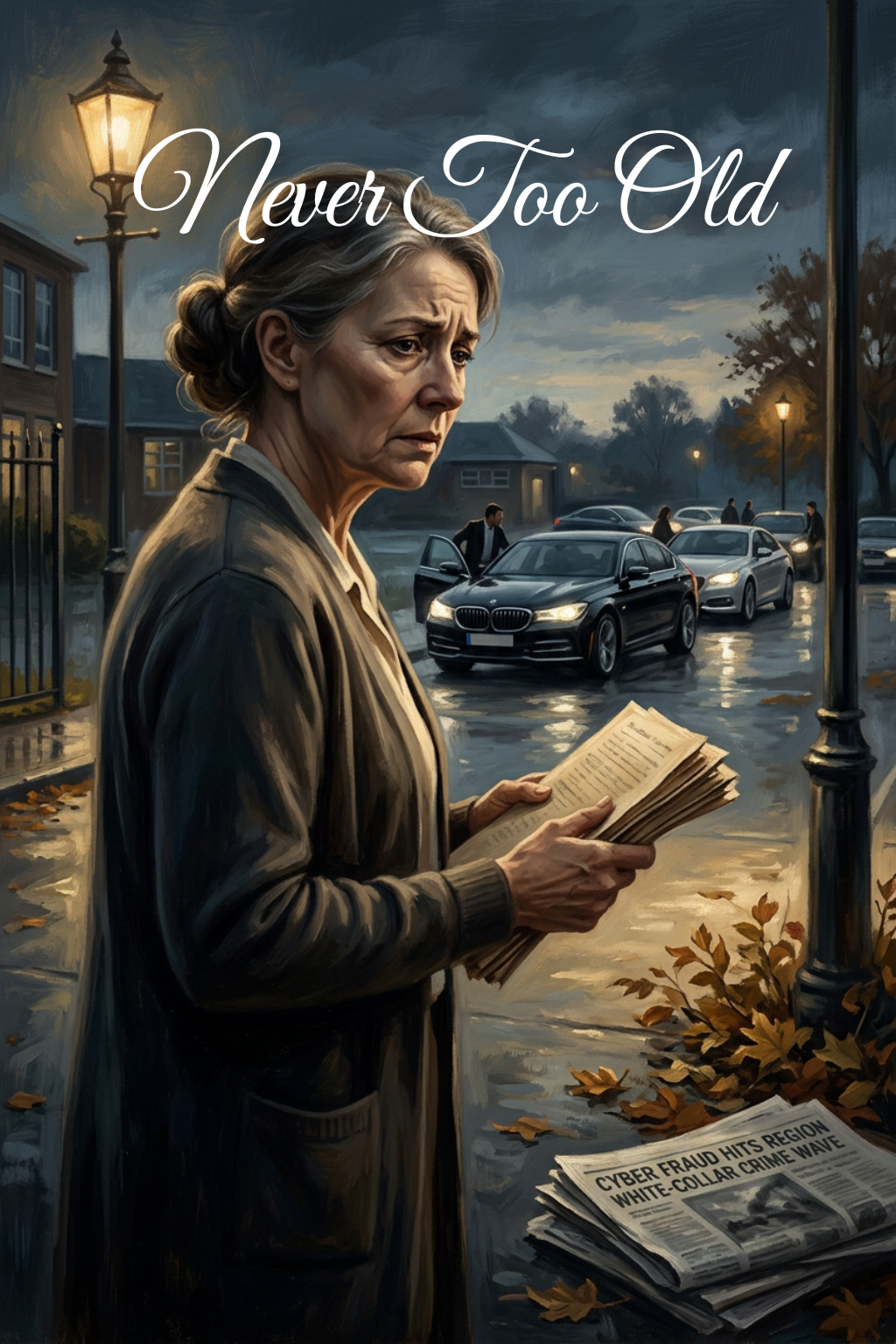
Novel · 8 chapters · 32,899 words
Never too old
Contents8 chapters
Chapter 1
The Cars in the Drop-Off Line
Margaret Vale was halfway across the crossing with her whistle between her teeth when the first one rolled in.
Not rolled, exactly. Glided.
It came up School Road with a low, expensive hush that did not belong among the dented utes and child-seat-stuffed hatchbacks of Wattle Creek Primary. Deep charcoal paint, windows dark as welding glass, chrome catching the pale morning sun in hard white flashes. It slowed at the gate while Year Three boys in oversized hats dragged their feet over the yellow lines, and Margaret put up one hand without looking at the driver. The vehicle stopped so neatly it seemed to resent braking.
“Move along, Noah,” she said around the whistle. “You know better.”
Noah skipped the last two stripes, grinning at her, and made for the path with his backpack thumping. The car idled at the curb. When she reached the gate and turned, she saw who was at the wheel.
Tracy Bell.
Margaret stopped with one hand on the latch.
Tracy leaned over from the driver’s seat, sunglasses still on, all white teeth and glossy ponytail. “Morning, Mrs Vale,” she called through the open passenger window. “Bit of a beast, isn’t she?”
In the back, little Cooper Bell climbed over a booster seat, wrestling one shoe onto his heel. His lunchbox had fallen open and crackers were scattered over leather the colour of cream.
Margaret knew Tracy Bell’s beast. Two years ago it had been a twelve-year-old Corolla with a bumper tied on with fencing wire. Tracy worked three days a week at the pharmacy in town. Her husband laid turf when there was work and repaired ride-on mowers when there wasn’t. Last winter Tracy had sent in a note apologising that Cooper’s excursion money would be late till Friday.
“It certainly is a large car,” Margaret said.
Tracy laughed as if that were praise from someone qualified to give it. “Safer for the roads. You know how the highway is.”
She reached back, scooped up Cooper’s hat, and put it on backwards. “Out you get. Kiss.”
Cooper planted a hasty peck on the air somewhere near her cheek and clambered down. Margaret watched the boy trot through the gate, one lace trailing, while Tracy guided the machine into the drop-off lane with the confidence of someone who had never had to worry about a scratch in her life.
The whistle tasted metallic. Margaret let it hang on its cord against her chest.
Behind the Bell vehicle came the usual procession: a white Hilux with two sheepdogs spinning in the tray, a faded Subaru wagon spilling out twins and violin cases, old Mrs Cranley delivering her granddaughter in a sedan so battered the rear door had to be shouldered open from inside. The school morning settled around her in familiar fragments—the squeal of the oval gate, lorikeets in the gums, the smell of sunscreen and warm dust and a faint drift of coffee from the staffroom urn through an open window.
She might have let the thing go then, filed it under lottery win, inheritance, foolish debt. Country towns bred explanations as quickly as rumours. But ten minutes later another four-wheel drive turned in.
This one was pearl white and even larger. It sat high on polished alloys, roof racks empty but assertive, a bull bar broad enough to fend off cattle. There was no mistaking the woman driving it either.
Janelle Ross had taught canteen volunteers the cost of every sausage in bread as if the budget were pinned to her own skin. At the Easter raffle she had asked, apologetic and red-faced, whether she could pay for three ticket books the following week after Wayne got his hours. Wayne Ross stacked shelves at the IGA on night shift. Janelle cleaned holiday cabins out by the creek when there were bookings.
Now Ellie Ross climbed down from the back seat of a vehicle that smelled, when the door opened, of new plastic and expensive air freshener—something sharp and citrusy that cut through the dust. She held her violin case against her chest and looked up at the car before shutting the door carefully with both hands, as if she had been instructed.
Margaret bent to straighten the child’s collar. “New wheels, Ellie?”
Ellie’s eyes flicked to her mother. Janelle was busy with her phone, face angled down, thumb moving fast. The screen’s light reflected in her sunglasses.
“Mum said don’t kick the doors,” Ellie murmured.
“A sensible rule.”
Ellie nodded, but she still glanced back once as she walked away, checking the car, checking her mother. Margaret watched Janelle pull off without looking toward the crossing guard or the children at all.
By the time the bell rang, Margaret had seen a third.
Mick Darlow, who delivered gas bottles and had once come to parent-teacher interviews smelling of diesel and singed rope, coasted to the curb in a black LandCruiser with tan trim and a pair of fishing rods sealed untouched in plastic on the roof. His twin boys hopped out in clean boots. Mick did not meet Margaret’s eye. He kept both hands on the wheel and stared past her at the flagpole while the boys slammed the doors.
“See you, Dad,” one of them shouted.
Mick lifted two fingers and drove off.
Margaret stood in the lane a moment longer after the last child had gone through, the empty road shimmering beyond the school sign. Wattle Creek had one mechanic, one pharmacy, a pub with a warped billiard table, and a bakery that closed if Rhonda’s arthritis was bad. It did not, as a rule, bloom with luxury vehicles between one term and the next.
“Mrs Vale?”
She turned. Little Asha Kumar stood by the office garden, clutching a recorder in both hands. “Do we line up outside music today?”
“Yes, darling. Bag on the hook first.”
Asha nodded and ran off, plaits bouncing. Margaret looked once more at the road, then shut the gate.
By recess she had nearly convinced herself she was being foolish.
Week Nine always sharpened people. Children grew noisy and stupid with the scent of holidays in the air. Teachers misplaced notices, snapped at photocopiers, drank tea gone stewed in forgotten mugs. Margaret spent the morning with her Year Five class reading Banjo Paterson and refereeing a dispute over whose turn it had been on the class iPad. At ten-thirty she confiscated a packet of sour lollies, wrote a note home about persistent talking, and forgot entirely about Tracy Bell’s gleaming dashboard until she crossed the quadrangle carrying her lunch tin and saw the white four-wheel drive again.
It was parked beyond the admin block, in the spot marked VISITORS, nose angled toward the assembly hall.
Janelle Ross sat in the driver’s seat with the engine off. Another man stood beside the passenger door, half turned away. Tall. Work shirt. Sun on a shaved head. He held a cardboard box against his hip.
Margaret slowed.
The man leaned down to the open window. Janelle said something Margaret couldn’t hear. The man shook his head once, sharply, and glanced toward the hall. When he saw Margaret on the path, his face changed—not guilt, not exactly, but a flattening, as if a blind had dropped behind the eyes. He straightened at once, tucked the box under one arm, and walked off along the building.
Margaret saw the tattoo on the back of his calf before his shorts hid it again when he rounded the corner. Black ink, a looping shape. Not enough to place.
Janelle started the car and drove away.
In the staffroom, someone had burnt toast. The smell sat over everything. Sharon Mills was rinsing yoghurt from a spoon at the sink while the deputy, Peter Latham, stood by the fridge peeling an orange in one long spiral.
Margaret set down her lunch tin. “Has Janelle Ross been in to the office?”
Peter looked up. “Today?”
“She’s just been parked by the hall.”
“Could have had uniforms.” He shrugged. “Lorraine does collections this week.”
Sharon snorted. “If the Rosses can afford uniforms from the school supplier all of a sudden, miracles do happen.”
Margaret glanced at her. “You noticed the car.”
“Hard not to. It takes up half the lane.” Sharon dried her spoon on a tea towel. “And the Bells’ new one. And the Darlows’. I said to Kev this morning, either someone struck oil in Wattle Creek or we’re all in the wrong business.”
Peter flicked pith into the bin. “People buy cars on finance.”
“Three of them?” Sharon said. “At once?”
“It’s none of our business.”
His tone was light, but it landed with a little slap. Margaret opened her lunch tin: two sandwiches in wax paper, half an apple, and the Anzac biscuit she allowed herself on Thursdays. “Not our business,” she repeated. “No. Though it’s surprising.”
Sharon leaned one shoulder against the counter. “I heard Tracy Bell’s husband’s cousin does cash jobs over near Berrinba. Fencing, maybe. You know how stories grow.”
“Cash jobs buy that?” Margaret said.
Before Sharon could answer, the staffroom door swung in hard enough to knock the wall. Dean Mercer came through carrying a folder and his stainless-steel coffee cup.
He was one of those men who wore energy like cologne. Mid-forties, trim, dark hair disciplined by product, shirts with the school logo embroidered over the pocket. He had arrived at Wattle Creek three years earlier speaking briskly about metrics and parent engagement and fresh directions, and half the town had admired him on sight. Margaret had never entirely trusted people who smiled with all their teeth in every photograph.
“Staff meeting moved to Tuesday,” he said to the room at large, though there were only three of them in it. “Peter, can you email everyone?”
“Sure.”
Dean set his folder on the table and took the lid off his cup. His eyes moved over them in that quick way of his, taking stock. “What’s surprising?”
Sharon had the poor instinct of people who could not resist a poke. “Just admiring the prosperity of our school community.”
Dean sipped. “Meaning?”
“The parade of new four-wheel drives out front.” She smiled. “Makes my Forester feel like a wheelbarrow.”
There was a small pause. Margaret heard the hum of the fridge, the click as Peter dropped orange peel into the bin. Dean replaced the lid on his cup with care.
“Well,” he said, “good for them.”
Sharon lifted her brows. “You don’t find it odd?”
“No more odd than anyone else spending their own money.” His smile remained, but it had gone thin around the edges. “I’d be careful with that sort of talk, Sharon. Families hear things. We’re not here to speculate about parents’ finances.”
“Speculate?” She laughed once. “I merely said—”
“You implied something.” Dean turned to Margaret then, perhaps because she was older, perhaps because she had not yet spoken enough to be pinned. “We set the tone in this school. If parents are feeling judged in the drop-off line, that becomes a problem.”
Margaret folded the wax paper from her sandwich into a square. “No one has been judged.”
“Let’s keep it that way.” He picked up his folder. “There’s enough gossip in a small town without staff feeding it.”
He left as abruptly as he had entered.
For a moment nobody spoke. Peter bit into his orange segment. Sharon muttered, “Touchy,” and reached for the kettle.
Margaret looked at the closed door.
It was not the reprimand itself that troubled her. Dean managed by trimming anything untidy before it could spread; he called it professionalism. It was the speed of it. The way he had stepped into the conversation already braced, as if he knew what would be said before Sharon opened her mouth. And Janelle Ross by the hall. And the box in the stranger’s arms.
“You all right?” Peter asked.
Margaret realised her sandwich remained untouched in her hand. “Of course.”
But the biscuit stayed in the tin.
The rest of the school day dragged a little, then rushed. Children painted bilbies with blunt watercolours. The office sent round a notice about head lice in Year Two. At three-fifteen the buses coughed away in a ribbon of red dust, and the grounds quieted to the cries of currawongs in the reserve behind the oval.
Margaret was stacking readers in the cupboard when Lorraine from the front office tapped on her door frame.
“Dean wants the excursion forms from last term if you’ve still got them.”
“Now?”
“He says before he leaves.”
Margaret wiped chalk from her fingers onto a tissue. “I’ll bring them.”
The admin office smelled of printer toner and hand sanitiser. Lorraine sat behind the counter with her cardigan buttoned crookedly, chewing the arm of her glasses while she reconciled receipts. Through Dean’s open door Margaret could see him standing by the filing cabinet, one hand in the top drawer.
“I’ve got those forms,” she said.
He turned too quickly, then smiled. “Margaret. Thanks.”
She held out the folder. As he took it, a manila envelope slid from the top drawer and fell to the carpet between them.
A thick one. Not sealed. The mouth gaped open just enough for Margaret to see bands of fifty-dollar notes packed inside.
Dean bent and snatched it up in one movement, almost graceful. “Christ,” he said lightly. “Petty cash for camp reimbursements. Lorraine keeps overstuffing things.”
From the front desk, Lorraine called, “Not mine.”
Dean did not look at her. He slid the envelope into the drawer and shut it with his hip. “Anything else?”
Margaret met his gaze. “No.”
“Good. Try to have your semester comments in by Monday. The system closes Tuesday.”
He had already turned back to his computer. Dismissed.
In the corridor, Margaret paused beside the honour board with its brass nameplates and fading class photos. Through the office window she could see the visitor car park. Empty now except for Dean’s silver Prado and the groundsman’s ute. A magpie hopped over the gutter, tugging at something stringy.
Petty cash, he had said, though camp reimbursements at Wattle Creek tended to arrive as direct deposits if they arrived at all. And if Lorraine had nothing to do with it, why say her name?
At home, the silence in the house had a settled shape. Margaret unlocked the back door, set down her handbag on the cedar hall table, and stood a moment listening to the familiar small sounds: the refrigerator motor clicking on, a branch brushing the laundry window, the old wall clock in the dining room taking its measured bites out of the evening.
She lived alone now in the weatherboard cottage on Grevillea Street where she and Alan had raised two sons. One was in Perth with a surveying company and called every second Sunday unless a job sent him farther inland than signal reached. The other taught TAFE in Newcastle and was forever promising a visit next holidays, next long weekend, next month for certain. Alan had been dead eleven years. His boots were gone from beside the back step, his jackets gone from the hall cupboard, but from time to time she still caught herself listening for the soft slam of his ute door.
She changed from her school skirt into navy track pants and put the kettle on. The kitchen window over the sink looked out toward the reserve, paperbarks standing pale beyond the back fence. Children cut through there after school despite the signs. So did dogs, teenagers, drunks from the pub, and men who did not care for signs.
On the bench lay the local paper from yesterday, folded to the community pages. She had not got to it. While the kettle heated she turned pages with one finger, skimming netball results, a council dispute over verge mowing, a photograph of the Men’s Shed presenting bird boxes to the preschool. Bird boxes. The caption made her think again of the polished vehicles in the drop-off line, absurdly large and shining like beetles among the ordinary cars.
The kettle clicked. She made tea in her blue mug, added one biscuit from the tin, and carried both to the sitting room.
The six o’clock local news came on with its usual earnest music and bright aerial shot of the district—the river like dull metal, the highway cutting north, paddocks squared off under the late light. Margaret sat in Alan’s old armchair, though she had re-covered the cushions years ago, and watched the headlines crawl.
Roadworks delay. Hospital funding announcement. Then a young presenter in a navy blazer said, “Authorities are warning residents to report unusual activity in bushland and on rural properties after a spike in wildlife trafficking across the region.”
Margaret set down her mug.
The story cut to footage of police carrying wire cages from a shed. The cages were covered in hessian, but one had a claw hooked through the mesh, grey and curved. Another shot showed a cardboard crate stamped LIVE ANIMALS and a table laid out with heat lamps, plastic tubs, and clear deli containers punched with air holes. In one tub a coiled snake moved like poured oil.
The reporter stood outside a stockfeed warehouse in Berrinba, twenty minutes up the road. “Investigators say sulphur-crested cockatoos, black cockatoos, blue-tongue lizards, and several protected reptile species have been taken from reserves and private land over the past two months. The animals are often held temporarily in outbuildings or vehicles before transport to buyers interstate or overseas.”
Vehicles.
Margaret leaned forward.
A wildlife officer in a khaki shirt spoke into the microphone. “These networks don’t always look the way people expect. It’s not one bloke in a trench coat. We’re seeing ordinary community links used to move animals around—family properties, sheds, even places with a lot of daily traffic where comings and goings don’t draw attention.”
The footage changed again. A close shot of white feathers snagged on chicken wire. A rescued cockatoo under a towel, beak opening soundlessly. The reporter’s voice-over continued: “Officials say members of the public should watch for unusual numbers of crates, animal noises at night, or people entering reserve land with climbing gear, nets, or bait.”
Margaret felt, rather than heard, the spoon settle against the inside of her mug.
Wattle Creek School backed onto reserve land. Children wandered its edges every day. Parents came and went in a stream no one counted after hours. There were sheds, storerooms, old undercroft spaces beneath the hall where sports gear and broken desks had been dumped for decades. Plenty of daily traffic. Plenty of reasons for doors to be unlocked.
On the television, the presenter returned. “Anyone with information is urged to contact the hotline—”
Margaret muted the set.
The room seemed larger at once. The clock ticked in the dining room. Somewhere down the street a dog barked twice and stopped.
It was nonsense, she told herself. Country coincidence. New cars and a news segment. She was a schoolteacher nearly retired, not a detective in a paperback. She knew too well what suspicion did in small places. Once spoken aloud, it went from mouth to mouth and came back wearing a different face.
Yet the details would not sit still.
Tracy Bell, whose excursion money had been late.
Janelle Ross in the visitor bay with a stranger and a box.
Mick Darlow staring straight ahead as if eye contact itself cost too much.
Dean Mercer cutting the staffroom conversation off so fast the words barely left Sharon’s mouth.
An envelope thick with cash in the principal’s drawer.
Margaret picked up the remote, unmuted the television, and listened to the hotline number as if she meant to write it down. She did not. Instead she stood and went to the front window.
From there she could see the street under the jacaranda trees, the footpath mottled with old purple stains where the blossoms had dropped last month and been ground in by tyres. Mrs Henley from next door was dragging her green wheelie bin to the curb, muttering at one sticky wheel. Farther off, a pair of boys pedalled past on bikes too small for them, knees pumping high.
Ordinary. Entirely ordinary.
Across the room, her mobile phone buzzed on the side table. Her elder son’s face flashed on the screen, then vanished before she reached it. A message followed.
Can call later. In meeting. You okay?
Margaret looked at the words, thumb hovering, and typed back, Fine. Just missed you. Talk Sunday.
She set the phone down, but she did not return to the chair. Instead she went into the spare room where she kept old school files and wrapping paper and the metal filing cabinet Alan had rescued years ago from a council cleanout. On top of it sat three exercise books she had brought home to mark, and beneath them a stack of past newsletters from school.
She did not know precisely what she was looking for. That in itself annoyed her. Evidence, if she were honest, that she had already crossed from noticing into searching.
Margaret took down the newsletters and carried them to the dining table. Fete rosters. Reading challenge certificates. Thank-you notices to sponsors. A photo of Dean Mercer in a hard hat beside a pallet of donated mulch. She flicked through until she found the page listing P&C contributions and business support. Bell’s Turf Services had paid for new shade cloth two years running. Darlow Gas & Rural Supplies had donated barbecue cylinders for sports day. Ross Cleaning Services had no listing at all.
She fetched a pen. On the back of an electricity bill envelope she wrote three names:
Bell
Ross
Darlow
Then, after a pause, she added:
Dean?
The question mark bothered her. She pressed harder and nearly tore the paper.
From the back of the house came a faint sound.
Not inside. Outside.
A vehicle turning slowly into Grevillea Street.
Margaret went very still, pen in hand. Most evenings she would not have noticed. Traffic passed now and then—shift workers, teenagers, someone lost on the way to the caravan park. But this car moved at a crawl, gravel ticking under tyres, then stopping somewhere near her front fence.
She crossed to the sitting room without switching on the lamp.
Through the lace curtain she could make out only shape and shine at first: a large dark vehicle under the jacaranda shadow, engine idling. Higher off the ground than a sedan. Broad bonnet. Tinted side windows reflecting the streetlights just beginning to wake.
The charcoal four-wheel drive from the school gate.
Or one like it.
Margaret did not pull the curtain farther back. She stood with two fingers resting on the sill, listening to the engine hum. After a few seconds the brake lights flared red against the tree trunk, then went out. The vehicle rolled forward another yard and stopped again.
Looking for an address, she thought.
Watching, another part of her answered.
The driver’s window lowered a fraction. She could not see a face. Smoke drifted out, or breath, or nothing at all in the half-light. Then, from two houses down, a front door opened and somebody called, “You lost, mate?”
The engine note changed. The four-wheel drive moved off at once, picked up speed, and turned the corner without indicating.
Margaret remained where she was until the tail-lights disappeared. Only then did she realise she had been holding the pen so tightly its edge had marked a blue line across her palm.
On the dining table, the envelope lay under the ceiling light with the four names on it, the last one ending in that small, needling hook of doubt.
She looked from the paper to the dark window, and back again, while the house around her kept its own counsel.
Chapter 2
Feathers in the Playground
“Back from the toilets, thanks, and if I see one more child with a Zooper Dooper in class I’ll confiscate it and eat it myself.”
A few of the Year Fours laughed. Margaret took the tub of readers from the front table and passed the first row their books. The room still carried recess in it: sunscreen, hot asphalt, that faint sugar smell of fruit straps and muesli bars. Someone’s knees had tracked dust onto the mat. The fan above the whiteboard clicked every third turn.
“Page twenty-eight,” she said. “Silently first. Then we’ll hear it properly.”
Chairs scraped. Pages turned. Connor Pike, who never sat straight unless he was asleep, folded himself over his desk and began tracing each line with a blunt finger. Ellie Ross sat by the louvre windows, violin-case neatness somehow carried into the way she held a paperback. Her plait hung over one shoulder, ribbon loosened from the wind.
Margaret moved between the desks, checking mouths and eyes. Reading after recess was usually a rough business, children’s bodies still half outside, minds snagging on footballs and arguments and ants. Today there was another current in the room, less noisy but stronger. Twice she caught students glancing toward the windows facing the oval.
At the back, Noah Bennett had his book open and unread.
Margaret touched two fingers to his desk. “Page twenty-eight, Noah.”
He started as if she’d woken him.
“Yes, Mrs Vale.”
His ears were pink. There was dirt under one fingernail and a burr stuck in the cuff of his sock. Not unusual. Wattle Creek children grew burrs and scratches the way city children grew tantrums. But Noah kept looking past her shoulder toward the trees beyond the chain-link fence.
She let it go for the moment and went back to the front. “Connor. First paragraph.”
Connor stood, read three lines, got bogged on “migratory,” and sat down hard when she supplied it. The lesson found a rhythm. Child, paragraph, correction, child. The ordinary work of it soothed her more than she expected. Last night’s shape under the jacarandas had followed her into sleep and out again; all morning she had listened for the sound of a large engine and seen nothing but council utes and the bakery van.
When the final reader finished, Margaret set down her pencil. “Right. What tells us the dog in the story is frightened?”
Hands went up. Ellie’s. Asha’s. A boy near the sinks who answered every comprehension question with “because it was.”
Before Margaret could choose, a sharp noise rang from outside. Metal on metal. Then silence.
Half the room looked at the windows.
“Eyes this way,” Margaret said.
They looked back, but not all at once.
After literacy she sent the class to music with their recorders and borrowed ukuleles, then took the empty lunch containers to the bin outside the block. The path ran beside the junior playground, across from a strip of scrub the council insisted on calling a reserve. Paperbarks crowded the gully there, and blackened grass from an old burn still showed between new spear-green shoots. A narrow dirt track began near the fence and cut into the trees, not an official path but one children used anyway despite notices and stern talks and the deputy’s occasional patrol. It led, if you followed it far enough, toward the old irrigation sheds by the back oval.
Margaret dropped the containers into the wheelie bin and turned to go inside.
Something white snagged her eye.
On the fence, where the wire had been twisted years ago and left with one end sticking out, a feather had caught and wrapped itself there. It was longer than her hand, white with a grey shadow at the base. One side was matted. The blood had dried to rust.
Margaret stopped.
There were always feathers around a school. Magpies took scraps from lunch boxes. Corellas raided the fig near the hall and left down on the grass. But this was not down, and not a little puff from some schoolyard squabble between birds. It was a flight feather, split near the quill, with a smear of fresh dirt across one edge as though it had been dragged.
She looked along the fence line. At first she saw only couch grass, wrappers, a tennis ball half flattened in the weeds. Then a second feather lay under the bottlebrush, smaller and also white.
“Mrs Vale?”
Noah Bennett was standing at the corner of the block with his recorder case banging against his leg.
“Aren’t you meant to be in music?”
He didn’t move closer. “I forgot my red book.”
“So fetch it.”
His gaze slid to the feather, then away. He swallowed. “That’s from the bush.”
Margaret straightened. “What do you mean, from the bush?”
He shrugged too quickly. “Just is.”
“Come here a moment.”
He came by inches, face pinched with the effort of wanting not to. Margaret kept her voice level. “Have you been down this track after school?”
“No.” Too fast again. Then, softer: “Not all the way.”
“How far is not all the way?”
He looked toward the music room, measuring the risk of lateness against something else. “Past the tyres,” he said.
There were old tractor tyres half buried at the track entrance to stop bikes. Margaret waited.
Noah pressed his lips together. His eyes watered suddenly, not crying exactly but close enough to it. “Lachie and them go there,” he said. “To the sheds.”
“Which sheds?”
“The rusty ones. Near the big oval. Where they keep the pipes.”
“What happened there?”
His fingers tightened on the recorder case handle until the plastic creaked. “Nothing.”
“Noah.”
He took one breath and then the words slipped out. “I heard stuff.”
“What sort of stuff?”
“Crying.” He said it in a rush, as if getting rid of it. “Not people. Animals, I think. I said it was probably foxes but Lachie said foxes don’t sound like that.”
A teacher coming across the courtyard with a stack of art folders glanced at them and kept going. Margaret lowered her voice. “When did you hear this?”
“Yesterday. No, day before. After school.” He scuffed the dirt with one shoe. “There was a ute there.”
“What colour?”
“I dunno. White maybe. Or dusty.”
“Did you tell anyone?”
“No.” His face tightened. “Lachie said if we got caught there we’d get in trouble too.”
Of course. Children were marvellously efficient at policing one another when adults might be involved.
“Listen to me.” Margaret touched his shoulder lightly, enough to settle him. “You did the right thing telling me. You are not to go near those sheds again. Not you, not Lachie, not any of your friends. Do you understand?”
He nodded.
“And if anybody asks, you came back for your red book and I sent you to music. That’s all.”
He looked up properly then, startled by the permission in that. “Am I in trouble?”
“Not if you move.”
He moved. Off at a run, one lace untied.
Margaret looked back at the feather on the wire. Beyond it the bush track entered shade at once, the paperbark trunks close together, ground under them bare and dark. Something had happened out there. A dog after a bird, perhaps. A goanna raid. A child’s prank. The blood on the quill said otherwise, though she could not yet have said why.
She pinched the feather free with the corners of a tissue from her pocket and folded it carefully. Then she went to find Peter Latham.
The deputy was in the admin block wrestling the photocopier with one hand and eating dry Sao biscuits with the other. A stack of excursion forms sat on the bench beside him.
“It jams if you look hopeful,” he said when Margaret came in.
“I need you to do a fence check after lunch.”
He squinted over the copier lid. “For what now?”
She unfolded the tissue on the counter.
Peter leaned closer. “A feather.”
“With blood on it.”
He gave a one-shouldered shrug. “Bush school. Could be anything.”
“Exactly. Which is why I’d like someone to have a look at the track to the irrigation sheds.”
His chewing slowed. “Students been down there again?”
“One at least. He says he heard animals crying.”
Peter took another biscuit, perhaps to buy time. “Children hear all sorts of things.”
“Yes,” Margaret said. “And they also wander. That’s the point.”
He blew crumbs from his thumb. “Dean’s in meetings all afternoon.”
“I wasn’t asking Dean.”
“Margaret.” He lowered the copier lid with care. “We can’t go chasing every dead cockatoo in the district. Council handles wildlife. If the fence has a gap, put in a work order. If kids are trespassing, we remind families.”
The machine spat out a sheet with a black line down one side. Peter swore at it mildly.
She kept her eyes on him. “There was a vehicle near my house last night. One of the same kind that’s been dropping children here.”
That brought his head up. “Did you get a plate?”
“No.”
“So it might have been anyone.”
“Might have been.”
He pushed the copy aside. “Then be careful about joining dots that aren’t touching yet.”
The phrase irritated her because it was sensible. It also irritated her because it was meant to settle her. Margaret refolded the tissue. “Will you at least have grounds check the back fence?”
“Tomorrow morning.” Peter reached for another form. “I’ll tell Matt.”
“Today.”
He looked at her over the top of his reading glasses. They had taught together long enough for silences to carry rank. At last he said, “If Matt’s free.”
Margaret thanked him without warmth and left.
The afternoon dragged. Music bled through the demountable wall in halting scales. Someone in the next room was doing papier-mâché and the paste smell turned thick as porridge in the corridor. At final bell the school burst open. Bags thumped. Children called across the asphalt. Engines woke one by one in the pick-up lane.
Margaret took crossing duty at School Road and watched faces through windscreens.
Tracy Bell’s charcoal four-wheel drive rolled up first, polished even under dust, Cooper already unbuckling before it stopped. Tracy wore oversized sunglasses though the sun was lowering. Her forearm, tanned and bare, rested on the open window in an easy display of time and money. She did not glance toward Margaret.
Then Janelle Ross in the white vehicle, Ellie climbing in with her violin held upright between her knees. Janelle’s smile looked pasted on from a distance. She was speaking before Ellie had the door shut, chin jerking once toward the school as if finishing an argument nobody else could hear.
Mick Darlow came later in the black LandCruiser, a dog crate strapped empty in the tray. That was new. Margaret’s gaze snagged on it long enough that Mick noticed and gave her the thinnest nod, neither friendly nor hostile, merely a man acknowledging another human while wishing not to.
No sign of anything else.
When the line cleared and the road quieted, Margaret stood with the lollipop sign under one arm and looked past the buses to the back oval. The oval lights were off. Beyond them, low among the melaleucas, the old irrigation sheds sat in their little pocket of ground beside the reserve fence. One had lost half its corrugated wall years ago in a storm and been patched with mismatched tin. The other still had a roller door no one seemed able to lock properly.
Matt from grounds had not done the fence check. Or if he had, nobody had told her.
At quarter past four she signed out at the office, carried her bag to her Corolla, and then sat without starting it. Through the windscreen she could see the hall roof flashing dull in the late light and, beyond that, the first fringe of bush. A sensible person would drive home, ring council, ring the ranger, ring perhaps even the non-urgent police number and state only what she knew. A sensible person weeks from retirement would not go walking toward derelict sheds on school property because a child had heard crying and a feather had turned up on a fence.
Margaret put the key in the ignition and then took it out again.
By five o’clock the school was mostly emptied of sound. A cleaner’s van stood beside the admin block. Somewhere out near the netball courts a blower whined, then cut off. The western sky had gone from yellow to the flat tin colour that came before dusk. Margaret crossed the staff car park, skirted the cricket pitch, and headed for the bush track with her phone in one pocket and a small torch from her classroom emergency kit in the other.
At the fence she paused.
The place looked thinner now without children moving through it, every object less disguised by use. The bottlebrush leaves hung still. A lolly wrapper lodged in the wire gave one dry twitch. She found the snag where the feather had caught; there was a tiny smear left on the metal, almost black.
Margaret ducked through the opening beside the half-buried tyres and stepped onto the track.
The path was narrow but clear enough, tamped hard by sneakers and bike tyres. Dry eucalyptus leaves crushed underfoot with a brittle sound that seemed much too loud. Mosquitoes rose in weak little drifts from damp spots. To her right the reserve fell away into a drainage line choked with reeds and old shopping trolleys. To the left, through the trees, she could still glimpse the back fence of the school.
She kept going.
The paperbarks thickened after twenty metres. Their trunks were pale and peeling, strips of bark hanging in curled tongues. A plastic drink bottle lay half buried beside a root. Then the old tyres Noah had mentioned, sunk upright in the ground like giant black stepping-stones. Beyond them the track forked. One branch bent toward the creek bed. The other ran straighter, toward the oval and sheds.
Margaret took the straighter one.
There were signs, once she stopped hurrying her eyes. Fresh mud in a tread pattern too deep for children’s joggers. A flattened patch where something heavy had been set down. Two cable ties cut and discarded beside a stump. She crouched to look at them. White. Thick. Not the kind used on bread bags or classroom posters.
A noise carried through the trees.
Not crying. Not now. A dull thud, then another. Wood on metal perhaps. She switched off the torch she hadn’t yet needed and stood listening. The sound came from ahead, near the sheds.
Margaret moved again, slower. The track rose slightly. The school oval fence appeared through the scrub, rusted cyclone mesh with lantana pushing through it. Beyond it she saw the old pump housing and, farther on, the first shed roof.
Voices. Men’s voices, low and blurred by distance.
She crouched behind a clump of wattle saplings and looked.
The sheds sat in a scraped patch of dirt between the oval fence and the reserve boundary. One was open. A ute had been reversed almost to the doorway, tray facing in. Not council. Not school. White, dust-coated, with a blue tarp thrown over something in the back. Another vehicle stood beyond it, partly hidden by the remaining wall of the second shed. She could only see a dark bonnet and the edge of a headlight.
Two men were at the open shed. One lifted, the other guided. Crates. Not cardboard this time. Plastic stacker crates with lids, the sort used for produce or fishing gear, but these had hessian thrown over them and secured with bungee cords. They handled them carefully, not like tools or rubbish.
Margaret leaned forward without meaning to.
The man nearest the tray straightened, braced one hand in his lower back, and turned his head to say something over his shoulder.
Dean Mercer.
Even at that distance she knew the set of him: the broad pink face gone ruddy in the evenings, the expensive sports shirt he wore on casual Fridays, the way he planted his feet as if always addressing an assembly. He was not in a suit jacket now. He was in work boots and a faded polo, and he had both hands on the end of a crate while the other man pushed from inside the shed.
The second man stepped into view.
Tall. Ropey through the shoulders. Black singlet. Tattoo wrapping his left forearm and disappearing under the sleeve line. Not enough to see the design, but enough to hit Margaret with the memory of a visitor parking bay, Janelle Ross, a cardboard box, and the way the man’s head had snapped toward her.
Her breath went shallow.
Dean said something. The tattooed man answered with a short movement of his chin and jumped down from the shed lip. Together they slid the covered crate into the ute tray and set it snug against two others already there.
From one of the crates came a sound so faint she might have invented it: a rapid scrabble, then stillness.
Margaret did not move.
Dean looked around the clearing in the offhand way of a man checking for a dropped tool. Not alarmed. Not yet. He wiped his hands on his shorts, crossed to the dark vehicle, and opened a rear door. More hessian. More crates, smaller ones this time.
Organised, she thought, though the word arrived not as conclusion but as chill.
She fumbled in her pocket for the phone. The screen lit blue against her palm. Too bright. She turned it down with clumsy fingers, lifted it just enough between leaves, and framed the clearing. The image shook. She took one shot. Then another. On the third, the shutter click sounded obscenely loud even though she knew it was electronic and muted.
The tattooed man stopped.
Margaret went rigid.
He stood with one hand on a crate and looked toward the trees. Not directly at her, not immediately. Listening. Dean kept talking, unaware. The man held up a finger for silence.
Then, from somewhere behind Margaret in the scrub, a branch cracked.
Not an accident. Too clean. Close. Deliberate.
She spun. Nothing visible but trunks and thorny undergrowth. Another sound came from her left this time, a rush through dry leaves as if something large had moved a step and then stopped.
Her scalp tightened.
Someone else was in the bush with her.
She backed up, eyes trying to work in three directions at once. Ahead, the clearing. Left, scrub. Behind, track. A low whistle came from the sheds—Dean now, sharp with question. The tattooed man set down his crate and started toward the tree line.
Margaret turned and moved.
At first she tried for quiet. That lasted two strides. Then a twig snapped under her shoe and caution became speed. She half-ran down the track, branches flicking her sleeves, bag thumping her hip. Behind her she heard voices, louder now. One man. Then another. Not words she could make out. The blood beat in her ears.
The path forked and for one stupid second she could not remember which branch she had taken. Left was darker. Right had the tyre sunk in the ground with a white scuff on it. She went right.
Something crashed through scrub parallel to her.
Human pace. Not animal.
Margaret’s chest burned. She hit a patch of loose sand and skidded, caught herself on a paperbark trunk, bark peeling into her palm. The phone nearly flew from her hand. She clutched it harder and kept going.
Another crack, closer. A voice behind and to the side: “Hey!”
Not calling for help. Calling to halt.
She did not.
The school fence flashed ahead through the trees. The opening by the tyres. If she could reach the open ground by the junior playground, lights from the admin block still on, cleaner’s van, possible witnesses—
A shape moved in the scrub to her left, low and quick. Margaret flinched hard right and ran straight into a drooping branch that slapped across her face. Her glasses shifted. She tore them off before they fell, shoved them into her cardigan pocket, and kept going half-blind.
Then, clear and ugly in the hush between her footfalls, came a sound from back near the sheds.
A bird screaming.
Not magpie, not currawong, nothing free. A hoarse tearing cry cut short as if by a hand over it.
Margaret reached the fence opening and stumbled through, scraping her shin on wire. The school side felt no safer for being familiar, only more exposed. Open dirt. Playground beyond. The low block of classrooms catching the last of the light.
She did not stop until she reached the concrete path by the demountables. There she bent, hands on knees, dragging air into herself that tasted of dust and iron.
Silence behind her.
No one came through the fence.
After a moment a door banged near the cleaner’s van. A man in fluorescent work trousers stepped out carrying a black rubbish bag. He glanced at Margaret, took in perhaps a teacher out of breath, and went about his business.
She straightened carefully and walked, because running now would draw eyes, toward the staff car park. Her knees felt unreliable. At the Corolla she unlocked the driver’s door and got in, then immediately locked it again. Only then did she look at the phone.
Three photos.
The first mostly leaves and dusk. The second better: white ute, one covered crate, Dean turned three-quarters away but recognisable if you knew him. The third blurred by movement, though the tattooed man’s arm showed clear enough, reaching.
Margaret sat very still.
A knock came on the passenger window.
She jerked sideways with a noise she would later deny making.
Dean Mercer stood there, one hand lifted in a small apologetic wave.
He smiled when she lowered the window two inches. “Didn’t mean to frighten you. Long day?”
He was breathing evenly. Too evenly. His face showed no sign of a chase through scrub, no sweat except the ordinary sheen of evening. Either he had not followed her or he had taken his time. Behind him, in the failing light, the oval lay broad and empty.
Margaret kept both hands in her lap so he would not see one shaking. “I might say the same to you.”
“Just locking up.” He glanced toward the back of the school. “You all right?”
“I went for a walk.”
“In there?” His eyebrows rose, mild concern. “Not the best idea after dark.”
“It’s not dark yet.”
“No, but it will be.” He rested an elbow on the roof of the car as if they were discussing nothing more dangerous than the P&C raffle. “Peter mentioned you were worried about the fence.”
“Did he.”
“Said you found a feather.”
Margaret watched him. “A bloodied one.”
Dean’s smile thinned but held. “Foxes get into the reserve sometimes. We’ve had plovers taken before. Nature’s not very tidy.”
From the rear of the school came the distant slam of metal. Dean did not turn his head.
“Is that what you were doing out there?” Margaret asked. “Tidying nature?”
He chuckled once, without sound. “There’s a phrase. I was checking old irrigation stock with a contractor before end-of-term disposal. Very boring, I promise.”
“Boring things usually happen in daylight.”
“That depends how many interruptions you’re trying to avoid.”
The answer landed between them and stayed there. A cleaner’s radio started up somewhere nearby, all static and one line of a country song before being turned down.
Margaret said, “There are children on those tracks after school.”
“There shouldn’t be.”
“But they are.”
Dean’s gaze sharpened. “Then perhaps we need to remind staff not to let them linger unsupervised.”
Not let them. As if the children’s movements were a matter of timetables and whistles and not the simple fact of a patch of bush drawing them like water. As if the burden already sat where it could most conveniently be placed.
Margaret leaned nearer the slit of the window. “I heard an animal.”
For the first time his expression changed. Not much. Just a pause, a tiny stillness around the eyes.
Then he shrugged. “You heard one, or you think you heard one?”
The difference was a blade. She saw him put it there for her to step on.
Dean straightened from the car. “Go home, Margaret. It’s been a big term. Retirement creeps up on people in odd ways.”
He tapped the roof lightly, two knuckles, principal to veteran teacher, friendly enough for anyone who might be watching from a distance.
Then he walked away across the car park toward the admin block.
Margaret waited until he was inside before she raised the phone again and enlarged the second photo. The image broke into grain. White ute. Covered crate. Dean’s profile. Behind him, half-hidden by the shed wall, something she had not seen in the moment: a child’s drink bottle on the ground near the doorway, bright green with a dinosaur sticker peeling off the side.
She stared at it.
Not proof. Not yet. It could have been dropped weeks ago by any student who’d ignored the rules and gone exploring. It could mean nothing. Or it could mean children had been closer than anyone knew, close enough to hear what was inside those crates, close enough to be seen.
Her thumb hovered over Peter’s name, then over the local police station, then over her elder son’s message thread as if common sense might somehow be found there.
Instead she opened a new contact search and typed Ravi Singh.
The number still sat in her phone from a Christmas card two years earlier, back when he had come to speech night with a camera around his neck and told her he was stringing for the district paper until someone in Brisbane noticed him. Margaret had not called him since.
She looked once more toward the dark seam of bush behind the oval.
In the trees, just beyond where the fence line disappeared, something pale moved and held—a face, a shirt, bark catching the last light; she could not tell which.
Then her phone began to ring.
Chapter 3
The Shed Beyond the Paperbarks
Margaret nearly dropped the phone.
The pale shape in the trees vanished as the screen lit in her hand. Unknown number. Not Ravi.
She let it ring twice, still staring at the fence line, then pressed answer and said nothing.
Breathing. A scrape, as if the caller had shifted the handset against denim. No voice.
“Who is this?”
The line went dead.
For a second she sat rigid in the Corolla, listening to the tick of the cooling engine and the far, thin yelp of children being collected at the road. Then she hit Ravi’s number before she could talk herself out of it.
He answered on the fourth ring, words rushing in over newsroom noise. “Mrs Vale?”
The old honorific struck her harder than it should have. A room came back in one clean slice: Ravi at ten, hair sticking up, ink on his thumb, reading a bushfire report aloud like it mattered to Parliament.
“It’s Margaret now,” she said. “Are you somewhere you can talk?”
A pause. A chair scraped. The noise behind him dulled. “What’s happened?”
“I’ve seen something at the school. Not in a staffroom-gossip way. I mean something that should not be there.”
He heard enough in her voice to stop asking the wrong questions. “Are you safe?”
“I’m in my car.”
“That wasn’t exactly the question.”
Margaret looked again toward the reserve. Nothing moved beyond the paperbarks except the slow thickening of dusk. “For the moment.”
“Tell me.”
She did, though not elegantly. The feather on the fence. Noah’s frightened face in class. The track. The white ute. Dean Mercer at the sheds. The covered crates. The scream she could still feel between her shoulders. When she got to the green drink bottle in the photograph, Ravi swore softly.
“You’ve got pictures?”
“Not good ones. Grainy.”
“Doesn’t matter. Don’t send them yet.”
“Why not?”
“If someone’s already jittery enough to prowl your street and call you breathing down the line, I’d rather they didn’t intercept anything. Can you drive somewhere public?”
“I am not twenty-two.”
“No,” he said, and she heard the quick smile he was trying to hide. “You’re the woman who once made me rewrite an entire article on Federation because I used the word good six times in one paragraph. Drive somewhere public anyway.”
There was a bakery on the corner of Main and Tucker that stayed open late for tradies and nurses heading off shift. She told him that. He said he’d be there in fifteen minutes.
He beat her by three.
Ravi Singh stood outside the bakery window with a takeaway cup in one hand and a camera bag looped over his shoulder. He had broadened since school, not in the gym-made way of boys who wanted themselves looked at, but as men do when they spend too much time in cars and at desks and think meals can be solved with service-station sandwiches. His hair was shorter than she remembered. His face wasn’t. The old quickness was still there, in the eyes and in the way he scanned the parking bay behind her before opening her door.
“You shouldn’t have come alone,” he said.
“I wasn’t going to ask a committee.”
“Fair.”
Inside, the bakery smelled of fryer oil, sugar glaze and burnt coffee. A teenage girl in a visor wiped down a cabinet of sausage rolls with the blank, practised resentment of the underpaid. Ravi chose a corner table with a view of both the street and the till. Margaret noticed that and disliked noticing it.
He slid into the seat opposite. “Show me.”
She passed him the phone.
He enlarged the first image, then the second. His jaw shifted once. He did not hand the phone back straight away.
“That’s Dean,” he said.
“Yes.”
“And that”—his fingertip hovered over the edge of the frame—“that’s not just any contractor.”
“You know him?”
“I know the tattoo.”
Margaret leaned forward. On the blurred slice of arm, visible between sleeve and glove, a dark shape hooked around the wrist and climbed toward the forearm. At the time she had taken it for nothing more than a snake or strip of tribal nonsense. Ravi pinched the image wider.
“Death adder,” he said. “Or meant to be. A local bloke named Troy Mease has one very much like it. Used to run reptiles for birthday parties, school fetes, shopping-centre animal displays. Lost his wildlife permit two years ago.”
“For what?”
Ravi sat back as the girl behind the counter dropped a metal tray too hard into the sink. The crash made both of them glance up.
“He said he filed paperwork late. Department said enclosure breaches, unregistered transfers, species discrepancies. Which means things on lists that shouldn’t have been there, things missing that were supposed to be there, or both. There were rumours he was selling to collectors out west and claiming stock had died. Never got enough to print.”
“You think this is him.”
“I think I’d know that tattoo on a less blurry day than this.” He pushed the phone back to her. “And I think if Troy Mease is lifting crates behind a primary school with your principal, it’s not because they’re clearing old hoses.”
Margaret wrapped her fingers around her teacup and found it was empty. She had no memory of drinking it.
Ravi opened his notebook. Proper paper, spiral-bound, corners bent. “Start at the beginning and do it slow.”
So she did. This time he stopped her. Asked where Dean had stood in relation to the ute. Asked whether the hessian was tied or tucked. Asked if she had smelled bird musk or snake room, though he called it reptile ammonia, which was less picturesque and more exact. Asked about the bottle, its colour, the sticker on it. When she said green with a dinosaur, he scribbled something and frowned.
“What?”
“Nothing yet.” He tapped the pen against the page. “You said Noah mentioned a white ute before you ever went back there?”
“Yes.”
“And kids use that track after school.”
“They shouldn’t. They do.”
“Who’s complained?”
“Me. More than once. A few parents, when they’re in the mood to notice where their own children are. Peter says we can’t fence every metre of bush. Dean says the same thing with a tie on.”
Ravi nodded, not because he agreed but because it fitted. “There’ve been raids the last month. Berrinba, Koorala, two properties outside Merton. Lorikeets packed into cat carriers, shinglebacks in feed bins, black cockatoos with flight feathers cut so they wouldn’t smash themselves trying to get out. Police keep saying the same line—that these networks use ordinary places because nobody sees what’s right in front of them. Sheds. Men’s garages. Stock trailers. Community buildings.”
“Schools?”
He hesitated a beat too long.
“You’ve heard that before.”
“Not a school exactly.” He lowered his voice, though the girl at the counter was now studying her phone with complete indifference to them. “A childcare centre in Toowoomba had an unused maintenance shed sublet through a fake landscaping company. Turned out they were holding turtles there before moving them south. Nobody in the centre knew. Or if they did, nobody admitted it.”
Margaret looked through the bakery glass at the line of parked cars and saw, layered over them, the bright school drop-off of that morning: polished paint, anxious children, parents calling reminders through cracked windows. “Why there?” she said. “Why anywhere near children?”
“Because people think certain places are above suspicion. Also because parents come and go all day. Vehicles on school grounds don’t stand out.” He closed the notebook. “You said there were other names. The expensive cars.”
She told him. Tracy Bell. Janelle Ross. Mick Darlow. The envelope of cash in Dean’s desk. Janelle with the tattooed man by the hall. Mick’s dog crate strapped empty in the back of the LandCruiser. The charcoal four-wheel drive outside her home. Ravi listened without interrupting this time, but she could see him sorting the pieces, testing how they might touch.
“Bell’s husband does roofing, doesn’t he?” he said.
“Sometimes. When there’s work.”
“Ross is shelves and night shift. Darlow takes odd jobs and swears each one is his last.”
“You know everyone.”
“I report court rounds in a district the size of a dinner plate.” He rubbed a hand over his mouth. “That doesn’t prove anything. People buy stupid cars on stupid loans every day.”
“No,” Margaret said. “But not all at once. Not with cash falling out of desk drawers and men breathing down telephones.”
His expression changed at that. “The call. Tell me again.”
She did. He wrote down the time.
“Could have been a scare tactic,” he said. “Could have been someone making sure you were alone. Could have been a child with a blocked number and bad manners. I don’t like any option.”
The girl behind the counter called last pies. Nobody moved.
Ravi looked up at the clock above the drinks fridge, then back to Margaret. The impulse arrived in his face before the words did. She saw him decide whether to say them.
“There’s a place,” he said. “Not the irrigation sheds you saw. Another one.”
She waited.
“Crown strip behind the school boundary, technically old council storage. Half-swallowed by paperbarks. Years ago they kept mowing gear there when the sports fields were being done up. Now it’s supposed to be empty. I’ve had a tip twice in six months about lights out there after dark.”
“From whom?”
He gave a small shrug. “One of those men who know everyone’s bins and everyone’s business. He drinks too much and notices more than is good for him. First time he said he saw a ute backed up to the side door. Second time he said he heard birds at two in the morning and thought someone was keeping aviaries.”
“Why didn’t you follow it?”
“I did. Gate was chained. By the time I came back with someone from council in daylight, there was dust, mouse droppings, nothing else. The lock had been changed.”
Margaret felt the back of her neck tighten. “And now?”
“Now if someone’s using the school side for loading and the reserve side for holding, that second shed starts to matter.”
He was already reaching for his keys.
“Ravi.”
He looked at her.
“We are not calling this journalism if it involves trespassing.”
“Of course not.”
“What are we calling it?”
He slung the camera bag over his shoulder again. “A walk.”
The paperbarks along the reserve edge were white in the headlights, their bark peeling in curled strips that flashed and vanished as they drove past. Ravi killed the beams before the last bend and eased the ute—older than anything Margaret had expected a reporter to own, tray full of milk crates and extension leads—into a gravel lay-by screened by wattles.
“No lights until we need them.”
Margaret had brought her torch from the Corolla. Its batteries were weak. He handed her a smaller one from the glovebox that felt solid as a tool. “Use this instead.”
They crossed on foot through knee-high grass silvered by moonlight. Crickets sawed from the ditch. Somewhere beyond the trees a motorbike whined and then cut off. The school sat as a blacker shape against black, low roofs and guttering, the hall rising above it. Margaret knew every classroom in daylight, each chipped step, each mural dulled by sun. At night the place withdrew from her. Windows became blind squares. Play equipment looked assembled for another species.
Ravi held her lightly by the elbow where the ground dipped. She should have shaken him off and did not.
The shed stood farther back than she had pictured, not visible from the road or the school unless you knew exactly where to angle yourself between the trunks. Corrugated iron. One roller door rusted down. One side door with a chain through the handles. The roofline sagged over one corner where a branch had come down in some past storm. A council stencil, almost gone, marked the wall in flaking green letters.
Ravi crouched by the chain and touched it. “New.”
The padlock shone dull brass. Around it the hasp was scored with fresh silver marks.
“Can you open it?”
He glanced at her. “Mrs Va— Margaret. If I say yes, you can decide whether to remain technically innocent.”
She folded her arms. “Get on with it.”
The tools came from his camera bag, not because he lived a secret criminal life, he muttered, but because regional reporting sometimes required getting through gates when councils forgot to leave keys where they said they would. A flat wedge. A short bolt cutter with tape around one handle. He worked quickly, shoulders tucked, pausing twice to listen. Metal gave with a clipped snap that sounded far louder than it should have.
They froze.
Nothing answered except frogs from the drainage swale.
Ravi lifted the chain free and eased the door open an inch. Air breathed out, thick and stale and carrying a rank sweetness that tightened Margaret’s throat. Not bird, not exactly. Warmer. Dirtier. Alive until very recently.
He shone the torch low first. Concrete floor. Feed sacks stacked against a wall. A coil of extension cord. One overturned plastic tub.
Then they went in.
Heat hit Margaret at knee level. Several ceramic heat lamps still glowed red in metal fittings clipped to a frame that had once held shelving. Someone had unplugged half the setup in a hurry; the remaining lamps hummed over emptiness, washing the shed in a butcher’s light. On the far side stood rows of wire units and timber racks, all bare. The cages themselves were gone. Their absence made shapes in the dust where they had been.
“Jesus,” Ravi said softly.
The floor was stippled with droppings, shed skin fragments, seed husks, clotted feathers no bigger than a thumb. Along one wall sat shallow trays with cloudy water and pellets softened to paste. A smell of mice came off a lidded bin in the corner. Margaret did not need it opened to know what it held.
She moved with care, torch beam skimming. Her shoes stuck once to a patch of something syrupy. Beside the wall, several plastic crates had left damp rectangles on the concrete, as if they had only just been lifted. One still held a scatter of bark chips and a length of frayed zip tie.
“Minutes,” Ravi said behind her.
“What?”
“They were here minutes ago. Maybe an hour. Those lamps are too warm.”
He knelt near the racks, touched the concrete, brought his fingers up. “Still holding heat.”
Margaret swallowed against the taste in the back of her mouth. “From what?”
“Snakes. Lizards. Maybe birds in carriers under cover.” He pointed the torch to a shelf bracket where pale dust shimmered. “Scales.”
She bent closer. Not fish scales, as her mind first tried to make it. Thin translucent flakes, some no bigger than a fingernail clipping, caught in the splintered grain.
On the ground beneath the lowest rack lay a child’s muesli bar wrapper folded into itself and a bent orange straw. Not old. No dust on either.
Her chest went tight. “Children have been in here.”
“Or adults who buy children’s snacks.”
“No.” She crouched, careful not to touch. “That school canteen brand changed this term. New packaging. I’ve emptied enough lunchboxes to know.”
Ravi took photographs from three angles, then more of the water trays, the racks, the lamp fittings, the snapped zip tie. Each click sounded indecently loud. He switched to his phone and began filming a slow pan.
Margaret moved farther in and found a bench at the back with a digital thermometer, a roll of paper towel, and two small medicine syringes without needles. Beside them, a ledger book lay open with half the pages torn out. On the top remaining sheet, someone had pressed hard enough to leave grooves.
“Ravi.”
He came over. Together they angled the torch across the paper. Impressions surfaced. Not words at first, just dents. Then fragments.
…6 ringtails
…2 blue tongues
…Mercer Thu
…Ross gate 3.15
Margaret’s hand closed on the edge of the bench.
“Don’t touch anything else,” Ravi said, but his own voice had gone flat. He photographed the page, then took from his bag a pencil stub and lightly shaded the next sheet underneath. The indented writing rose darker. Quantities. Initials. Times. A word that looked like BERRIN. Another like paid.
“You’ve done this before,” Margaret said.
“School magazines and carbon copies.” He kept working. “And one very stupid councillor who thought ripping pages out fixed the problem.”
Outside, a twig snapped.
Both of them stopped.
Not an animal’s quick skitter. Weight. Deliberate.
Ravi killed his torch at once. Margaret’s beam died a heartbeat later. The heat lamps glowed on, red and low, turning the doorway into a cutout of black.
They listened.
Another sound. This time from the rear wall. A scrape along corrugated iron, then silence.
Margaret could hear her own breath and, worse, Ravi’s measured effort to keep his steady. The shed smelled stronger in the dark. Feed. dust. old droppings. Something sharp like bleach where somebody had tried to clean in a hurry and not succeeded.
Ravi leaned close enough for his mouth to brush her ear. “Back door.”
She had not seen one, but then he was already moving, one hand at her sleeve. They edged along the wall past the glowing lamps. At the rear, concealed by hanging tarps and a stack of broken mower decks, a narrow service door stood on a hooked latch.
The scrape came again. Front side this time. Then a brief metallic rattle at the chain.
Someone outside was testing whether they had relocked it.
Ravi eased the rear door open a fraction. Cool night air slipped in. Beyond lay a strip of trampled ground and the denser black of paperbarks. He looked back once, weighing the choice between hiding, confronting, bolting. Margaret saw him reject all three in favour of the least bad.
“Now,” he breathed.
They slipped out and pulled the door to without letting it click. The ground behind the shed was soft with leaf rot. Margaret’s shoe sank at the heel. Ravi caught her again and they moved crouched under the low sweep of branches, circling toward the school side by instinct rather than plan.
At the front of the shed a torch snapped on.
Its beam swept the grass, paused at Ravi’s parked ute beyond the trees, then swung to the broken padlock hanging useless on the chain.
Margaret felt, more than saw, the moment the watcher understood.
A voice, male, carried low and furious through the trunks. “They’ve been in.”
Not alone, then. A second voice answered too quietly to catch.
Ravi’s hand tightened on her wrist. They crouched behind a fallen limb furred with lichen while the torch beam slashed once through the paperbarks so close she saw the white bark flare around it. Her knee ached. Ants crawled over the back of her hand. She did not move.
Footsteps broke apart, one set going left, one right.
They were being bracketed.
Ravi bent to her ear again. “When I move, follow me. Don’t look back.”
He waited until the left-hand steps cracked through a patch of dead branches, then went hard in the opposite direction, hauling her with him between two trunks and down a shallow runnel that stank of stagnant water. Branches whipped her sleeves. Something grabbed at her calf—wire or vine—and let go. Behind them one of the men shouted.
The next thirty seconds came in hard pieces. Ravi vaulting a low fence she had not seen until he was over it. Margaret hitting it hip-first and swearing under her breath. Torchlight strobing through scrub. Mud sucking at soles. The oval opening ahead, pale and broad and horribly exposed.
“Keep going,” Ravi said.
They ran for the shadow of the hall. Margaret had not run like that in years. Her breath tore. The torch in her pocket thumped against her thigh. Somewhere behind them a vehicle engine coughed alive, then revved high and cut across gravel.
Not toward the road. Toward the back track.
“They’re moving something,” Ravi said.
He stopped so abruptly she nearly collided with him. They were at the corner of the hall, hidden behind a bank of wheelie bins and old concert flats. From there they could see through a gap in the gums to the reserve side.
Headlights ghosted between trunks. White ute. No mistaking the square tray or the way it fishtailed on the dirt before straightening. It pulled out from behind the farther line of sheds—the irrigation ones this time—and headed toward the service gate that opened onto School Road.
Another vehicle followed with its lights off until the last second. A dark four-wheel drive. Higher bonnet. Broad shape. Margaret could not make out the number plate at that angle, but when it hit the gate and turned, the paint caught enough spill from the ute’s brake lights to show charcoal.
Her mouth went dry.
Ravi lifted his phone, filming over the bins. “Can you see the driver?”
“No.”
The gate, usually chained after grounds crews left, stood open. The white ute bumped through first. The four-wheel drive paused a fraction, as if checking behind, and in that pause the interior light flared. A face turned toward the rear seat. Not clear. Just the line of a cheek, a woman’s hand reaching back, the glint of rings.
Then the light died and the vehicle followed the ute onto the road.
Margaret stood very still. “Tracy,” she said, though it was nothing like certainty and far too much like it.
Ravi lowered the phone. “Maybe.”
“No.” She heard the old classroom correction in her own voice and hated it. “No maybes. We need facts.”
“Agreed.”
He looked at her as if only now taking stock: scratched shins, mud at the hem of her skirt, grey hair snagged loose from its clip. His face did something between apology and alarm.
“We need to go,” he said. “If they’ve seen the ute they’ll know we were close. And if they know that, they’ll start deciding what to erase next.”
Margaret did not move. Her gaze was fixed on the service gate swaying a little on its hinges where the vehicles had passed through. Beyond it, dark road. Dark reserve. Somewhere inside all that dark, cages had been lifted and loaded while children’s drink wrappers and school-brand muesli bars lay under the racks.
“Margaret.”
She turned then, not to him but to the hall. Under the building, beneath the timber skirt and the slatted vents, a thin ribbon of light showed where no light should have been. Not from the hall itself. Lower. Ground level. A line of yellow seeping through a vent grille half hidden by lantana.
She took two steps toward it.
Ravi followed her gaze. “What is that?”
“The old storerooms,” she said. “Under the stage.”
“I thought those were sealed.”
“So did I.”
The light went out.
They both stopped.
For a second there was nothing at all. Then, from under the hall, faint as a breath through clenched teeth, came the sound of something knocking once against metal.
Ravi looked at Margaret.
She was already moving toward the dark.
Chapter 4
Open Day, Closed Mouths
By nine-thirty the school smelt of sunscreen, cut onions and hot dust.
Margaret stood beside the cake stall with a roll of raffle tickets looped around one wrist and watched the drop-off line turn into a showroom. The gate kept opening, letting in families carrying slice tins and folding chairs, and every third arrival seemed to come wrapped in polished paint and chrome: Tracy Bell’s charcoal four-wheel drive, Janelle Ross’s white one, Mick Darlow’s black LandCruiser with the rods gone from the roof and the back scrubbed clean enough to shine.
Not parked together. That was the first thing.
Not by accident, either.
Tracy pulled in near the junior block, too far from the others to look social. Janelle took a space by the library, got out with a tray covered in foil, then stood for a moment with one hand on the door as if waiting for someone else to arrive. Mick rolled around the back of the hall and stopped near the service lane, where visitors weren’t supposed to park on open day at all. He stayed behind the wheel a beat too long before climbing out.
Margaret tore off ten tickets for a father wanting the meat-tray raffle and kept her smile in place while she counted his change. Over his shoulder she saw Tracy turn her sunglasses up into her hair and touch two fingers to the side of her neck. Not a wave. Not exactly. Janelle, fifty metres away, shifted the foil tray to her other hip and dipped her chin once.
“Mrs Vale?”
A little girl in pigtails held out a two-dollar coin damp from her palm. “Mum says six tickets. The blue book, not the red one.”
Margaret took the coin. “The blue book it is.”
Children streamed past in house-colour T-shirts, faces painted with crooked butterflies and football stripes. The P&C barbecue was smoking under the shade sails. Somewhere on the oval a portable speaker was already distorting a pop song into static and thump. It would have looked, to anyone coming through the gate, like the sort of ordinary school day that invited complacency. Sugar, sausages, community spirit. Mothers laughing too loudly. Fathers unfolding camp chairs they would leave in the sun all morning and complain about later.
She had taught at Wattle Creek long enough to know the difference between bustle and strain. Today the strain sat underneath everything like wire under grass.
“Margaret.”
She turned. Ravi had come in through the side gate carrying a camera bag and a coffee in a cardboard cup. No press pass around his neck. Sensible shirt. Local-boy face, older now, the jaw squarer than when he’d been thirteen and forever in detention for talking, but still quick-eyed enough that she felt the same mixture of fondness and concern she always had.
“You said ten,” he murmured.
“I know what I said.”
He followed her line of sight without seeming to move his head. “All three?”
“And more, I think.”
Margaret handed a strip of tickets to the pigtail girl and watched her skip away. “Don’t look at them all at once. They’re watching each other.”
Ravi sipped the coffee. “So are we.”
At the far end of the quadrangle, Dean Mercer emerged from the administration block with a clipboard tucked under his arm. He had on a navy polo with the school logo and the expression he saved for inspections and photographers: broad, capable, just shy of avuncular. He stopped every few paces to clap a shoulder, shake a hand, crouch to a child’s level. A principal in his element. A man with a school to show off.
Margaret had seen him in torchlight by the sheds. The daylight did not improve him.
Dean crossed to the barbecue and leaned in toward Paula Webb from the P&C, saying something that made her throw her head back and laugh while still turning sausages with the tongs. Then, without hurry, he looked up and found Margaret.
He did not nod. He did not smile. His gaze touched her and moved on.
Ravi saw it. “Pleasant.”
“He’ll be counting who I speak to.”
“He already is.”
A bell rang from the verandah outside the Year Two rooms. Open day tours. Student leaders in oversized badges began herding clusters of prospective parents toward the classrooms with scripts they’d been made to practise. Margaret was due in twenty minutes to read with a group in the library corner and answer gentle questions about literacy and transition. It struck her, not for the first time, how useful a school could be to anyone needing noise, traffic, and people too busy to notice one extra vehicle at the wrong end of the grounds.
Ravi set down his coffee on the trestle table behind the cake stall. “I’ll do a lap.”
“Take the back path past the hall,” she said. “Watch who shouldn’t be there.”
He gave a small nod and drifted off toward the art display, just another local man turning up to support the school.
Margaret kept selling tickets. She did not hurry. She did not stare. Years in classrooms had trained her into a patience that looked benign from a distance and was nothing of the sort. She saw Tracy Bell refuse to make eye contact with Janelle near the second-hand-book stall, then angle her car keys so the fob hung visible against her skirt. Janelle’s hand vanished into her cardigan pocket and came out empty. Five minutes later Mick Darlow left the service lane and walked across the back of the oval carrying a slab of soft drink he did not set down at the barbecue with the rest of the donations. He took it straight to the canteen side door, where Lorraine from the office opened to him before he knocked.
That made Margaret frown. Lorraine did not usually leave the front counter on event days. The side door opened, Mick slid the slab inside, and the door shut again at once.
Not social. Not friendly. Functional.
Two mothers from Kindergarten arrived together, flustered by missing gold coins and forgotten hats. Margaret sold them tickets, accepted apologies she had not asked for, and answered questions about where to find the lucky-dip jars. All the while she kept a part of herself angled outward, measuring distances, timings, intersections. A pattern was there. It had edges now.
Ravi came back ten minutes later with a school map someone’s child had coloured in. He laid it beside the ticket roll and spoke into the noise without looking at her. “Black LandCruiser’s shifted.”
“To where?”
“Past the hall. Closer to the old service gate.”
“Did anyone stop him?”
“Dean waved him through.”
Margaret tore another strip of tickets. “Of course he did.”
“And the white ute’s not here.”
She did look at him then. “You expected it?”
“I expected arrogance.”
A shriek of laughter went up from the face-painting table. Dean was moving toward the stage area now, shepherding a pair of grandparents and a real-estate agent Margaret recognised from town. He stopped beside Peter Latham, spoke in his ear, and Peter went at once toward the barbecue.
“You have your phone?” Ravi asked.
“In my bag.”
“Keep it on you.”
He took up his coffee again and wandered off before anyone could notice he had lingered.
Margaret left the raffle table to Sharon Mills with a promise to be back after the library session. Sharon, lipstick already softening in the heat, gave her a look.
“You all right?”
“Busy.”
“That reporter bloke’s very handsome.”
Margaret fixed her with a flat stare. “He was in my reading group in 2002.”
Sharon grinned despite herself. “That old.”
The library was decorated with laminated stars and student book reviews curling at the corners. Parents sat on tiny chairs pretending not to mind. Margaret read two pages from a picture book about a sulphur-crested cockatoo who disliked sharing, listened to a five-year-old explain solemnly that cockatoos screamed because they were “rude birds,” and answered questions about sight words while half her mind ticked away somewhere else.
Through the broad library windows she could see the front drive. A silver SUV she didn’t know pulled in, idled, then moved off without parking. A man in a broad-brimmed hat stood by the fence pretending to read the gardening-club sign while watching the administration block. Janelle Ross crossed the quadrangle with empty hands, went into the office, and came out thirty seconds later with nothing she had not taken in. Dean did not accompany her. Peter did not either. She walked away too quickly, mouth set hard enough to show white at the corners.
Margaret lost her place in the book.
A little boy in a Spider-Man cap corrected her with grave delight. Parents laughed. She smiled, found the line again, and kept reading.
When the session ended she was meant to remain for tea and questions, but Asha Kumar materialised at her elbow with green paint on one thumb and said, “Mrs Vale, Paula says can you come because Mr Hegarty’s not there and the onions are burning.”
“Mr Hegarty?” Margaret said.
Asha nodded. “The barbecue man. The bald one.”
Margaret knew which one she meant. Colin Hegarty. Volunteer father. Good with tongs, poor with timekeeping, usually impossible to rattle. He had put his name against the ten-thirty barbecue shift three weeks ago because, as he liked to announce, no one else knew how to cook a sausage without drying it to bark.
She followed Asha out into the glare.
At the barbecue, Paula Webb had sweat on her upper lip and fury in her wrists. “Where is he? He went to get more bread and vanished.”
“Who sent him?” Margaret asked.
Paula jabbed the tongs toward the office. “Dean said there were extra loaves in the admin kitchen. Colin went ten minutes ago and never came back. If he’s having a smoke I’ll skin him.”
Peter Latham was boxing onions into bread with the hunted expression of a man who had not chosen public service. Beside him, the roster sheet curled under a tomato sauce bottle. Colin’s name was there in thick blue pen. Ten-thirty to eleven-thirty.
“Did he take anything with him?” Margaret asked.
“The bread crate.” Paula looked up sharply. “Why?”
“No reason.”
There were thirty people in the sausage queue. Margaret took tongs from the table and started turning what Paula couldn’t reach. The meat hissed. Grease spat onto the aluminium trays. The heat under the shade sail felt close and oily, full of smoke and school gossip.
“Mrs Vale,” Peter said quietly, bending as if to reach for a fresh packet, “today is not the day.”
She set a sausage crosswise with more force than necessary. “For what?”
“For whatever face you’re making.”
“I have no idea what you mean.”
He glanced toward Dean, who was now laughing with the real-estate agent under the assembly-hall awning. “Then keep it that way.”
Margaret looked at him. Peter’s shirt was damp between the shoulder blades. A blister of tomato sauce sat on his cuff. He did not meet her eyes for long.
Interesting.
Paula slapped down another row of bread. “If either of you have energy for riddles, one of you can also butter rolls.”
Margaret stayed for six more minutes, long enough to be useful and invisible, then passed the tongs to a grandmother from Year One and said she needed the ladies’. Instead she cut behind the hall and walked the path toward administration.
The back verandah was empty. The open-day tours were all at the far side of the school now, clustered around the music room where somebody was trying to lead “Kookaburra” on ukulele and losing. A paper plate blew along the concrete and stuck against the drain. From inside the office came the faint tick of the wall clock and the low murmur of voices from Dean’s room.
Margaret slowed before the frosted-glass panel.
One voice was Dean’s, even and clipped. The other snagged, started again. Male. Colin Hegarty.
“I’m telling you, I didn’t know,” Colin said.
“You didn’t need to know,” Dean replied.
A chair scraped.
Margaret moved back into the recess by the photocopy room just as Lorraine came through reception carrying a stack of enrolment packs. Lorraine saw her and blinked.
“Margaret. You after something?”
“A stapler,” Margaret said, because she had spent thirty-seven years in schools and excuses rose to hand. “For the raffle table.”
Lorraine shifted the enrolment packs against one hip. “Try the front desk.”
“Thank you.”
The office door opened before she could step away. Colin Hegarty came out with a bread crate in his hands and stopped dead when he saw her.
Mud darkened both his work boots to the ankle. Not playground dust. Wet, clotted, with scraps of leaf stuck in the welt. His face had the gone-grey look people got when adrenaline dropped out of them all at once. One shirt button was done up wrong. Behind him Dean stood in the doorway to his office, one hand still on the knob.
“There you are,” Dean said lightly to Colin. “Paula’s been hunting for you.”
Colin’s eyes flicked from Dean to Margaret and away again. “Yeah. Bread.”
He lifted the crate a little, as if it explained everything.
Margaret looked down into it. Three loaves of supermarket white and a packet of paper serviettes. Not worth ten lost minutes.
“You’ve been to the admin kitchen?” she asked.
Colin swallowed. “Storage room. Round the side.”
Mud to the ankles for a side storage room with a concrete floor.
Dean gave a small laugh, too polished to be warm. “Our volunteers go above and beyond. We keep overflow supplies near the grounds sheds on event days. Saves clogging up the office.”
“Do you,” Margaret said.
Lorraine had gone very still behind her stack of enrolment packs. Colin shifted the crate in his hands. He was trying not to look at anyone for more than a second.
“Paula needs him,” Dean said. “If we could not interrogate the help.”
“No one’s interrogating anyone.”
Colin jerked at that, as if the word itself had struck. He stepped around Margaret so quickly the bread crate clipped her elbow. “Sorry. Sorry.”
He did not wait for an answer. He went down the verandah at a pace just shy of running.
Dean watched him go, then turned that pleasant principal’s face onto Margaret. “Something I can do for you?”
“You seem very busy already.”
“Open day tends to be like that.”
Margaret let her gaze drop, just once, to the hem of his trousers. Clean. Shoes clean too. That told her nothing except that he knew better than to do the carrying himself when daylight was up.
Dean followed the glance and smiled with only his mouth. “Need a stapler?”
“I found one.”
He held the door wider to his office behind him. “Then perhaps you can help me with something later. We’ve had a few prospective families ask after transition support. Your name still carries weight.”
Still. It lay there between them like a pin.
“Does it?” Margaret said.
“For a few more weeks.”
Lorraine made a small sound with the enrolment packs, paper slipping. Dean’s eyes flicked to her, then back. “Enjoy the morning, Margaret.”
He closed the office door softly.
Margaret stood a beat too long in the verandah’s shadow, listening to the muffled hum on the other side of the frosted glass. Then she went to the front desk, took a stapler she did not need, and walked back toward the barbecue with her pulse punching low and hard in her throat.
Ravi found her behind the canteen where crates of soft drink were stacked against the wall.
“You’ve seen a ghost,” he said.
“Colin Hegarty came out of Dean’s office with mud on his boots.”
Ravi straightened. “How much mud?”
“Reserve mud.”
“Did he see you notice?”
“Yes.”
“And Dean?”
“Dean saw everything.”
The canteen exhaust fan rattled above them, pushing out air that smelt of hot chips and old oil. Children thundered up the nearby steps after icy poles, coins clenched in fists. Margaret waited until they’d passed.
“Colin was meant to fetch bread,” she said. “Ten minutes missing. Comes back with three loaves and panic.”
Ravi rubbed a hand over his chin. “Volunteer roster gives them excuses to move people around. In and out. Different spots on site. No one questions it because it’s a fundraiser.”
Margaret looked toward the service lane beyond the hall. A sliver of Mick’s LandCruiser was visible through the gums. “Or it gives them labour.”
“Did Dean say where Colin had been?”
“Overflow supplies near the grounds sheds.” She heard the contempt in her own voice. “On open day.”
Ravi’s expression flattened. “He wants movement near the back to look normal.”
“And he wants decent people involved without telling them what they’re carrying.”
Ravi took out his phone. “I’ve got Tracy on video making three trips to her car with ‘plant donations.’ All the same black tubs. Nothing in them on the way back.”
“Who was she meeting?”
“Not meeting. Timing. She’d leave only when Janelle was occupied somewhere visible.” He glanced over Margaret’s shoulder, checking the flow of people past the canteen door. “And Mick’s spent more time near the service gate than the barbecue.”
Margaret put the useless stapler on top of a crate and pressed her fingers to the cool metal. The picture was widening. She had been looking for poachers, handlers, drivers. Men in sheds with cages and torches. That had been simple, in a way. Wicked, but simple. Catch the animals. Move the animals. Sell the animals.
Schools, she thought, make other kinds of machinery possible.
“Dean isn’t carrying cages,” she said. “He’s carrying access.”
Ravi said nothing.
“He knows the grounds. The locks. When staff are on site, when they aren’t. Which spaces are forgotten. He can put a car where it shouldn’t be and call it deliveries. He can send a volunteer to the back of the school and no one asks why. He can keep Peter smoothing things over and Lorraine opening doors because it’s open day and there are a hundred little jobs.”
Ravi nodded once. “Cover.”
The word sat ugly and exact between them.
From the oval came the crackle of a microphone. Dean’s voice boomed thinly over the speaker, welcoming families, thanking sponsors, inviting everyone to gather after morning tea for the student choir. Applause scattered across the grounds. Margaret had the sudden, visceral urge to walk onto that oval, take the microphone from his hand, and ask in front of every parent where he’d been keeping the animals under their children’s feet.
Instead she said, “We need proof inside the school, not just behind it.”
“I know.”
“Not guesses. Not me saying a man looked frightened.”
Ravi slid his phone back into his pocket. “Then we find where cover becomes storage.”
A shadow fell across the crates. Both of them turned.
Ellie Ross stood there in her music whites, violin case hanging at her side. Her hair had been brushed too hard and tied with a ribbon that didn’t quite hide the frizz lifting at her temples. She looked not at Ravi but at Margaret.
“Mum says choir is starting,” she said.
“We’ll be there,” Margaret said gently.
Ellie shifted her grip on the violin case. There was a smear of green paint on the back of one hand. She did not move. Behind her, the school noise surged and thinned.
“Mrs Vale,” she said, almost soundlessly, “is the old science room open today?”
Margaret kept her face still. “Which old science room?”
Ellie’s eyes flicked toward the hall. “The one underneath.”
Ravi went very quiet.
“It’s not for students,” Margaret said.
“I know.” Ellie swallowed. “Sometimes the door is open when the music people come.”
“Who told you that?”
Ellie’s mouth closed. Fear changed her face in one small, devastating pull. Not tears. Something tighter than that. She shook her head once.
“Ellie.” Margaret took one step toward her. “Have you been down there?”
Before the girl could answer, Janelle’s voice cut across the yard.
“Ellie!”
Ellie flinched so sharply the violin case banged her shin. Janelle Ross was striding toward them from the hall steps, smile fixed too brightly for the passing parents to challenge. Up close, the skin around her eyes looked stretched thin.
“There you are,” Janelle said. “I’ve been looking everywhere. Choir.”
Ellie lowered her head at once.
“We were just talking about music,” Margaret said.
Janelle’s gaze landed on Ravi, took him in, and hardened. “Were you.”
Ravi offered nothing. He had gone into that deceptive stillness reporters had when they wanted the other person to keep talking.
Janelle adjusted Ellie’s collar with fingers that were not steady. “Come on.”
Ellie let herself be turned away, then twisted back just enough to look at Margaret once over her shoulder. It was not a plea exactly. More like a child standing on the edge of speech and being dragged off it by the wrist.
When they were gone Ravi let out a breath through his nose. “The old science room?”
“Under the hall,” Margaret said. “Before they converted the main block years ago, there was a prep room down there. Cupboards. Sinks. Lockable cages for class guinea pigs once, if you can imagine anything so innocent.”
“And you thought those storerooms were sealed.”
“They were supposed to be.”
The choir microphone squealed. Parents laughed and pressed closer under the shade. Margaret could see Dean at the front now, one arm spread as if ushering in delight itself. Peter stood off to the side with the attendance raffle bucket. Tracy Bell had repositioned herself near the back of the crowd with Cooper at her knee and a canvas tote on her shoulder. Mick was nowhere visible. Janelle was kneeling beside Ellie, smoothing her ribbon for the audience, but her eyes kept lifting toward the administration block.
Signals, Margaret thought. Not one chain. A mesh.
“Can you get under the hall from outside?” Ravi asked.
“Not now. Too exposed.”
“What about during the choir?”
“Everyone’s facing the front. Which means anyone doing anything at the back will know exactly who isn’t.”
Ravi followed her gaze to Dean. “He’ll be busy for ten minutes.”
Margaret considered. The old stage had access hatches from the rear service corridor, one by the stack-room, one behind the faded scenery flats. Most staff had forgotten them. Most, she corrected herself. Not all.
From the canteen came Paula Webb’s voice bellowing for someone to bring more sauce. A burst of applause rolled over the grounds as the first children began singing, thin and earnest and slightly flat.
Ravi said, “I can go.”
“No.”
“You know the layout better. Fine. Tell me where.”
Margaret was already looking across the moving bodies, plotting the cleanest line from where they stood to the hall’s side steps, then around behind the stage where the dustbins and sports hurdles were kept. There would be thirty seconds of exposure across open concrete. Forty if stopped. Less if they timed it to applause.
Her phone buzzed in her cardigan pocket.
Not a call. A message.
She pulled it out. No number. Just an image, delivered without text.
For a second she did not understand what she was seeing. Then the angle resolved.
A photograph of her own Corolla in the staff car park.
Taken close. Recent. Sunlight on the windscreen. Her blue shopping bag visible on the back seat.
Across the bottom of the image, one line of text appeared.
RETIRE QUIETLY.
The children’s voices carried over the yard, bright and off-key, singing about kookaburras in old gum trees while Margaret stared at the screen and felt the whole morning tilt under her feet.
Ravi saw her face and held out his hand. “What?”
She showed him.
His jaw set at once. He looked up, scanning the grounds, the verandahs, the windows above the office. Too many people. Too many places to stand and watch unnoticed.
“Who has your number?” he said.
“Staff. Parents. Half the district.”
“Who knows your car?”
“Everyone.”
Another wave of applause broke over the school. On the makeshift stage Dean Mercer smiled broadly and clapped for the choir, his palms meeting in perfect time.
Margaret slipped the phone back into her pocket. “Good,” she said.
Ravi looked at her. “Good?”
“If they’re sending warnings in daylight, on school grounds, then they’re afraid I’m close.”
The smile Dean wore out on the oval did not reach his eyes. From where she stood, Margaret could see it now with dreadful clarity: not community pride, not even confidence, but calculation, polished and patient and sure of the space around it.
Under the hall, she thought.
Not later. Now.
She turned toward the side of the stage just as Peter Latham broke from the crowd and started toward them at a run.
Chapter 5
The Child Who Saw Too Much
Peter Latham reached them red-faced, raffle bucket still banging against his knee.
“Margaret.” He bent once, hands on thighs, then straightened too quickly. “Dean wants you at the office.”
“Does he,” Margaret said.
Peter glanced at Ravi, took him in, took in the set of Margaret’s mouth, and lowered his voice. “Now. He says there’s a parent complaint.”
“Which parent?”
“He didn’t say.”
On the stage the choir had moved into the second verse. The children were trying their best. One small boy in the back row had forgotten the words and was mouthing along half a beat late, watching the others for cues. Dean Mercer stood near the portable speaker with his broad public smile pinned on like a badge.
Margaret said, “Then Dean can wait until they finish.”
Peter shifted the bucket from one hand to the other. “He said now.”
“Did he also tell you to run?”
Peter looked away. That was answer enough.
Ravi folded his arms. “What’s in the office, Peter?”
“I haven’t the faintest.” Too quick. Then, more quietly, “Margaret, just don’t make this noisy in front of everyone.”
“Make what noisy?”
His eyes lifted toward the hall and dropped again. “Please.”
The word sat strangely in his mouth. Peter was not a man who said please unless cornered. Margaret felt the message in her pocket like a hot stone. Photograph of her car. Retire quietly. Somewhere in the crowd the sender was likely still watching to see what she did with it.
She said to Ravi, “Go to the rear corridor. Not under the hall. Just the corridor. If anyone stops you, you’re looking for the toilets.”
Ravi gave the smallest nod.
Peter saw it. “No. He can’t be back there.”
“He’s a member of the public at open day.”
“You know what I mean.”
Margaret took the raffle bucket from Peter before he could stop her and thrust it back into his chest. “Then you’d better keep up.”
She walked toward the administration block without hurrying, because hurrying would concede something. Peter came beside her. Ravi peeled away into the crowd with the ease of somebody who had learned long ago how to look as if he belonged wherever he stood.
The office smelled of photocopier heat and stale instant coffee. Lorraine was at the counter with enrolment forms spread like playing cards. She looked up once, then down again too quickly.
Dean’s door was half open. Inside, Janelle Ross stood with one hand on Ellie’s shoulder. Ellie’s choir ribbon was crooked now. Her violin-case caution had returned to her whole body; she was carrying herself carefully, as if any abrupt movement might spill something fragile.
Dean smiled when Margaret entered. “There she is.”
Margaret stopped just inside the door. “You wanted me?”
Janelle’s jaw was tight enough to show at the hinge. “Ellie says you’ve been asking children strange questions.”
Margaret looked at Ellie. The girl fixed her eyes on a poster about attendance targets behind Dean’s desk.
“I asked Noah Bennett where he’d been after school,” Margaret said. “That was after he told me he’d heard animals crying near the reserve.”
Janelle gave a short laugh with no amusement in it. “Exactly. You’re frightening them.”
Dean leaned back in his chair. “We all understand your concern about safety, Margaret, but parents are sensitive when staff start discussing… rumours.”
“Rumours.” Margaret let the word lie there.
Ellie’s fingers worried the hem of her cardigan. Tiny white marks on the wool where her nails caught and released.
Janelle said, “I don’t want my daughter dragged into gossip.”
“I’ve not dragged anyone.”
“No?” Janelle’s eyes met hers at last. Cold, then bright. “You keep appearing wherever you shouldn’t. The back sheds. The car park. Now children.”
There was a beat in which no one moved. Lorraine shuffled papers at the counter outside, deliberately loud.
Dean said mildly, “Perhaps an apology would settle it.”
Margaret kept her gaze on Ellie. “If Ellie is worried about anything she’s seen on school grounds, I hope she knows she can tell any adult here.”
Janelle’s hand tightened on the girl’s shoulder.
Dean’s smile thinned. “That isn’t what was asked.”
“No,” Margaret said. “It isn’t.”
Ellie lifted her head a fraction. Her eyes met Margaret’s for a second only. Fear had a way of enlarging children without making them look older. It sharpened them. You saw what they were carrying because they had not yet learned how to hide it cleanly.
Janelle said, “Come on, darling.”
Dean rose to show the meeting was over. “Thank you for your time, Margaret. Peter, can you see the Rosses back to the choir area?”
“I know the way,” Janelle said.
She turned Ellie by the shoulder. As they passed, the girl’s hand came away from her cardigan hem. Something white flashed between her fingers, then vanished into her sleeve.
Margaret did not react. Years in classrooms had taught her the discipline of seeing without reaching.
By the time the choir ended, Ravi had nothing useful except a look that said he’d found the rear corridor locked from the inside. No sign of Mick Darlow. Tracy Bell gone from her earlier place. Dean everywhere at once, shaking hands, praising cupcakes, ushering grandparents toward the raffle table with the smoothness of a man laying fresh carpet over rotten boards.
Margaret worked the rest of the morning as if nothing had changed. She collected lost hats. Directed a pair of prep boys away from the sausage sizzle gas bottles. Took coins for the tombola while her mind kept circling back to the flick of white disappearing into Ellie’s sleeve.
At lunchtime, when the grounds had thinned and the volunteers were packing trestles, she found it in the pocket of her cardigan.
Folded into eighths. Torn from an exercise book. Soft from being clenched.
Inside was not writing but a child’s drawing done in blunt-coloured pencils pressed hard enough to score the paper. At the bottom, in shaky green, a row of rectangles with lines across them: cages. Above them, loops of brown and black twisted around branches or pipes. Snakes, unmistakable. To one side stood a tall stick figure in dark blue with a sleeveless shape inked on one arm. On the inside of that arm, near the wrist, Ellie had drawn a jagged black mark and coloured around it with red dots.
Not a wrist, Margaret thought. Forearm. The place where she’d seen the tattoo when the man shifted the crate. The death adder coiled there, its head raised. A child had simplified it into a bite.
Behind the figure was a block shape with a door and three steps. Above the door Ellie had drawn a small square window crossed by two lines.
The old science room under the hall.
Margaret folded the drawing back up with more care than she had unfolded it. Her fingers had gone cold.
Ravi found her behind the canteen beside the stack of milk crates and empty sauce cartons.
“What is it?”
She handed him the page.
He read the picture in silence. Then, “Jesus.”
“She was in Dean’s office with Janelle. She slipped it to me.”
“Did she say anything?”
“No chance.”
He looked back toward the oval. “You need to go to police.”
“With what? A child’s drawing, my photos from a distance, and your story about a shed we entered unlawfully?”
“It’s more than we had yesterday.”
“It’s also a child in the middle of it.” Margaret took the paper back and slid it into the zipped compartment of her handbag. “If I go too soon and they’re warned, Ellie goes home to people who know she’s spoken.”
Ravi rubbed a hand across his mouth. “If you wait and they move whatever’s under there, you lose the site.”
“Yes.”
They stood for a moment with the smell of onions and extinguished barbecue gas between them. Across the yard somebody laughed too loudly as folding chairs scraped on concrete.
Ravi said, “I can talk to a contact in town. Off the record. Feel out who’s safe.”
“Quietly?”
“As quietly as this gets.”
Margaret almost smiled. It didn’t arrive. “Do that.”
“And you?”
“I teach on Monday.”
“You’re saying that as if it’s a tactic.”
“It may have to be.”
On Monday morning the school returned to its ordinary costume so thoroughly it was insulting. Lunch orders clipped in rows outside classrooms. Wet paint smell from the art block. Magpies worrying at the edge of the oval. Children arrived with library bags, sports shoes, permission slips signed in rushed parental scrawls. The luxury cars still rolled through the drop-off line, paintwork polished, tyres black as liquorice. Tracy Bell wore dark sunglasses again though the morning was overcast. Janelle’s white four-wheel drive did not appear.
Margaret watched Ellie’s usual place in the line stay empty.
Inside, she taught long division. She read with Year Four. She moved from desk to desk and corrected grip on pencils and untangled playground grievances about stolen turns on the handball court. Every twenty minutes or so her mind slipped and checked the doorway.
At recess Noah Bennett hovered by her desk after the others had gone.
“Mrs Vale?”
“Yes?”
He shifted from one shoe to the other. One lace had frayed into a brush at the end. “Am I in trouble from before?”
“No.”
He looked relieved enough to make her angry on his behalf. “Mum said Dad says I should just stay away from the bush.”
“That’s sensible.”
“Lachie said if you tell, men come at night.”
Margaret set down the attendance folder. “Who said that to Lachie?”
Noah blinked. “I dunno.”
“Did Lachie see something too?”
He shrugged in the jerky way children do when the truth is close but not safe. “He just said.”
Margaret leaned back against the edge of her desk to lower herself to his height without making a ceremony of it. “Listen to me. You stay with your mates after school. You don’t go near the paperbarks or the sheds. If anyone asks you to carry anything or keep watch, you come straight to me or Mr Latham or the office. Straight away.”
He picked at the peeling dinosaur sticker on his drink bottle. Green plastic. A tail bitten flat at the edge. Not the same bottle as in her photograph, but close enough to prickle.
“What if it’s someone from school?” he asked.
The corridor outside seemed suddenly too open. She could hear Year Two thundering past toward the taps.
“Especially then,” she said.
He nodded but not convincingly and scuttled out to recess.
By lunch, Ellie was still absent.
Margaret checked the attendance records on the office screen while Lorraine searched a drawer for excursion forms.
“Sick?” Margaret asked lightly.
Lorraine did not look up. “Who?”
“Ellie Ross.”
“Family appointment, I think.” A paperclip pinged onto the counter. “Or maybe that was Friday. Dean has the notes.”
Margaret let the silence do a little work.
Lorraine found the forms she wanted and shut the drawer with her hip. “Her father picked her up this morning. That’s all I know.”
“Her father?”
“So I heard.”
Wayne Ross, Margaret thought. Night shift at the IGA, shelves and pallets and fluorescent aisles at two in the morning. Not usually the one who appeared at school.
She thanked Lorraine and went back to class with the hard feeling of pieces moving just out of sight.
Ellie came on Wednesday.
Not at the bell. Half an hour late, led in by Dean himself with a hand resting at the small of her back as if presenting a guest speaker. Janelle did not come to the door. Ellie’s hair had been braided too tightly. The skin at her temples pulled pale.
“Back with us,” Dean said to the class. “Let’s all make Ellie welcome.”
Twenty-eight children looked up from spelling. Several chorused hello. Ellie managed a smile that flickered and failed.
Dean lingered. “A word, Margaret?”
He stood outside the classroom with her in the corridor while children’s voices murmured behind them.
“Family’s had a rough few days,” he said. “I’d appreciate a little sensitivity.”
“Of course.”
“Ellie can be imaginative. Artistic children often are.”
Margaret said nothing.
He rested one hand on the windowsill. “If she tells stories about school spaces she doesn’t understand, I’d hate to see that amplified into something harmful.”
“Stories.”
He smiled without heat. “You know how children mix things up.”
“And adults?”
His eyes held hers. “Adults can do worse.”
From inside the classroom a ruler clattered to the floor. Both of them glanced in through the glass and saw Connor Pike stooping under his desk after it. When Margaret looked back, Dean had his easy expression on again.
“Retirement’s close,” he said. “No sense spending your last weeks distressed.”
He walked away before she could answer.
For the rest of the morning Ellie worked with the grave concentration of a child performing normality. She copied spelling words in perfect columns. She read aloud when called upon and did not stumble once. But when a chair scraped suddenly behind her she flinched so hard her pencil skidded across the page.
At fruit break, while the others ate on the verandah, Margaret stayed behind and erased the board slowly. Not watching. Waiting.
Ellie returned first.
“Mrs Vale?”
Margaret put down the duster. “Yes.”
The girl shut the classroom door with great care. “I didn’t make it up.”
“I know.”
Ellie came closer until there were two desks between them and stopped. Up close her face looked pinched with effort.
“It’s under the hall,” she whispered. “In the room where the sinks are.”
“The old science room?”
Ellie nodded.
“What did you see?”
Her mouth trembled once and steadied. “Cages. Not like bird cages. Bigger. And tubs with holes. And snakes in boxes.”
“When?”
“On open day before choir. Mum said wait in the side hall because she had to help. I heard a noise under the floor. Like tapping.” Ellie swallowed. “The door was open a little bit.”
Margaret kept her voice level by force. “Did you go in by yourself?”
Another nod.
“What else?”
“There was a man there.”
“Dean?”
“No.” She shook her head quickly. “The snake man.”
Margaret felt the skin tighten along her arms.
“What snake man, Ellie?”
“The one with the bite.” She touched her own forearm. “He had it there. Black and red. He was carrying one of those clear boxes with holes. There was a bird in it. White.” Her eyes filled but she did not cry yet. “It hit the lid.”
Margaret did not move. If she moved, the girl might stop.
“Did he see you?”
Ellie nodded once.
“What did he do?”
“He said, ‘Wrong place, possum.’” Her small voice changed around the words, making room for his. “And then Dad came.”
Margaret’s breath caught on the smallest hitch.
“Your father?”
“He was angry.” Ellie’s fingers twisted in the end of her braid. “He grabbed my arm and said I wasn’t meant to be there.”
Meant. Not supposed. Not allowed. Meant.
“Was your mother there too?”
“No. Dad told me not to tell Mum I went downstairs because she’d only scream.” Ellie wiped her nose with the back of her hand. “But she already knew. I think she knew.”
Margaret thought of Janelle in Dean’s office, hand fixed to the child’s shoulder, complaint ready and polished.
“Ellie, has your father taken you there before?”
The girl stared at the desk tops. “Sometimes if he comes early. He waits near the back because there’s shade.”
“Near the hall?”
“Near the gate. Sometimes Dean talks to him.”
From the verandah came the sudden rise of playground noise. Fruit break ending. Feet approaching.
Margaret said, “Listen carefully. You’ve done exactly the right thing telling me.”
Ellie looked up with naked hope, which was terrible.
“If anyone asks, we talked about your spelling. Nothing else. Do you understand?”
“Even Mum?”
“Especially if anyone is cross.”
The approaching footsteps passed the classroom door without stopping. Ellie exhaled.
“I made another drawing,” she said. “But Dad took it.”
“Did he?”
She nodded. “He was looking in my bag. He said little girls make trouble by pretending.”
The words landed in Margaret with an old, precise fury. She knew that sentence in different clothing. Not from her own home—Alan had not been that man—but from years of teaching children whose adults swept danger under rugs and called it imagination.
“Did he hurt you?” she asked, and regretted the bluntness at once.
Ellie shook her head. “Just squeezed.”
The bell rang. Both of them started.
“Go outside with the others,” Margaret said. “Stay where there are teachers.”
Ellie turned for the door, then hesitated. “Mrs Vale?”
“Yes?”
“There was crying again.”
“Where?”
“From under the floor.” She pressed her lips together. “Like something couldn’t breathe.”
Then she was gone into the noise.
Margaret stood alone in the classroom with chalk dust on her fingertips and the board still carrying the morning’s spelling words: thorough, neighbour, freight. Outside, children erupted toward the oval. Beyond the buildings the paperbarks made their thin dry hiss in the slightest movement of air.
She went straight to the office.
Dean was out. Lorraine said he’d gone to a principals’ cluster meeting in Berrinba and would be back after lunch. Peter was in the covered walkway supervising a wet-weather game despite there being no rain. Margaret found him by the trestle table where Year Three were building card towers.
“I need a minute.”
He saw something in her face and moved with her to the far end near the sports cage. “What now?”
“Why are children still able to get near the reserve side of the hall?”
Peter rubbed at the side of his nose. “Because this is a school, Margaret, not a prison.”
“Don’t.”
His hand dropped. “What do you want from me?”
“The gate shut. The under-hall access locked and checked. Today.”
“And what reason do I give?”
“The truth would be refreshing.”
He looked over her shoulder to make sure no child was close enough to hear. “You think I don’t know something is wrong?”
“Do you?”
His mouth compressed. “I think Dean’s been making decisions without logging them. I think grounds contractors are here at odd hours. I think if I accuse a principal without proof and get it wrong, my career is finished and this school tears itself apart.”
“And if you get it right?”
He did not answer.
Margaret said, “A child has seen under the hall.”
Peter’s head snapped up. “Who?”
“I’m not saying yet.”
“Then how am I meant to help?”
“By acting like an adult who is responsible for children on these grounds.”
A card tower collapsed behind them to shrieks and laughter. Peter flinched as if the noise hurt.
“I can chain the gate after school,” he said. “That’s all I can do without Dean asking why.”
“Do it before.”
“He’ll ask.”
“Let him.”
For one second she thought he might refuse. Then something in him, some final rag of self-respect perhaps, shifted.
“I’ll say there’ve been kids cutting through to the culvert,” he muttered. “I can get Colin to help with the chain if he’s on maintenance.”
“Good.”
“And Margaret—” He broke off, looked down the walkway, then back. “If you’re going to police, do it properly. Not with hints. Not with just enough to make them ring Dean for a courtesy chat.”
It was almost advice. It was almost fear.
Ravi called her mobile ten minutes later while she was on playground duty near the sandpit.
“I’ve got a name,” he said without preamble. Traffic hummed in the background. “Senior constable in town, Sophie Kwan. She’s good. Worked one of the Berrinba bird cases before they shuffled it regional. But if we go to her, we go with everything.”
Margaret watched Cooper Bell digging a trench with a plastic spade while two prep girls filled muffin trays with damp sand. Ordinary afternoon. Treacherous afternoon.
“Everything isn’t enough,” she said.
“It may have to be.”
She told him then, not Ellie’s name but the substance of it: child witness, old science room, tattooed man, father appearing at the doorway. Ravi was silent for two beats too long.
“That changes it,” he said.
“Yes.”
“Can you keep the kid in sight today?”
“I can keep her in class until three. After that she gets in whichever car turns up.”
“I’ll sit on School Road.”
“And if it’s her parents?”
“I’ll still note where they go.”
Margaret watched Peter in the distance walking toward the reserve-side gate with a loop of chain over one shoulder, Colin Hegarty behind him carrying a padlock and glancing around like a man helping move stolen furniture in broad daylight.
“Ravi,” she said, “what if the child isn’t the point?”
“What do you mean?”
“What if the bush matters because the children wander there? Because it gives cover. Because no one is watching them closely enough to notice what else moves in and out.”
He was quiet. Then, “You think they’ve been using the kids.”
“I think they count on children seeing things and being dismissed.”
A bell rang for afternoon sessions.
“Call your constable,” Margaret said. “Set it for after school. Somewhere not public.”
“You coming?”
“If Ellie gets home safely, yes.”
“And if she doesn’t?”
Margaret looked toward the white-painted weatherboards of the hall, the dark skirt of shadow underneath, the old vents like shut mouths along the base.
“Then I go under there first.”
Afternoon dragged with the peculiar cruelty of school time, each routine task needing its proper shape while her nerves ran ahead. Maths groups. A note about Friday sport. Two children arguing over whose turn it was to feed the class yabbies. Ellie did everything asked of her and nothing extra. Once, while the class copied homework into diaries, Margaret saw her glance through the louvre windows toward the side gate where the path to the reserve began.
At ten to three a black LandCruiser rolled past the front office and kept going toward the rear service lane.
Mick Darlow.
Margaret was at the classroom door before she had decided to move. From there she could see only the tail of the vehicle slipping behind the admin block. No reason, perhaps. Pick-up congestion. Turnaround. Except parents did not use that lane. Not unless someone let them.
“Books away,” she said to the class, too sharply. Several children jumped. She softened her tone by force. “Bags packed. We’ll line up in two minutes.”
Ellie had gone still in her seat.
Margaret’s phone vibrated in her pocket. A text from Ravi.
White ute just passed me heading service gate. No plates front.
The room seemed to narrow.
She looked again at Ellie, at the child trying not to show what she knew.
“Change of plan,” Margaret said, already moving to the intercom by the door. “Nobody leaves this room until I say.”
Her finger hit the office button.
Static. Then Lorraine: “Front office.”
Margaret kept her eyes on the windows. “Lock the main gate. Now.”
A pause. “What?”
“Lock it, Lorraine. And get Peter to my room.”
Outside, somewhere under the hall or behind it or beyond the paperbarks, a sound rose thin and ragged, so faint she could almost have mistaken it for metal scraping on metal.
Almost.
Then Ellie made a small, strangled noise in the back of her throat and whispered, “That’s it. That’s what I heard.”
Chapter 6
The Storeroom Under the Hall
Peter Latham came in breathing through his mouth, the chain grease still on his hands.
“What’s happened?”
Margaret stood beside the intercom with the class behind her, thirty children gone too quiet. Through the slatted windows she could see the side path and the strip of shade under the hall. Nothing moved there now. That was worse.
“Mick Darlow’s in the service lane,” she said. “Ravi’s seen the white ute at the gate. Ellie heard the sound again.”
Peter looked first at Ellie, because adults always did when they wanted to know whether something was real. Ellie had both hands under her desk. Her face had the colour of paper.
Peter lowered his voice. “Dean knows?”
“No.”
A beat. The office bell buzzed for end of day, shrill and ordinary. Bags rustled. Chairs squeaked. The noise made Margaret flinch.
Peter scrubbed a hand over his jaw. “Right. Keep them here another minute.”
He stepped out and pulled the door nearly shut behind him. Margaret saw him cut across the veranda toward the corner of the hall, moving faster than she had ever seen him move at school. Colin Hegarty appeared from somewhere beyond the toilets, still in his volunteer apron, and Peter snapped something at him. Colin turned at once and ran toward the service side.
The children began to murmur.
“Eyes here,” Margaret said.
She heard how tight her own voice sounded and made herself unclench it. She picked up the stack of homework diaries from the front table and put them down again. At the back, Connor Pike had risen half out of his chair to peer through the louvres.
“Sit down, Connor.”
Ellie did not turn toward the window. She stared at her pencil case as if there were instructions written on the lid.
The intercom crackled. Lorraine this time, already frightened. “Mrs Vale? Dean wants to know why the gate’s being locked.”
“Tell him I requested it.”
A pause. “He’s here.”
Of course he was.
Margaret reached for the handset, but Peter’s voice sounded from outside before she could answer. “Lorraine, leave it. Dean, over here.”
There was no shouting. That, too, was worse.
At ten past three, children were released class by class from the front only, through a pinch of adults and questions. Margaret walked hers to the admin verandah and kept Ellie beside her until Janelle Ross arrived, not in the white four-wheel drive but in Wayne Ross’s faded blue hatchback, one headlight yellowed with age. Janelle had no makeup on. Her hair was dragged back hard from her face. She did not look at Margaret at all.
“Ellie,” she said.
Ellie stepped forward, then stopped.
Margaret laid a hand on the child’s shoulder. “There was confusion with cars on the grounds. We held the class back.”
Janelle gave a short nod that could have meant agreement or hatred. “Fine.”
“Who’s driving the white vehicle today?”
“Mechanic.”
The answer came too quickly. Wayne was not with her. Margaret could smell cigarette smoke on the sleeves of Janelle’s cardigan, stale and sharp.
“Ellie forgot her violin on Monday,” Margaret said mildly. “Perhaps she could collect it from the room tomorrow.”
Janelle’s eyes lifted at last. A warning sat there, exhausted and hot. “She won’t forget.”
Ellie glanced up at her mother. There was a whole conversation in that look, one Margaret could not reach. Then Janelle took the child by the wrist—not rough, not gentle either—and led her away. Ellie did not look back.
Ravi texted before the hatchback turned out of School Road.
White ute gone. LandCruiser out through rear gate two minutes after Peter went down there. Couldn’t get plates. Meeting 5.15? Same place?
Margaret put the phone away as Dean Mercer stepped onto the verandah smiling for parents who were no longer fooled by smiles because they were busy collecting children and finding shoes and asking whether a water bottle had been seen. He crossed to Margaret with his hands in his pockets, principal easy, and stopped just close enough to make stepping back noticeable.
“Bit of drama,” he said.
“I locked a gate.”
“You frightened Lorraine half to death.”
“I’d say we’re all carrying strain.”
His smile thinned. “If you have a concern, Margaret, there is a process.”
Behind him, Peter emerged from the side path. His trousers were muddied to mid-calf. He gave the smallest shake of his head. Not here.
Dean saw it. Of course he did. “Peter?”
“Nothing down there now,” Peter said. “Someone’s forced the old mesh panel behind the hall again. Probably kids.”
Margaret held his gaze. He did not meet it.
Dean spread his hands. “There we are.”
She could have called him a liar on the spot. She could have asked why parents were using the service lane, why a white ute with no front plate kept appearing near school grounds, why children could imitate the sound of trapped animals too exactly for comfort. Instead she watched him produce a ring of keys and twirl it once around a finger before pocketing it again. Brass, steel, one newer security fob in dark blue. A soundless little flourish.
“Process,” she said. “Yes. Let’s not misplace it.”
His eyes rested on her for one second too long. Then he turned away to speak to a grandmother holding two lunchboxes and a lost jumper.
Peter came to her after Dean had gone inside.
“I checked under the hall door,” he said quietly. “Locked. Fresh scrape on the frame. Mud by the vent grilles.”
“Did you see Darlow?”
“No. Colin saw a vehicle heading out the reserve track, too fast for the ground.”
“Why did you tell Dean it was kids?”
Peter’s mouth tightened. “Because he was already making for the office phone. If he’d rung police before we had anything, this becomes you causing panic during pick-up. Again.”
He hated the word as he said it.
Margaret looked beyond him to the weatherboard hall, the cream paint gone powdery where the sun hit hardest. Underneath ran the line of old foundation vents, rust-flecked, some meshed over, some not. One of them had dark earth smeared around the lip.
“Five-fifteen,” she said. “Bakery.”
Peter caught her arm, surprising them both. “If you’re thinking of going under there tonight, don’t go without police.”
“Then persuade your principal to wait for police.”
He let go.
By the time she met Ravi, the bakery’s pie warmer had gone mostly empty and the girl behind the counter was scraping dried sugar from a tray with a butter knife. They took their coffees out to the side lane beside the bins because Ravi wanted walls at his back and eyes on the street.
He had circles under his eyes and burrs on the cuffs of his jeans.
“I followed the white ute as far as the bypass,” he said. “Lost it behind two caravans and a stock truck. But Darlow’s LandCruiser didn’t head out of town. It looped back. Parked near the bowling club for twenty minutes, then vanished.”
“Did you get Ellie’s pickup?”
“Blue hatchback. Janelle driving. I stayed off them.” He rubbed his face. “Sophie can’t meet until later. She’s tied up with a domestic and she doesn’t want this on open air.”
“Later when?”
“Nine-thirty, maybe ten.”
“That’s useless if they clear the place before dark.”
He tipped his coffee back, winced at the heat, and said nothing. The lane smelled of yeast and wet cardboard. Somewhere behind the bakery a radio was playing a game show too softly to make out the words.
Margaret took a folded sheet from her handbag. Ellie’s drawing, smoothed and re-smoothed until the creases had gone glossy white. She tapped the black rectangle beneath the hall. “There.”
Ravi glanced up the street. “Dean had every chance to shut it down this afternoon and didn’t.”
“No. He moved whatever was there.”
“Or what mattered most.”
A truck changed gears at the traffic lights. Margaret felt the grit of the paper between her fingertips.
“Peter saw mud by the vent grilles,” she said. “And the frame scraped. If there’s an underfloor room, there has to be another way in. Ventilation, drainage, something.”
Ravi’s attention sharpened. “Stormwater.”
She looked at him.
“Old schools around here were built on stumps or short brick piers where the ground falls away,” he said. “Later they boxed sections in for storage. If the hall’s got a low side, there’ll be a drain run under it. Maybe a culvert line straight to the reserve. Easy to move tubs or crates hidden from the road.”
“Would you like to say that as though it’s a theory, not a plan?”
“It’s both.”
She should have waited for Sophie Kwan. She knew that. Her age had not made her brave so much as rude toward the false comfort of delay. By nine-thirty, things vanished. By tomorrow, locks changed. By speech night, stories set like concrete.
“We don’t break anything,” she said. “We look.”
Ravi gave her a hard glance that meant he knew exactly how often looking turned into trespass. “We look.”
They parked separately and came in from different sides after dark, Ravi through the reserve track beyond the paperbarks, Margaret through the front, where she still had reason to be seen near school property if anyone happened to notice. The grounds were almost black except for the office sensor light and the dull orange wash from School Road. Moths battered themselves against the admin block eaves. The flag rope ticked against the pole.
Margaret waited by the drinking fountains until Ravi ghosted along the side of the hall and lifted two fingers.
At close range the hall smelled of dust, bat droppings, old varnish. Its skirting boards had warped in the damp years before the roof was fixed. The underfloor access on the rear side sat behind a clump of overgrown agapanthus, a plywood door painted years ago to match the weatherboards. Someone had added a new padbolt recently. The paint around it had chipped in a bright crescent.
Ravi crouched. “No padlock.”
“Because they think the hall itself is enough cover.”
He ran a pen torch over the frame. “Look here.”
At the bottom edge, the timber had been shaved back in a rough strip, enough for the door to clear when dragged over packed earth. The marks were recent. Pale wood showed through.
Margaret went to one knee. The ground in front of the door was not bare dirt but a crust of clay and fine gravel, tamped flat by repeated traffic. Near the corner lay a white scale no bigger than a thumbnail. Snake, perhaps. Or lizard. She did not touch it.
Ravi slipped a slim pry bar from his backpack.
She stared. “You brought that with the intention of not breaking anything?”
“I brought it with the intention of not standing around discussing hinges.”
Metal slid under the bolt plate. Ravi put his shoulder to the door and levered gently. The screws began to lift with a dry complaint. He stopped, adjusted, worked at the lower fixing instead. On the third careful pull the timber gave a fraction. Enough.
“Once in,” he murmured, “we put it back.”
The door opened onto a breath of air that had been used too often by living things.
Margaret smelled damp earth first, then a layered rankness she knew from the classroom yabbies tank when children forgot to close the feed tin properly: warm protein, waste, mildew, disinfectant trying and failing. Ravi switched on a hooded torch and the beam found brick piers, webbing, coils of ancient electrical cable, and a narrow path stamped through the dust.
The hall did not sit directly on the ground. Under here there was room to crouch, then to crab forward bent at the waist. On the far side, where the slope deepened toward the reserve, the space opened enough to stand.
They moved in sideways at first. Dirt clung to Margaret’s palms when she steadied herself. Something brittle cracked under Ravi’s boot—seed husks or insect casings. Above them, from the hall floor, came the faint amplified memory of assemblies: boards that had learned to carry feet and voices. Now they carried nothing.
Halfway along, the beam caught scratch marks on one brick pier. Not random. Vertical, repeated, at the height a large cage corner might hit if someone dragged it past.
Ravi’s torch slid farther and found the room.
It had once been partitioned off with fibro sheeting and a timber frame, perhaps for sports gear decades ago. Now the frame remained but the panels had been replaced in sections with marine ply and mesh. Two racks stood against the wall: on one, blue plastic tubs with drill holes through the lids; on the other, folded bird carriers, small nets, heat mats, rolls of tape. A camping refrigerator hummed in the corner from a power lead spliced into older wiring. Beside it sat a yellow crate full of bottles, syringes without needles, packets of latex gloves. The place had been stripped fast but not clean.
Margaret felt her throat close around the stink.
Ravi said, very softly, “Jesus.”
No dramatic heap of evidence waited in the middle of the floor. Just work. That made it worse. A bench made from trestles and melamine board. Newspaper spread under a metal tray. A bucket half full of shredded eucalyptus leaves. A sack of frozen rats defrosting into a second bucket, pink tails like dropped string. On the wall, a clipboard with no paper. The top sheet had been torn off in a hurry, jagged at the edge.
Margaret moved toward the shelving. In one tub, forgotten in the rush, lay a curve of shed skin translucent as onion peel. In another were feathers: white, grey, one iridescent green. Broken quills. Down stuck to old blood.
Ravi crouched by the camping refrigerator and opened it. The light inside was dead but the cold remained. He began lifting things out one by one.
“Vials,” he said. “Ketamine. Xylazine. Most labels peeled, some not.” He held one up to the torch. “Veterinary use.”
“Can you photograph without touching more?”
He already was. His phone clicked quietly. Tray. Bottles. A packet of export tags bound with elastic. He froze.
“What?”
“Come here.”
The tags were cream card with reinforced eyelets and printed fields in neat black lines: species, sex, origin, consignee, permit number. Some were blank. Some had been filled in and crossed through. One bore a partial sticker from a freight company in Brisbane. Another had a handwritten code instead of a species name: WC-3A, followed by weight and date.
“WC,” Margaret said. “Wattle Creek.”
“Or whoever wants it to mean that.” Ravi took more photos. “Still.”
She turned to the melamine bench. Under it sat two supermarket archive boxes. The first held old fete banners and laminated signs—CUPCAKE WALK, TOMBOLA, GOLD COIN RAFFLE. The second was heavier. Inside were school banking slips, receipt books, a rusted cash tin, and beneath these a black ledger wrapped in a tea towel.
For a second she could only look at it.
School fundraising had a particular smell: old coins on children’s hands, barbecue onions, raffle ticket ink, the sugary fur of fairy floss that got into everything on fair day. She had spent half a life counting and stapling and writing totals in neat columns while parents laughed in the canteen. The tea towel around the ledger was from the tuckshop, still faintly marked with the school’s old wattle logo.
Ravi set the ledger on the bench and opened it.
The first pages were innocent enough in appearance. Dates. Amounts. Initials. Then the coding emerged. Not names but letters and symbols repeated against larger sums. S.S. beside figures far beyond any cake stall intake. Canteen float entries rounded suspiciously to whole thousands. “Bird raffle” written once, then crossed out so hard the nib had gouged the paper. A sequence of deposits marked FND under P&C sub-account headings. Next to several of them, in a different hand, were tiny annotations: hold under hall, move via rear, M paid cash.
Margaret put a finger to one margin. “That’s Lorraine’s numbering style.”
Ravi looked up sharply.
“She loops her sevens. See? And writes receipts in blue, then reconciles in black. She did it for years under three principals.” Margaret felt sick as she said it. “That doesn’t mean she knows. It means they used the books she would trust.”
He flicked forward. Midway through, the entries changed again. A page had been folded around a strip of carbon paper. Inside were names reduced to first initials and local references that were not references if you knew the town: BOWLS, SHED, HENLEY RD, HALL. Payments out. Fuel. Feed. School concert night. Open day. Collection after choir.
Ravi photographed every page, his jaw set hard enough to ache by sight alone.
At the back of the ledger was an envelope of tags and two deposit slips made out to Wattle Creek School Fundraising Account, each for sums just under the threshold that might prompt questions. Attached with a bulldog clip was a list of dates matching school events, excursions, and speech night preparations. A timetable disguised as administration.
Margaret looked around the room again with new eyes. The camouflage was not only the buildings. It was the calendar. Assemblies, fairs, committee meetings, after-school sport, choir practice. Noise and movement. Cars coming and going. Reasons for strangers on site.
Ravi followed her gaze. “Whoever set this up understands the rhythm here.”
“Local,” she said.
“Or listening to one.”
At the rear wall a section of mesh had been bent inward. Behind it, the earth dropped away into a concrete throat wide enough to crawl through.
Ravi angled the torch and swore under his breath. Stormwater culvert, old cast segments joining a newer concrete box drain. The floor was slick with mud and feathers pressed into silt. A broken plastic milk crate lay on its side half inside the opening as if used to bridge the lip. The tunnel sloped away under the school boundary toward the reserve, and from somewhere far down it came the thin echo of running water.
Margaret knelt at the opening. On the concrete edge were scrape lines and black rubber smears. Things had passed through here. Not one panicked improvisation. Repetition.
“No child should get near this,” she said.
Ravi swung the beam along the tunnel. Twenty feet in, a side recess had been used as a pocket. There were hessian fibres snagged on a rusted bar, and a length of zip tie on the ground.
“It links to the culverts under the reserve track,” he said. “You could bring stuff in from the paperbarks without touching the road. Then wait under the hall until pick-up or an event masks vehicle movement.”
She pictured children squeezing through the half-buried tyres by the fence, playing explorers while beneath and beside them this machinery of concealment went on. The neat classes above. Recorder practice. Merit certificates.
Ravi took out his notebook to sketch the layout.
“Photographs first,” Margaret said.
“I’m doing both.”
A sound came from somewhere overhead. One knock. Then another, muted through timber.
They both went still.
The hall was booked by community groups some nights, but this was no line dancing shuffle, no chair scrape. These were footsteps crossing the stage, measured, pausing.
Ravi killed the torch. Darkness shut over them at once.
Margaret heard her own breath. The hum of the camping refrigerator seemed suddenly loud enough to summon anyone. Then even that stopped with a small click. Power cut. Someone had thrown a switch.
The black under the hall changed character. Not empty now. Listening.
A strip of light appeared at floor level near the storeroom wall where it had not been a second earlier. A door above? No. A hatch, opening somewhere in the hall floor or behind the stage skirting.
Ravi’s hand found her sleeve in the dark and tightened once.
Voices. Muffled. One of them male, low and quick. Another answered from nearer the hatch.
Margaret could not make out words. She did not need to. Whoever they were, they knew this space well enough to move in it without torchlight.
Ravi bent close to her ear. “Culvert,” he breathed.
She nodded against the dark, though he likely could not see it.
They backed toward the concrete opening on hands and feet, slow enough not to scrape the ground. Above them, timber shifted. A dull thud. Then a heavier clatter inside the storeroom: something set down or kicked over. The smell of mud strengthened. Someone was below now.
Ravi slipped into the culvert first, shoulders turning to fit. Margaret followed, cold slime seeping through the knees of her slacks. The concrete sucked sound from their movements but magnified drips. She could hear the blood in her ears. Behind them, in the room they had just left, a torch clicked on.
White light cut across the floor, thin through the bent mesh.
A voice said, clear this time and very close, “He’s been in here.”
Not Dean. Not Peter. Someone older, flatter, the accent local enough to belong at the pub or the council depot or the back pew at funerals. A man who did not need to raise his voice to be obeyed.
Ravi moved ahead faster. The culvert narrowed at the first join then opened again. Margaret dragged herself after him, one hand on the damp curve of concrete, the other clutching her phone in her pocket because if she dropped it and it lit up they were finished.
Behind them came the scrape of metal on wire.
“He’s got the pages?”
“No. Find the notebook.”
The words chased them into the dark.
The culvert jogged left. Ravi switched his pen torch on for one second only, enough to show a junction where a side run met from the reserve. Then off again. Margaret’s shoulder banged concrete. Pain flared. She kept moving.
A boot struck water behind them.
“Go,” Ravi whispered.
He shoved the ledger photos into his satchel, or thought he did. In the dark it was impossible to tell what was in his hands and what was wedged under him. They reached a grated stormwater outlet where the tunnel rose toward the reserve bank. Moonlight silvered the bars. Ravi put his shoulder into the grille. It held.
“Side branch,” he said.
They turned. The side branch was lower, older, choked with roots. Margaret could smell paperbark and stagnant water ahead. Then Ravi jerked, a breath punched out of him.
Something had come through the dark behind them fast and silent enough that she only understood it when Ravi’s torch flew from his hand and struck the tunnel wall in a brief spinning flare. A shape. Arm. Shoulder. Then Ravi on one knee in the water.
“Run,” he said, and it came out as a cough.
There was no room to turn properly. Margaret shoved backward into the branch, scraping skin from her knuckles. In the torch’s dying roll of light she saw Ravi grapple with someone in the culvert, the space too tight for fists, all elbows and choking grunts. A notebook skidded through the water. A hand snatched for Ravi’s satchel.
Margaret did the only useful thing left to her. She hit the emergency button on her phone and held it up blind, praying there was enough signal through earth and concrete to spit coordinates to somebody. Then she thrust the phone into the attacker’s face and triggered the torch.
A white blast of light filled the culvert. She saw a wet sleeve, a broad forearm, the curve of a rain jacket, and no face at all because the man had turned it away. Ravi lunged, caught the satchel strap, lost it again. The attacker slammed him sideways into the wall with a sound that made Margaret’s stomach drop.
The phone flew from her hand.
Darkness. Splashing. Ravi swore once, savagely. Then another body coming toward her through the branch and she kicked out on instinct, heel connecting with shin or knee. A curse answered her, not loud, furious because it had to stay quiet.
Hands found her calf. She clawed at root mat and concrete and dragged herself higher into the branch while below her Ravi made a strangled noise that did not sound like speech anymore.
Then a whistle split the reserve above—one sharp note, then another. Not police. Human, close. The men in the culvert froze for a fraction.
Someone outside shouted, “Who’s there?”
Mrs Henley, Margaret thought wildly. Or a teenager. Or God.
The grip on her leg vanished. Water surged as a body backed away. Ravi gasped, “Margaret—out—”
She kept climbing until the branch opened into a broken headwall screened by lomandra. Cool night air hit her face. She rolled onto the bank on hands and knees among leaf litter and cigarette butts and lay there choking, listening.
Below, in the drain, movement retreated the other way. Fast. Practiced. By the time Ravi hauled himself out after her, muddy to the chest and bleeding from the mouth, the reserve was silent except for frogs and the ticking contraction of cooling metal from the irrigation sheds.
She got an arm under him.
“My bag,” he said.
“Forget the bag.”
“My notes.”
He tried to turn back. She held him harder than she knew she could. His glasses were gone. One cheek was swelling already in the dark.
“Ravi.”
He stopped fighting her then, not because he agreed but because breath had become a task.
A torch beam swept across the paperbarks fifty metres away on the walking track. Someone called again, “Anyone there?”
Margaret recognized Colin Hegarty’s voice.
“Here,” she called, and heard how old and ragged she sounded. “Here.”
Colin came crashing through the scrub in his volunteer apron still on, absurd as that was, carrying a torch and a tyre iron. Peter was behind him, limping slightly, shirt untucked, as if both men had come in a hurry from separate lies.
“What happened?” Peter said.
Ravi spat red into the grass and looked at Margaret before he answered. In that glance lay the whole ugly arithmetic: what to say, what to keep, whom to trust with which piece.
“They were under the hall,” Margaret said. “At least two. They took his bag.”
Peter shone the torch at the drain opening, then up toward the school boundary, then back at them. Fear changed his face. Not surprise. Recognition.
“Did you see who?”
“No.”
That was true in the narrowest possible sense.
Colin looked from one to the other. “I heard someone moving by the old fence and thought it was kids.”
“Did you call police?” Margaret asked.
Peter did not answer immediately. In the dark, that pause became its own fact.
“I called Sophie,” he said at last. “Direct. Not dispatch.”
Meaning he had chosen a lane inside the law and outside the usual record. Meaning he was frightened of who might hear it if done properly.
Ravi wiped his mouth with the back of his hand. “The ledger’s photographed.”
Margaret stared at him. “You still have it?”
He tapped his breast pocket with two muddy fingers. Phone. Not bag.
Relief hit too quickly to trust.
Peter exhaled once, hard. “Then we move now. Before anyone with keys gets there first.”
Margaret looked past him at the dark bulk of the hall, lifted on its stumps above the slope, windows black, stage end toward the office like a face turned politely away. Somewhere under it, among the mud and feathers and false accounts, was proof enough to hurt people who thought themselves safe. Somewhere above it, or around it, was a man whose voice had sounded as if this town belonged to him.
She could still hear him in the culvert.
He’s been in here.
Not panic now. Not even fear, cleanly named. Something colder. The understanding that whoever had arranged this did not merely have access to the school. He had reach. Enough to use its accounts. Enough to cut power. Enough to send men into a drain to recover a reporter’s notebook before police could arrive.
And Peter, standing there with a torch in his shaking hand, knew enough to make a private call instead of a public one.
Far off, from the road, came the rising wail of a siren that might be for them or might be for anything at all.
Margaret straightened, mud drying stiff on her shins.
“If Sophie goes in blind,” she said, “he’ll have someone waiting with a story.”
Peter looked at her. Ravi, bent and bruised beside her, did too.
Under the paperbarks the drain mouth gaped black behind them, and in the bank below the hall a thread of yellow light had appeared again where no light should have been.
Chapter 7
Speech Night
By the time Margaret reached the side steps of the hall, the place already smelled wrong for a school function.
Not the usual mix of floor polish, dust from stacked plastic chairs, and burnt cordial from a tired urn. Tonight there was florist foam, damp hessian, and something else under it all—musky, sour, faint but undeniable once it found the back of her throat. She stopped halfway up the steps with her hand on the rail and listened.
Children shrieked on the oval. Cutlery rattled in the supper room. Someone inside was testing the microphone with little dull taps that boomed through the timber floor. Beneath those ordinary noises lay another sound, so soft she could almost have made it up: a dry, intermittent rasp, as if a stiff brush were being dragged over rough boards.
Ravi came around the corner from the car park with one shoulder lifted against pain. His lip had split again. He had found another pair of glasses, too wide for his face and slightly crooked.
“You shouldn’t be carrying things,” Margaret said.
He held up a slim manila folder. “Photos. Two printed sets. One for Sophie, one for whoever panics first.”
He smiled without conviction. The bruise on his cheek had gone from purple to green at the edges.
She took the folder from him. “Inside.”
“No heroics?”
“You can barely breathe when you laugh.”
“Then I’ll try not to be amused.”
The front of the hall had been dressed for sentiment. A gold paper banner sagged between the stage curtains: THANK YOU MRS VALE. Someone had set out native flowers in old preserving jars along the lip of the stage, and on the piano stood a framed photograph of Margaret from some camp years ago, windblown under a broad hat, younger than she felt she had any right to have been. Round tables covered in white butcher’s paper filled the floor where assemblies usually sat in straight obedient rows. At the back, beside the pie warmers and the raffle trays, a tripod held a phone clamped horizontally over a ring light. Live-streamed for grandparents, Dean had announced that afternoon, because it was important the whole community share the evening.
Important, Margaret thought, watching the little green light flicker on the streaming phone. Useful.
Lorraine intercepted her before she had gone three paces.
“Your son called the office line,” Lorraine whispered, as if this were church. “I told him you were tied up and I’d have you ring after.”
Margaret nodded. “Thank you.”
Lorraine’s eyes went to Ravi’s face and widened. She had too much tact to ask and too much imagination not to know.
“They’re setting up extra chairs near the side wall,” she said instead. “Dean says we’ve had more RSVPs than expected.”
“From whom?”
“Old families. Committee people. A few from council.” She lowered her voice again. “And three men I don’t know went in through the supper room ten minutes ago carrying the boxed desserts. I asked one of them where Paula was and he said, ‘Out back.’”
Margaret looked toward the supper room doors. Closed. Stainless-steel handles catching the hall lights.
“Where is Paula?”
Lorraine gave the smallest shake of her head. “That’s just it.”
On stage, Peter Latham was fussing with the lectern microphone. He looked as if he had dressed while running: tie too short, shirt collar buckled wrong, hair still damp at the temples. When he saw Margaret, he came straight down the steps.
“They’ve opened the service gate,” he said, not bothering with hello. “Dean says it’s for the caterer van because the front’s blocked.”
Margaret felt something inside her settle into place with an ugly little click.
“Have you seen the van?”
“White ute. No branding.” He glanced at Ravi. “Darlow’s up near the old canteen. Bell came in with two insulated tubs and left them in the supper room. Janelle’s here with Ellie. Wayne’s hanging around the rear corridor instead of sitting down like a normal parent.”
“And Sophie?”
Peter tipped his head toward the back wall. A woman in a navy blazer stood by the honour board pretending to study the names of former school captains. Two other adults near her, both carrying paper cups, looked like anyone’s aunt and uncle from a distance. The way they held their shoulders gave them away.
“She wants movement,” Peter said. “Not just possession. She says if this is as big as it looks, she wants the handoff.”
Ravi muttered, “Wonderful.”
Margaret kept her eyes on Sophie Kwan, who had turned a page of the printed program she was not reading. “How long?”
Peter swallowed. “Not long, if tonight is what we think it is.”
Margaret opened the manila folder in her hands. Inside were the printed photographs Ravi had managed from his phone before the rest vanished with the stolen bag: the under-hall room with its shelves of veterinary drugs and wire traps; the ledger open on a crate; the tags stamped with the school’s fundraising code; the vent grilles smeared with mud; Dean, half turned in torchlight, his forearm bare, the dark coil of tattoo above the wrist unmistakable.
Tucked among the photographs were copies of the ledger pages Ravi had enlarged enough to read. The codes meant more now than they had in the bakery lane with cold pies going stale beside them. WCSF. Hall hire. Music night. Open day. Cross-country. Speech N. Quantities. Pick-up times. Initials.
B. R. D.
Bell. Ross. Darlow.
Not the only hands, perhaps, but hands all the same.
And beside tonight’s date, in cramped blue pen, one line she had not noticed properly until now:
SN / retire / stage full / rear clear 20:40
She read it again.
Retire.
Not a category. Not a code from before. A note. Their note. Tonight planned around her.
“Margaret?” Peter said.
She looked up. “They built the move around the speeches.”
Ravi leaned in. “What?”
She showed them the line. Peter went pale in a way that made his freckles stand out.
“Stage full,” Margaret said. “Everyone looking this way. Rear clear at twenty to nine. While I’m thanking people for sponge cake and laminating.”
“They’re using your farewell,” Ravi said.
She slipped the page back into the folder. “Yes.”
Out on the oval a whistle blew. Families began to stream in, folding prams, shaking grass from hems, shepherding children through the doors in clumps. The room changed all at once. It always did. Empty halls belonged to echo and dust; occupied halls became heat, perfume, chatter, wet shoes, dropped programs, a hundred separate domestic worlds pressed together under one roof. Margaret saw Tracy Bell first, still in sunglasses though the light was fully artificial now, carrying a foil-covered tray she handed off without looking. Mick Darlow came in by the side wall, broad shoulders filling the gap between two Year Six fathers, his face turned from the stage. Janelle Ross arrived with Ellie in a neat cardigan and violin-black shoes, Wayne behind them with a hand on the small of Ellie’s back that stayed there one beat too long after she stopped walking.
Ellie glanced up and found Margaret across the room.
She did not smile. She only looked, quick and direct, then lowered her eyes and went to her seat.
Margaret felt the weight of the folded papers under her thumb.
“She mustn’t be anywhere near the back when this starts,” she said.
Peter followed her line of sight. “I’ll keep the kids in the front rows after the music item.”
“No. Don’t announce anything. Just do it.”
Sophie had left the honour board and crossed toward them with her paper cup untouched. She spoke from the side of her mouth, eyes on the crowd.
“My people have the front and side exits. One’s out by the service lane. I can’t cover the reserve properly until uniform arrives.”
“How long for them?” Ravi asked.
“Too long, if your principal gets spooked.”
Margaret held out the copied ledger page. Sophie read only the one line she was shown, then looked up.
“Well,” she said softly. “That’s ugly.”
“He’ll move them during my speech.”
Sophie considered this for less than a second. “Then don’t let him move.”
Dean Mercer materialised beside the stage steps wearing a navy suit and his broad public smile. He had a wireless microphone in one hand and a stack of programs in the other, as if he had been born to make small institutions feel important.
“There you are,” he said. “Margaret, you look lovely.”
“I look like a woman who was told six o’clock and arrived at five-thirty.”
He gave a little laugh for anyone listening. “Still punctual after all these years.”
His gaze skimmed Ravi’s face and came back without resting. “Mr Singh. Brave of you to return after your tumble. Peter mentioned there was a bit of confusion out near the drains.”
Ravi said, “Gravity’s a thug.”
Dean’s smile showed teeth. “Indeed.”
Margaret watched his free hand. A man who lied all day learned to keep his face calm, but the hand told its own stories. Tonight it was too still. No program tapping against his leg, no cuff straightening, no absent touch to the microphone wire. He was counting time.
“You’ve got a full house,” Margaret said.
“We all wanted to send you off properly.”
“Even the caterers, it seems.”
His eyes shifted by a degree. “Community turns out for people they value.”
“So I’ve noticed.”
For a second the noise of the hall seemed to pull back from them. Dean’s expression remained perfectly arranged, but something in it hardened and thinned, like sugar taken too far in a pan.
“You know,” he said quietly, “there are ways to conclude a career with grace.”
Margaret thought of the line in the ledger. Retire. Stage full.
“And there are ways to use a school,” she said.
Peter moved half a step nearer. Ravi didn’t move at all.
Dean gave the microphone a cheerful little lift. “Five minutes.”
He walked away before any of them answered.
Margaret stood looking at the back of his head as he stopped to kiss an elderly committee member on the cheek and thank a local councillor for coming. He never hurried. That was part of it. Men like Dean borrowed calm from the institutions around them. The office. The stage. The polished floorboards. If he stood beneath the school crest and spoke in the right tone, half the room would assume sense must belong to him.
“Can you get the projector feed?” she asked Ravi.
He looked at the AV table near the piano where a Year Six parent was cueing up a slideshow of Margaret through the decades. “Probably. Why?”
“Because reading papers aloud will sound like spite. Pictures won’t.”
Sophie said, “If you’re about to tell me there’s a file—”
“There’s a folder in my bag marked retirement photos.” Margaret was already moving. “Lorraine helped me print one this afternoon. I put the rest in after.”
Ravi stared. “You did what?”
“I had an hour to think and no guarantee anyone would believe me over him once he started talking. Keep up.”
At the AV table the parent—Mr Hennessy, who sold hardware and always smelled faintly of fertiliser—blinked at her with immediate goodwill.
“Margaret. We’ve got the old class photos loaded. There’s one of the centenary cake and—”
“I’ve added a few pages at the end,” she said. “Would you mind leaving it on manual click? I may want to mention them.”
“Of course.”
She set the USB beside the laptop herself and saw the first thumbnail: a grainy photograph of her first class in 1989. Below it, further along, the harsher recent images waited like buried stones.
When she turned, Ravi was close enough to murmur without being heard. “You planned this.”
“I planned not to be sent home with flowers and a warning.”
The hall lights dipped once and came back brighter over the stage. Chairs scraped. Parents shushed children. Somewhere near the rear corridor a metal trolley rattled over the threshold and kept going.
Margaret looked toward the sound. Wayne Ross had disappeared from his seat. So had Mick Darlow.
Dean stepped to the lectern and the room obediently faced him.
Speech nights had their own stale script. Welcome. Thank-yous. Growth. Community. Bright futures. Dean gave them all of it, smooth as poured batter, while Margaret sat at the front table with her notes in her lap and watched the side doors. The choir sang in clear uncertain voices. Certificates were handed out. A local pharmacist made a speech too long for the honour of sponsoring reading awards. Laughter rose in the right places. The streaming phone glowed steadily at the back, catching everything.
Twice Margaret saw Tracy Bell slip from the hall and return by the supper room. Once she saw Peter stop a cluster of younger boys drifting toward the side steps and steer them back to the front with forced cheerfulness. Ellie sat between her parents with her hands flat on her knees. Wayne came and went. Janelle never once looked down at her daughter.
At 8:31, Dean invited Margaret to the stage.
The applause was warm. Too warm, almost. It pressed against her chest as she climbed the steps. For one absurd moment she noticed that one of the preserving jars held paper daisies among the gum leaves, and thought some child must have insisted on adding them. Then she was at the lectern and Dean was stepping back with his pleasant host’s smile, and the room was waiting for the sentimental version of her.
Margaret unfolded her notes.
She had written the first lines properly. Thank the staff. Thank the families. Say something kind about children changing and not changing. Buy herself time.
She did it. Her own voice came back to her through the speakers calmer than she felt. Laughter in the right place when she mentioned glitter surviving three renovations. A murmur at Alan’s name. She saw Lorraine dab at one eye with a tissue. Even Dean relaxed a fraction, standing just offstage with his hands loosely clasped.
Then Margaret turned one card over and did not look down at the next.
“I have loved this school,” she said. “That is not a small thing to say in a town this size, because schools here are not buildings. They are memory. They are trust. They are where you leave what matters most and assume the adults nearest will be worthy of it.”
The room stayed with her, still ready to be pleased.
“I used to think danger announced itself better than this. A stranger. A broken lock. A fence cut open in the night. You tell yourself you would see it. But often it arrives in broad daylight with a roster sheet and a smile, and what it wants first is not money. It wants ordinary.”
There was a movement to her left. Dean straightened.
Margaret lifted one hand toward Mr Hennessy at the laptop. “Could you please show the next image?”
The first recent photograph filled the screen behind her before anyone could stop it.
Mud-smeared vent grilles under the hall.
A ripple went through the room. Not understanding yet. Only surprise.
Dean started forward. “Margaret, perhaps—”
“Please stay where you are.” Her voice, sharpened by the microphone, cut him off more cleanly than she could have hoped. “Next.”
The second image: shelves under the hall stacked with bottles, syringes, feed tubs, tags.
Now the room made noise. Not loud. Small sounds. Questions breathed between teeth. Chair legs. One child asking too clearly, “What’s that?”
Dean reached for the side of the lectern. Peter moved first, stepping between them as if to adjust a stage cable.
“Technical mix-up,” Dean said, smile gone. “I’m so sorry, everyone, we seem to have had—”
“It is not a mix-up.” Margaret took the copied ledger pages from between her speech cards. “These were found beneath this hall.”
No one was applauding now. The only light that seemed to matter was the hard rectangle of the projector behind her shoulder.
“This page records dates when the space under our assembly hall and adjoining culverts were used to store native birds and reptiles caught in the reserve and further afield. This line”—she held it higher though most could not read it from where they sat—“says tonight’s movement was planned during my retirement speech. Stage full. Rear clear. Twenty-forty.”
A woman near the front gave a stunned laugh that ended badly. Someone else said, “No.”
Dean’s voice changed. The public softness dropped out of it. “Put that down.”
Margaret did not look at him. “The initials on these pages match adults in this room. Access was arranged through school events, storage through school property, timing through school schedules and fundraising codes. While parents came to fetes and open nights and music rehearsals, crates were moved through the service lane and along the reserve track where children have always been allowed to wander because harmlessness was part of the disguise.”
She heard it then, from beneath the stage or beyond the floor, impossible to place: three knocks in quick succession. Hollow. Then silence.
A few heads turned automatically downward.
“The children were not ignored by accident,” Margaret said. “They were left unwatched because a busy track is a useful track. Children on bikes, children taking shortcuts, children cutting through the paperbarks after school—if that becomes normal, then a man carrying a covered crate does not stand out. A ute by the fence does not stand out. Crying in the scrub becomes someone’s imagination.”
“Noah,” a woman whispered somewhere in the middle rows, and pulled her son closer.
On the screen Mr Hennessy, white-faced and obedient now only to the force of events, clicked to the next image without being asked. Dean with a hessian-covered crate at the irrigation sheds. The tattoo on his forearm visible in the torch glare.
The room broke.
Not into chaos, not yet. Into voices. Sharp, rising, disbelieving, furious voices. Chairs shoved back. A plate fell in the supper room and smashed. Janelle Ross was on her feet at once, one hand snatching for Ellie’s shoulder. Wayne appeared at the side aisle as if from the wall itself. Tracy Bell stood but did not move toward the stage. Mick Darlow was not in his seat at all.
Sophie Kwan stepped into the aisle and showed her badge high enough for the front half of the room to see.
“No one leaves,” she said.
Dean laughed once, too loudly. “On what basis?”
She did not take her eyes off him. “Sit down.”
He spread his hands to the crowd. “This is exactly what I’ve been trying to manage for weeks—rumour, trespass, paranoia. A staff member under strain and a reporter who’s turned a stumble into a story. We are live-streaming this. Think very carefully.”
Ravi’s voice came from the back of the hall, carrying more than his bruised ribs should have allowed. “That’s why you’re in trouble.”
People turned. He stood beside the streaming tripod holding his phone up. “Copies are already out.”
Dean’s head snapped toward him. There it was at last, naked and immediate: not fear for reputation, not indignation, but calculation interrupted.
Margaret looked into the crowd and saw Ellie half standing, trapped between her mother’s grip and her father’s body in the aisle. The child’s face had gone white.
“Let her go, Janelle,” Margaret said.
Janelle’s voice came back shrill enough to crack. “You leave my family out of this.”
“You were paid to move what he stored. Bell, Ross, Darlow. The ledger is clear.”
“It could mean anything.”
“Yes,” said Margaret. “It could. If there were only the ledger.”
Mr Hennessy clicked again. The screen showed tags stamped WATTLE CREEK SCHOOL FUNDRAISING looped through cage wire. Then a photograph of the old under-hall room. Then the close shot of the veterinary bottles with school dust thick on the shelf around them.
Lorraine had both hands over her mouth.
Dean lunged for the laptop cable. Peter caught his wrist.
Not dramatically. Not with a punch. Just both men suddenly locked together in a clumsy, ugly grip beside the piano while the microphone squealed.
“You don’t get to do that,” Peter said.
The words burst out of him as if he had been storing them for years.
Dean twisted. “Move.”
“No.”
The hall inhaled.
Sophie was already moving. One plainclothes officer took Dean’s other arm. Another went toward the side aisle where Wayne had started backing away. Janelle let go of Ellie only when Sophie barked her name. Tracy Bell, to Margaret’s surprise, sat back down slowly and folded her sunglasses into her hand as if accepting an overdue bill.
Then from the rear of the hall came Colin Hegarty’s voice, hoarse and wild.
“They’re loading now.”
Every head in the room turned.
Colin stood in the open supper room doorway with his apron still on over a good shirt, chest heaving, flour or dust down one sleeve. “Darlow’s at the service lane. The white ute’s backed up to the under-stage door.”
For one split second everything hung there. The whole room. The school crest above the stage. Dean pinned by three hands. Ellie with tears starting and no sound yet. The projector humming. The preserving jars trembling faintly from movement on the floorboards.
Then Margaret heard it again beneath her feet, louder this time.
Scratching. A thud. Something alive striking timber from below.
Sophie swore under her breath and into her shoulder radio at once. “Rear lane. Now.”
Dean stopped struggling.
The change in him was so sudden it chilled Margaret more than the fight had. His face emptied. Not beaten. Listening.
As if he, too, was waiting for something from under the hall.
Another knock came from below the stage. Then a frantic drumming, too rapid to be human, followed by a single raw cry that sliced through the microphone hum and the crowd noise and every excuse anybody in that room still had left.
Margaret gripped the lectern until the paper in her hand bent.
Dean lifted his head toward the sound, and for the first time all evening he looked not angry, not smooth, not in command.
He looked late.
Chapter 8
What the Bush Gave Back
The second cry came from under the stage with a scrape of claws on timber, and the hall broke.
Chairs shoved back. A child screamed because other people were screaming. Someone knocked a plate of lamingtons off the supper table and the smell of coconut and chocolate suddenly sat absurdly in the air among polish, dust and that sour animal tang from beneath the floor.
“Stay where you are,” Sophie barked, but half the room was already standing.
Margaret came down from the stage before she knew she had moved. Peter had one hand still hooked in Dean Mercer’s sleeve. Dean twisted once, not to get free now, but to look past them all toward the side exit and the service lane beyond it, his face sharpened by calculation, every smooth school assembly smile burnt off him at last.
“Key,” Sophie snapped at him. “Under-stage door. Now.”
Dean said nothing.
Ravi was limping up the aisle, phone in one hand, the other pressed to his ribs. “He’s stalling.”
Colin Hegarty appeared again at the rear doorway, white around the mouth. “The ute’s still there. I saw a man at the back with a clipboard.”
A clipboard. Of course. Not a hurried theft then. A handover.
Sophie pointed without looking. “You two with me. Peter, keep him. No one else moves.”
“I’m coming,” Margaret said.
“No.”
“It’s my school.”
Sophie’s eyes cut to hers, measuring the argument and discarding it. Then she jerked her chin once. “Stay behind me.”
The run to the rear corridor seemed both too fast and clogged with bodies. Lorraine flattened herself against the trophy cabinet clutching the office keys to her chest. Ellie was crying into the front of Sharon Mills’s cardigan while Janelle Ross shouted at a plainclothes officer that she had done nothing, that her child was upset, that this was outrageous. Tracy Bell stood in the aisle with her hands clasped over her bag and watched without speaking. Wayne Ross had both palms up while another officer pinned him against the wall beside the honour board, his protest thin and repetitive now, all the boldness drained out of it.
Margaret followed Sophie through the side fire door and into the service lane. Gravel rolled underfoot. The white ute stood backed square to the under-stage access, tray angled slightly, one taillight cracked and blinking. A man in a navy work shirt was halfway through hauling the roller door down when he heard them and let it slam.
He did not run.
He turned.
Tall, pale from weeks indoors or months in warehouses, maybe both. Clean boots. A folder clipped under his arm in a clear plastic sleeve. Not a local father with a side hustle. Something colder. He looked not startled but inconvenienced.
“Police,” Sophie said. “Hands where I can see them.”
He lifted them slowly, still holding the folder by one corner. “You’re too late.”
Behind the metal door, something battered once against timber. A parrot, Margaret thought instantly, because she had grown up with that hard, panicked wing-noise in gum trees at dusk. Then another sound followed it, lower and rasping, and she knew she did not know enough to name half of what had been hidden under their feet.
The man glanced toward the sound, almost impatient. “You’ll want those papers handled properly. Some of these species require—”
Sophie crossed the distance and took him hard against the ute tray before he finished. The folder slid, spilled. Plastic sleeves, typed forms, photocopied permits, freight documents with false consignor names. One page fluttered face-up at Margaret’s shoes: ornamental fish supplies. Another: educational materials. Another bore a company letterhead from Brisbane.
Ravi bent and scooped them before the lane breeze could take them. “Buyer?” he said through his teeth.
The man looked at him and did not answer.
The roller door shook again from the inside.
Sophie handed the cuffed man to the plainclothes officer who had come up behind them at a run. “Get him clear. Bag those.” She held out her hand. “Keys.”
Dean was not there to refuse now. The buyer gave a tiny shrug toward his belt. “Right pocket.”
Sophie took a ring with three tagged keys and crouched at the lock. Margaret heard sirens then, finally close, not somewhere out on the highway but turning into School Road, one after another. Uniform. Too late for comfort, in time for the work.
The key grated. The roller door jumped up a foot, jammed, then lifted with a metallic rattle.
Heat hit them first. Not fresh heat. Trapped heat, stale and chemical, carrying droppings, old straw, bleach, musk, the ammonia bite of frightened things kept too long in too little air. Margaret had to fight the urge to step back.
Inside, the under-stage space had been made into compartments with wire pens and stacked plastic crates. A work lamp swung from a beam and threw jerking shadows across tubs with drilled lids, bird cages covered in hessian, blue feed barrels, folded nets, sacks of seed, a portable generator, a table lined with syringes and brown bottles, and at the far end a sectioned-off bay where larger wooden travelling crates sat lashed with ratchet straps.
The scratching became frantic at the light.
“Jesus,” Ravi said softly.
One cage cover had slipped. Underneath, two cockatoos flung themselves against the wire, yellow crests ragged with stress, beaks blackened with dust. In a tub near the table, something heavy-bodied coiled and struck again and again at the plastic lid, thud, thud, thud. A lace monitor, Margaret thought, or hoped, because if she was wrong it could be worse. Crates along the wall were marked with simple codes she had already seen in the ledger—B, R, D—and date scrawls in thick marker.
Sophie was already on her radio. “We need wildlife rescue now. Repeat, rescue unit and gloves. Multiple live animals, possible venomous reptiles, under-stage holding site at Wattle Creek Primary. Secure everybody. Nobody touches a container without assessment.”
A uniformed constable arrived at a trot, stopped dead at the threshold, and swore in disbelief.
“Find Kwan two more bodies,” Sophie snapped. “And get Dean Mercer in cuffs before anyone tells me there’s a complication.”
The constable moved.
Margaret stood just inside the doorway, one hand over her mouth, eyes stinging from the heat. On a bench near the lamp sat a school ice-cream bucket half full of pegs and cable ties. Beside it lay a lunchbox spoon with cartoon dinosaurs rubbed nearly off by use. Not evidence arranged on a table now. Not photographs. Things carried down here by ordinary hands during school hours while children lined up outside for assembly or recorder practice or tuckshop duty.
Ravi was taking pictures despite Sophie’s glare. “Public record,” he muttered. “Before anybody starts losing files.”
Margaret looked farther in and saw the back wall was not a wall at all but a sheet of plywood fixed across an opening. Mud tracked around it. Culvert access. In and out below ground, straight from the reserve.
One of the travelling crates shuddered.
“Don’t,” Sophie said sharply, as Margaret took a step.
“I heard it.”
“I know.”
Another officer came with bolt cutters, another with evidence bags. Then more boots in the lane, more radios, the machinery of consequence finally grinding into place. Someone marched Dean past the open doorway. He had his hands cuffed behind him now. His tie hung loose, hair damp at the temples. He did not look at the animals. He looked at the papers in Ravi’s hand.
“This can still be straightened out,” he said to no one in particular, voice low, almost conversational. “There are permits mixed through those consignments. Legitimate stock. If you trample chain of custody—”
Sophie turned on him so fast he stopped. “You stored live native animals under a school hall.”
Dean’s jaw worked once. “Temporary holding.”
Margaret heard herself laugh. It came out raw.
He looked at her then, and in that look was the thing she had felt around him from the beginning: not temper, not greed exactly, but rank entitlement. The belief that systems were merely gates to be worked, people pieces to be placed, rules for other people.
“You knew the children went through the reserve,” Margaret said.
Dean kept his eyes on hers and said nothing.
That silence answered more than denial would have.
The rest came in layers.
Police went first to the irrigation sheds, then to the council shed beyond the paperbarks, then down into the culverts with head torches and masks. By midnight the school looked lit for disaster rather than prize-giving, red and blue light turning the weatherboards and the silver trunks of the gums unreal. The hall was emptied. Parents gave statements on plastic chairs in the library. Children were carried asleep to cars. The wildlife officers arrived from district in heavy gloves and canvas carriers, competent and grim, counting under their breath as they worked.
Margaret sat on the front office steps with a foil emergency blanket around Ellie Ross’s shoulders while Sophie took Janelle’s formal statement inside. Ellie’s violin case rested against Margaret’s shin. The child had refused to let it out of her sight.
“It wasn’t just one time,” Ellie said eventually, face blotched and exhausted. “I heard them under there before.”
Margaret kept her voice level. “You did the right thing.”
Ellie watched the torch beams moving near the reserve fence. “Mum said not to make trouble.”
Margaret thought of Janelle’s pearl-white car, its polished door and careful rules about not kicking it. Of Wayne Ross stacking shelves at the IGA by day and doing something else by night. Of envelopes of cash. Of children asked to keep still because adults preferred convenience to conscience.
“Some grown-ups forget what their job is,” Margaret said.
Ellie leaned into the blanket and closed her eyes.
Near one in the morning, Sophie came out of the office with her notebook thickened by loose pages. “We’ve got Mercer, Darlow, Wayne Ross and the buyer. Name’s Stephen Voss. Freight broker on paper, facilitator in practice. Janelle’s talking now that Wayne’s blaming her. Tracy Bell’s given us enough to save herself or thinks she has.”
“Save herself from what?”
“Transport runs. Pick-up cover. Storage between drop-off and collection. She says Mercer handled access, schedules, school accounts codes, keys. Darlow trapped and moved the live stuff from outer properties and the reserve lines. Ross used family vehicles when they needed clean local transport. Voss brought papers and buyers south of Brisbane.” Sophie rubbed at the bridge of her nose. “Mercer was the organiser here. Not the top of the whole trade, but the one who made this school usable.”
Margaret stared out toward the dark reserve, where torchlight blinked between the paperbarks like slow fireflies. “And the children?”
Sophie let the pause sit.
“That’s what turns my stomach,” she said at last. “No evidence they were targeting kids. Plenty of evidence they accepted the risk. Open culvert access. Sedatives stored where a curious child could reach them. Animals stressed, injured, some venomous. If one container had come loose in daylight, or one of them had decided a witness was a problem…” She stopped there. She did not need to finish it.
Margaret pulled the emergency blanket closer around Ellie’s shoulders though the night was not cold.
At half past one a wildlife officer brought out a crate with mesh sides and set it gently into the rear of a van. Inside, a tawny frogmouth sat rigid on the perch, broad beak chipped, eyes reflecting amber in the yard lights. Margaret had heard them for years in the reserve without seeing them, low and mournful after sunset, a sound like old wood creaking. To find one here, boxed and tagged with school fundraising codes, undid something in her chest.
“How many?” she asked the officer.
The woman looked over her clipboard. “Alive? More than I expected. Fewer than there should be.”
By dawn the count had spread across whiteboards and evidence sheets. Parrots. Lizards. Two pythons. Turtles stacked in shallow tubs. Smaller skinks in takeaway containers punched with air holes. Eggs in incubator trays at the council shed. Bird snares. Hook poles. Heat mats. Drugs. False permits. Lists of destinations. Bank transfers. Cash.
And under all of it, threaded through almost every timing note and movement record, school language. Fete. Choir. P&C supper. Hall booked. Rear clear. Crossing. Buses late. Sport offsite. Children’s routines turned into camouflage.
When Margaret finally went home mid-morning, Grevillea Street seemed indecently normal. A sprinkler ticked on someone’s patchy lawn. Mrs Henley stood at her letterbox in a housecoat and saw Margaret’s face before she saw the police sedan idling two doors down.
“Oh, love,” she said quietly.
Margaret did not trust herself to explain in the street. Mrs Henley pressed a hand to her forearm, practical and brief, then fetched over a container of barley soup and left it on the step without fuss.
Sleep did not come. She made tea and forgot to drink it. Her son rang at eleven and she let him speak first.
“Mum?”
“Yes.”
“I’ve just seen the paper’s site. Ravi Singh byline. Wattle Creek Primary? Tell me you are not in the middle of this.”
Margaret looked at the kitchen window over the sink, at the bottlebrush outside where a pair of noisy miners were arguing as if the world had not nearly tipped. “I’m afraid I am.”
He went silent long enough for her to hear traffic behind him.
“Are you all right?”
“No,” she said. Then, because he deserved more than that, “But I will be.”
By afternoon the town had chosen sides in the loud untidy way towns do. The bakery queue buzzed with outrage, denial, satisfaction, gossip sharpened into moral certainty. People who had ignored the new cars now said they had always wondered. People who had taken raffle books from Dean’s hand now claimed he had given them the creeps. Others hissed about entrapment, media grandstanding, police theatrics. Someone scratched DOG on the school sign by evening. Someone else scrubbed it off before dark.
The children came back before the adults had finished their stories.
On Monday, the first day school reopened under district supervision, they moved carefully at first, as if the buildings might still be listening. The under-hall area was sealed with official tape. Counsellors sat in the reading room beside tubs of pencils and boxes of tissues no child touched. Lorraine answered phones until her voice gave out. Peter looked as though he had aged ten years in a weekend.
Dean’s office door stood open and emptied. No framed inspirational quotes. No neat stack of newsletters. Just rectangle marks on the wall where things had hung, and one stray rubber band near the skirting board.
Margaret took Year Four for the morning because Sharon had lost hers to tears before nine o’clock and because there were limits to what retirement timetables meant now.
Noah Bennett asked the question nobody else would.
“Miss, are there still snakes under there?”
“Not under the hall,” Margaret said.
“In the bush.”
“There have always been snakes in the bush.”
A ripple went through them. Not fear exactly. Resentment. Betrayal. The ordinary hazard had been replaced by human danger, and now they distrusted the whole landscape.
Connor Pike stared at his desk. Asha Kumar had bitten all the blue polish off one thumb. Ellie sat very straight, colouring a banksia cone in three shades of brown as if accuracy itself were a life raft.
Margaret put down the attendance sheet.
“When adults do a bad thing,” she said, “they can spoil more than the thing itself. They can spoil a place. They can make children think a track or a tree or a shed was frightening all along, when it wasn’t. What happened here was not the bush doing harm. It was people using it badly.”
No one spoke.
From outside came the ordinary lunchtime racket of magpies and a mower at the council oval beyond the fence. Such plain sounds. Such effort to hear them as plain again.
By week’s end district had appointed an acting principal, a careful woman from Kooringa who wore flat shoes and wrote everything down. Sophie Kwan came twice more for follow-up interviews and once to thank Margaret without saying the words exactly. Charges widened. More names appeared from the ledger and Voss’s phone. Troy Mease was picked up outside Toowoomba with undeclared reptiles in a horse float modified with false walls. Ravi ran it all in the paper with a steadiness that kept the ugliness from becoming spectacle. He printed the wildlife officers’ explanations alongside the arrests. He printed, too, the line about no children being physically harmed and the harder line underneath it: that chance, not care, deserved much of the credit.
The P&C wanted Margaret to go ahead with her retirement morning tea at the end of term, postpone no longer, make it a show of resilience. She surprised herself by refusing.
“Not yet,” she told Peter in the staffroom, where someone had removed Dean’s mug from the draining rack and left a pale circle in the dust. “I’m staying until they can walk that track again without imagining cages.”
Peter looked at her over the rim of his tea. “You don’t owe the school that.”
“Probably not.”
He gave a tired half-smile. “You always were impossible to manage.”
“Only when management needed improving.”
That won a short laugh from him, the first she had heard in days.
The idea came from the children, though Margaret later received credit for it she had not earned. One afternoon Ellie put her hand up during writing and said, “Could we have bush lessons again if a police person came first?”
Not police, Margaret thought immediately. Not uniforms and caution tape. Something else. Something that belonged to the place before all this.
So she rang the wildlife rescue unit. Then the local ranger. Then an Elder from the community who had worked with the school years ago on seasonal plants and tracks and stories of water moving under stone. Calls led to other calls. Permissions were found. The reserve was checked, then checked again. Unsafe areas were fenced. The culvert mouths were sealed with heavy grilles. The old irrigation sheds were emptied, photographed, and marked for demolition. Council removed rubbish, old wire, rusted drums.
Three weeks after Speech Night, Margaret stood at the reserve gate with Year Four lined behind her in hats and sunblock, each child carrying a clipboard and a water bottle, and felt her own pulse in her throat.
The gate itself was new. Galvanised steel, hard to romanticise. Necessary.
Beside her, Ranger Elise Morton held a snake hook and a laminated chart of local species. Uncle Ray Barlow—thin as a fence paling and twice as steady—rested both hands on his walking stick and watched the children with patient eyes.
“No one wanders,” Margaret said. “No one runs ahead. If you see something alive, you point and call an adult. You do not touch. You do not pretend to be brave.”
Asha raised her hand. “What if we’re actually brave?”
“Then you can prove it by listening the first time.”
That got a few smiles.
They went in.
The paperbarks were shedding in pale curls. Wattle had gone over, leaving a dry honey smell close to the ground where blossoms had fallen. The track showed scars if you knew where to look—new fill over tyre ruts, cut stumps where officers had cleared sight lines, a torn knot of old tape caught high in a branch—but the bush had already begun the work of taking its shape back. Ants moved over everything. Sun warmed the sandy patches. Somewhere deeper in, a butcherbird ran through a run of notes so clean it made several children stop and listen without being told.
Uncle Ray knelt by a patch of disturbed dirt and showed them the difference between goanna marks and rabbit scratchings. Elise pointed out a shed skin looped through coarse grass and explained that an empty skin meant growth, not menace. Margaret watched Noah crouch carefully to sketch tracks. She watched Ellie lift her face at the call of lorikeets overhead and not flinch.
Near the place where the culvert entrance had been sealed, the children found feathers.
The whole line of them went still. Margaret felt the stillness move through the group like one body.
They were old feathers, weathered now, not bloodied, mottled grey and white, likely galah. Perfectly ordinary. Still, she understood the freeze.
Elise bent first and picked one up by the quill. “Dropped in a squabble or moult,” she said. “Birds leave feathers all the time. It doesn’t always mean damage.”
She handed it to Ellie.
For a second Margaret thought the child might refuse. Then Ellie took it, turned it in her fingers, and held it to the light.
“It’s soft,” she said, surprised.
“Yes,” said Margaret.
Nothing dramatic followed. No grand speech. No healing laid out like a lesson objective. The children wrote down bird calls. They argued over whether a track by the mud belonged to a swamp wallaby or a dog. Connor found a beetle shell bright as enamel and forgot to be solemn. Noah asked three questions about frogmouth camouflage and one about whether smugglers could come back, which Margaret answered honestly: not if enough adults did their jobs.
On the walk out, Uncle Ray paused near the gate and looked back into the reserve.
“Country remembers,” he said. “So do kids. Best not to lie to either.”
Margaret carried that sentence with her.
By the time Dean Mercer’s case reached the committal stage, the story had hardened from scandal into record. Fraud. Wildlife trafficking. Endangering children. Conspiracy. The papers printed his old school portrait beside the charge list and there was a particular ugliness in how ordinary he looked. Stephen Voss had interstate links and transport papers reaching farther than anyone in town had guessed. Mick Darlow took a plea. Tracy Bell named routes and dates. Wayne and Janelle Ross turned on each other in statements so bitter they almost read like revenge. Profit had held them together only while it flowed. Under pressure, every alliance split along its cheapest seam.
Margaret attended one hearing because Sophie asked if she would. Dean stood in the dock in a plain shirt without his principal’s jacket or school lanyard or office around him. Just a man with thinning hair and a careful mouth. He did not look at her until he was led out, and when he did the expression was not apology. It was grievance.
As if exposure itself were the injury.
That evening she went back to school late to leave a set of copied worksheets on Sharon’s desk. The grounds were empty. The hall steps had been scrubbed. The under-stage access was boarded over pending works. Beyond the back oval the paperbarks held their own dusk.
She walked as far as the new reserve gate and stood there with the key in her palm.
From somewhere inside the trees came the low, blunt call of a frogmouth.
Then another, answering.
Margaret let herself listen until the sound settled into place among the crickets and distant traffic and the soft knock of a loose halyard at the flagpole. Not proof of anything solved. Not innocence restored. Just life continuing in a register older than the school, older than Dean Mercer and his keys and ledgers and false paperwork. The bush had given evidence because it could not help doing so. Feathers on wire. Tracks in sand. Crying carried at night. It had also given back what it could, if people chose to deserve it.
Her retirement papers were still in the top drawer of her desk, unsigned at the final line.
When she turned to go, headlights swept briefly across the far fence from School Road and were gone. For one sharp second her body remembered the charcoal four-wheel drive in her street, the ring of a phone in the dark, the shape of men using silence as a threat.
Then the lights passed on.
At the gate her hand closed on the key, and she thought of the children coming again next term with clipboards and questions, of Ellie with a feather held to the sun, of Noah bending over tracks, of all the small repairs that counted because they were small and repeated and done in daylight.
Behind her, in the reserve, something moved through dry leaves and climbed, deliberate and unafraid, into the dark.
Write your own novel.
ScribistIQ generates full-length novels in minutes. Type your premise, walk away, come back to a finished book.
Try ScribistIQ